Lally MacBeth‘s ‘The Lost Folk: From the Forgotten past to the Emerging Future of Folk’ is our Book of the Month for July. Read an extract on model villages below.
I must admit that, although I’ve long been intrigued by model villages, I hadn’t until very recently ever visited one – surprising perhaps, given that Cornwall, where I live, was home to a small army of them when I was growing up. Perhaps the time was not right and I had to wait until I was older to enjoy the true wonder of a visit to a miniature land. In reality, the reason is more practical: I don’t drive and am often reliant on public transport or lifts, which can be hard to come by when the words ‘model’ and ‘village’ are mentioned together.
I did actually try to visit a model village earlier this year, only to find it very much ‘shut for winter’. As I stared out of the café window hopefully, I heard a woman behind me explain to another visitor that ‘the buildings have to be mended – it takes a lot of work to get them ready for the summer season, you know’. I continued staring out of the window hoping to see someone busily re-tiling a roof or mending a door, but it was entirely devoid of any life. Nevertheless, I vowed I would return when the summer came round.
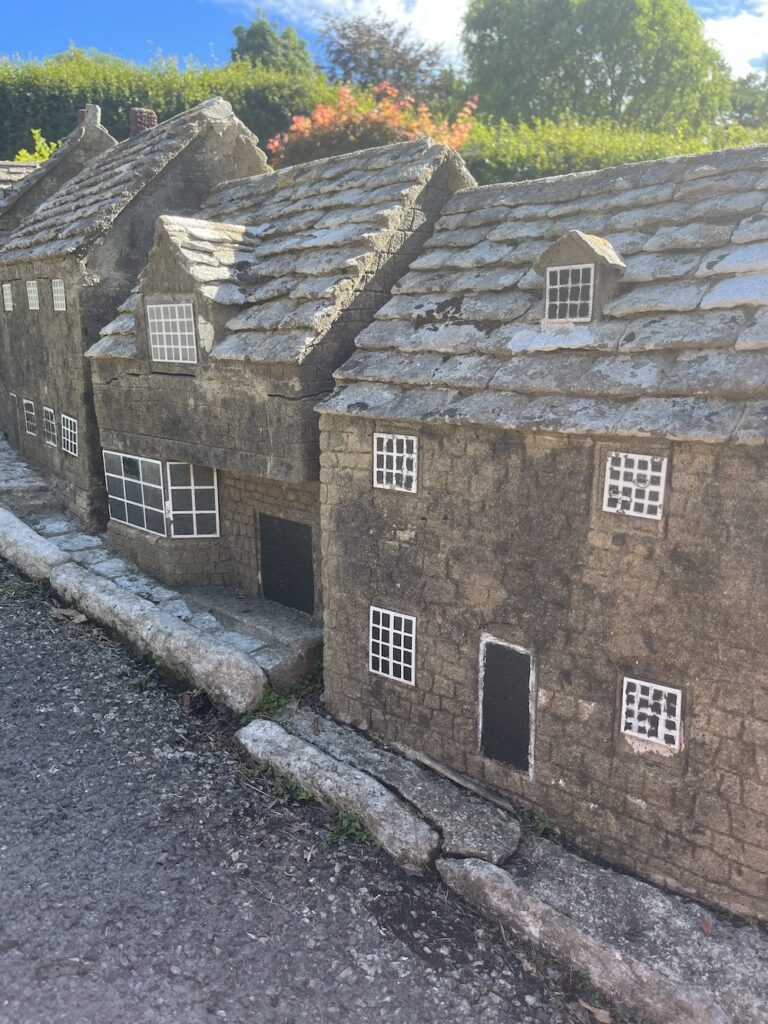
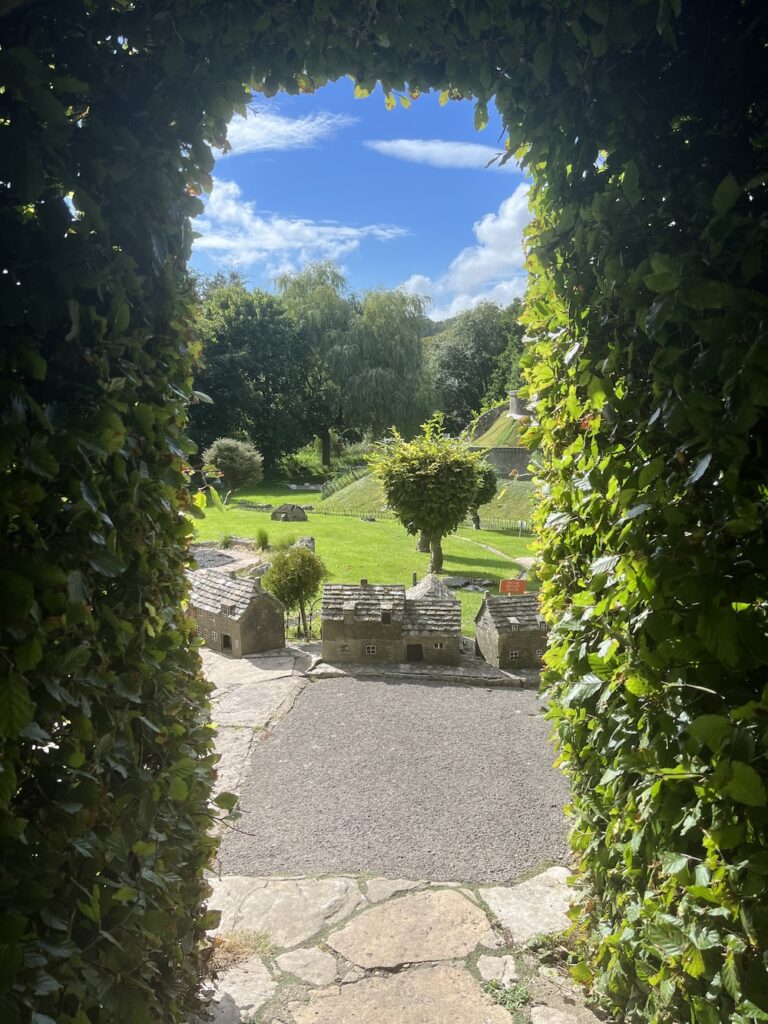
Cut to five months later, and I am standing in the middle of Corfe Castle Model Village. It is smaller and more exciting than I ever could have imagined. The thatched roofs are made from what look like cut-up old doormats. The tiled roofs are made from individual tiny pieces of slate. There’s a fully working water mill and a small plastic ghost in the manor house courtyard. It is truly marvellous. As I wander, I consider the hours of labour that have gone into these near-exact replicas of Corfe Castle. It is remarkable and obsessional. There is a human-sized potting shed with some information. The village was opened in 1967 and was the brainchild of a local shopkeeper in the village, Eddie Holland. Although Eddie came up with the idea and paid for the village, he did not make the models himself, but instead employed a local builder called Jack Phillips to construct the houses and shops of Corfe (this is actually quite unusual for a model village; generally, the instigator is also the builder).
My fellow visitors are particularly interesting to me: a smartly dressed man with an earl grey teabag wrapper placed in his hatband (is he saving it for later?), a couple who don’t speak a word to one another but offer to take my picture by the replica castle, and a man in a luminous red T-shirt, who loudly declares the models ‘very accurate’. They all look and sound like they could have stepped straight from the miniature scenes I am examining.
What I learn quickly is that if you are not willing or able to bend, you will miss most of the joy of a model village. So much of the detail is contained within the windows and gardens that are only visible when you are stooped. At points I find myself sitting on the floor (I’m not sure if this is good model village etiquette but no one complains) to really get in on the action. Look! Some people are getting married at the church! A family is having lunch in the garden! A farmer is tending his cattle! It is staggering how the mundane becomes remarkable when translated into miniature.
The next day, buoyed up by how exciting I found Corfe Castle, I make my way to Wimborne Model Town. I’ve read about it online, and it looks bigger and even more comprehensive than Corfe – which makes sense, given that Wimborne itself is a much bigger town. The admission fee is slightly more, at £10 a ticket, but it is certainly worth it. The woman on the reception desk informs us it is valid for an entire year. Bargain! Corfe was only valid for a week. On entering, we hear a ringing sound. I look down at my feet to find a tiny telephone box ringing. I am giddy with joy. Some time later the miniature bells of the replica Wimborne Minster ring. On the outskirts of the village is a woman on a mobility scooter who, while unable to access some of the narrower streets at the village’s centre, is able to look at many of the buildings given their slightly larger height than the average model village. There is a general sense that everyone is welcome in this model town.
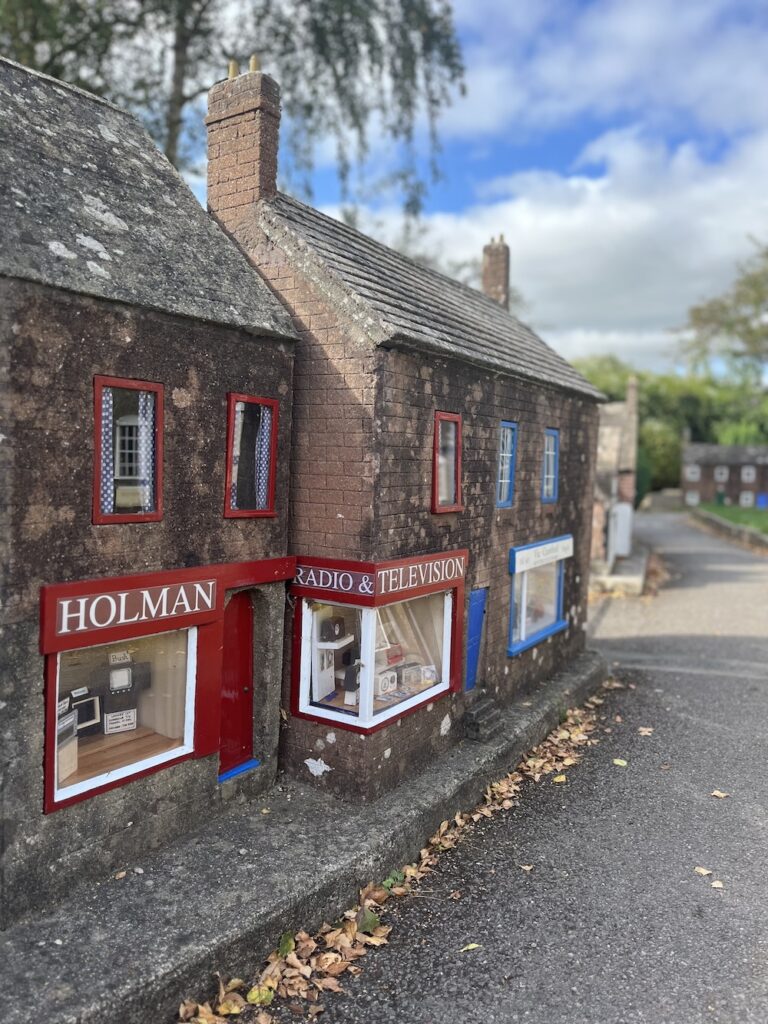
There are streets and streets of tiny buildings, each containing shops or homes. As I peer at the handwritten signs and windows filled with wares as varied as country wines and jewellery, I am aware that here is an incredible record of lost crafts and businesses. From an ironmongery to a poulterer, here is a series of long-forgotten ways of making a living. What also strikes me is the level of craftmanship in the rendering of these buildings. It is much less crude than Corfe (although for me there is a charm in Corfe’s basic construction). Here the signs have obviously been hand-painted, the bricks have been properly laid and each window has individual, albeit plastic, panes of glass. There is even ivy growing up the side of one of the (on my count) five pubs.
Best of all is the model of the model. There was also one at Corfe and it seems it’s a bit of a feature of all model villages: a little maker’s joke, if you will, like the modern version of a medieval stonemason’s graffiti on the tower. Wimborne has, in fact, got a model of the model of the model of the model (phew!), rendered so small it becomes almost impossible to see.
Re-entering the real world feels strange. I can now entirely map Wimborne (despite having never previously visited) exactly as it was in 1950. I spend the rest of the afternoon unpacking the strangeness of being giant in a seemingly normal town; stomping through the streets like some sort of human Godzilla is an odd feeling but it is also intensely magical. When else do we get to experience seeing an entire town or village from above or below (depending on whether you tower or crouch)? I feel evangelical about model villages. I want everyone to get a chance to spend an hour or so as a giant. These little worlds are unique, and odd, and filled to the brim with humour, and they should be cherished and adored. In a mad moment on returning home, it occurs to me that they should also be listed . . . imagine that! Hundreds of miniature grade 1 and 2 listed buildings. It is a silly thought (probably), but at their heart, model villages encourage silliness – which is something we could all do with more of.
*
‘The Lost Folk: From the Forgotten Past to the Emerging Future of Folk’ by Lally MacBeth is out now, published by Faber. Buy a copy here (£19.00).