Rowe Irvin’s ‘Life Cycle of a Moth’, published last month by Canongate, was our Book of the Month for June. As part of a wider folk revival that is wonderfully queer and femme, the book finds in place and tradition what is transgressive, transformative and liberatory, writes Abi Andrews.
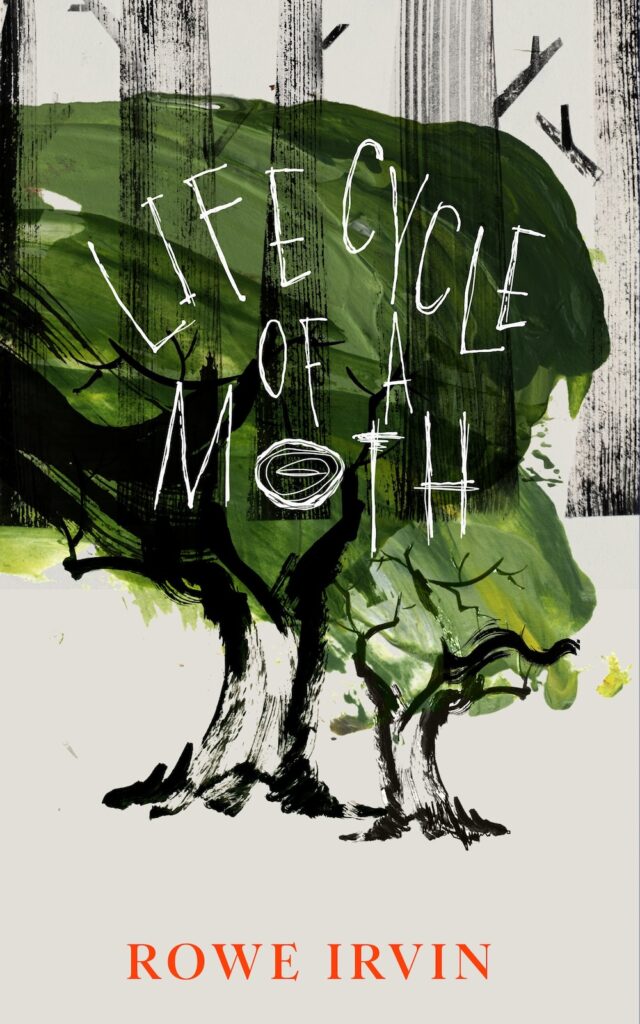
Rowe Irvin’s Life Cycle of a Moth could be considered part of a wider panorama of inheritance and rebellion to a phenomenon first described by Robert Macfarlane in 2015 as the ‘English Eerie’, playing with Mark Fisher’s term. In a Guardian article, Macfarlane had drawn a nebulous map of an eerie counter-culture, an ‘occulture’, encompassing writers, film-makers, folk musicians and artists, that was responding to the ‘turbulence’ of England in an era of late-stage capitalism poised before Brexit, with a revising of folk and attention to landscape. A decade on, this occulture persists, but it has metamorphosised. Unlike the cultural spectrum named by Macfarlane, what is humming into being now among young UK artists who engage with landscape, is a wonderfully queer and femme folk revival.
This new queer-folk is erupting in guises across music-art-literature, in a bloom of popularity for occulture, discernable in folk musicians like painter-singer-instrumentalist Daisy Rickman, femme-only morris dancing troupe Boss Morris, as well as the popular Weird Walk journal and Stone Club, a neolithic rock club set up by artists Matthew Shaw and Lally Macbeth, whose new book The Lost Folk was published last month by Faber. The phenomenon extends its network outside of England, especially in the revival in folk music with strong Celtic roots, with bands like Goblin Band and Wales’s Craven reworking songs from across the isles, reclaiming lyrics for queer, decolonial and feminist means, and the likes of Shovel Dance Collective infusing them with psychogeographic field recordings that hark back to some of the artists named by Macfarlane.
But this queer-folk departs from the more sinister facets of Fisher/Macfarlane’s eerie, while still very responsive to the latent violence possible in the eerie landscape, ‘the skull beneath the skin of the countryside’. The surge of Reform – its patriarchal, patriotic, anti-immigration rhetoric, and its anguish over ‘woke’ threats to British ‘culture and values’ – leaves identification tied to landscape and tradition easily exploitable for exclusionary means. In response to attacks on queer identity and the threat of far-right-folk-volkism which seems to push closer to the surface of the soil post-Brexit, the queer-folk finds in place and tradition what is transgressive, transformative and liberatory. It has been necessary to turn away from the sinister, towards something euphoric and inclusive; a trans-border peasantry that takes ‘folk’ to mean a particular relationship to landscape and tradition, rather than authentication of origins. Perhaps rather than eerie (and I cannot take credit for this, it was suggested by my partner, who is excellent at word-play) we might call this emergent phenomenon the queerie.
Reading Irvin’s novel, I was immediately excited to hear the echoes of eerie predecessors like Alan Garner and Susan Cooper, also to be heard in younger writers of ‘the tens’ like Daisy Johnson and Fiona Mozley, who took the folk-eerie and directed it at gender relations (Elmet 2017, Everything Under 2018) with brilliantly evocative stories of parental love and the mirrored threat and promise of our landscape to nurture or destroy. Irvin’s recent collaboration with artist Georg Wilson, Quiver, an illustrated book of poems, reminds me of Sylvia Linsteadt and Rima Staines’ Tatterdemalion, a work of wonder that slips into landscape-eerie in its evocation of a post-apocalyptic netherworld populated by Staines’ mythic, faerie creations. Irvin fits into this procession, as she seems connected to that wider queer-folk landscape and its utilisation of occultish iconography, in not just her writing, but also her artistic practice, making pewter pendants of spoons, jesters and falconers.
Life Cycle of a Moth follows a child without a name, referred to as Daughter, and her mother, or Myma, who live isolated in a cabin in the woods. Outside of the woods, as far as Daughter is aware, there is only ‘rot’. Daughter is almost sixteen and has never before questioned this. She knows not to go beyond the fence and its amulets; snippets of their hair, animal bones, and lost teeth, which ward off the rot. She has everything she needs inside their forest, in Myma, their inventions of games they call ‘this-and-that’, their rituals and their collection of canned puddings which can only be eaten with ceremony. But then a ‘rotter’ – a human-like figure with a torso that gapes from behind like a hollow tree trunk – crosses the fence into their forest.
The subtlety and detail with which Rowe invents the mannerisms of Myma and Daughter – the occult and ritual of their lives – is sublime. Daughter’s feral character is richly imagined, down to the way that her view of the world is built into her grammar, like her confusion at the introduction of new pronouns the rotter brings, not needed when it had been just the two of them. Daughter lives androgynously, without gender as socially proscribed, until the arrival of the rotter. She takes the names of beings around her temporarily, becoming fragments that call to her in the forest – Flint, and Tooth – each name suiting her evolving stages, like a moth that was first a pupae. The names she gives to herself disclose the careful attention she pays to the properties and beingness of the forest around her. The power of words to make a person and a world is cleverly explored, and this endeavour is the novel’s central success.
Life in the woods is rich and raw. It is also sometimes menacing, brimming with eerie allusion. And likewise the relationship at the heart of the book is beautiful yet abusive, Myma’s protection as fierce and primal as it is dogmatic. Without the wider nurture of a community, their world is a cult of two. The dynamic of a mother-daughter relationship is played out in the extreme, in the struggle of Myma to allow Daughter to fledge, as though her reproduction could be achieved via cloning or a cell dividing. It is a portent allegory of what distrust of the world can do to those relationships that define us.
Life Cycle of a Moth begins like a fable and ends with the intrusion of the real, and I found myself pulling away from the end I could see coming, wanting, like Myma, to stay with Daughter’s singular character intact. But Myma’s stunting protection becomes more and more a preservation by force, as Daughter pushes back against her bounded existence. Stories of mother-daughter interdependency are not new, but Rowe succeeds in writing one that feels contemporary. It seems to speak to that queering of folk, in its appraisal of preservation vs renewal. Myma’s dogma has provided a stable cove in which to shelter. But identity and belonging are complicated and not without struggle; they require testing, choice, and inevitably, change. Likewise, the queerie knows that the new must transgress from the old while maintaining connection. That belonging is not static. That the challenge of the moment is to remain euphoric in outlook, taking what is rotten in the world, and making the best with it.
*
‘Life Cycle of a Moth’ is out now, published by Canongate. Read an extract from the book here.