Annie Worsley and Kirsteen Bell’s latest croft-to-croft correspondence comes accompanied by grasshopper chitters, and the smell of crushed heather.
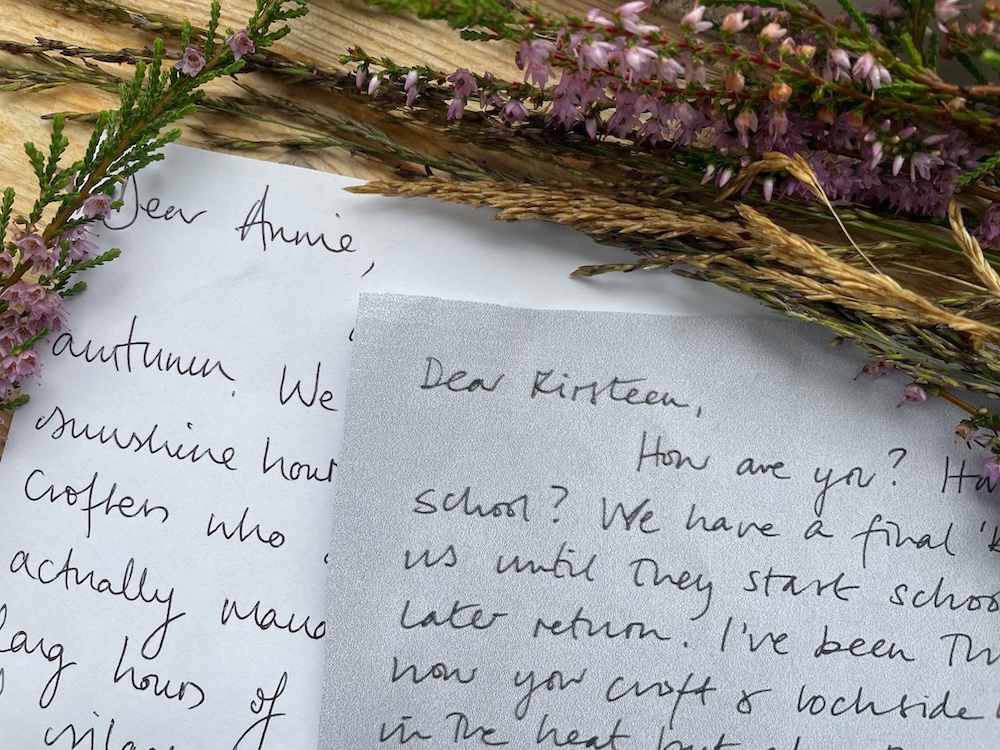
Dear Kirsteen,
How are you? Have your boys gone back to school? We have a final ‘batch’ of grandchildren with us until they start school in September – a much later return. I’ve been thinking about you, wondering how your croft and lochside home have fared, firstly in the heat but also through the big storm.
What a strange summer. High temperatures, Mediterranean blues, humidity. I’ve sweated through layers of suncream and insect repellent, and although the midges haven’t been too bad here, the clegs have come in clouds. On one particularly calm hot day at the beach, I spent most of my time in the sea. Horse flies even found me there, neck-deep in water but they left the children alone. Not a single bite between them.
Our flood meadows have steamed too, their growth fast, dense and aromatic. And even during the hottest, dryest spells of summer sunshine, the soils of these riverside fields have remained damp.
One day, I wandered slowly around the croft. Because the air was so thick it felt like wading in a swimming pool. I clambered up the steep embankment covered in bugs – beetles, spiders, craneflies, ticks (of course) and grasshoppers – reassuring riches in these troubling times. I thought of Jeff van der Meer’s strange and unsettling Southern Reach book series in which nature is mystery, entity and controller.
When our meadows bloom so profusely and seeing how many other species rely on this habitat, scientific words I once used regularly seem insufficient, unable to capture how this place feels. I know there’s more than data and definitions and I have an increasingly profound love for this small patch of land; maybe I sense a van der Meerish ‘otherness’ in some way; perhaps meadows are living organisms, like rivers, or mountains.
My friend Jen Jones is a soil scientist, and for years we’ve discussed whether peat bogs and soils are more than the sum of their scientifically understood parts, confident the answer is yes. In the light of current wiser and greater discussions, I wonder if our beautiful fields are alive, whether our baby woodlands will mature into ‘being’. New ideas are emerging it seems, beyond the old paradigms of science and ecology.
🌾🌾🌾
Over the summer our children and grandchildren have visited, one group after another. I love how children accept nature and wild creatures as important parts of their lives. They’re fascinated by every bug, bird and flower; they ‘see’ our wilder neighbours more than we do. Together, we draw pictures of our finds and make up stories about the adventures of spiders and butterflies, otters and deer. Their suitcases fill with found treasures and artwork. They cry when they leave. When they’re home, we connect via computer video links rather than paper, but I often wish we could go back in time and write letters. Pen-pal-grandkids.
I’ve also been thinking about letter-writing of a different kind. Even though Windswept was published two years ago, I still receive lovely emails and hand-written letters from readers who ‘found’ the book one way or another. It’s astonishing. A few weeks ago, a letter from a lady in the US arrived. Enclosed in the pink airmail paper was a piece of sagebrush. Its aroma, of dry desert hills, fell open just as the pages revealed her wonderful stories of home.
I’ve no literary training, only ‘O’ level English, so my knowledge about the great letter writers is sparse, but as a teenager, I loved 84 Charing Cross Road. Since living here, I discovered the correspondence of American artist, Jon Schueler. You’ll know his work – he lived for a while near Mallaig and painted the Sound of Sleat. His magnificent skyscapes are the stuff of dreams yet they’re portraits of place. His wondrous skies are mine too, here over the Minch and Outer Hebrides.
There were Schueler clouds when Storm Floris blew in, I thought we would suffer a lot of damage and expected flattened hay meadows. Before the winds grew too strong, I watched them aggravate everything. Under a purple-grey glowering of sky there was little difference between fields and sea. Both alternated between flattening and flexing, olive and grey snakeskin, writhing and glimmering, then erupting with white light. Wind speeds grew until the air filled with fragments – leaves, stems, twigs – and it became too dangerous to stay outside. At the height of the storm, my friend’s weather station measured a gust of 92mph. Afterwards, in the strange lurid light of Floris’s retreat, we were astonished to see a thick layer of debris covering almost everything. How did you fare?
Over the last fortnight everything has settled under a steadfast calm. The air changed noticeably. It’s all golden and honeyed, different chemically – heather perfumes fill the spaces between crystals of salt and droplets of water – a heady mix of chemistry and physics.
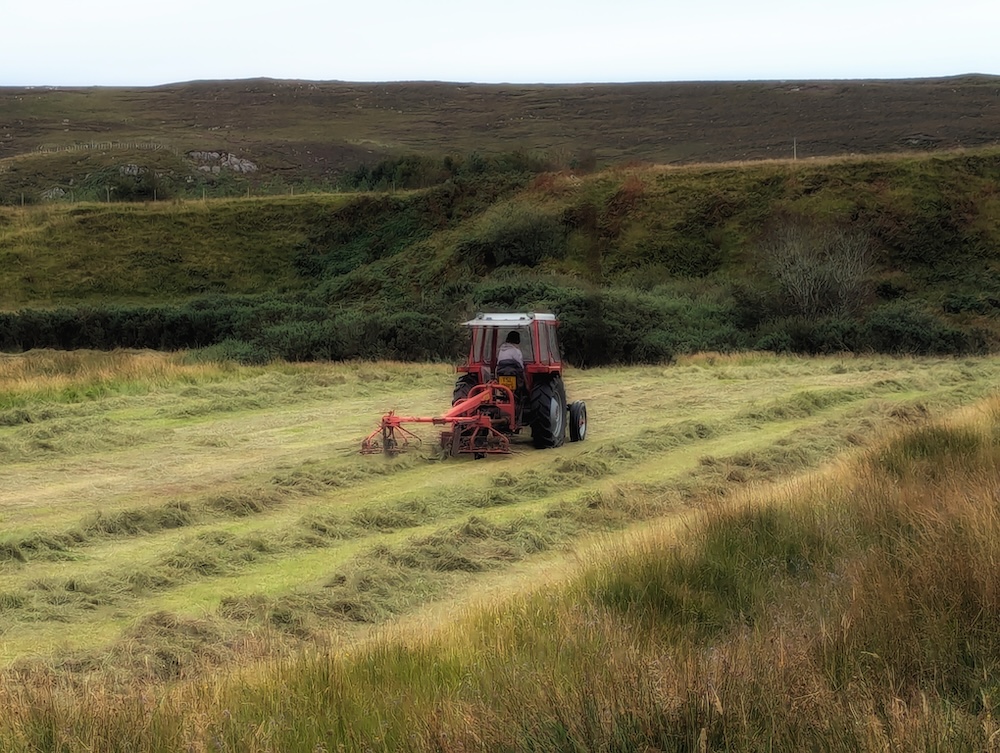
Young crofters from nearby Opinan who harvest our hay arrived with the change of light to cut the riverside meadows. This is a symbiotic partnership – the croft benefits from a late cut, the hay is used to feed local cattle – and it works well, reminiscent of practices in the past. The ongoing steady drop of grass and flower seeds over recent weeks rapidly accelerates during the cutting and tedding and within days the greens pale into piles of blonde tresses. Gradually, next year’s bounty is incorporated into the surface soils, a library of information to be revealed in the summers to come.
Once, dragonflies and bees descended to the glistening turf between the windrows. They were drowsy and drunk. The same strange thing happened this year. I remember reading that salt and sweat may accelerate the absorption of various particulates through our skin, perhaps the same happens with molecules of plant perfume – frankincense of myrtle, sweet honey of heather, mellow vanilla of coumarin from drying grasses. It might explain why I feel tipsy in these late August harvest days. Just like the bees and dragonflies.
Send news soon
Axx
*
Dear Annie,
Summer here is already laced with autumn. We have had double the amount of sunshine hours from last August. As a result the crofters who still cut hay on the lochside are actually managing to make hay, turning it in the long hours of heat, instead of the usual ferment of silage. Bramble bushes are already heavy with black fruit, and brown flutterings in the woods could just as easily be a curled falling leaf as one of the many scotch argus butterflies that drift down from the moorland above.
Our own library of soil remembers its past as a hay field in places. Straggles and sprays of rye and fescue have moments of triumph against the deep green of new rushes. However, without grazing it is dense rush and bracken that dominates. And of course saplings of birch and oak, rowan and hazel take root where they can. Another generation and it will look different again, grown into a mature woodland I hope. A reshelving of stock in the library.
The young trees have taken the worst of the summer’s warmth, the edge of their leaves curled into themselves. Thanks to the addition of humidity, many of the little oaks are white with powdery mildew too. But the older oaks are heading towards a mast year, even with the onslaught of those winds.
While L fretted over the waves and spindrift tearing around the floats that hold fast to the mussel lines, I worried most for the woods. Those full summer leaves were a billion tiny sails straining into the sky, pulling at roots that weren’t always deep enough to withstand the force. I reminded myself repeatedly that the big oak on the knoll is old enough to have experienced many summer storms. The wee hill is deep with dark soil and I imagine the round sweep of the tree’s roots, untroubled by the air lashing above ground. It remained standing, but for one torn arm. The broken limb hung lifeless, pale splintered inner exposed and vulnerable. While the rest of the tree was still flounced in every whim of the wind, the shorn branch leaves were oddly still, like the wee stone ruin behind the tree. Squat and immovable as always, the crofters who lived there when it was roofed and whole would have been surrounded by hay rippling as yours did. Those stalks were as precious to their survival then as the trees and mussels are to us now.
The strength with which delicate stalks hold to the soil in the face of gale-force winds defies belief. The yellow and orange hawkweed in the garden, the bell heather and ling on the hill, even the bog cotton and asphodel, all emerged from the tumult with flowers and fronds intact. But the woodland smelled like a giant hand had crushed and rubbed every leaf, making the air sharp and herbal.
I’ll be honest and say that I relished the force of those winds — as I know you do too. Even as I went round shutting every window, a small part of me wanted to stand at the highest point on the grazings and open myself out to it all. To stand with the tiny birch that have begun to repopulate the moor.
I recognise that yearning was in part a reaction to the intense busy-ness and noise of the summer holidays. Summers are almost always a write-off for me (pun intended). Your letter coming just when the kids went back to school felt like a reopening of those pathways.
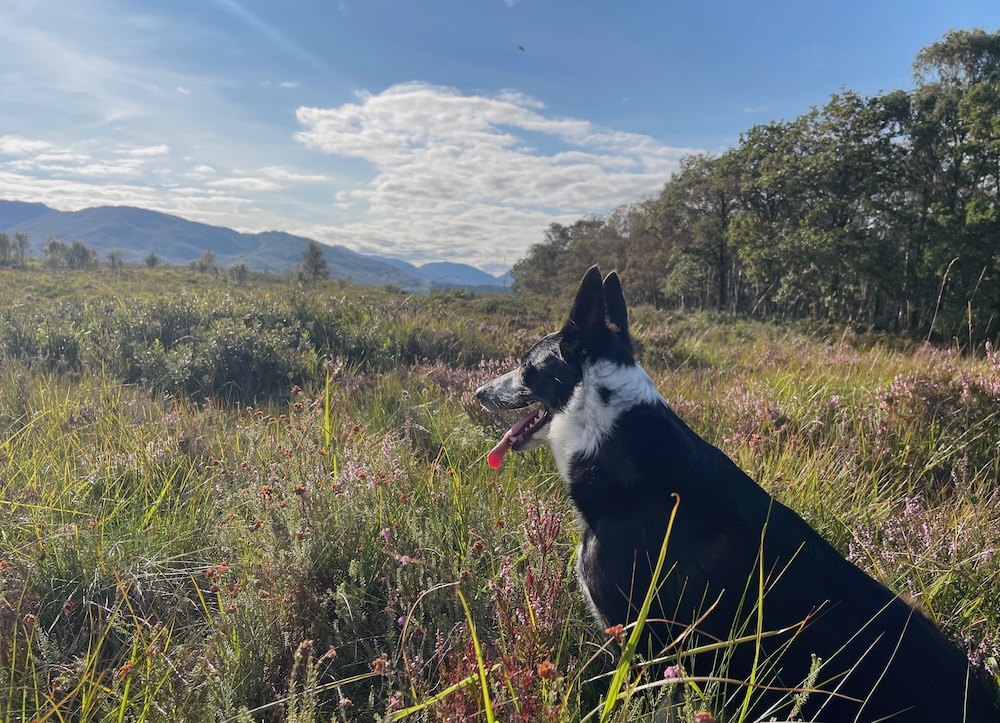
The idea of ‘nature as solace’ carries the risk of creating a two-dimensional and self-serving relationship with land. The croft is not my, or anyone’s, retreat. But I can’t deny that calm moments walking the croft was a much needed grounding during the summer weeks. Even just a few minutes flying with the dog across the grazings is enough to remind me who I am and the context I exist in. I am a better human for it. Certainly a more patient mother.
Better still, because what I often need is solitary silence, my exhausted mind was tired enough that all it could do is listen.
I very much liked your and Jen’s ideas on the landscape as a whole being. I have been thinking too about the voice of this land and the ways in which we hear it. I read Neil Ansell’s new book, The Edge of Silence, in which his hearing loss sends him on a quest to hear some of those voices disappearing from the UK’s landscape. Since reading Neil’s words I’ve found my eyes closing, letting sound take precedence over my vision to listen to that voice. It is too quiet. On reading Neil’s chapter on black grouse, it was distressing to realise that it had been years since I’d heard their deep quavering calls on the hill here. Another tone in the soundscape lost, the range of the landscape’s voice diminishing. It was soothing then to hear of the cacophony of your insect landscape.
Just as soothing is this circle of words and world: I love to think of our bodies interpreting the signals of the crofts, windblown and wild or sunbaked and still; translating the experiences gleaned from our senses into words that carry these lands to each other. I was struck again reading your letter how we layer our own voices into the retelling, like an accent laid over the voice of the land. I love to hear South Erradale’s voice through yours, and the marriage of science, art, and beauty in your words, your heather perfumes amid salt crystals and water droplets. Crushed heather underfoot and the grasshopper chitter here now release notes of memories not just my own, so that even in my ‘solitude’ there is quiet company, human and land.
With love,
Kx
*
Kirsteen Bell is a Scottish writer of narrative non-fiction and sometimes poetry. All her words are gathered from the croft in Lochaber where she lives, and the surrounding Scottish Highlands. Her writing and reviews can be found in such places as Paperboats, Caught by the River, The Guardian Country Diary, The Lochaber Times, and Northern Scotland Journal. Kirsteen can also be found at Moniack Mhor, Scotland’s Creative Writing Centre, where she is Projects Manager and Highland Book Prize Co-ordinator.
Annie Worsley is a writer, crofter, grandmother and geographer with an enduring love of the Scottish Highlands. In 2013 she and her husband moved to the crofting township of South Erradale near Gairloch. While her husband was a community pharmacist, Annie worked on Red River Croft. She began a blog about life on the croft and then wrote essays on nature and environment for various publications including Elementum Journal, Women on Nature, the Seasons’ Anthologies edited by Melissa Harrison, Caught by the River and Inkcap Journal. Her first book about life on Red River Croft and the natural history of Wester Ross, ‘Windswept: Life, Nature and Deep Time in the Scottish Highlands’, was published by William Collins in 2023, and is out now in paperback.