Like the plants that give the pamphlet its name, Sam Francis’s ‘Teasels’ is impossible not to get snagged on, writes Emily Hasler.
 Photos: Emily Hasler
I shall be your witness. Gathering clues about you like a hybrid, a private detective, a scientist, a lover. I am your beholder, your gaper, your gazer. Your plucker, your puller, your teaser.
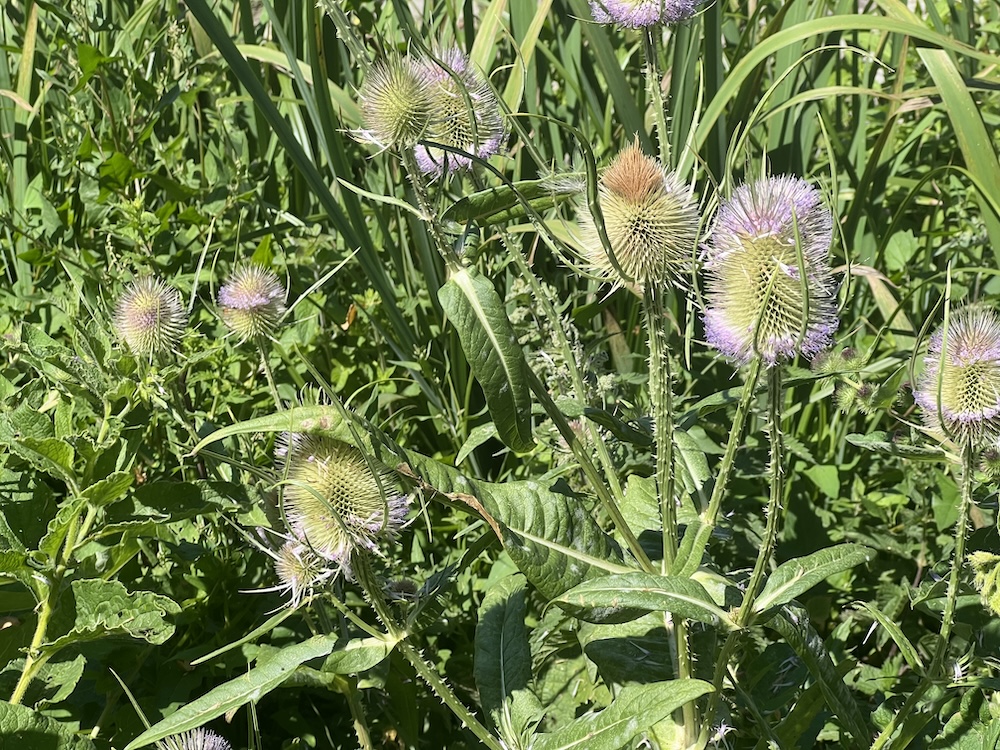
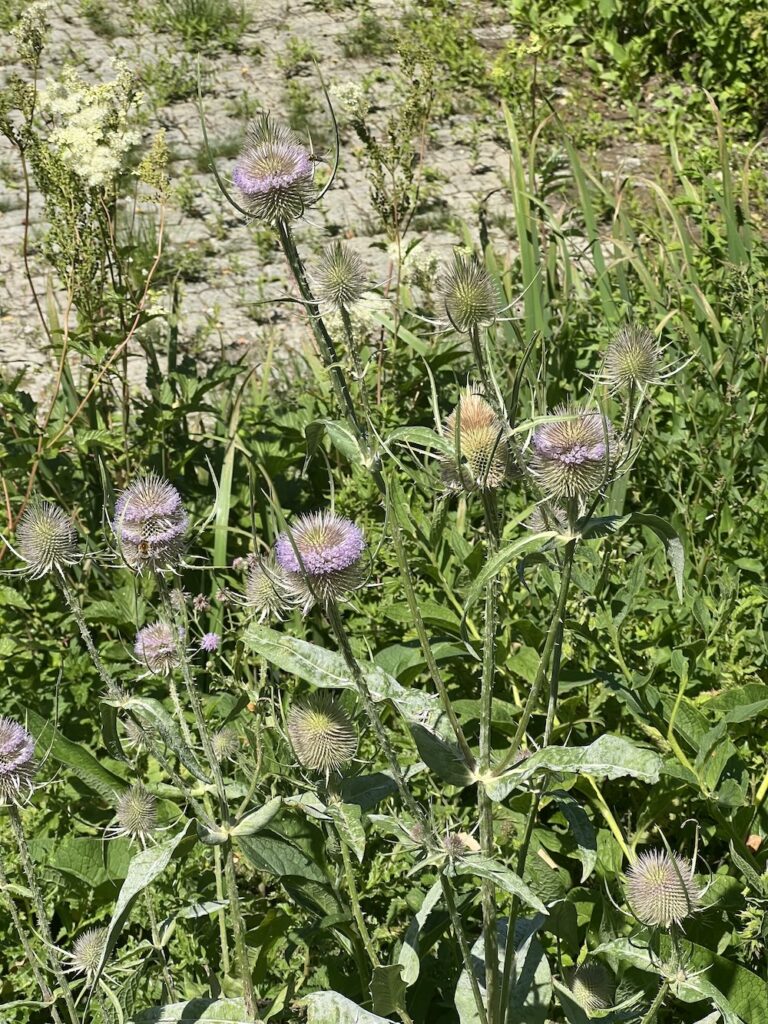
A few days before I am asked to review Sam Francis’s Teasels I notice the first flowering teasels on the dry clay that makes up the sea walls near my home. This ‘unfussy’ plant will grow in most places unbidden, but Francis plants it in her garden ‘purposefully’ in order to ‘know’ it, asking ‘What is it to be teasely, what is it to be teased, plucked and attended to as you thrive, grow and age?’ To understand the observer becomes ‘teasely’ herself:
… to pluck, pull, tear, pull apart, comb. Though it is not my wish to tear you apart. Instead, I shall look upon each part of you closely and attempt a kind of visual plucking. I shall comb your hair and attend to you diligently.
(‘Preface’)
The Hazel Press website calls Teasels ‘an almanac’, but we could also think of it as a diary, a sketchbook, poetry and prose. The descriptions of the teasels are exquisite, but there is also more going on. Our narrator or recorder – whether we presume this to be Francis herself or not – is direct, clear, confusing and confused, objective, unreliable, a distanced observer and deeply involved in drama that plays out in her garden. And like the teasels, this pamphlet is difficult to grasp, tricky to cut open and describe, impossible not to get snagged on.
From the first appearance of leaves to the dried, brown stands holding strong against winter, every stage of this plant’s life is defiant, almost combative, even the tender first leaves armed with ‘short, sharp spikes’ (‘Sometime in Spring’). Teasels grow high and fast so that by ‘May’ ‘Much is occurring’: ‘Multiple limbs lurch out diagonally all up their height. Thick leathery leaves as thick as cats’ tongues.’ But there is still a tenderness and a vulnerability to the young plants: ‘Those blazing spikes are ridiculously soft. Like baby hair. Soft enough to run your fingers through. As I do.’ This is just one of the contradictory, intricate tensions Francis grows in this carefully structured pamphlet. Our speaker is servant and mistress, jailor and prisoner, god and mortal, scientist and artist, subject and object, sister and stranger.
The observer attempts to rein the plants, herself and us in as ‘measuring begins’ in ‘the month of all flourishing’ (‘June’): ‘Withholding my approach to remain discreet, I observe from the kitchen window’. Science allows to look ‘within the thin layers of plant matter’ where ‘the xylem and phloem are shunting green-gold liquid around beneath the epidermis’. But there is always a sense of wonder, of artistry to the language used, as well as a more mythical, anthropomorphic side. The human-imposed description of the structure of the plant is royalist, the central flowering head being the king, the circling queens lower down, and below them the princes – and this becomes a key factor in how our speaker views the plants: ‘Good morning winged Queens of the Otherworld. Good morning to you Titania and Mab. Look at them, flickering verdant candelabras in the eye of the peaking sun, the lean, green, loving lovelies.’ It begs the question ‘And where am I in this hierarchy? A mere onlooker, a commoner. A royalist? A yeoman (woman?) of the garden?’ Her sense of empathy with and loyalty to the female-ascribed parts of the plant grows dramatically: ‘In the garden, alone, unwed, childless, I tend […] As the Queens gather and ascend, unalone in the garden, I wend and I bend.’ ‘This is a matriarchal garden, full of love’ she swears, and allegiance is pledged, ‘I am your servant, your hand-woman, your peer.’ By the end of ‘June’, despite scientific intentions, our narrator has taken her shears to the ‘King’.
In ‘July’ the relationship intensifies further: ‘I want to get to know you better, more intimately. To capture you, to make a surface of you, to frame you. To make of you mine beyond your own lives.’ She tries to press one small flower head, but can’t; ‘I shall have to tease you apart to get inside your head. To protect the fine outer parts, I place your head in a tea-towel and slide a silver blade through the centre from crown to chin. It feels like a lobotomy. Inside you are a marvel. A spike-feathered headdress edges your hollow cavern.’ As flowering commences further dissection takes place: ‘I try to tease a lilac flower from the honeycomb matrix with my fingers. After several failed attempts, I take a needle and slide one out like a splinter.’ There’s obsessiveness here, both love and viciousness in this attentiveness.
In ‘July’ flowering is frenzied, with ‘about two thousand flowers on each head’ attracting a great many pollinators, but it is also brief, overlapping with pre-flowering and seeding alike – just a moment in a two-year lifespan: ‘Once the flowers finish, green goes golden, glowing copper becoming rust, shedding its lustre. Moisture drained from all the lilac suckings’. With this ageing comes further identification: ‘A new era, the Queens are maturing; I can see it in their eyes. […] We are ageing, and growing, and shedding together.’ As we pass into August she admires the plants’ strength: ‘They are fit and firm at mid-life’, ‘Their scaffold is sturdy.’ This continues in ‘September’:
Nothing much is happening now. Their once verdant bodies slowly turning to bone. No more insects visit. The Queens exist, I exist. We exist together, apart. They are just standing there still, while I move about like a big, busying thing.
Autumn progresses and you can smell the change in the air as the plants are ‘Fading, crisping, peeling, returning to brown, turning to ground’ (‘October’). She tries to spread seeds, collects them, sends to friends (the only mention of other humans). This is also a time for collecting thoughts:
I am beginning to see now. In these long months of looking and seeing, as we enter these slow-moving days, I wonder who has been taking care of whom?
Again, there’s strength, and lessons to be learned, in ‘November’:
While you are not without vulnerability, there is nothing weak about you, even when you are close to the end you remain mighty and full of wonder. Now it is time to learn from you what it is to really be still. To rest a while, to transition without moving.
In ‘December’ we are presented with a ‘fertile rage’, a sort of lyrical outburst, full of revelations, all of the distinctions between self and plant broken down:
all of the phases distractions diversions that were there with the young the old and the middle placed ones you see it’s all a hint a loop of returning to the cardinal the umbilical
It’s a sense that continues in ‘Deep Winter into Spring’ where our narrator is ‘at the back door observing with my own shifting body. Your body as my body. All this transitioning flesh in a circle.’ Time and life cycle are pressed together and the sketches of the young, vigorous plants that open the pamphlet have been worked-up into a still life, with all the attendant memento mori. Or is it still life? We’re so captivated by flowers, their incidental attractiveness to us an evolutionary side-effect, that we forget this is only one part of a plant’s life. Francis shows us the plants in space, in time, reflecting their transience and durability, reflecting on femininity and ageing. By the time I finish this review the bouquet of teasel heads has dropped a confetti of dry flowers on my kitchen table. I have spent weeks with them as I have with Sam Francis’s Teasels – trying to see, to describe, finding it catching at my thoughts repeatedly. A kind of plucking. A mutual teasing.
*
‘Teasels’ is out now and available here (£12), published by Hazel Press. Read an extract here.
Emily Hasler’s latest collection of poems is ‘Local Interest’ (Pavilion Poetry/LUP, 2023).