Annemarie Lopez joins a gathering of walkers, artists, scholars, and ecologists in Northern Greece.
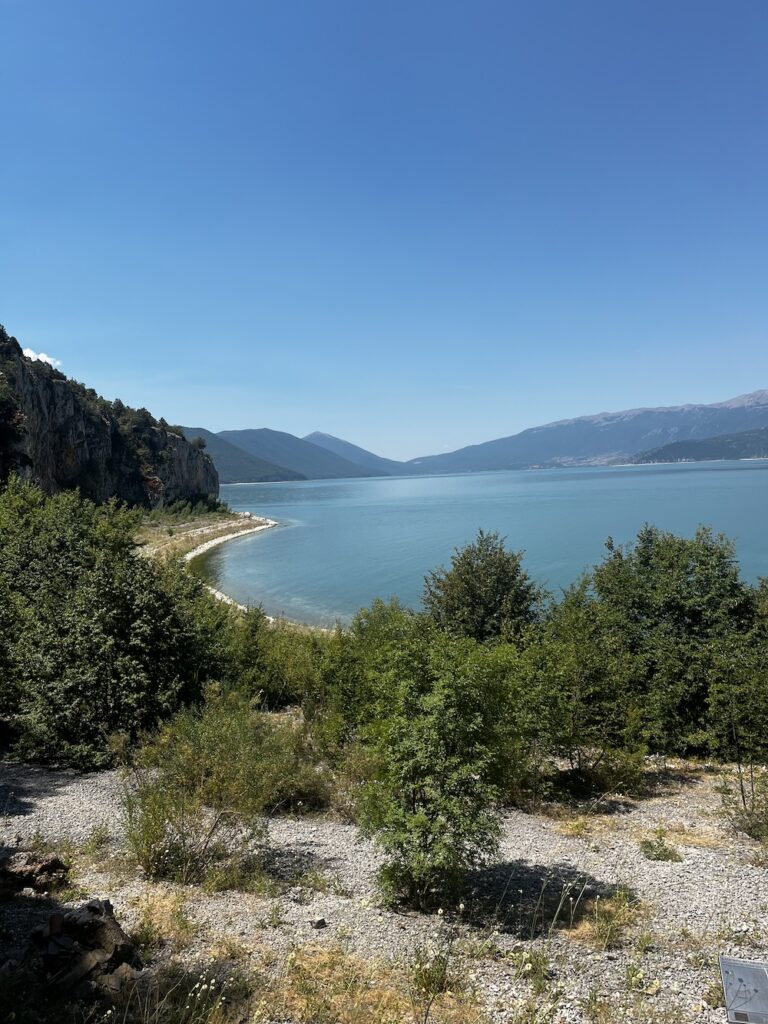
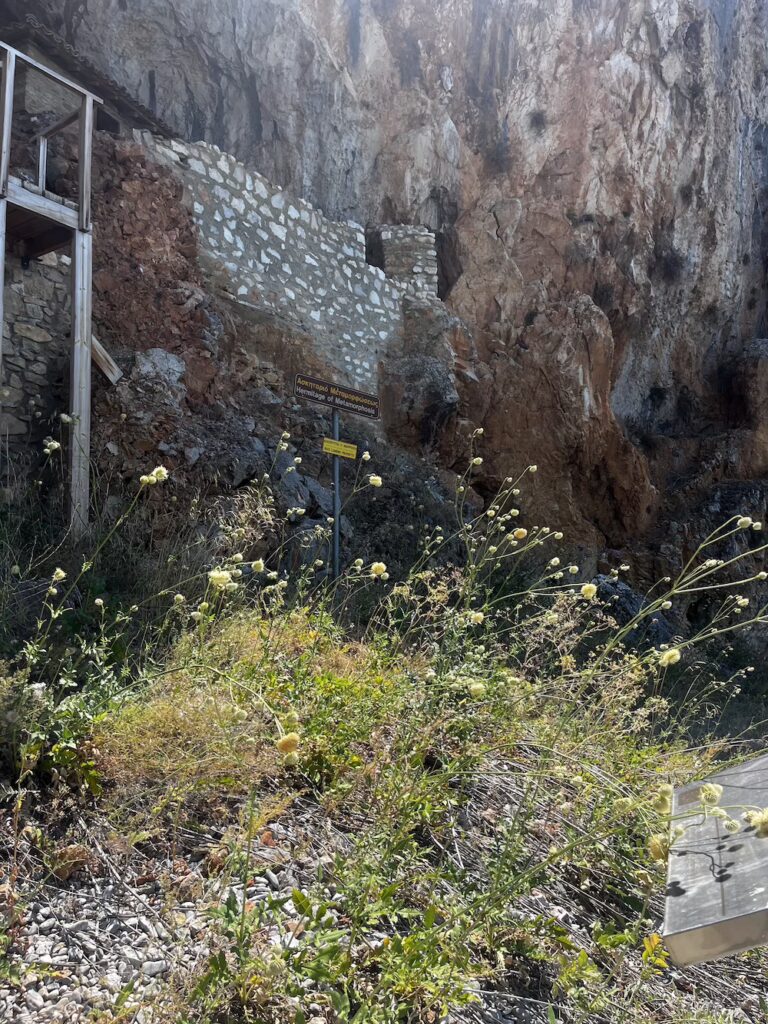
It’s hot and my legs burn as I scramble down the steep rocky path to Cape Roti. I’m with a small group of fellow seekers, and we are looking for the evocatively named Metamorphosis hermitage, a sort of cave chapel that was once inhabited by orthodox monks who came there seeking solitude, reflection, and perhaps some sort of connection with God. Others from the group left as the path became too steep and the sun too high. We’ve been told to talk loudly, even sing, to alert any bears in the area we are here so we don’t surprise one with a cub. This isn’t a problem, as we’re relative strangers with lots to talk, if not sing, about.
We have come to Prespa in far Northern Greece for the Walking Arts Encounters, a biennial gathering of walkers, artists, scholars, and ecologists. The event is centred around Psarades, a tiny fishing village of on the southern banks of Great Lake Prespa, where pelicans wheel on the updrafts and the honey-scented linden trees hum with bees. Prespa is a place suspended between borders, a tri-border region where Greece, Albania, and North Macedonia meet. It’s also caught between a troubled past and an uncertain future. Marked by a legacy of civil war and the looming pressures of climate change, it hosts both a fragile ecosystem and way of life.
The lake itself holds countless stories that ripple beneath the surface, as the writer Kapka Kassabova noted in her spellbinding book To the Lake. She describes the waters as containing ‘the unconscious and the conscious; the darkness of history and the radiance of life and love.’ She speaks of an ‘unsettling feeling of something lurking beneath’ whenever she swims there, as if the lake remembers the residue of blood and trauma.
What persists in the soil, or in the water, of a place after violence is washed away? This question lingers on my mind as I explore Prespa’s landscape. The impact of the civil war is visible in the depopulated villages and abandoned houses. But one of the ironies of this depopulation is that it has allowed nature to re-build. The hills and forests around the lake are home to rare mushrooms, lizard orchids, bears and wildcats. Nature is both overpowering and fragile. The lake is shrinking, the summers are hotter and there is less snowmelt, but there are new forests where the shoreline has receded.
The Walking Arts Encounters, initiated by Yannis Ziorgas, an artist from the University of Western Macedonia, seeks to harness the tensions of the area. It aims to re-engage with and repopulate spaces that have been abandoned over decades, not with overtourism or development, but with a more sensitive and creative sort of presence. Here, art, especially walking art, is like a breath of fresh air, a gentle breeze on a warm, still afternoon, stirring life back into forgotten places.
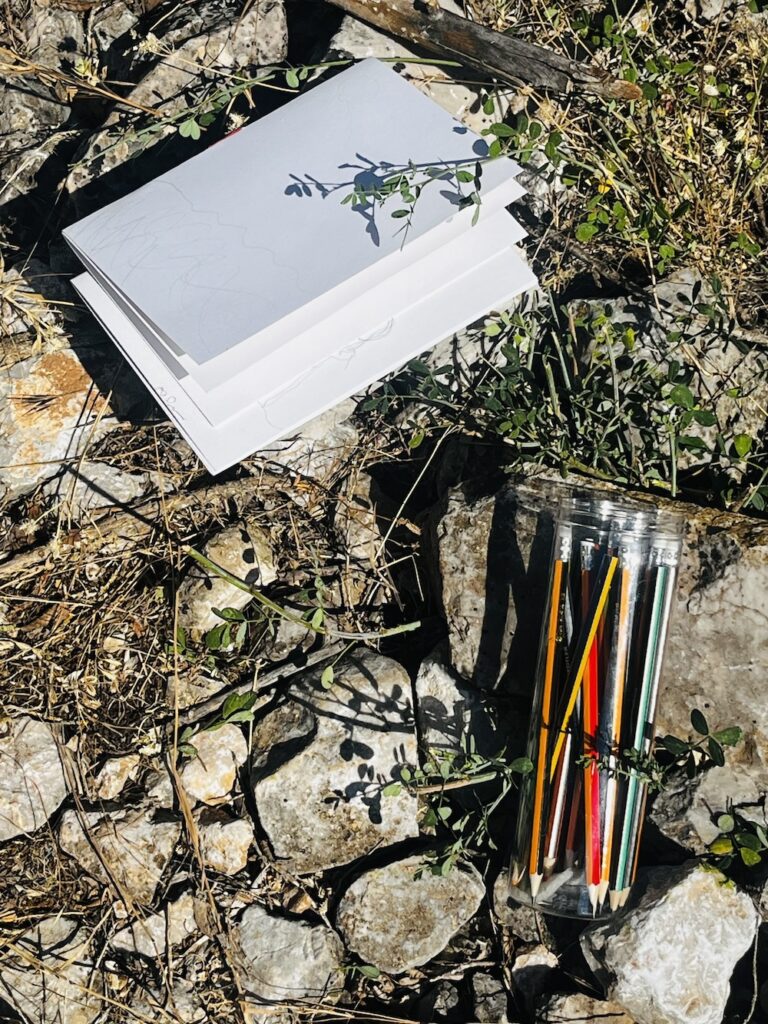
For Clare Qualmann, a British scholar and founder of the Walking Artists’ Network, walking is “a way of making invisible stories visible”. Qualmann, who organized a walking program for children in Prespa this year, explains that walking “opens space for reflection and belonging”, a way to slow down and notice what might otherwise be overlooked. Walking alongside a child, for example, pointing out things in the landscape is a simple ritual of presence, of tuning oneself to the child, to their rhythm and their needs, but also to those of the landscape.
Greek-American educator and curator, Lydia Matthews, who helps shape the Encounters, ascribes a transformative power to walking. After two hip replacements, Matthews was forced to confront the limitations of her body but also freed her from chronic pain. She began to look for new ways of teaching outside the classroom. It led her to take her students on long walks through Brooklyn and Queens without their phones as a way of encouraging them to pay attention to their surroundings and she noticed how it enriched their work. Since then, she has continued to make walking the centre of her practice and has led a series of walks in Prespa exploring both the history and ecology of the area.
For Matthews, walking is a way to “remember our connections, both to each other and to the plants and animals that share this land.” This year, Lydia is leading a foraging walk with local ecologists, weaving storytelling and local knowledge of the landscape. For her, well-being is collective, not commodified, and walking together, gathering herbs, is an act of community restoration.
Local writer, Julian Hoffman found a slightly different path to the shores of Lake Prespa. Twenty-five years ago, he travelled here with his wife, lured by a compelling book about the area and a desire to escape the grind of London’s commuter life. When his Greek was “almost non-existent,” walking became a form of literacy and a way to learn the language of the land by tracing the steps of others, reading stone walls, abandoned houses, plant communities, and animal tracks. “Walking was a way in, a way to begin to belong,” he says.
Today, walking remains central to Hoffman’s work as a nature writer documenting Prespa’s changing environment in books like Lifelines. The pace of walking allows him to attune himself to the subtly changing patterns of the landscape. He has watched the lake receding, leaving jetties stranded on dry land. But where the lake once stood, he saw new life emerge. Hoffman describes how “the southernmost birch stands in Europe” now grow here, along with alder, willow and poplar. There is a lesson in adaptability here, he says, and hope. Life finds new pathways even when the future is uncertain.
Hoffman believes stories are “engines of connection,” linking people to one another, to other species, and to place itself, and walking can often stir these stories into life. He stresses that listening can be “just as transformative as a voice,” because “in quiet attention, stories can grow into something larger even into a forest.”
This ethos of deep care and connection animates the Walking Arts Encounters. Unfolding over a week in early July, it brings creative thinkers from diverse disciplines and countries. During the week I see a giant puppet tell fairytales to local children before sailing off across the lake, migrant stories projected onto a tent pitched in the main square, I’ve walked under the stars and watched the sun rise over the mountains.
The event is deliberately loose, people scrambling for lifts to events, riding in the backs of pick-up trucks with dogs, or just hanging out for hours in a waterside café talking about the walk they’ve just finished, or one they are planning to start.
Walking, here, is a way of exploring artistic possibilities outside of gallery spaces, of conceiving of art as not just a market for exchanging commodities, but a practice of connecting to the landscape and a community. It exposes both the fragility of these communities and ecosystems and seeks to support them.
Why walking? Perhaps because walking happens at a pace the body inherently understands. It is both grounded and mobile. The gentle rhythm allows the senses to tune in more fully: the scent of honey in the air, the chorus of bees in the linden trees, the play of light and shadow on the mountains and water. Studies in environmental psychology support this, suggesting that walking in natural settings enhances attention, reduces stress, and deepens our sense of belonging. It’s called “attention restoration theory”, ART. In Prespa, I see walking art, and ART, in action.
We make it to the bottom of the path, to the pebbly foreshore of the lake at Cape Roti. Hot and sweaty, we strip off and rush into the water. It is a cool balm on a scorching day, but I think of Kapka Kassabova’s comments about what ripples under the surface, and I don’t swim out too far.
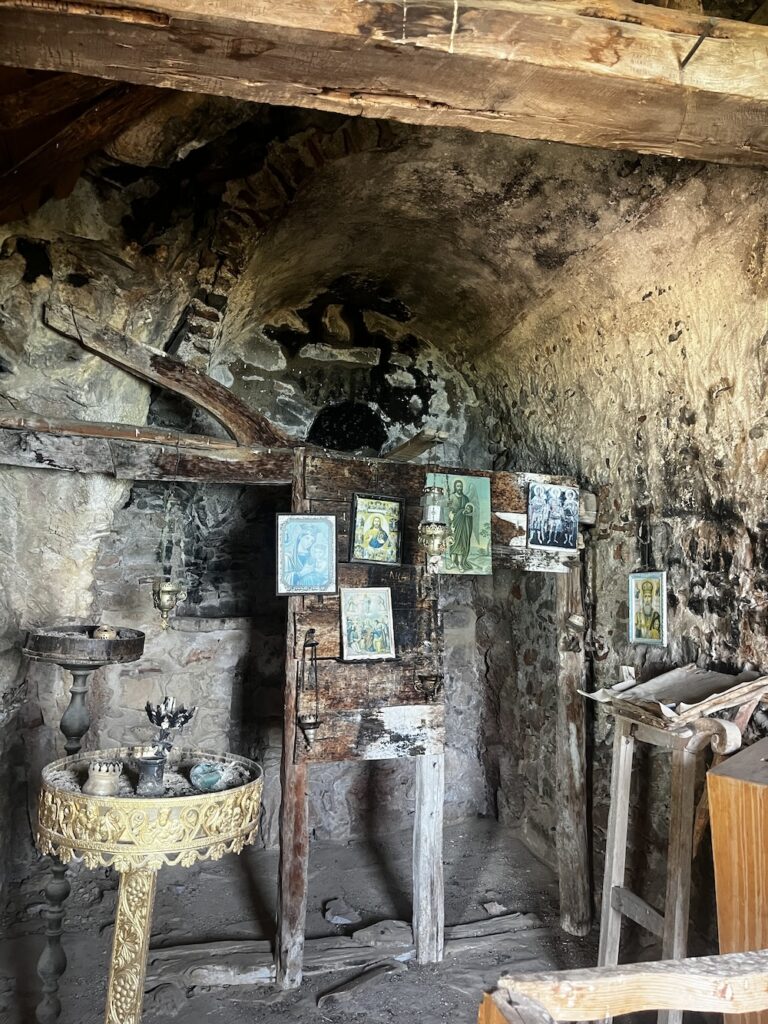
Later we climb up to the hermitage, a rough stone cave etched with faded frescos of the saints. It looks out over the serene waters. The air buzzes with insects, a soft electric charge threading through the silence. We don’t speak of it, but we all feel it, an aliveness, a creative force which is perhaps what the monks had come here for over millennia. Is this how Metamorphosis got its name?
Back in London, I walk to a café in search of inspiration, but my mind turns back to Prespa, to tiny orchids peeking from crags, the delicate scent of wild thyme and honey on the breeze, that electric creative force, a sense that nature is more powerful than we give it credit for. Perhaps, then, the greatest gift of walking in Prespa is its invitation to linger on this threshold between past and future, not forgetting trauma but awaiting renewal, feeling both the ache in our legs and reviving coolness of the water, and carrying that energy back into our everyday lives.
*
Annemarie Lopez is an Italian-Australian writer, editor and digital storyteller/creator of walking games. She has worked as a cultural journalist in the UK, France and Australia.
Annemarie holds a PhD in Cultural Studies, focused on the intersections between walking, fiction and psychogeography. Currently based in London, Annemarie loves walking in the city and the wider world, and especially in her ancestral Aeolian Islands, Sicily. You can follow her on X or Instagram.