On a Suffolk beach, Maartje Scheltens meets an artwork that marks out the passage of time, shell-by-shell.
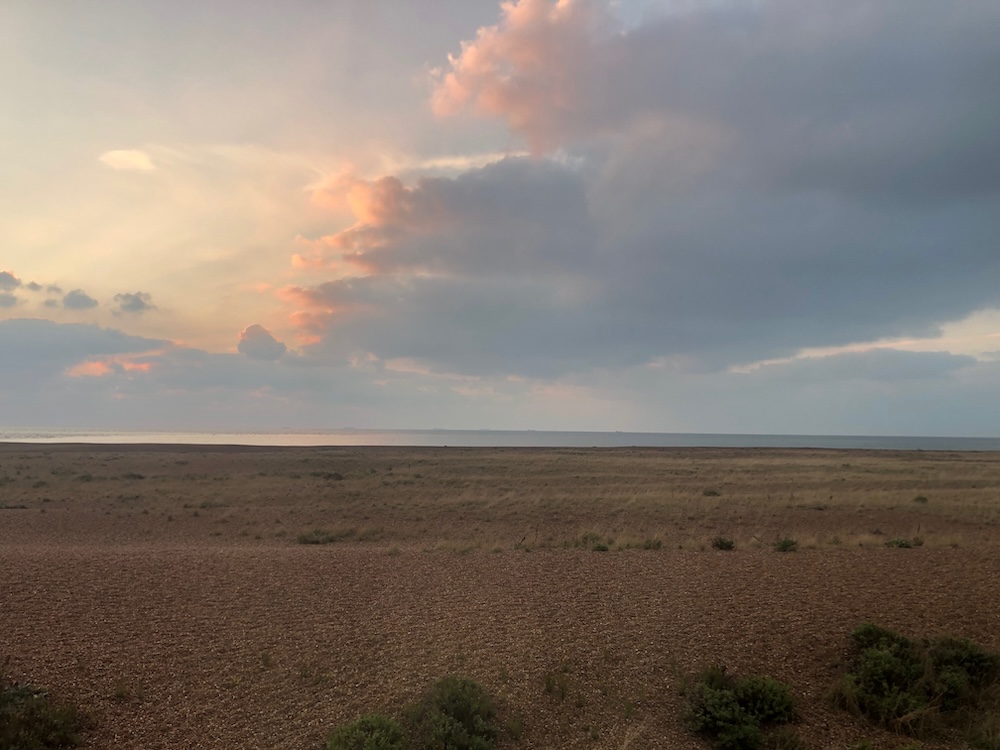
“Do you want to come see the comet?” I asked. Later I realised I had implied to L. that I had some idea of where the comet was. For the first time in 80,000 years, this piece of space rock was supposed to be visible with the naked eye in a certain direction, at a certain angle above the horizon, at a certain time. These parameters would shift every night. In my room, we framed our faces against the window with our hands, but looked out only at darkness. That evening we’d already been outside several times to look for the Northern Lights, which were also supposed to appear – what a chance that our visit to such a remote place with no light pollution would coincide with both events. On the moonless night before we’d seen the Milky Way directly above the courtyard of the house, but now, apart from a faint brightness to the north – the lights of Aldeburgh? – there was nothing but cloud on the horizon. The last time the comet C/2023 A3 (Tsuchinshan–ATLAS) grazed our visible sky, the papers say, Neanderthals looked up.
*
Early October. My friend L. and I are at Shingle Street this weekend to write. We have rented one of the white coastguard cottages that back onto the beach. This is the first time since we were students decades ago that we have worked alongside each other in a room, and yet it feels familiar and comfortable.
It’s very quiet. The house catches the wind. The living room and my bedroom face the sea. I wake up with the sun rising on the left, before it arcs like an outstretched arm and sinks unseen over the marshes behind us.
A single winding road across the marsh from the nearest village leads to the hamlet, on the Suffolk coast between Orford and Felixstowe. It has just one street, but it’s bigger than the well-known photos that only show the white terrace of coastguard cottages. There are Martello towers1 converted into circular loft apartments, and covetable houses with picture windows behind which are chairs and telescopes facing the sea. Some have New England-style porches with steps out to a part of the shingle where the tall dead Verbascum flowers make the beach look like an exotic desert forest. The beach is home to many rare plants – the kind of ecosystem that is never not accompanied by the word fragile.
The sea changes colour every time I look – as clouds pass over, the light shifts and the tides vary the depths. All the greys, silver, blue. About five nautical miles offshore a queue of freight ships lies at anchor. Through binoculars their towers of stacked containers form fantastical cities on the horizon, a row of tiny Manhattans.
*
After breakfast, we work for a couple of hours, then walk. One day over the marsh, the next on the coast path. When I think of the shingle I feel it in my ankles, agony to walk on, and the most inhospitable aspect of the place. On the path itself lurk deep cracks and rabbit holes, interspersed with muddy patches. We can see as far as Bawdsey cliffs, an hour’s walk to the south, and we turn around by the battery there, where the waves are trying to erode the higher land with violence. Coming in out of the wind afterwards is a relief.
To our left, up the coast, is the former military testing site at Orford Ness, the port of Felixstowe to our right. War on one side and trade on the other. Too on the nose a metaphor for the state of the world. Four surviving Martello towers, built at regular intervals for Napoleon’s invasion that didn’t come, rearrange themselves in perspective as a row or a group as we follow the turns of the winding coast path. Just outside the hamlet lies a row of large concrete cubes, Second World War anti-tank defences, one in the middle toppled over to stop them becoming stepping stones to a protected part of the marsh.
Somehow I’m always looking out of the window at the right time to see the Dutch ferries pass in and out, in and out. Stena Britannica leaves Harwich, just down the coast, at 9 a.m., and returns overnight, meeting Stena Hollandica coming the other way. I watch both coming and going and think about home.
After sunset, we catch a faint peal of bells. You have to listen for the silences between the bells, like how the Pleiades go fuzzy when I try to look at them directly in the night sky, but out of the corner of my eye, while focusing on the dark, they are absolutely distinct. Sometimes the sound seems to be coming across the marshes, from the bell tower of All Saints, Hollesley that we can see above the line of trees to the west; sometimes it seems to be playing out at sea. The ghost bells of towns lost to coastal erosion? A trick played by the wind? When we hear the bells at noon precisely we look to the church tower, and wonder how they can be all around us. But at night the sound is clearly coming from the water. Finally I check the faded nautical map pinned out in the courtyard and spot a bell buoy, warning ships of the sand bank at the nearest tip of Orford Ness. The wind determines the volume of the sound, the strength of its alarm.
At night the horizon lights up like a motorway and this remote place reveals itself as a crossroads connected to the whole world. Thanks to radar, developed during the war just down the coast at Bawdsey Manor, we can track the marine traffic on our phones, so we know that the brightly lit cargo ships come from Singapore, Bremerhaven and Colombo, and are waiting at anchor between yellow shipping lane markers. Blinking planes cross the shore overhead. Navigational aids are all around us – the stars, the radar mast of the former coastguard station next door, the buoys and the rows of twinkling red lights on the offshore wind farm. I feel pinned onto the map, struck by the specificity of the place. I can understand why people want to live here. Choose this as your sit spot and the entire world will spin by.
*
From my bedroom window in the morning, I see hares running across the Shingle Street Line. I’ve already shown L. the narrow line of shells that cuts diagonally from the other end of the terrace towards the shore. It was this work of art that first brought me here eleven months ago.
Much of Suffolk was flooded that week in storm Babet. The same storm had cancelled a planned holiday to Guernsey, so my husband and I set off to Orford instead, only to be stuck overnight in a pub in a flooded village just off the closed A14. The satnav, with a sense of humour, kept sending us down Drinkstone Road, which was blocked by stranded cars.
After a few days we worked out the driest routes in and out of Orford and visited the radar museum at Bawdsey, then took a turn off the main road to Shingle Street to see the line.
Two artists, both Dutchwomen who grew up together, created the Shell Line. Ceramicist Els Bottema and letter carver Lida Lopes Cardozo Kindersley, both then recovering from breast cancer, stayed in a house at Shingle Street together in 2005. One day, they started collecting bright white shells and placing them onto the shingle, first in a circle, then in a line. On their second visit, a little stronger, they were pleased to find their circle was still there, and started extending the line in both directions: towards the sea and the Netherlands, and inland towards Cambridge, where Lida has made her home as an immigrant – like me. Over subsequent visits they laid and re-laid the line, which undulates with the contours and ridges of the shingle beach, a wave pointing to the horizon. The line became famous; they published two books about it, and it appears in photographs and postcards, a beautiful piece of landscape art but more than that, a tribute to their resilience and survival. The Shell Line holds meaning, contains and keeps it safe, memorialises love and grief and the passage of time; it repeats itself in seasonal cycles of dispersal and redrawing.
Walking up from the hamlet’s small car park that first time, the shells were not visible. But with Lida and Els’s first, pocket-sized book about the line in hand, I used the photos to navigate to it.2 I recognised the two women kneeling on the shingle, laying shells, a few metres apart. “Is it you?” I asked, then switched to Dutch.
They were pleased to meet a fan, happy to chat. They were repairing the line, they explained. It is just one whelk wide, each a bright white curve coiled into itself, the pointy end south, but over time, with the action of wind and waves and humans, it blurs. This artwork that celebrates survival is made of the remains of dead creatures. Ten thousand exoskeletons that once housed lives, little homes become little absences, shaped to fit the molluscs’ bodies but outliving them by decades or even centuries, until the abrasive shingle finally breaks them up into sand. On each visit, the artists reposition the shells and remove the ones that have dulled to grey. Some will make their way back to the sea to be bleached by the shearing action of pebbles and tides and wind, until they might be found again and rejoin the line to sit out entropy once more. While Lida and Els discard the grey shells, they keep the imperfect ones with holes. Because ‘we are all a little broken’, they wrote.
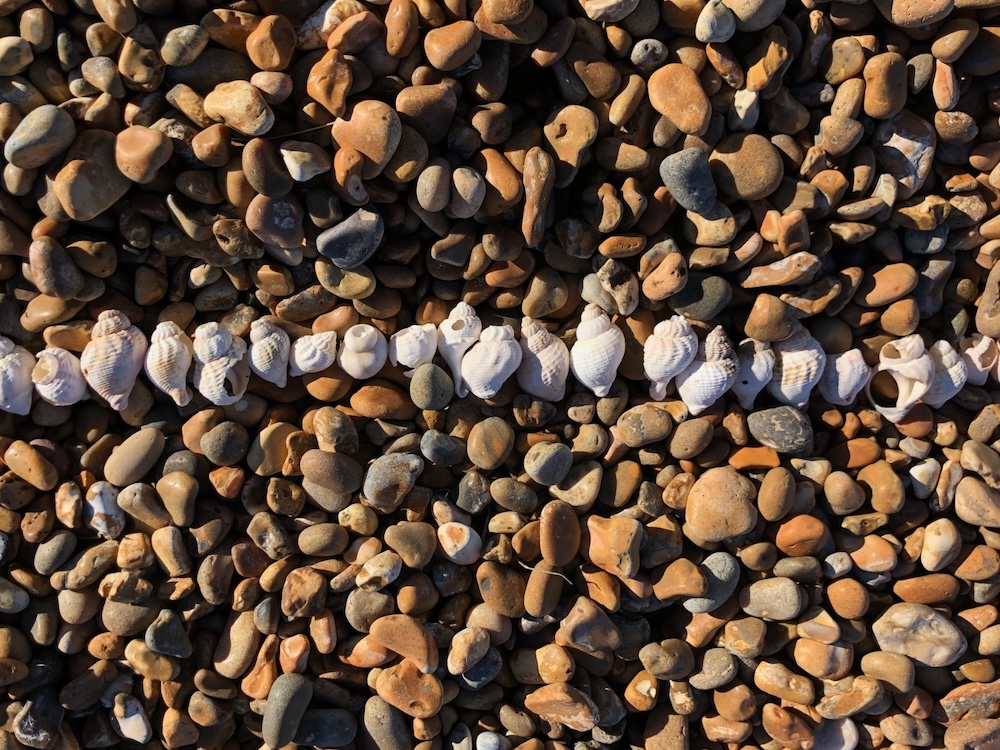
Each placement of a pure white shell just so is a little moment of love and care. A gathering and sorting task, grading the shells, searching for purity and beauty in this old world. The process of making the line is not an occasion but a repetition, and a reset after the time in between. For the artists, a check in with each other and with the line. Freshly laid, the line as a piece of landscape art gives an illusion of stability, until the shifting shingle, defying those who try to walk on it, gives out. The line, Els and Lida wrote, ‘is complete and yet never done, never’.
This weekend, the line is blown out, multicoloured. Other things have been placed in among the whelks – white stones and cuttlebones. It is almost a year since I met Lida and Els and another visit must be due. Tracing the line to the shore, I see it has a new ending since last year, or it’s different to how I remembered it. An arrow of shells pointing east, where a steep bank of shingle meets the sea. The symbolism hits me. The arrow points home.
L. and I collect some white whelks and offer them to the line. I like the idea that they will pass through Els and Lida’s hands, equally content for them to be placed carefully in the next iteration of the line or be rejected and tossed back onto the shingle with a clack.
*
Like all writing retreats we try to stay away from distraction and news, and have chosen this quiet spot deliberately. But we can’t quite resist turning off airplane mode to look up a wildflower or a landscape feature, and then it turns out there is a strong mobile signal here, perhaps because we’re right next to a mast signalling to the nearest coastguard station. So that’s how L. researches percolation lagoons, the hidden dips on the beach in which samphire grows, bright blue pools with rounded edges of wet shingle. They are formed by seawater trickling slowly through the shingle, drop by drop, or by a storm slamming into the beach. Over time, they might move or be filled in as the unstable shingle shifts. And as soon as she tells me about this I feel like a percolation lagoon.
I didn’t tell Els and Lida I’ve had cancer too, twice even. I didn’t want to insert myself into their work and I have a compunction about mentioning relapse to cancer survivors. In their joint memoir they write movingly about the sadness they felt after their treatment, the suffering they each went through and how it brought them together to make the line.3 I thought about chemo drugs percolating though the line into my chest. I thought about how I had avoided raging and feeling angry at my cancer, and as always I congratulated myself a little bit on my equanimity and resilience during chemo. But I also thought about the aftermath of the shock wave – and how long the pool of feelings would stay.
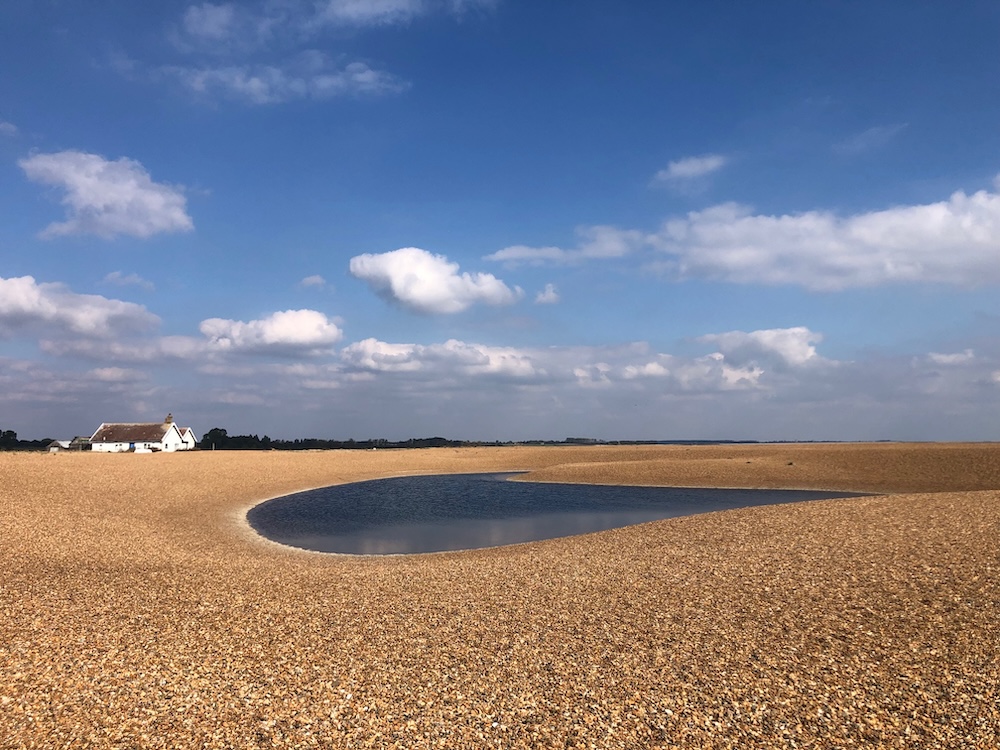
It’s all here, all the hard defences, the shells, cliffs, concrete cubes and pillboxes, the brick Martello towers – and the soft defences, the raised beach and the marsh soaking up floodwater. A patient is not a bunker but a percolation lagoon. In the end, for those who are lucky, the tide retreats, and you clamber out, changed, but the salt stays encrusted on you.
*
Lida or Els asked me how the English pronounce my name. “Something like Marsh.” For a long time now I’ve been trying to write about marshland, fens, floodplains and pumps, about the ways excess water is managed in East Anglia and the Netherlands, about driving through flooded roads to reach the coast the day before my first visit to Shingle Street. I became obsessed with the future flood projection map, which shows my homeland and my current home under water by 2050. How can I have survived cancer only to be faced with the prospect of watching the landscapes I love be destroyed? A tutor suggested my obsession with floods was about being overwhelmed, flooded by emotion. I realised my response to diagnosis was to keep still and quiet. just accept everything as it came. But in a flood, in the face of loss, you must build defences, make art.
*
On the last day of the weekend the spell is broken; the beach car park is full. Kite flyers and fishers, a few people walking the line and stooping to add a shell. Proper walkers pass the window with tripods, backpacks and bobble hats on the long-distance path between Felixstowe and Lowestoft. The crunch of footsteps on the shingle, so spooky late at night, is common now.
Soon, the artists will come back and relay the line, then the wind will be back to disperse it, and so the cycle goes on. But this trip is a one-off for us. During our stay in the cottage, we discover it has been sold. The new owner will live in it, and we will not have the chance to come and stay here again. If the sea defences are not improved, will Shingle Street be here in another twenty years?
We don’t spot the comet, or the Northern Lights, but on the coast path we find a pleated inkcap – a delicate fungus that elegantly unfurls its parasol-like cap for a single day before it dies.
*
Els and Lida signed my book: ‘Amazing we should meet here at Shingle St.’
1 Round defensive structures built during the Napoleonic wars
2 The Shingle Street Shell Line (2008)
3 A Shell in Time (2023)
*
Maartje Scheltens is a freelance editor and writer living in Cambridgeshire. Her non-fiction has been published in ‘Granta’.