We should all be deeply grateful for Emma Warren’s timely cultural history of the youth club, writes social historian and former youth worker Ken Worpole.
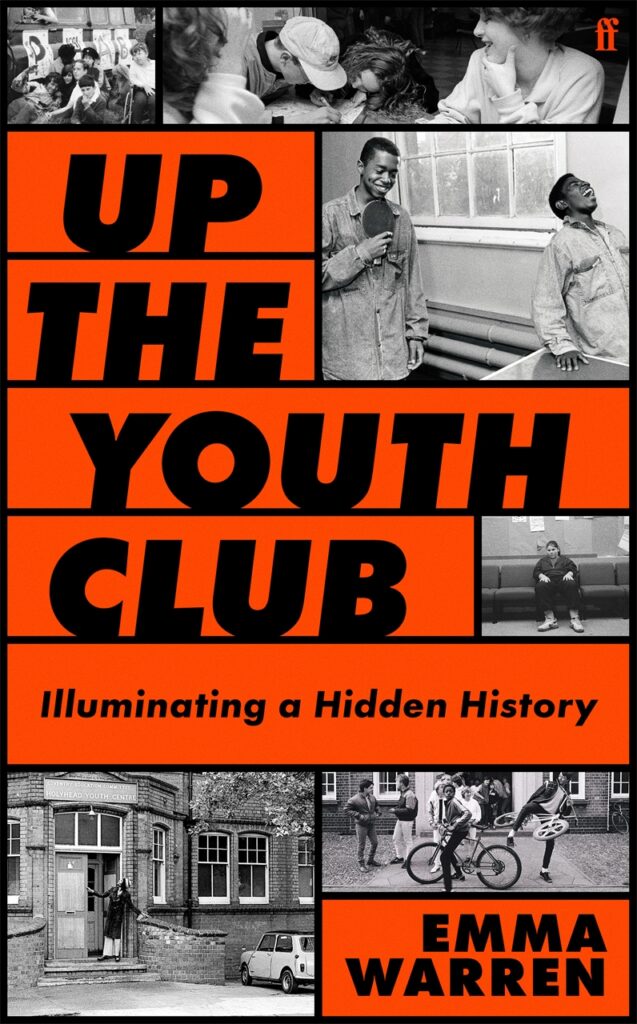
Emma Warren’s study in contemporary British culture starts with a simple question: ‘Where have all our youth clubs gone?’ Once a feature of everyday life – whether provided by a church, settlement, local council or voluntary effort – like so many other local facilities they have quietly disappeared. As a character in Hemingway’s novel, The Sun Also Rises, replies when asked how he became bankrupt: ‘Two ways. Gradually then all at once.’ The same seems to have happened to Britain’s youth clubs.
‘Every writer has a relationship to their subject, even if they claim their interest is objective,’ Warren admits: ‘Mine is familial: I spent most of my thirties as an informal youth worker, while friends, loved ones and family members have also done this work.’ She has also written widely on grassroots music and youth culture in magazines such as The Face and in books such as Dance Your Way Home.
In the distant past, my wife and I worked as accredited youth workers near Brighton, working evenings at The Courthope Centre in Portslade, and later in London in a youth club off the Holloway Road. The Courthope was one of 3,000 dedicated youth centres built as a result of the recommendations of the 1960 Albermarle Report. In retrospect, that report and its consequences represented a high point of post-war government commitment to providing for the needs of young people as citizens in the making. Sadly it has been downhill all the way ever since.
At ‘the Courthope’, as I remember, there was table tennis, quizzes, invited speakers and outings, but every Friday night local bands would play – the ‘must-go’ night for members. As Warren suggests, one of the most successful developments in youth club provision from that time onwards was encouraging and supporting live music, as the ‘do-it-yourself’ aesthetic arrived to challenge the commercial recording industry in the heady days of the 60s and 70s.This was most famously evident in Coventry where a former Quaker Meeting House, later used by the Fire Service to train recruits before being left empty, became the home of a group of young people with connections to reggae sound systems and soul clubs. Renamed the Holyhead Youth Club, it became formative territory for Two-Tone band, The Selector, along with other initiatives challenging racism and youth alienation in the city.
Similarly, South Asian youth also developed centres of their own, via the Federation of Bangladeshi Youth Organisations, as a way of developing forms of resistance to racism, which in turn spurred the creation of the League of Joi Bangla Youth focused on developing young Bengalis’ interests in music and fashion. Warren’s own experience in the world of locally-based, home-grown musical culture came when working at a teen-run publication called Live Magazine in Brixton as an editorial mentor, where she oversaw the production of a quarterly magazine, website and video channel.
If there is a key trend evident in this fascinating and passionate history, it is that the most successful developments in providing social and creating opportunities for young people in recent times – especially in areas of high social deprivation and institutional racism – result from offering training in all the new popular cultural forms: music, dance, graphic design, social media. It is no longer adequate simply to provide a building where young people can hang around amiably while offering no longer term vision of how they might take charge of their own destinies. One of the most successful of these initiatives to my knowledge, was WAC the Weekend Arts College established by Inter-Action in Camden more than 40 years ago, and through which thousands of young people from diverse backgrounds got a first foot in the arts, many going on to professional careers as a result, and still going strong.
As Warren writes, historically the first youth clubs were started by religious organisations concerned with the moral improvement of young people, seen to be unduly influenced by popular street culture or unsavoury, irreligious home lives. Nonconformist churches such as the Methodists and the Salvation Army were particularly active in providing places for young people to meet in a more salubrious environment, as did university settlements. The growth of uniformed youth organisations such as the Boy Scouts, Girl Guides, Boys’ Brigades and Army Training Corps followed. Here the author is especially perceptive, having spent time in Northern Ireland during some of its most troubled times. There is a terrific chapter on the youth DJ scene in Belfast and Derry, as well as the unlikely account of the RUC (Royal Ulster Constabulary) running as many as 480 different youth clubs in the late 1970s. Who knew?
Yet the youth service remains of marginal interest in government initiatives or funding schemes in recent decades. Warren notes that when the UN deemed 1985 ‘International Youth Year’, while the Canadian government allocated £8 million of new funding to the initiative, the UK government offered just £250,000. Several decades later, in pursuit of its austerity programme, the 2012 Cameron government cut spending on youth services by 70%. The Institute for Fiscal Studies later concluded that ‘Closing youth clubs was not cost-effective’, suggesting that, in Warren’s words, there were an ‘estimated £3 of societal costs for every £1 ‘saved’ by closing youth clubs.’
Yet only this month a National Audit Office report noted that ‘The cost of a single place in a residential children’s care home in England has nearly doubled in five years to an average £318,000 a year.’ It is quite staggering to realise that the cost of maintaining a single child in care could in other circumstances underwrite the fitting out and running costs of a youth club – potentially offering support to several hundred young people each week, hopefully at least helping one or two of them avoid going into care. These policy absurdities speak volumes as to how we continue to use public money often in the most counter-productive ways (because that’s how Treasury dogma works).
One small quibble with this otherwise inspiring book is the absence of photographs. Similarly, little is said about the development of unattached youth work, quite the thing in the 1970s and 1980s, with a distinctive professional sub-culture of its own. But these are minor matters when we all should be deeply grateful to Emma Warren for this timely and urgent study of a subject too often overlooked or simply ignored.
*
Published by Faber, ‘Up the Youth Club: Illuminating a Hidden History’ is out now and available here (£18.04).