‘England’s Military Heartland’ is a unique, insightful, in-depth inquiry into how war ideology, preparation and practice has insinuated itself into the narrative of Salisbury Plain, writes Nicola Chester.
The rolling, thunderous booms from the shelling of Salisbury Plain, and lately, the rapid fire, dut-dut-dut-dut from Apache helicopter guns, provide a deeply familiar soundscape at home on the West Country border. In autumn and winter, the military thunder is preceded by soundwaves reaching the legions of pheasants a few seconds before, causing them to call out in mass, alarming choruses that echo off the downs — a trait noted by ornithologists and gamekeepers, ahead of Zeppelin raids in the First World War. Chinook helicopters beetle along the ancient droveway above the house, or hover just above the hillfort, their double rotor blades drooping drowsy as a jam-drunk wasp’s antennae. In childhood, I remember Mum’s irritation when they spattered the washing on the line with tiny drops of engine oil. On consecutive nights, helicopters train in pairs, flying low with their lights off. The Army, Salisbury Plain and the Tidworth ranges, even at a few miles distant, are an embedded, camouflaged part of this rural landscape.
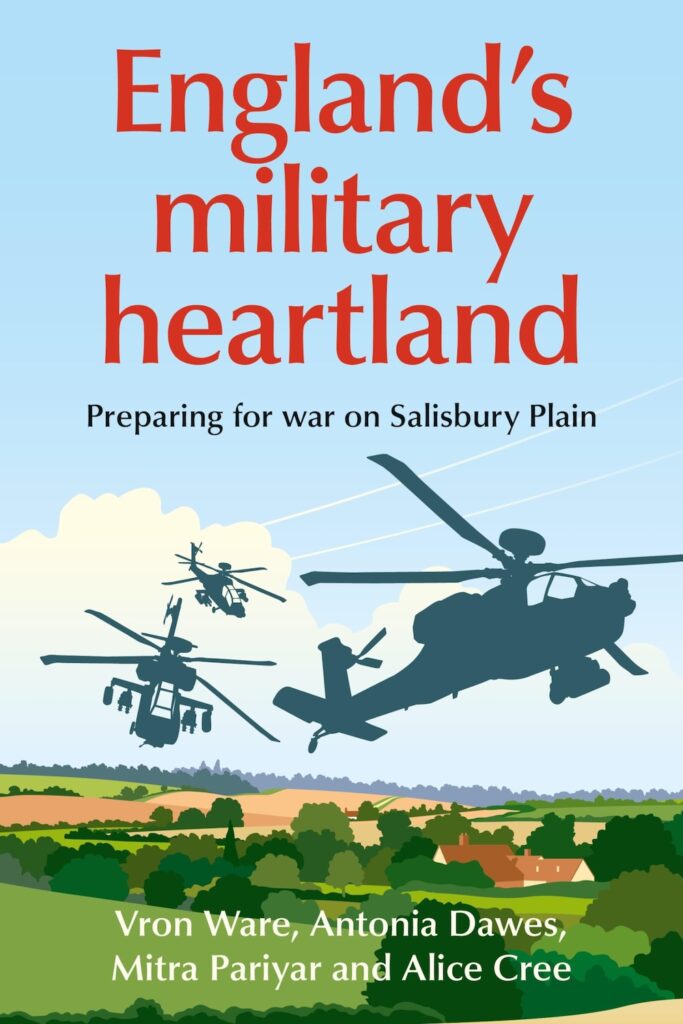
It is telling then, that the striking front cover of England’s Military Heartland, the sort of stylised, railway poster-view of the countryside I have on my walls, should shock. Across it swing the silhouettes of three of those missile-laden Apache helicopters, so close, you can almost hear them. It’s a call to wake up. When you live in this landscape, there’s a tendency to normalise and ignore the meaning of a daily military presence, permanently training for warfare.
This is an extraordinary book, with a unique, insightful, in-depth inquiry into how defence and war ideology, preparation and practice (as well as what supports it) has insinuated itself into the narrative of this particular place. Salisbury Plain, known simply as ‘The Plain’ by Jane Austen, Thomas Hardy and local people, is home to one of Britain’s four super-garrisons, created after the relocation of soldiers and their families from Germany. With ten years of observations, the four authors have triumphed in bringing us the context, and up-to-date reality, of life in and around a super-garrison. Their research is deep and expansive, exposing its social, cultural, political, ecological, historic and economic impact. Around 20% of the British Army are ‘hidden in plain sight’ here, within small towns, isolated from much public transport. In this sparsely settled, predominantly agricultural National Landscape, the county of Wiltshire exudes remote and lonely expanse, and mystery: big skies, secret chalk folds and bleak grassland. There is an amnesiac incongruity between the military hardware of tanks and barbed wired, and its UNESCO World Heritage status, of the ancient monuments of Stonehenge and Avebury — as well as the peace and environmental preservation of a Special Area of Conservation. But are its hen harriers, stone curlews and great bustards, specialist wild plants such as vipers bugloss, early gentian, juniper scrub and orchids, its marsh fritillary butterflies, and fairy shrimp in tank track puddles, still there, or possible, because of the military presence? Protected from industrial farming and development, is an accidental environmentalism, eagerly embraced as ‘khaki conservation,’ genuine action, or green [camou]wash? Another cloak with which to veil itself? It’s a landscape felted together, with these rarely questioned complexities.
Tidworth, where locals and military mix, and where we used to take our son to mountain biking trials, has been a garrison town since the Boer or Anglo-South African War of 1899-1902, at the height of Britain’s imperialism. Older buildings and new housing estates mingle, and bear, deeply uncomfortably, the names of battles of colonialism and empire, as well as two world wars against the Nazis. Jellalabad, Rorkes Drift Drive, Ramnuggur Road, Lucknow, Ypres, Normandy Road and desperately poignantly, Gaza Road, mingle with Furse Hill and Nadder (for adder) Road: ‘lest we forget military prowess, bloodshed and honour,’ or any soldier’s family should forget who their landlord and employer are. Even the street’s litter bins are styled with familiar Help for Heroes soldierly silhouettes. But Tedworth House, the requisitioned stately home that became an officer’s club and more recently, the Help for Heroes flagship recovery centre, for soldiers of the post-9/11 wars of Iraq and Afghanistan, is, barely a decade later, in disrepair. Under collapsed and leaking roofs, its state of the art facilities became unusable; the house itself, a symbol of national forgetting.
This is an academic book, with searching scope, but also one of human story. Here are conversations and disputes about land rights and rights of way, the difficulties of farming under Army jurisdiction, shockingly poor housing, new builds and the housing of asylum-seekers; institutionalised lives and accepted hierarchies, complex communities, and already stretched local services. It is sympathetic and poignant, acknowledging the bravery, resilience, sacrifice and hardships of military life, but it doesn’t pull its punches.
Unexpectedly, it’s a passage about the isolated village of Imber, forcibly evicted in 1943 and never returned, as promised, to its inhabitants, that hits home. Perhaps for me, a lifelong tenant of rented or tied (though non-military) accommodation, it is the fear and precarity of eviction. Perhaps it is because my new book, Ghosts of the Farm is partly set in that time, and records an apprenticed woman farmer, crossing The Plain with her car and caravan, becoming temporarily caught up in a terrifying column of tanks. But as I recall the haunting tale of village blacksmith Albert Nash, led weeping from his forge at Imber, and who died of a broken heart, the authors agree ‘there is nothing anachronistic about [the blasted buildings] in our age of perpetual war. The gaping windows and torn roofs stand as testimony that the word ‘civilian’ ought never to be used to designate a simplistic ‘non-combatant’ status. Civilians are those whose lives are merely collateral damage in the practice of modern warfare.’ I think again of Gaza Road.
A renewed phase of militarised geo-politics reverberates around these chalk hills, with redoubled thunder. It reminds me too, of Thomas Hardy’s poem, Channel Firing, where skeletons in their graves (and perhaps long barrows) are wakened by ‘gunnery practice out at sea’ and are reassured ruefully by God, that all is normal:
‘Just as before you went below;
The world is as it used to be:
“All nations striving strong to make
Red war yet redder…
[and]
Again the guns disturbed the hour,
Roaring their readiness to avenge,
As far inland as Stourton Tower,
And Camelot, and starlit Stonehenge.’
Timely, urgent and sensitive, the relevance of this book’s insight, work and message is one to be heeded.
*
‘England’s Military Heartland: Preparing for War on Salisbury Plain’ is out now and available here (£18.99, Manchester University Press). Read an extract from the book here.
Nicola Chester’s most recent book ‘Ghosts of the Farm: Two Women’s Journeys through Time, Land and Community’ was September Book of the Month. Read an extract here, Melissa Harrison’s review here, or buy a copy here (£20.90). Paid subscribers can also read a bonus interview with Nicola.