As Jill Hopper walks by the River Wandle, electric blue shoots across the water.
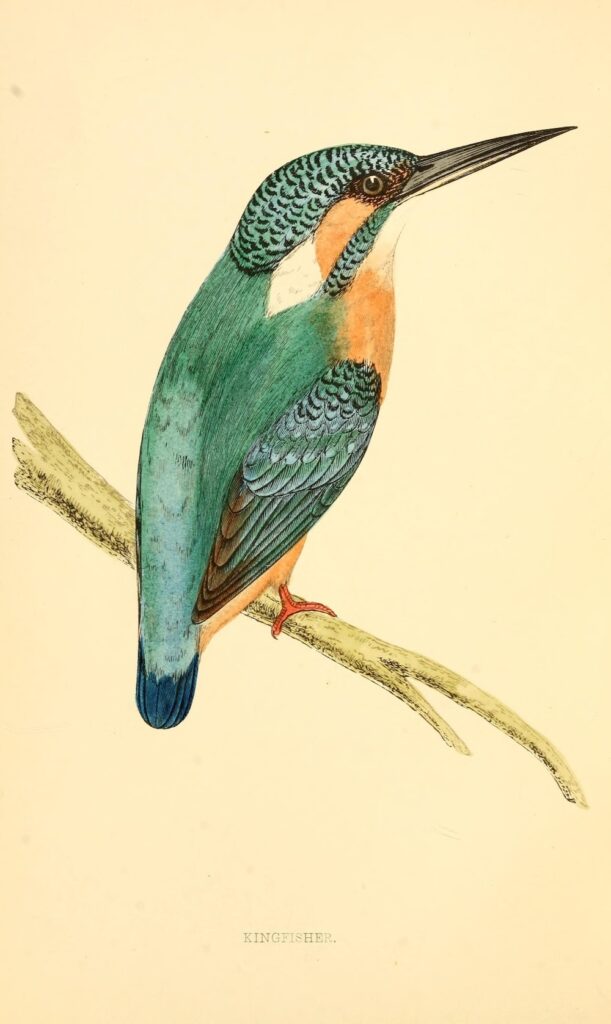
Image from ‘A history of British birds’ (London, Groombridge and Sons, 1862-1867, via the Biodiversity Heritage Library.
The hardest thing about the end of the holiday is leaving the kingfishers. For the past decade or so, our friends have lent us their flat in a converted mill by the River Dart in Devon. We swim, we walk, and most of all, we watch the kingfishers. If you spend a few quiet minutes on the tree-lined riverbank, you’re almost guaranteed to see one. In a thunderstorm once, my son and I swam under a low-hanging branch where two perched side by side, feathers puffed, sheltering from the rain.
Returning home to south London is a wrench. My nearest watercourse is the River Wandle, which flows fast between vertical concrete banks, and is crossed by a flat road bridge swarming with traffic. When I walk to Earlsfield train station, a route I’ve taken for the past twenty-five years, I always stick to the right-hand side of the road, glancing upstream to see if there are any birds. This once-green corridor is getting ever more crowded with new-build offices and blocks of flats, squeezing out those margins that are so vital to life. Pining for the Dart, I make do with pigeons, a duck or two, and maybe a coot or heron if I’m lucky.
One evening last week, a break in the traffic and a vague impulse made me cross the road to the bridge railings on the other side. I saw the overhanging branches of a dusty sycamore and, almost immediately, a shot of electric blue. The kingfisher broke cover and skimmed the water out of sight, its high, sharp cry like a toot on a tin whistle. Seconds later, its mate appeared. For several minutes I stood and stared as they looped, settled, flew again, feeling like I was in a dream.
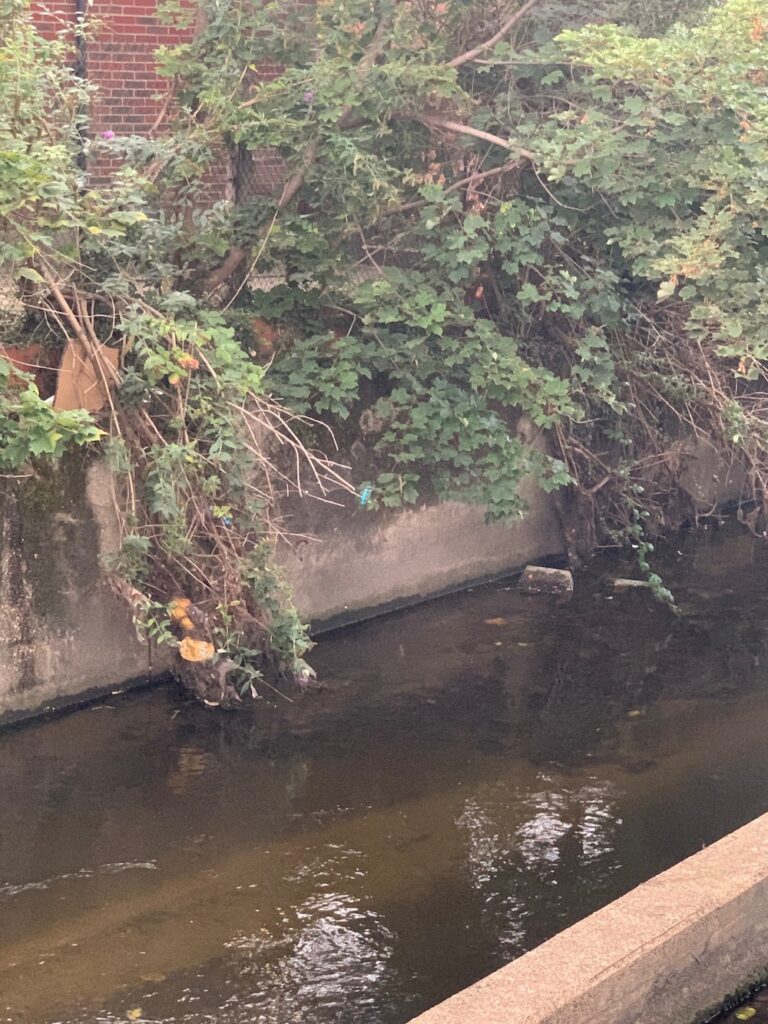
Kingfisher on the River Wandle (perched on a branch, centre of the shot)
Kingfishers are especially vulnerable to habitat degradation. This summer has been punishingly hot, with drought sending the water level as low as I’ve seen it. Back in February, 4,000 litres of diesel spilled into the Wandle from a train depot near Croydon, with devastating effects. And yet this pair have somehow managed to survive, amid the vans and commuters, half a mile from Wandsworth Prison.
Can they really have been here all these years, with me passing by in ignorance? Next morning I went back, to test whether I’d dreamt the encounter. I hadn’t; both kingfishers were there again. These days, I walk on the left-hand side.
*
Jill Hopper’s memoir, ‘The Mahogany Pod’, is published by Saraband.
The South East Rivers Trust (SERT), works to restore and protect the River Wandle.