The spiders are ripening and the foxes are cussing in Mark Mattock‘s “feral’d” NW2 garden.
August, September.
“When one tugs a single thing in nature, one finds it’s attached to the rest of the world.”
— John Muir
Without thought I turn off the gas. The throaty snake-like hiss ceases, the seething molten water instantly settles and the pot stops stammering. Silence. Early morning peaceful silence. I lift the saucepan and carry it over to the sink, sit it under the tap, turn the tap on and leave it running. New noise. Feeling, yet again, like I’m being watched I glance over to the kitchen window. On the salvaged school-science-bench the huge mutant courgettes I harvested a couple of days ago still lay like a pod of beached deep green cetaceans bent in distress, over-bloated on the urgent relief-rain-water that fell during the week I was away. Beyond the window the now arid un-edenic garden jungle: parched, hard, brittle, brown, dusty, dying, decaying. Limp, shrivelled, stunned; gone to seed. Spot colours of last chance flowers. One of the tall foxglove spikes that looked done squeezes a few more magenta bells from its tip like the last toothpaste. I am being watched, studied. Three points of dark in the dead, chin-high hogweed forest towards the back reveal the sharp triangular face of the skinny adolescent fox cub. Its stare is not one of curiosity, it’s judicious, and it is silently cussing me, cursing me. I turn and walk back to the sink, turn off the tap. I’ve just used considerably more clean fresh water to cool my eggs than millions of families will use today for everything; in desperation, clinging to survival, whether in apocalyptic droughts, floods, or being deliberately deprived as an act of genocide. I look back towards the fox. It’s gone.
I still have the dry crimson scabs from mosquito bites on my hands as I peel the eggs that I left — this time — to cool on the bench. French mosquitos, Loire valley mosquitos. Hot itchy nights with eventual relief and soothing in the cool air of early mornings, where the dawn chorus included the haunting song of tropical melancholy from golden orioles. Despite the fact that it is raining, finally, I leave my phone out on a patio chair with Merlin, the bird ID app, checking out tunes. Despite the rain the pale skinny fox cub emerges again from under the thorn spinny and makes its way through the crisped umbellifer thicket to the tiny pond now blanketed, skinned over, with reptilian scale like duckweed. The tiny oasis looks like an impossibly bright green moist scab in a desiccated ‘outback’ garden of faded lustreless hues. I don’t even warrant a glance. It half disappears into the water hole as if going to earth. It drinks sparingly, the lapping and swallowing action ripples in its ribcage. It drinks just a few seconds, just enough. The skinny fox scrambles back out, turns to me briefly in the kitchen window as it licks the lentil-like thalli off its nose, turns and quickly slinks back to the dark thorny corner. Even in the hiss and patter of the rain I hear the coal, blue and great tits up in the blueing ash canopy. Merlin confirms them but also surprises me when it suggests there’s a siskin among them. I doubt it often. It usually is right.
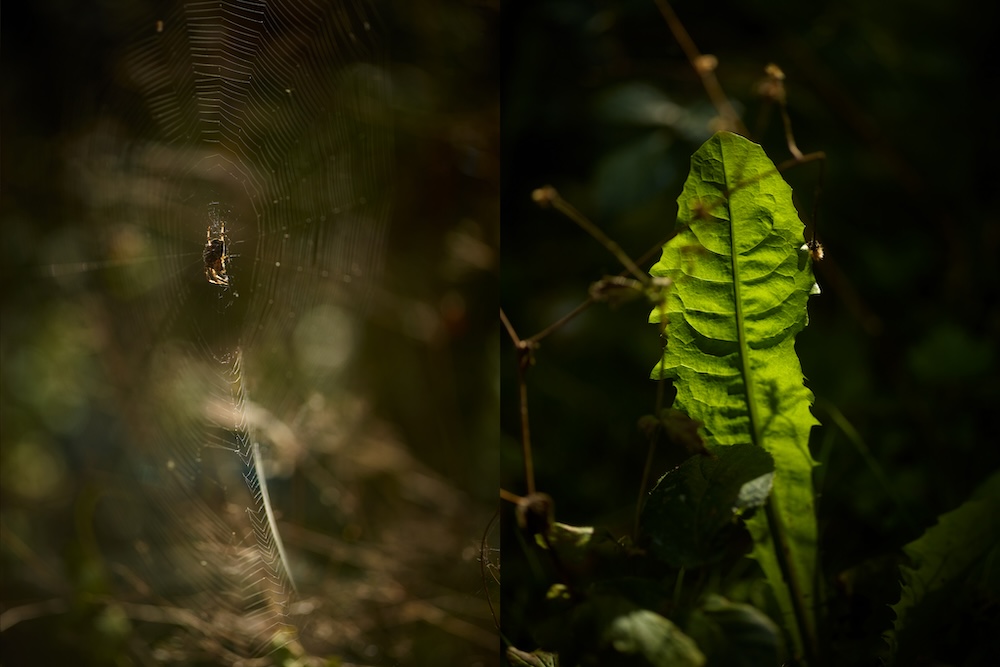
The small garden spider, rocking gently on its web cast among the spent drooping cones of buddleia blooms, is frantically shrink-wrapping — immobilising in fine silk — an unidentifiable insect. Embalming it like the cellophaned luggage of paranoid passengers at airport check-ins. Fascinated as it rapidly pulls seemingly endless silk strands from the spinnerets – half a dozen small weird and creepy little spigotted appendages at the end of its bulbous opisthosoma (butt) — with its back legs as it slow-turns the prey with its mid legs. Spider silk is a liquid protein that solidifies instantly in air. The individual threads are interwoven, spun, for web construction and produced in different grades depending on purpose. It already has a full larder of micro-biochemically spit-roasted insect patties cached under a crisp curled leaf.
The pair of coal tits seem to see opportunity in my watering of the courgettes and tomatoes. Unbothered by my proximity, even flitting in and out of the desperately needed, very local, shower. The backlit nettles are steaming in random small puffs of pollen as if the root tips have reached a subterranean thermal pool. A charcoal-plumed crow watches me silently from the crown of the highest ash. Holly blues as blue as the hazed blue sky chase around ivy tower. Quick to aggress, a sentinel speckled wood dashes out to assault them, launching from one of the now huge but dry mould-dusted courgette leaves wilting in the midday heat. He in turn is attacked by a rival male. They resume their relentless daily sparring, around and around in tight g-forcing circles. It looks like a crazed spinning brawl, but freeze-framed it is far from; more performative compound-eye-to-compound-eye combat; a butterfly flamenco. A male who’s-got-the-biggest-whatever thing. No idea what that might be with speckled woods.
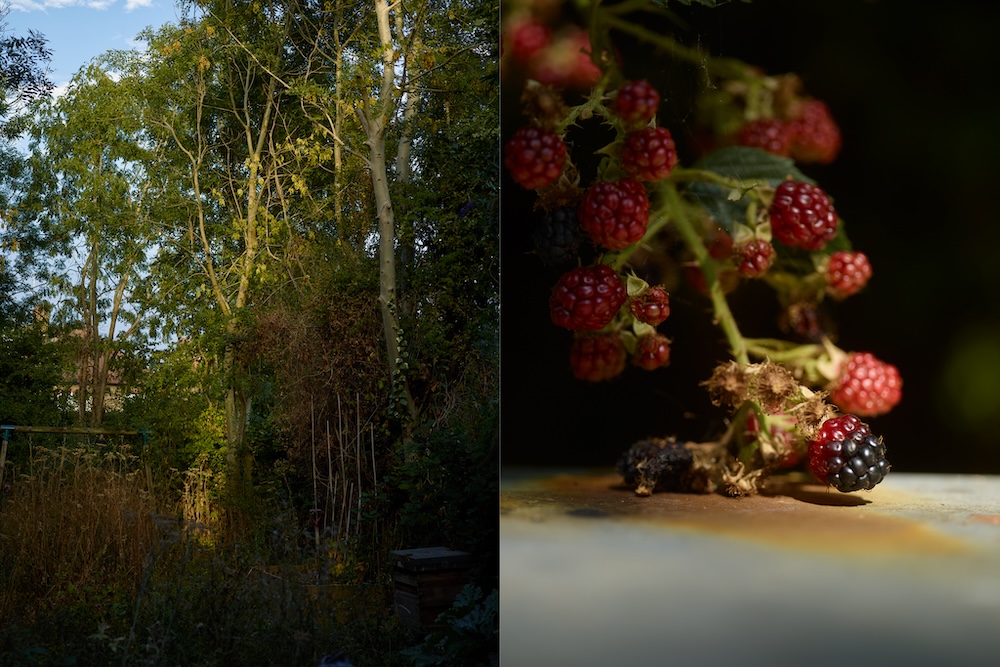
Mackerel sky. Breezeless. Still. Low-res urban rumble and hum. A great spotted woodpecker, probably the female I’d not seen since the trees were bare, is back hammering at the dead serpentine ivy stem peppered with the exit holes of wood-boring beetles. The dawn chorus now just mostly dribbling robins and occasional outbursts of irritable wren. The screaming swifts long gone. The ground parched. Cracked. Concrete. Blackberries are shrunken, shrivelling at the final point of ripening, looking like little shrunken heads with the orange stain seeds like tiny teeth. No more clafoutis, I was baking one a day just over a week ago there was so much fruit. The blackthorns have a few sloes, and they’re big as small plums, almost edible, no involuntary purse-lipped gurning at the biting of one. This summer has been a phenomenal year for haws and sloes. Fruit-drenched hedgerows. But as in the garden most of the bramble fruit shrunken and dry.
Slugs have left their glistening riverine trails all over the hallway rug. It looks like satellite footage of the surface of Earth with its mighty arterial rivers glinting, flashing, as it orbits. Like looking down from an airplane window at 38,000 feet. Not all slugs successfully traverse the vast plain, return to squeeze back into damp crannies before sunrise. Succumbing to the dry indoor air. Slow death shrivel and dry. Found in the morning, sometimes by bare foot, they look like the scat left by the skinny fox neatly on a patio slab, tinselled, haloed, in the very same shimmering silver slime.
The feral roses are rampaging in the drought-dry Mediterranean conditions. Exploding in long serrated arcs of pin-sharp hooks. Splattering scarlet hips among the hot green chlorophyll sparks and flames. The buddeia echoes the roses like a second exploding firework but at the point of burn-out, the tips of its drooping branches a cooling fade-out purple. On one the alarming don’t- fuck-with-me looking Volucella zonaria, the hornet hoverfly, an imposter, totally harmless, a buzz pollinator. The carder bees and cabbage whites with which it shares the floral wind-sock are unfazed. The bush has a kind of doppelgänger in the mint, the only proper greenery on a large area of the cracked concrete hard ground. Small wads of tiny purple flowers feeding spent insects. Above wiry Sparrow Bush, from which it ascends, the yellowing boa of the grapevine drooling with deep bruise-coloured bunches of fruit, is pulling down on the slim ash boughs already overburdened by the weighty pom-poms of rust-stained ash mast. The honeysuckle is now a huge dead tangle of sun-bleached cornflake leaves, its blood-bead berries evaporated. Another arboreal snake of heraldic ivy leaves continues to slide its way up a smooth grey ash bole at an almost discernible pace. Glowing cabbage and green veined whites, so white they still glow in the blinding sun pools, flutter endlessly in search over the parched ground for any viable cruciferous leaves (mustards, cabbages) on which to deposit an egg, or eggs.
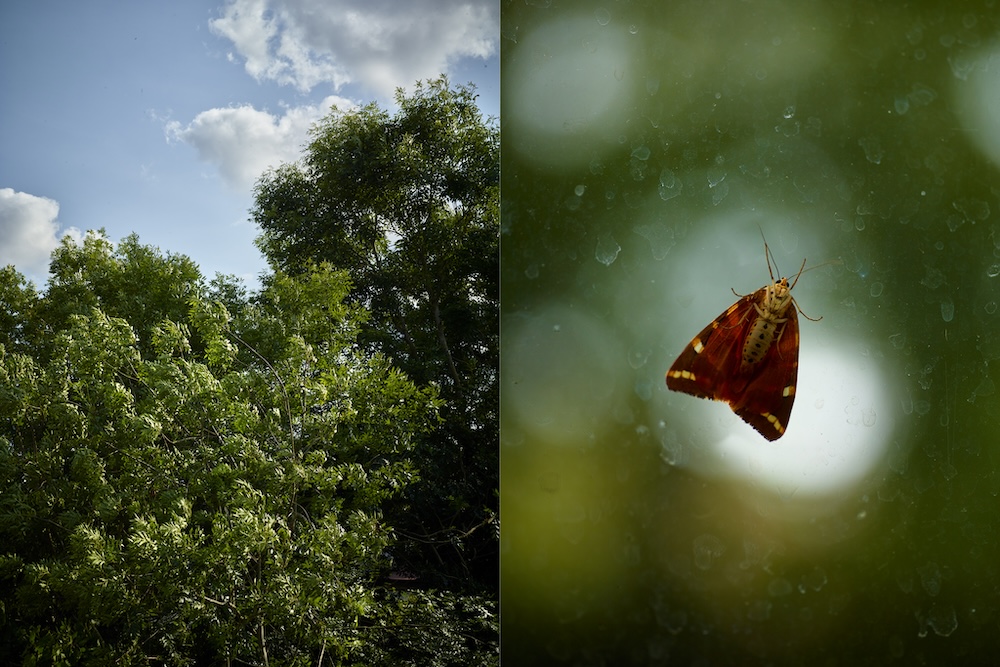
A hidden tiger bursts from the tomato foliage into my face as I pick the fruit. A Jersey tiger. Unbelievably I didn’t notice it. Its deep dark chocolate brown and cream tiger-striping can hardly be called camo, unless as in a dazzle-ships way: the disruptive pattern actually looks more miniature zebra-skin rug. Flashing scarlet orange hind wings make sure you can’t miss it, or mistake it for anything else bar one other. A moth on fire. More usually encountered sitting quietly on the kitchen window. Yet another loud insect indicator of warming climate. Just a couple of decades ago confined in the UK to the Channel Islands. It’s now a proper Londoner, like the rose-necked parakeets screeching from the ash tops. The loud carnival-goer moth processioning, southern breezing, north, steadily summer on summer. I haven’t seen common garden tiger moth — of woolly bear caterpillar fame — in decades. One has not ousted the other but both are symptoms. I’m surprised by the amount of potatoes I forked from the second raised bed that I paid no attention to at all this year, until now. Didn’t even water, just planted a row of beans along the back edge. The potatoes grew from the leavings of the previous year, so disappointing I swore to never bother again. A reminder about the abundance possible as a result of neglect and let be — the perfect excuse for not having green fingers.
The cat has regained his confidence, retaken his hunting grounds, resumed his territorial patrols. Re-discovered new, fresh-smelling shitting sites in neighbours’ borders. The foxes obviously gone. Only the occasional ghost appearance of skinny one.
A jay shouts and I look up just in time to see it get a face full of piercing talons, from the fierce little musket whose stealth-gliding silhouette simply evaporates in the kaleidoscopic light-dark dazzle of the swaying ash foliage immediately after, leaving the jay screaming with rage at the indignity.
The full moon rising over the horizon at the front of the house when I went to bed has climbed over the roof and is now demanding my attention, as if a torch is being shone directly face, from high over the ash canopy at the back. The leaves glistening with its shine in the dead still air. My heavy eyelids lifted by its gravitational pull to find the room filled with silverine light, as if by some monster anglepoise lamp, as if still in a dream. I squint at it bare in the face. It’s magnificent. Wild as in wilderness wild, I could be anywhere. I remember the cabin. Cabin nights. Once again, very briefly, I feel the thrilling enormity.
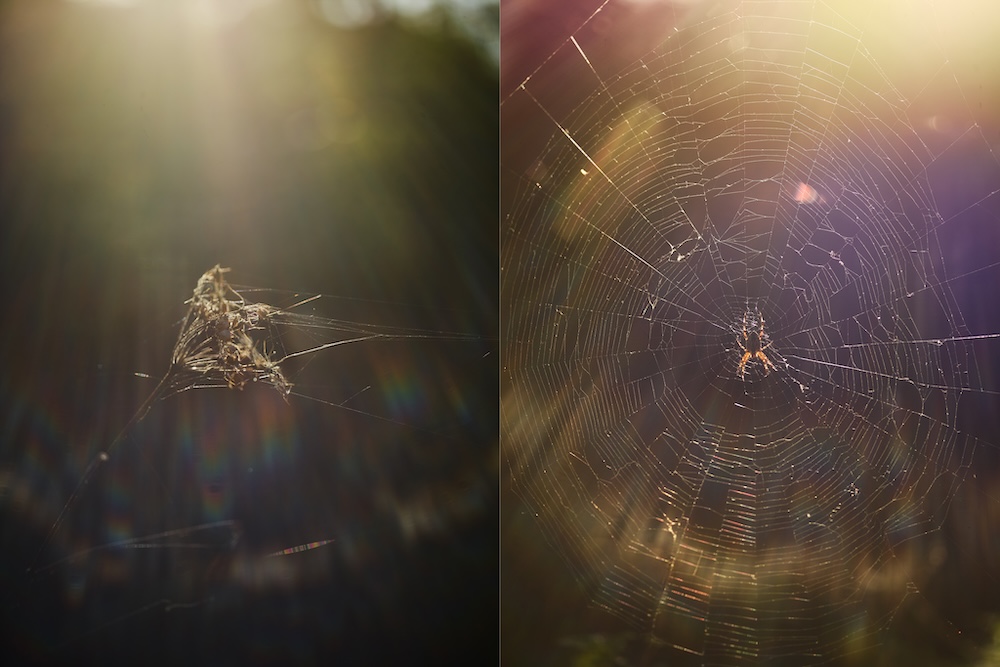
The spiders are ripening. Palimpsests of intricately-orbed mist-nets spun under the moon pulse silk rainbows in morning sun-pools, invisible in shade, hang in every gap from kitchen window to the compost bins at the back. Centred in each, bulging looking-to-burst abdominal blobs of Baroque tattooing with white altarpiece crucifixes like some alien berry — nut — arachnid hybrid. Some crouched crablike, some symmetrically radiating banded bristle-legs with the tip of each delicately touch-hooking a single silk thread. Eight eyes staring, terrifying fangs folded. Motionless. Carrying the kitchen waste to compost corner the supporting tensile silks from which the webs are hung cut across my face one after the other, pulling down the hogweed seed heads before audibly snapping with enough force to scatter the spice-hot seed flakes on release, sending spiders scrambling for cover or ejecting to earth in an emergency bungee-jump.
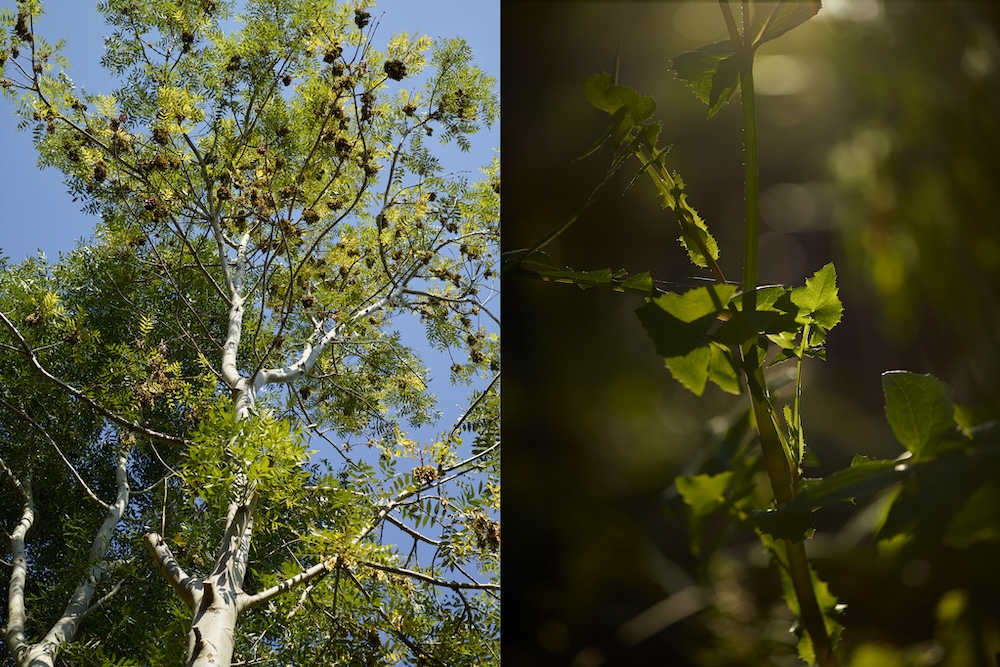
A faint autumnal odour permeates the damp air, the worm is turning, lush new green oozes from the rain-softened soil, hinting next spring’s possible configuration of flora. The nettles that looked dead leak new fresh green leaves as if the stems are frost-split pipes. Centimetres-high hedgerows between the paving slabs. I haven’t actually investigated the garden much for the last six weeks, work has kept me from it. So mostly just mornings. On one such Merlin claims to hear twelve bird species during our half-hour early morning coffee. The eyebrow-raiser being a spotted flycatcher. A migrant’s quick stop-off? From the kitchen window I follow focus along the right side of the garden with binoculars, passing through the webs without disturbing them. Most are spiderless, too cold and dull. One large web hangs under a supporting silk cable that incredibly spans across eight feet of space, from a bean cane to a hogweed head. How? How did its maker do that, join one high point to a distant other? It looks as if there’s some unseen specimen angler sat concealed in the boundary vegetation, as if it’s the riverbank, and all that gives them away is their taught monofilament line emerging from it. And when by chance a falling yellow pinnate of ash leaf hits the line, the hogweed stem jumps as if a fish has bitten. Under another web, a smaller one, set in the blushed pink dogwood leaves, a snared rose leaf pirouettes, suspended on a single elastic filament, dull yellow, bright yellow, like an angler’s spinner.
Die-hard speckled woods still going strong when the sun pops. White butterflies re-materialise to dip in and out of the refreshed greenery with renewed urgency. Running out of time. Strange runic inscriptions are appearing on the leaves of the tall cherry suckers like some alien denotations of the sound of the very loud robin that when it ‘lets off’ really, but impossibly, sounds like a cetti’s warbler. Merlin doesn’t fall for it. The scribblings are the larval tunnels of leaf miners — species of micro moth or fly, each with its own handwriting. Some burdock and old hogweed leaves like ancient deteriorated parchments, ‘mined’ to the point of collapse.
A troupe of dirty pale white discs has materialised in the damp new greens and dead stems. Ghostly apparitions in the dawn dull. They are agricus not-quite- sure-which-exactly mushrooms. They’re a bit late. Very tasty. I don’t pick them until the evening though. I’m a bit late, they are maggot-riddled yet again. Maybe the larvae of the gnats skanking in the last beams of the setting sun right now. More importantly though is that they are beacons of health, soil health, eco health, and the garden’s ever increasing biodiversity.
“In wildness is the preservation of the world,” is often misquoted as ‘wilderness,’ but he — Henry David Thoreau — definitely said and meant wildness…as in free-willed…feral.
(Never never pick any mushroom that you cannot identify with absolute certainty)
*
Mark Mattock. Artist. Photographer. Publisher. Rabbit Fighter. @the_rabbit_fighters_club