In an extract from ‘The Company of Owls’, Polly Atkin learns to love the night — and everything that lives in it.
Are you now, or have you ever been, afraid of the dark? Of the dark, or what might be moving in it? Of the dark, or a shadow of threat, something lurking just outside your range of vision?
When I was a little thing, still squeaking for my parents, I was afraid of the dark. I slept with a nightlight. I slept with the door open a crack to the hallway, to let the light and activity of the rest of the house in, or to let the quietness in my room out. It was a long time before I realised I was not afraid of the dark in itself, but what the dark held, unseen, and the dark itself, trapped indoors, primed to lash out defensively. Outside dark was less scary, more unknown. Outside dark was afternoons in winter, cold air thick with leaf mulch and fog, and the promise of bonfires and fireworks and the bright lights of Goose Fair. Outside dark was the moon and the expanse of the sky. Indoor dark was hostile.
I was afraid of what might be stuck in that bounded dark with me. I expected things there: wolves, sneak-thieves, monsters, baddies. I slept with my face to the wall, convinced if they entered the room and saw me not watching them, it would buy me essential time to escape or call an alarm. I was the kind of child who worries about these things, who thinks they can control outcomes with rituals. Every night I said to my mum, ‘See you in the morning,’ and she had to say, ‘See you in the morning’ back so that we would all arrive into it safely.
Like many human children who are afraid of the dark, I read The Owl Who Was Afraid of the Dark to teach me to see it differently. Jill Tomlinson’s baby barn owl, Plop, thinks ‘dark is nasty’ and won’t go hunting with his parents. As the story unfolds, he learns through others who love the dark that it can be exciting, kind, fun, necessary, wonderful, beautiful and super. Around the same time, I read Phyllis Arkle’s Magic at Midnight, in which all the animals painted on all of the signs of the village’s many pubs climb down from their frames as the clock strikes twelve and get up to all sorts. They include, of course, an owl, and my Puffin copy of the book had a beautiful soft-faced tawny owl on the cover. These stories reframed night-time as a magical space, where the normal rules of mundane day do not apply, and anything could happen. I began to see the possibilities of the dark. I began to see the dark as a zone of brilliant potential.
When I left home, I swapped the faint glow of suburban Nottingham for East London, where atmospheric light meant night was never even close to dark. I used to love how the streetlight threw its orange into my room, like a city-wide nightlight. It baffles me now, when a single LED in a room can keep me alert till dawn, unable to find the exit from myself into dreams. Who was that person? Still a little afraid of the dark in my early twenties.
Then, largely by chance, I moved to the Lake District and cohabited with real dark for the first time in my life. I learnt the wonder of a starful sky, how the longer you look up the more appear, and the deeper you can see into the fabric of the universe. On winter nights when the stars were sparkling with ice and close enough to touch, I would wrap myself up in my granny’s sheepskin coat and lie on the old road by the farmhouse – empty then of everyone but owls and bats – and let myself stretch out into the sky. I learnt the dark is never really dark, not outside. I learnt that the night is full of colour and sound. I learnt the Northern Lights. I learnt the long summer evenings when it barely gets dark at all. I learnt to love the night. I learnt to love everything that lives in the night.
*
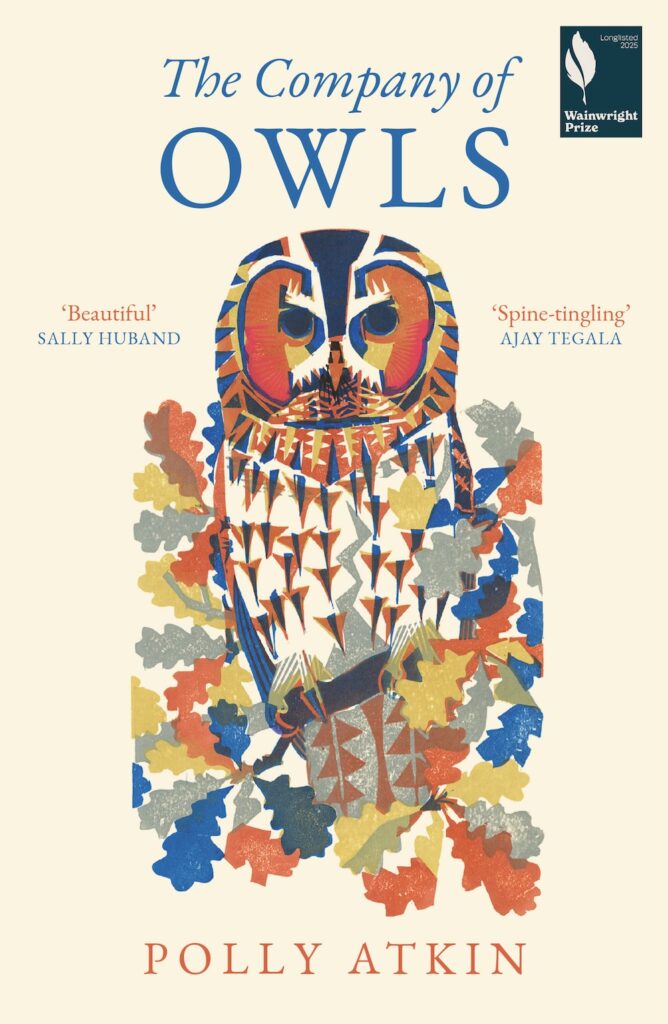
‘The Company of Owls’ was Longlisted for this year’s Wainwright Prize for Nature Writing. It is newly published in paperback by Elliott & Thompson. Buy a copy here (£10.44).