Unfolding over two years in the Bergamasque Alps, the Orobie Biennial allows us to explore the porous boundaries between self and other, human and nature, industry and sustainability, writes Anna Fleming.
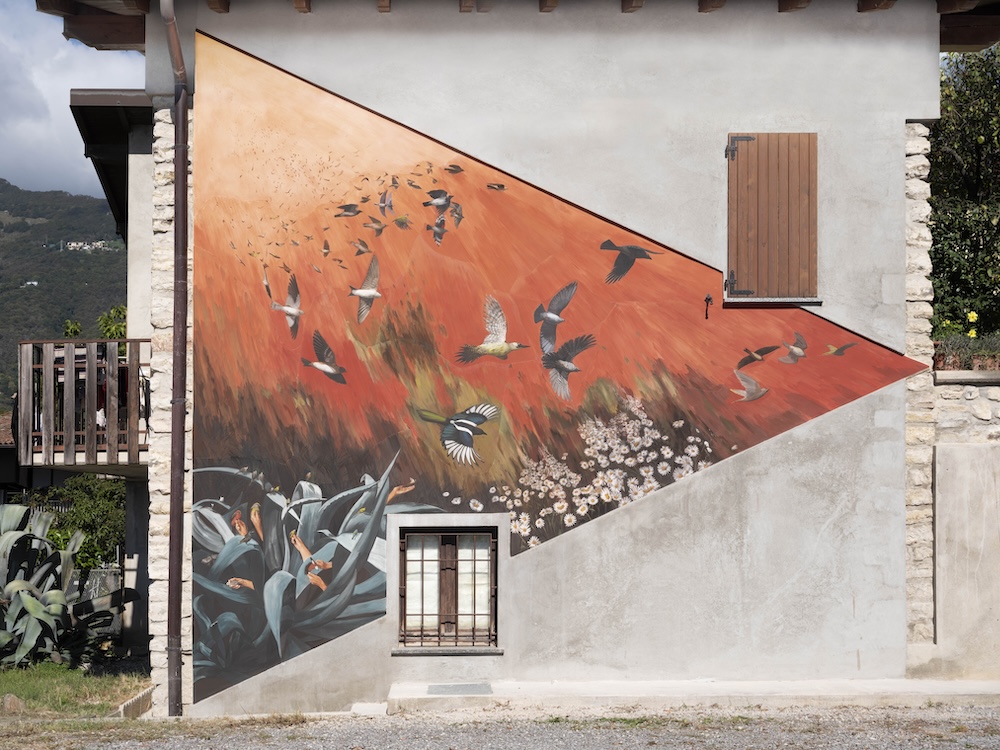
Agnese Galiotto’s ‘La montagna non esiste’, photographed by Nicola Gnesi Studio
What does it mean to think like a mountain? For the last two years, artists and communities have been exploring this question through the Orobie Biennial, by GAMeC – Galleria d’Arte Moderna e Contemporanea di Bergamo. Time is of the essence, stresses artistic director Lorenzo Giusti. Reinventing the usual biennial format (an event held every two years), the Orobie Biennial takes place over two years.
Through this longer durational programme, GAMeC is experimenting with new ways of working post-Covid. Reaching out beyond Bergamo, they are connecting with communities across the industrial valleys and mountain villages of the wider territory – Orobie is a pre-alpine region that centres around the Bergamasque Alps with peaks of up to 3000 metres. For the Orobie Biennial, international artists have been working with communities across the region, and producing artworks sited over a vast area. I was invited along to review the fifth and final cycle of this social, ecological and artistic programme.
The scale soon emerges as we journey out from GAMeC in Bergamo and into the region, driving up valleys that narrow into the mountains, passing through towns and villages on roads that twist, turn and climb steeply. The bus has to make several stops: these are not journeys for those who suffer from travel sickness.
In these valleys, the sublime and picturesque sits beside heavy industry. We pass forests, waterfalls, and beautiful towns and villages with grand Catholic churches. There are also huge factories and quarries where layers of dolomite, limestone and marble are extracted and processed. We drive through San Pellegrino where the water is bottled, shipped and distributed across the world.
Higher up, the industrial towns give way to mountain villages with alpine houses. We travel further up still, a good hour from Bergamo, to reach the first artwork inside Dossena mine, where generations of men and women have extracted fluorite. At 1000 metres altitude, it’s noticeably cooler up here. The leaves are starting to turn, and the air has the sharp tang of autumn. We are given helmets and led into a tunnel.
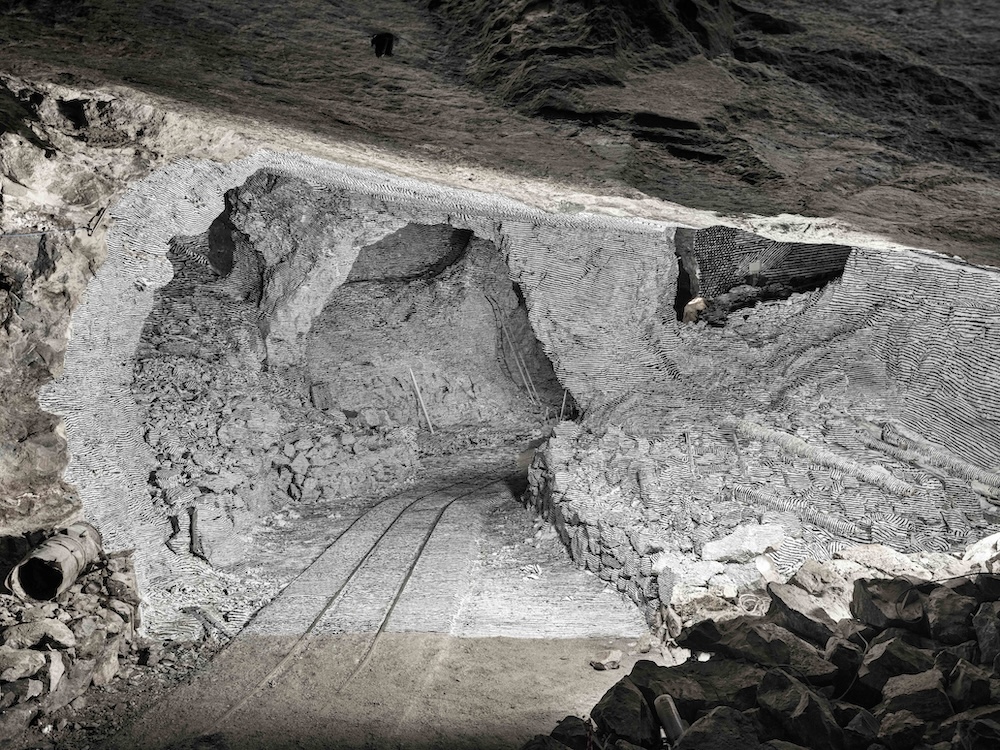
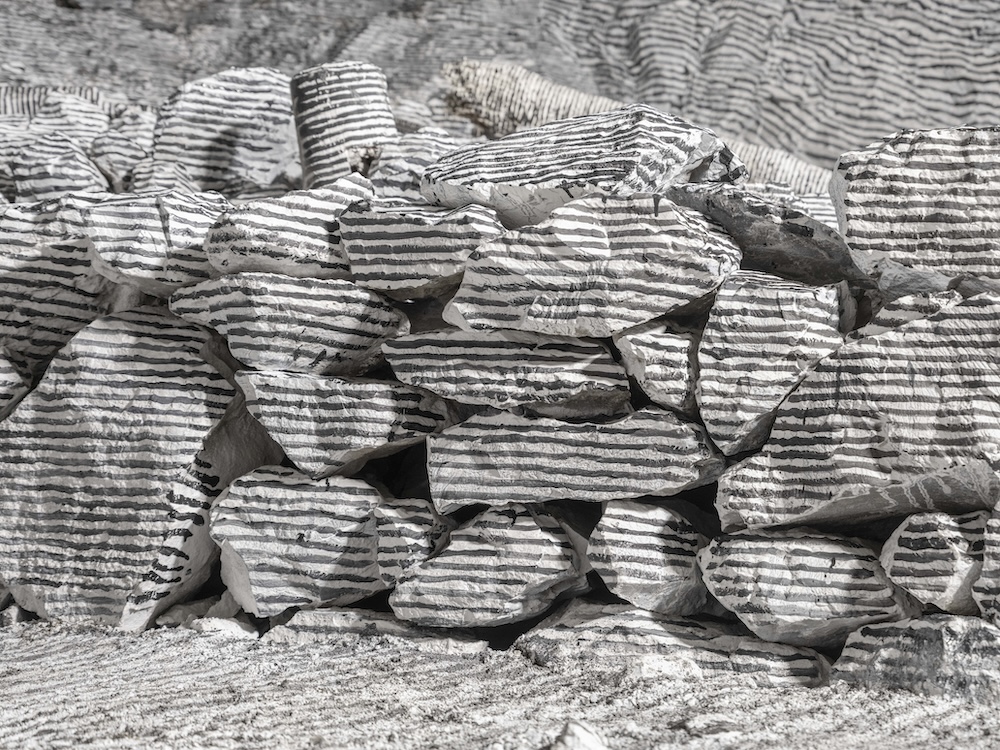
‘Landscape Painting (Mine)’ by Julius von Bismarck, photographed by Nicola Gnesi Studio
We walk down a dark and dank passage inside the mountain, full of shadows from the rough-cut rocks – it’s a sensory and aesthetic experience in itself – and then we meet the artwork. It’s like walking into a hallucination. In Landscape Painting (Mine), Julius von Bismarck takes on the tradition of landscape painting in a direct and subversive manner.
In a section of the tunnel, everything is painted white: from the walls to the floor, the rocks and stones, every rough surface, every aspect, even an old ladder and metal pipework. Black stripes have then been added on top to create an intervention that resembles an engraving. I feel like I’ve entered an illustration of a mine, the dimensions flattened by the striped paintwork; but it’s real – living, breathing and multidimensional. Painting directly onto the landscape, the German artist has gifted the community a thought-provoking comment on the simplification, objectification and ownership of nature.
From Dossena, we drive for another hour or so to Sottochiesa, in Val Taleggio (where the famous cheese comes from), and walk through the village, past the church and down onto a farm track. This valley feels different – more pastoral, with a hidden, enchanting quality. The chestnut and ash trees are starting to turn and, on the edge of the track, light streams into a hay barn. Inside, a giant sculpture kneels in the hay with her arms raised.
The terracotta sculpture is faceless and feminine. Tiny clay children clamber over her shoulders and arms, creating a powerful and uplifting image of care. Mother of Millions was made by Gaia Fugazza who was inspired by the Mexican plant, Kalanchoe daigremontiana, which reproduces asexually, cresting millions of tiny offspring along its leaves.
Fugazza explains that she is interested in alternative models of conception, and she created this figure as a monument to care. (Fugazza is a single mother to two children.) The sculpture’s skin is coloured with impressions from plants and flowers that the artist found on the old transhumance trails of this valley. Drawing in these local influences, she considered the changing nature of this valley, and the porous relationship between self and others.
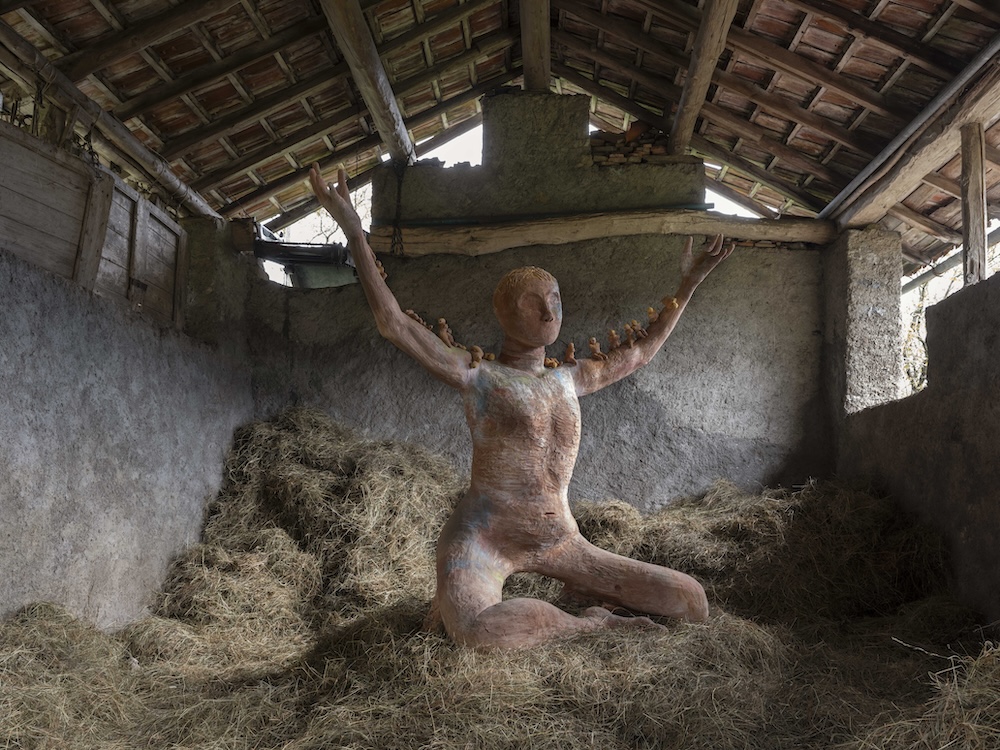
Gaia Fugazza’s ‘Mother of Millions’ photographed by Nicola Gnesi Studio
From one valley to another, we journey around more hair-pin bends and breathtaking views, then climbing to reach the Romanesque church of Santa Maria in Montanis, perched in a commanding position over Val Brembilla. Here, the community have gathered for lunch in the field. There’s ravioli, lentils, polenta, delicious cheeses and hams, and wine. I’m amazed: all ages have turned out for this arts and community festival.
“There’s food,” Guia Cortassa, an Italian reviewer explains to me. “If there’s food,” she says, “the people come.”
The villagers gather expectantly around a table in the centre of the field where an enormous platter of dessert is laid down. The villagers move in closer, hovering beside this untended platter of cannoncini, pasticcini and a huge iced cake, until two women come to serve and everyone piles in, fast.
Guia laughs. “In Italy,” she says, “You must be quick to get dessert.”
Inside the deconsecrated church, seven life-size figures stand in a circle, dancing. We have stumbled upon a forbidden act of human expression – nudity and dancing, inside a hallowed space. This is Bianca Bondi’s artwork, Graces for Gerosa. It is stunning. The art blends into the fabric of the building, the dancers made from white plaster that harmonizes with the plaster on the walls, as though the figures are part of the building. In place of heads, they have vivid bouquets of leaves, flowers and coral. The piece feels both pagan and contemporary.
Bondi explains the figures were cast from members of the local community; their heads removed partly to preserve anonymity. Bondi wanted to reclaim this space and reconsecrate the body by setting the figures dancing in ecstatic celebration, with vivid head-pieces that celebrate life. In a further symbolic gesture, the dancers stand in mounds of salt, the great preservative and purifier.
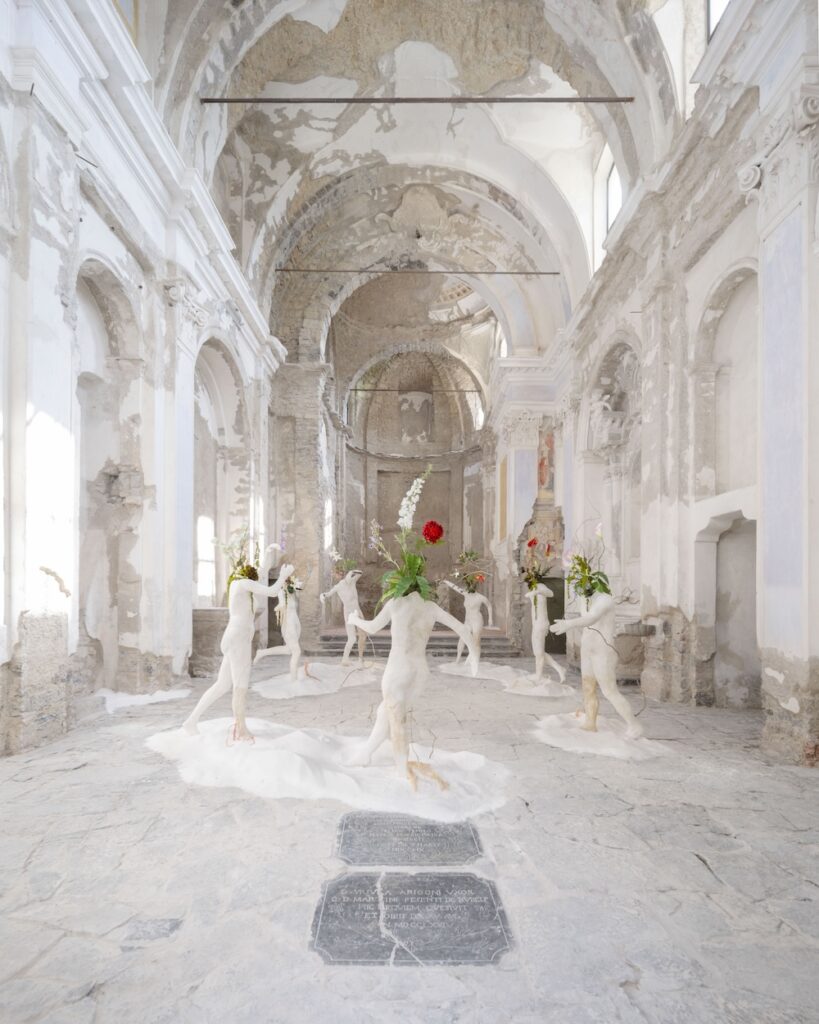
Bianca Bondi’s ‘Graces for Gerosa’ photographed by Nicola Gnesi Studio
Back down on the plain, we visit Dalmine, an industrial town on the fringe of Bergamo where Mexican artist Abraham Cruzvillegas has made a site-specific intervention. His striking ensemble has an absurdly long title, reading like a poem or short story: An unstable and precarious self-portrait munching some traditional Fritos, sipping a couple of caballitos of Casa Dragones, after a busy journey with some dear friends, listening at the same time to the ‘Clair de lune’, performed by Menahem Pressler, and ‘Folie à Deux’, by Stefani Joanne Angelina Germanotta.
Cruzvillegas’s sculpture is made from discarded materials that he acquired through collaboration with local organisations and co-operatives. In the finished piece, three wheelbarrows are held aloft on giant steel poles, painted ultra-matt green and hyper-glossy pink. The sculpture could be a surrealist flag or totem pole; the wheelbarrows gesturing to both industrial and agricultural labour and the overlapping of these realms.
We arrive as sound artist, Dudù Kouate, is playing the sculpture. With animal sounds, wheelbarrows and other everyday objects, Kouate builds upon Cruzvillegas’s work, adding further experimental dimensions to the wider exploration. Kouate’s performance heightens my awareness of the role of error, collaboration, found objects, improvisation, participation, and the unforeseen in this work; a piece that plays on our too-often separated conceptions of ‘industry’ and ‘environment’.
Back in GAMeC, we visit TEN, a retrospective exhibition of the extraordinary Atelier dell’Errore, an Italian collective of 12 neurodivergent artists. Atelier dell’Errore began life in 2002, as a visual arts workshop for neurodivergent children, led by artist Luca Santiago Mora. In 2018, the group entered adulthood and became a professional collective. Their bold, experimental artworks follow two fundamental rules: 1. An animal must be the subject of every artwork; and 2. There are no mistakes. In Atelier dell’Errore, nothing is ever erased – it can only be developed. The resultant artwork is incredible.
There’s a series on the seven deadly sins, rendered through precise pencil line drawings that gleam off dark paper. Large-scale canvases take over huge walls, the paintings depicting enormous gold-leaf creatures, idols and medusas. The fantastical creatures are created with the utmost detail; the collective blending mythology with metamorphosis to produce Kafka-esque visions of life, re-imagined.
The following day we travel up the mountain to see an installation in an extremely remote location, where design company Studio EX, working in collaboration with GAMeC and the Italian Alpine Club, have reconstructed the historic Bivacco Aldo Frattini. The new bivouac is perched on a ridge-line at 2,300 metres altitude.
Across the Alps, shelters are often designed to give the ‘wow’ factor. Studio EX resisted this approach, wanting to design something that would draw people into the spirit of the mountain, rather than producing another statement of humanity’s prowess. The designers used light materials, for a light touch emergency shelter. Five beds hang from the walls; light comes in from a ceiling window and, insulated with cork, the bivouac muffles sound, offering a distinctive sensory experience. This is simple space for rest and protection on the mountain, offering a unique aesthetic experience. The new Frattini bivouac will remain in place for decades to come. It will serve as GAMeC’s high-altitude base: not a space for exhibitions, but rather, a place where people can connect with the higher mountain world.
Through an extraordinary range of artworks, the Orobie Biennial travels across the region, taking international art out of the gallery and into diverse communities at all altitudes. Some, like Agnese Galiotto’s fresco La montagna non esiste, met resistance and had to be relocated to a more amenable community. Others, like Maurice Cattellan’s Seasons, intentionally court controversy. The engaging programme of sculpture, performance, installation and visual art investigates people’s relationships with place, allowing us to explore the porous boundaries between self and other, human and nature, industry and sustainability, as well as our past and possible futures, collapsing all of these categories so that we can attempt to think across times, cultures, communities and species. Unlike the single event format of the traditional biennial, Orobie Biennial is long-term and vastly expansive in approach. This is urgent, experimental art for changing times. The result is a journey, inviting all of us to think like a mountain.
*
Thinking like a Mountain: The Orobie Biennial runs until 18th January 2026.