A collaboration between Little Toller, architecture collective Assemble and the arts organisation Common Ground, and written by a diverse group of farmers, foresters, smallholders, campaigners, academics, consultants and writers, ‘Common Treasures’ Vols. 1 & 2 offer an alternative perspective on the future of the countryside, writes Jennifer Edgecombe.
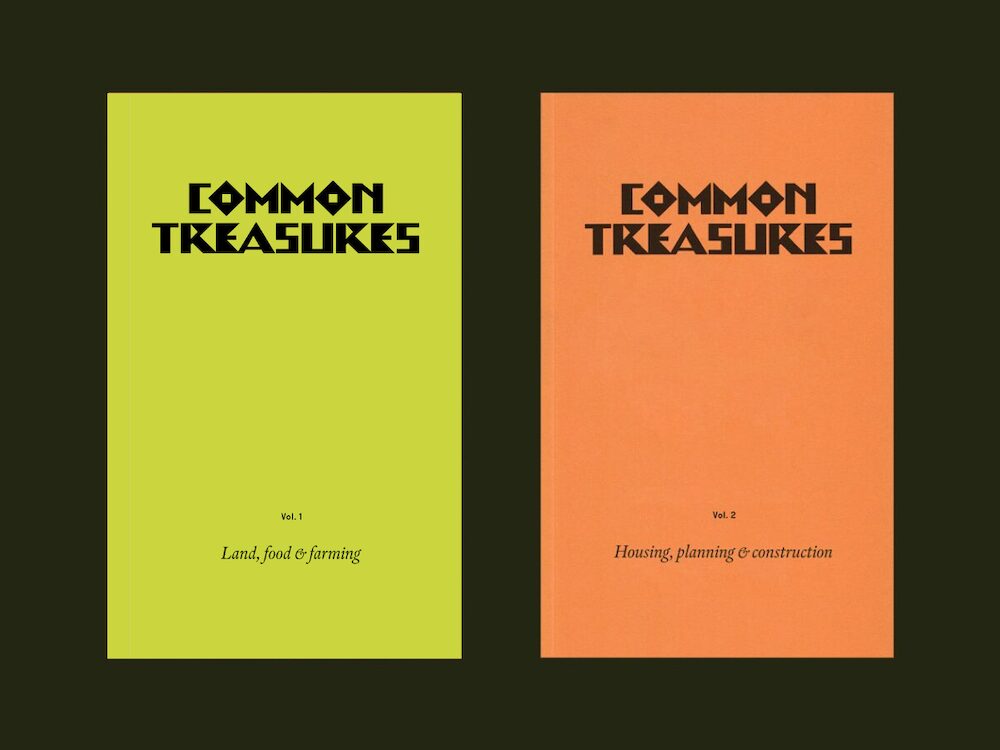
Common Treasures Vol. 1 and Vol. 2 consist of essays on rural land use, housing and the future of the countryside, each offering an alternative to the prevailing political discourse and written by a diverse group of people ‘working on the ground and in the fields’ – farmers, foresters, smallholders, campaigners, academics of biology or planning, consultants, writers, and so forth. As the construction industry in the UK is ‘directly responsible for 25 per cent of national carbon emissions’, and the topic of housebuilding is currently so contentious, it is no surprise that housing – where it should go, how it should go – is an underlying theme of these two volumes.
The contributors argue for a more ecologically-conscious, holistic housing movement – everything from the adoption of more environmentally-friendly construction materials through to the renunciation of living in a built environment altogether. Writing from Tinkers’ Bubble, an off-grid woodland community in the South West of England, artist Megan Willoughby presents us with a visionary way to live that spurns the modern conception of dwelling places:
Life here has peeled back the layers I have accumulated over the years living in the engineered safety of a warm, convenient, fossil-fuel-enabled life.
Walls made from cob; for firewood, horse-powered woodland management; a solitary cow (in this case, ‘Daisy’) slaughtered each year. And although the group is sustained through the reaping of these natural resources, Megan and her community humbly repay this debt through work, toil, local outreach – and respect. To acknowledge the loss of nature to human hand is critical: ‘We should feel the grief, and the gratitude.’
Is there a middle ground, between the eco-ideal of Tinkers’ Bubble and the modern housing estate, a way to mitigate the impact of what the majority of people would prefer? Summer Islam – an architect interested in challenging the way the housing industry operates – considers the use of biomaterials in construction a positive way to lessen the environmental impact of development. Straw, for example, can be grown in the UK through regenerative agriculture, creating new and sustainable biobased supply chains, with the added bonus of supporting the agricultural sector. Modern processing methods can turn straw into a highly effective ‘low cost’ and ‘abundant’ housebuilding material, one proven to be a ‘brilliant insulator’.
However, Barbara Jones, the UK’s foremost expert in straw-bale construction, is ‘close to despair’ at the widespread resistance to change within the construction industry: ‘the developers have local authorities over a barrel’. Until there is a ‘national-level policy change’, people will not be ready to take seriously the use of straw, or similar materials, for building: ‘The people who want to build with straw are not the people who are actually able to build homes under our current system.’
Realistically of course, most people would prefer the new estates. But due to cost and time pressures, they are often ill-designed and not in keeping with their environment. Hana Loftus – a chartered planner specialising in rural planning and community development – suggests that the poor quality of newbuilds, ‘built to the same space standards as a flat in an inner city’, do not deter buyers, many of whom are ‘desperate for an affordable home close to family and friends’. And when developments encroach on a much-loved field or village green, the well-meaning local community often attempt to fight or change the development, not only to protect their cherished countryside from homes designed ‘from the pattern books used by developers up and down the country’, but also from the potentially devastating ecological consequences that may follow.
Given the current environmental crisis, no wonder NIMBYism arises, Loftus suggests. But her essay raises an important question: what kind of communities are developers encouraging by building these ‘ugly’ and ‘banal’ estates? To take a stand against others who also aspire to realise their own rural dream is, she argues, ‘deeply hypocritical if they seek to deny the same choice to others’.
A community can also enact positive change upon the land. When Charlotte Hollins began a campaign to save her family farm from eviction, she set up a charitable agricultural tenancy for interested parties to become financial investors. When the initial investment support was spearheaded by her local community, she realised just how important the land felt to it, and how willing people were to reframe their concept of use and ownership:
The conversations at that meeting made it clear just how many people were hungry for a new relationship to the land – one rooted not in ownership and control but in care, community, and stewardship.
Charlotte’s farm now employs one hundred local people, has onsite glamping, a farm shop and a café, and hosts school visits. This symbiotic relationship between those caring for the land and those working it bears a resemblance to the ‘grief toll’ at Tinkers’ Bubble – Willoughby’s coinage for the continual appreciation of the natural world and a deep awareness of the trade-offs required. It means the farm is able to continue the organic farming practice adopted by her father: the foggage system – a traditional method which is ‘nurturing the worms, providing homes for the birds, and creating a place where over 70 different plants and grasses can nourish our livestock.’
Hollins outlines her involvement in a campaign to introduce a ‘Community Power Act’ in England, the aim of which summarises the path she, Willoughby, Islam and Jones think is necessary – ‘to fundamentally shift the balance of power so that communities can have more influence over what happens to the land and places where they live’. But with greater influence would come the need for caution, as no decision that alters land is without consequence. Instead of a one-size-fits-all approach, the essays within Common Treasures are effective in putting forward for our consideration a wide range of responses to housebuilding. The stakes are high, as Jez Ralph – a forester working in an industry that must plan for fifty to a hundred years’ hence – warns when considering the monocultural woodland plantations of the past. After all, ‘those who went before us were absolutely sure they were doing the right thing’.
*
‘Common Treasures’ Vols. 1 & 2 are both available in the Rivertones Bandcamp shop (£15). Read an extract from Megan Willoughby’s contribution here.
Jennifer Edgecombe’s poems have appeared in Ambit, Magma, New Poetries VIII, PN Review, The Spectator and Wild Court. Her pamphlet, The Grief of the Sea, was published by Broken Sleep Books. She is currently working on a narrative non-fiction book about the redevelopment of agricultural land. Visit her website here.