Untamed and gorgeous, autumn arrives on Annie Worsley and Kirsteen Bell’s respective crofts — bringing with it ravens, comets & ghosts.
Dear Annie,
I thought of you tonight, north of us as you are, and wondered if you have been seeing the aurora in your skies? The boys and I stood out watching a faint smirr of light over the north-west hills, our eyes slowly adjusting to the stars through the shadowed dance of na fir chlis, the nimble men. Night brings life to the Gaelic name for October too, Am Damhair, the rutting time. The cool silk of northern air carries the stags’ bellows, their strength roaring in echoes from all airts.
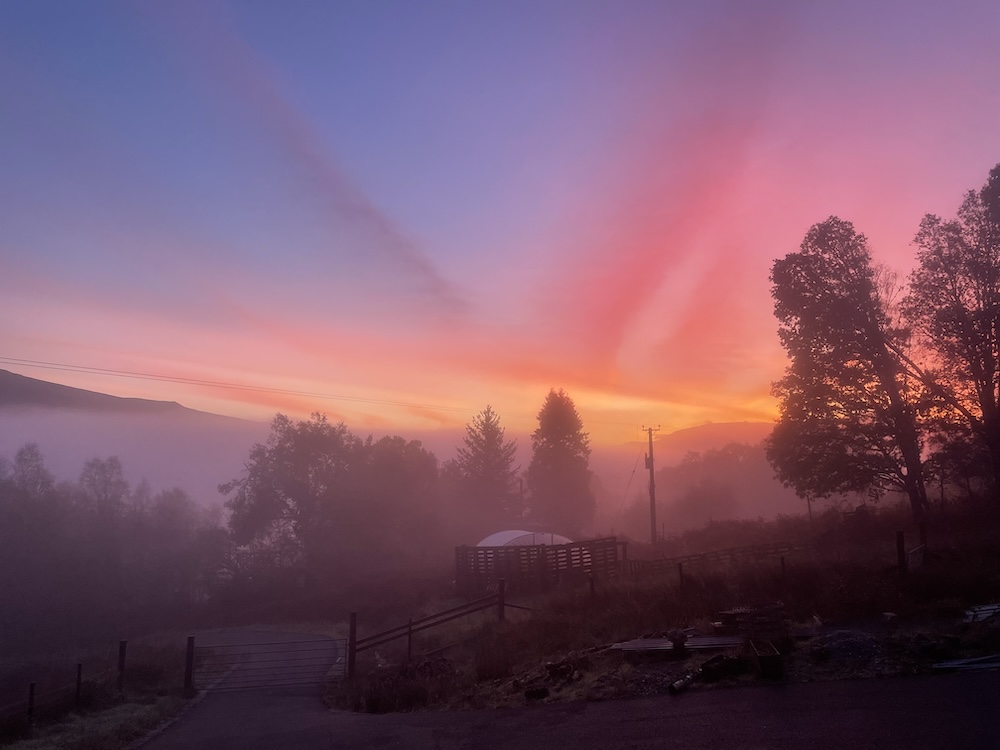
Mornings are softened with their own kind of autumn glamourie, the woods around the house half-hidden in mist and pearlescent light. Dew clings to gossamer webs strung in cities through bronzed fern and rush, and the lanky birch trees flicker with dark wings. You would not believe the noise and volume of the ravens, Annie. They are young I think, juveniles gathering into flocks ahead of winter. Every open window lets in their rowdy clamour, and even quiet in the woods you can hear them speaking in plinking tones, like water chiming into a well.
One in particular likes the oak in front of the house. They glide daily down into its easternmost edge and pick their way westward through the lichen-strewn branches. In summer I see only glimpses of shadow, but as the tree lets its leaves go one by one, it reveals the raven’s path.
I love the release, the clearing of the year’s activity. This settling closer into the bones of the earth that is a precursor to the clean slate of winter.
On a practical level, it has allowed us to measure our boundaries for croft registration. You would have laughed though at the pair of us shouting to each other from either end of a long line of measuring tape, trying to measure as the crow flies across ground that lifts and tips and rolls in all directions. The boundaries we’re recording were set out at the croft’s creation, sometime in the 1700s. Marked today by the same drystane dykes that were built then, their grey stone is mottled and patched where it reemerges from wilting turf. They’re easier for us to see and follow now that the heavy growth of summer is gone.
Have you had to register the croft, or was it done during your succession to the land? It wasn’t needed when the croft was passed to L from his father, or when we built the house. As you likely know, since 2012 the Crofting Commission require a croft to be registered before you can apply for any of the rural agricultural grant schemes, hence our motivation. Up to now, we’ve managed to contain the pigs with pallets and what’s left of the post and wire fencing, but it’s such a stress when they get big enough to shunt the pallets around. They push easily at our makeshift boundaries to reach fresher grass. So, until we sort out better fencing there are no pigs. And we can’t afford better fencing without a grant, so we must jump through the registration hoop.
Walking below the older oaks this month, I wish we had done it all sooner. The acorns underfoot have fallen in layers so thick it feels like walking on shingle. If the pigs were still here, they’d have turned the earth skyward rooting out every round brown nut.
While all else is creeping earthwards, the polytunnel is overrun like sleeping beauty’s castle. Nasturtium vines twist around the old camping chair I left in the open door to deter the deer, grown from the wee baubles cast by last year’s flowers. At the other end of the tunnel, a make-shift chicken wire gate has fallen, held up only by the collapsed archway of fence wire that once hosted cucumbers. Empty hanging baskets are pushed aside by bracken that sneaks its rhizomes underneath the frame, still strong and green inside the tunnel where everywhere outside it has bowed to the weight of autumn.
At first glance I feel the usual guilty pang of failure, my inability to work this earth as productively as others might. I have to remind myself that doing something slowly and taking time to learn is just fine. In the early years I learned the hard way that forging on without attending to the actions of the soil and the voices of my predecessors and peers is its own kind of neglect.
And the slow listening is working. I have been referring of late to Crofting Agriculture – Its Practice in the West Highlands and Islands, recommended by an older crofter down the lochside. The author, ecologist Frank Fraser Darling, travelled across post-war Highlands, documenting crofting practices just when the world was on the cusp of new industry. One small note records the ease with which kale grows. Sure enough, succulent purple-tinged leaves curl out from under long suckers from the raspberries. Like the nasturtiums, all this growth is self-seeded from previous years’ work. Questions I unwittingly posed to the soil are now being answered.
I find an empty plant pot to gather the raspberries in, the softer ones dropping into the dirt before I can catch them. I can’t help but imagine a faint hint of disapproval from the ghost of previous crofters’ memory, but I leave them all the same.
How has autumn been on Red River Croft? I want to quote the ubiquitous George Elliot quote at you, you know the one – ‘Delicious autumn! My very soul is wedded to it, and if I were a bird I would fly about the earth seeking the successive autumns.’ – just to say I wish I could fly north to see yours.
With love,
Kx
*
Dear Kirsteen,
I came home to your lovely letter from the Isle of Harris, my head filled with ancient standing stones, wild Atlantic beaches and wilder ideas about this and that. Your words grounded me. The tail end of Storm Amy riddled our wee holiday with windy grey days but fabulous wave watching. Only once were the hills of Harris clear-headed and bright.
Back home our skies have been mostly thick with cloud but I’m hopeful of seeing the Milky Way and if not the Northern Lights, then perhaps a comet or two, heading who knows where. There’s one currently near the Plough. Its name (Comet Lemmon C/22025 A6) strikes me as reductive. Science often strangles objects of difference and strange beauty with numbers and acronyms but, weather permitting, I’ll be looking up with wonderment.
So, when nights are cloud free, our sky is vast – a huge upturned bowl with a solid ancient rock rim, a continuous 3600 undulating horizon made from this wide-open landscape of mountains and islands. The firmament seems close enough to touch. I want to converse with the universe. The cosmos is the reality, not soil or rock or fields. I hold onto an old wooden post as Planet Earth seems to slip away. The reverie is only broken by the scent of peat, its mosses and rich wet depths, or intense cold.
Yes, Red River Croft was already registered when we arrived. Each year I grumpily complete all the necessary form-filling, censuses and so on but there are crofts whose owners live far beyond the requisite 32km with few repercussions for failures to comply or manage their land appropriately. Crofting is coming to a critical point, I think. Does the Scottish government, do we want to maintain crofting and this form of land management, or not? The break-up of crofts with parcels sold off for profit and more second homes present many challenges to the local communities. One thing I do know – traditional crofting can be good for the land. It can help biodiversity, soil development, carbon storage. It’s an important part of a unique cultural landscape. We risk losing all of this unless some form of legal protection or financial help is provided.
I loved reading about the plans for your croft, about oak trees and pigs. We ‘borrowed’ our neighbour’s pigs for a few years to clear patches of old rushes and tough tussock grasses. They did a good job, especially in the early days of meadow restoration. There had also been an infestation of New Zealand flatworms (from historical planting of non-native shrubs) but the pigs got rid of them. Now there are native earth worms in every corner of the croft.
And ravens, with their night-dark feathers; we see them too, flying from hills and crags, passing above us on their business, their raucous ‘kronking’ carried on the winds, bouncing off the rocks. Our small peninsula of crofting townships and wild hill country is called ‘Overside’ by the good folk of Gairloch village, and ravens are often seen flying from here to there across the wide sea-loch. Off to do their messages.
I think about our tiny oaks and wonder what will have happened to this place, to my family and the wider world by the time they are mature. (How old are your oak trees? Perhaps more than 30 years if producing acorns? ‘Veterans’ if they’re 150.) One thing is certain, R and I will never see ours bear cnò daraich, let alone witness a mast year here, but in my dreaming mind’s eye their future is magnificent. They sway in winter winds, lift their branches to summer sunshine and carpet autumn floors with acorns.
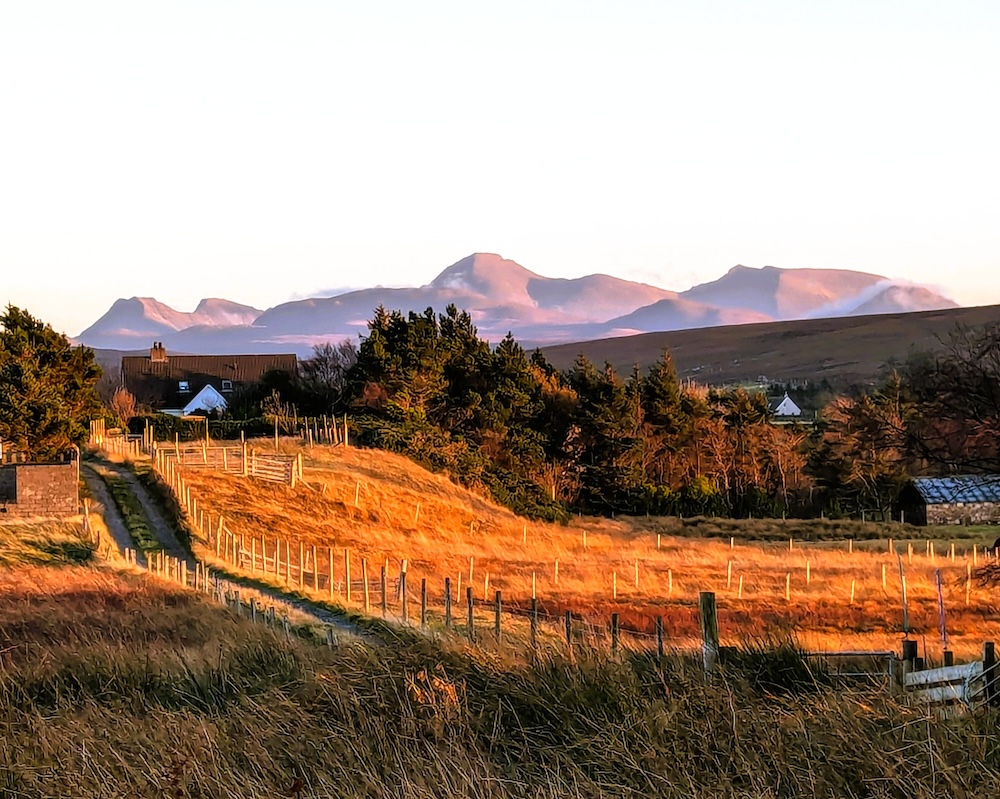
We are surrounded by raised mires and hills covered with blanket bog. Now, they are vividly ochre and amber, with areas as burnished as new copper piping, others as dark as rusting iron. In the setting sun hillsides are the colour of brandy snap biscuits; light plays across the rippled edges of old peat cuttings; bog pools are fragments of broken mirror – blue here, white there, black under the crested overhangs of heather. And down on the shore, autumn has heaped colour in great seaweed tangles of different species, some lava-red or pumpkin-orange, others as pale as cream.
I love this untamed country in autumn. The similarities in hue and chroma across the varied wilder habitats and landscapes is riotous and joyous and spirit-lifting.
In contrast to coast to coast and hill, much of the croft now looks like a crumpled chenille bedspread washed a thousand times. At the fraying edges the sheer diversity of grass and wildflower species is still visible in an astounding array of botanical architecture. Their seeds have long since dropped but as any remaining stems and crowns crumple and pale, the shrink-wrap effect of decomposing plant life and the emergence of shapes and forms temporarily lost under summer abundances, reveal the ghosts of this place. They wander about when dawn comes with a blaze of light or dusk falls in a silver veil.
There are deep time ghosts too, memories not only of people long gone but ancient life forms and geologies. And we breathe everything in – fungal spores, dust particles, viruses – to be stored in our cells stashed among mitochondria, to label our DNA in ghostly connections to the remote past and as drafts for the future.
On our crofts, every footstep, every dig of spade, rebuilt wall, seed scattered or sapling planted adds to the landscape – palimpsests of our lives in tandem with those of landforms, soil and biomass. One day we will become stories too. Future histories.
Ah Kirsteen, this autumn is one more in a long line of seasons added to my aging bones. I dream about our nursery woodlands, the small yet strong oaks planted in drifts with other native species, the forests of distant futures. Then I think about all the years to come before they reach maturity and wonder how many autumns are left before I become a ghost who walks among the trees.
With love,
Annie x
*
Kirsteen Bell is a Scottish writer of narrative non-fiction and sometimes poetry. All her words are gathered from the croft in Lochaber where she lives, and the surrounding Scottish Highlands. Her writing and reviews can be found in such places as Paperboats, Caught by the River, The Guardian Country Diary, The Lochaber Times, and Northern Scotland Journal. Kirsteen can also be found at Moniack Mhor, Scotland’s Creative Writing Centre, where she is Projects Manager and Highland Book Prize Co-ordinator.
Annie Worsley is a writer, crofter, grandmother and geographer with an enduring love of the Scottish Highlands. In 2013 she and her husband moved to the crofting township of South Erradale near Gairloch. While her husband was a community pharmacist, Annie worked on Red River Croft. She began a blog about life on the croft and then wrote essays on nature and environment for various publications including Elementum Journal, Women on Nature, the Seasons’ Anthologies edited by Melissa Harrison, Caught by the River and Inkcap Journal. Her first book about life on Red River Croft and the natural history of Wester Ross, ‘Windswept: Life, Nature and Deep Time in the Scottish Highlands’, was published by William Collins in 2023, and is out now in paperback.