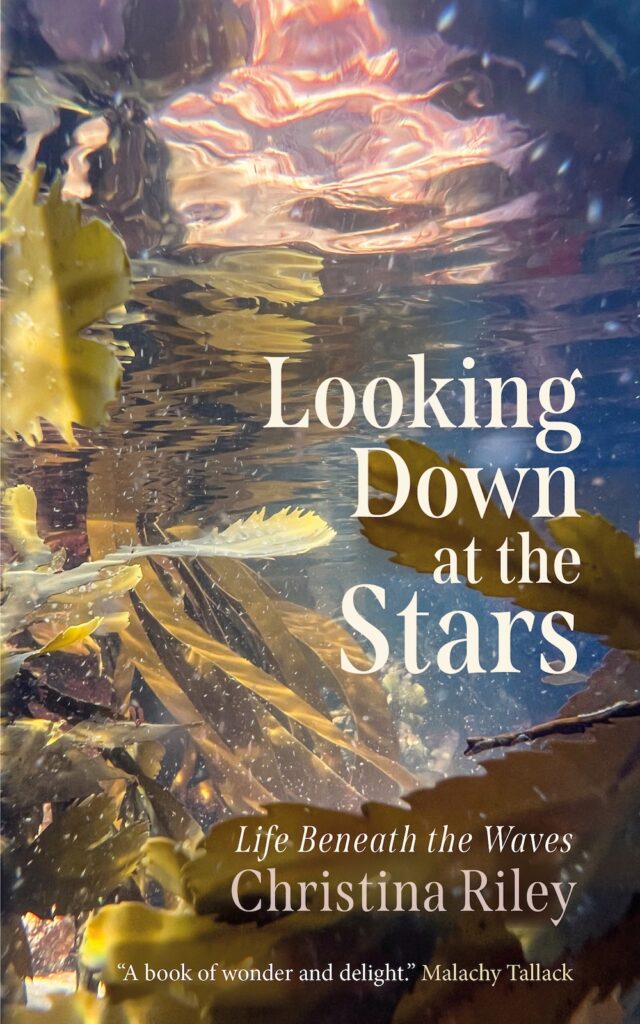
Christina Riley’s ‘Looking Down at the Stars: Life Beneath the Waves’, published today by Saraband, is our November Book of the Month. In an extract from the book’s introduction, Christina finds in beach detritus the fragments of stories waiting to be told.
Initially, all I can do is stand and stare. Where land plays with being sea, the breeze blows onto the shore from the open ocean and cools any skin left bare to it. With each inhale it swirls down into my chest and becomes breath, bringing my body back to its oceanic past. Loose sand tumbles back and forth, gathering up fragments of life beneath gigantic skies of shifting colour cascading over the horizon, ever unpredictable and impermanent. On the beach, the push and pull between the vast and minute is constant, making every glance inimitable.
Each second, I witness the way the sunlight flickers on a particular wave, from a particular angle, and by the time the wave has been witnessed it becomes a memory; no one has ever looked at the sea the same way twice. Similarly, to pick up a stone or shell while walking on the beach is to mark that walk with a significance it might not have held otherwise and cannot hold for anyone else. Even if another person walked on that same beach, on that same day, their eyes may have been pulled by a fleeing oystercatcher, or discarded aquamarine fishing rope, while mine were drawn down to this particular shell. This one of many. This one like no other.
There’s a romantic idea of letting the sea happen to you. The coast is a place where so many of us go to let out a sigh of relief; to feel a passive acceptance, a collective letting go. In its presence, the sea hands us a gift. Maybe that gift is clarity, or perspective, or beauty. Maybe its vastness opens up the world to let more light in. Maybe the gift is knowledge. A soothing sound, or a kind of silence. A deeper breath. But to expect it to provide at my will is senseless. The gift is a concept of my own creation and has nothing to do with the sea. It is so unspeakably deep, so constantly in motion, and so filled with complex life. It is not here for me, and it is surely impossible for any of us to ever understand it fully.
My romantic image of the coast might conjure this: I am looking out from miles and miles of marvelous white sands flicked by cresting waves, glassy green and blue and backlit by the sun, impossibly quiet but for the champagne fizz of their falling upon the shore, the plop of a gull landing in the shallows echoing out into the endless sky. My bare feet sink into soft sand that is like caster sugar melting in the warm shallows. I lick my lips and taste the salt in the air, drying onto the fine hairs; if I could look at them closely enough, I bet they’d be sparkling. In this vision, I’m the only person to be seen for miles.
But in reality, even in the rare case of being the only person on the beach, there are always clues of past visitors. Bottle caps, a single sock, a fading Mars wrapper, charred remains of a bonfire, a pearlescent balloon string, disposable vapes, a tennis ball, several golf balls, the tyre marks of a seaweed scooping tractor, a footprint. The sand, here in Scotland, will probably be cold, and very likely blowing into my eyes. The sparkles along the strandline are chocolate bar wrappers and crisp packets, the fizz coming from an empty can of Tennent’s crushed into the fetal position. But if what I see isn’t classically romantic, it’s still a picture of beauty, and still one of hope. It offers those first pangs of would-be love; the presentation and pursuit of desire, and the hunger to know everything about a person, or a place. Looking down instead of out, beach objects in the sand begin to read like words on a page, fragments of stories ready to be pieced together. A page-turner, every step piques the interest and offers something new.
I pick up an empty shell and look into its hollows, a tiny cavern that once held the animal who built it, while the calcareous carvings on its surface tell tales of creatures who moved in later, barnacles and herbit crabs. If a romantic view is one that is often, forgivably, blinded by optimism, then perhaps to be hopeful is closer to the act of love.
*
‘Looking Down at the Stars: Life Beneath the Waves’ is out now and available here (£12.34).