Annie Worsley looks back over a year of nurturing child and croft.

Notes from a Grandmother’s Diary, 2025
January
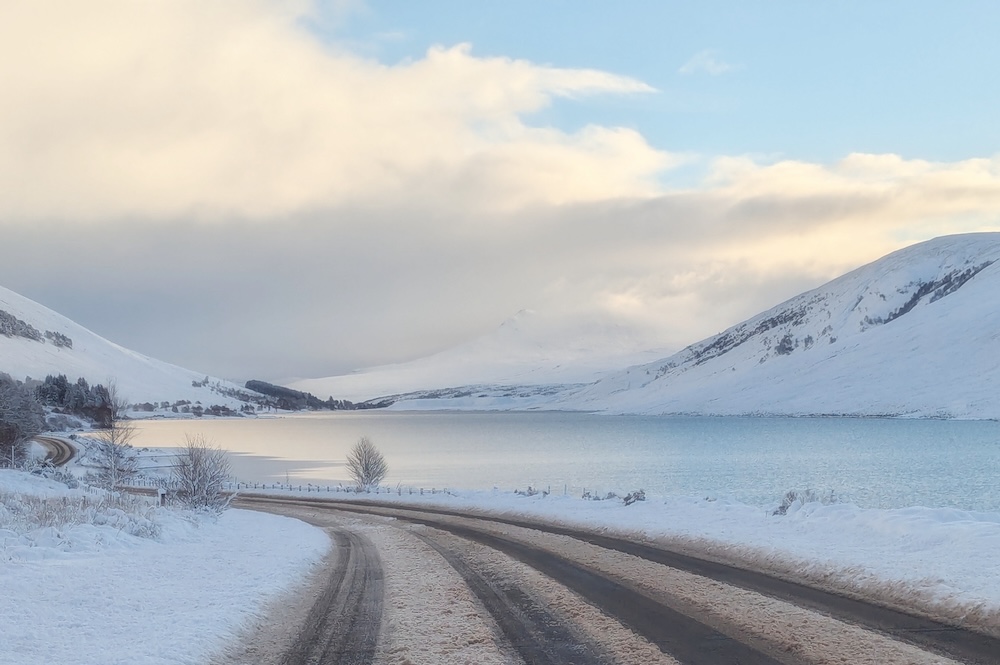
I travel home to deep bone-breaking freeze and deep bone-breaking heartache. My friend has died. Her funeral is drenched in cold. Everyone wears traditional black and something bright red – my friend’s favourite colour. Both colours are harsh against deep white snow. For a few days, solace comes from mountains of palest pink and lavender, luminous ghostly outlines above peach mist and lochs of frosted glass. Then, after one blood red crimson dawn, the snow vanishes. I think of my friend and watch waves surge between 2-billion-year-old rocks and wish we could do the same. Surge, recover, surge. Huge lichens, some the size of dinner plates, glow in the winter light, revitalised by frost and burial under snow. A high-sky brash blue morning lights up my end-of-the-month birthday. The air is utterly still. At low tide the beach is a mirror. I could step into a parallel universe through this sand-water portal.
February
The position of sunrise has moved. Spangles of light spear the bedroom wall. There are charcoal shadow-trees, and yellow pennies. Once the dawn finds its way in, I know spring is coming. Wicked cold returns. The beach freezes. Huge crystals and patterned ice sit between concrete-hard ripples of sand. A starfish is a comet with a trail of sand grains – each rimed with tiny shards of ice. In the mountains I find icicles as long as my legs and watch ducks slither on a frozen loch. I receive hand-written letters from America, emails from the Netherlands, Australia. I wonder what has prompted these people to write to me. The bog is frozen. Crispy crowns of Sphagnum shine – orange, crimson, purple, lime green. Our winter valley is empty. I love the quiet. I miss but anticipate the decadence of birdsong.

March
Clear night skies are lit by fluorescence and shimmering colours. I think about the bioluminescence of deep ocean life. Looking up feels like gazing down. We drive south. There’s a new baby in the family. Our ninth grandchild and probably the last. I feel the urgent draw of grandmothering. Nothing compares to cradling a new life. We take the older siblings to a park carpeted with crocuses. They climb and run and sing and shout. I feel my age, am exhausted by the exuberance of spring life. Bright light, birdsong and the colourful crocus-carpet energise the children. All our senses are heightened by new arrivals – flowers, baby, nature reborn. At dawn I cradle the sleeping infant, reluctant to put her down. These minutes are so precious. I am undone as Górecki’s Symphony No. 3, Op. 36: II. Lento e Largo Tranquillissimo plays on the radio. This will be my last baby unless I live to see a great-grandchild. Her tiny face is beatific. I can’t stop the tears. Grief for youth and motherhood, four babies in four years, when everything was so tough but utterly beautiful. Time slips through my fingers like sand.
April
Home. We check the young woodlands. The whole valley is a cacophony of sound. New growth, new light, fresh colours. Compensation for saying farewell to the little ones, to family. Nights glitter with stars and ripple with the colours of a pride flag. The daytime sky is a searing, resonating blue. One Tuesday the western horizon is smeared with coral-pink haze. I wonder if I’m seeing the limits of our atmosphere or the effects of dimethylsulfoniopropionate. In his epic works on Gaia, James Lovelock described how DMSP aerosols produced by oceanic life are able to seed cloud. Old otter spraint mounds are bright green with splatters of pink and white. They mean a concerted effort to catch and remove invasive mink has been successful. Along the riverbank, gorse has burst open with hot mustard-yellow blooms. Their scent is tropical and overpowering. A big squall grows over the mountains; a textbook diagram of a thunderstorm dwarfs the mountains, miles high and miles wide. At sunset it’s the colour of a blood orange.

May
Kingcups bloom, almost out-yellowing the gorse. Smaller flowers – milkwort, heath bedstraw, stitchwort – also flourish in bright blue days and gentle breezes. One morning after a pink dawn, we’re enveloped in a sea mist so dense everything disappears. Heat builds, the ground seems to shrink. Our riverside fields remain damp but others grumble about cracked earth and dust-dry soil. Spectacular sunsets come one after another in a parade of reds. We check our young trees again. In “Willow Billow Flood Wood” they’ve grown tall and strong. I love the notion of these ‘baby’ woodlands thriving in tandem with our grandchildren. I’m grandmothering life on the croft. Enormous drifts of cotton grass flower on surrounding hills and blanket bog. As the day ends, they dance in crimson and gold.
June
A change in weather brings the first family visit of summer. Wellies and waterproofs reduce the chill of brisk north-westerly winds. We go to the beach almost every day. Sandcastles are monumental. There’s rock-pooling, paddling and picnicking. Shells, stones and driftwood turn into artworks. The kite flies, a bright red and yellow phoenix against a sapphire sky. The sea turns milky and turquoise. One granddaughter says the whole sea is a single piece of sea glass. I read about algal blooms and ocean temperatures. The seas around Scotland are 20C warmer than average. News items report the beauty of this “summer of summers” but not the disquiet of marine scientists. A nationwide abundance of jellyfish changes the tune. The children do not see our unease. They find an upturned crab shell the same colour as bougainvillea but sleep through a series of livid pink, red and purple sunsets. I temporarily forget about warming oceans because the croft fills with orchids.

July
An early harvest of blackcurrants. Purple treasure. We fill jars with jam, make puddings, eat fresh berries with ice-cream. A single small white orchid appears, followed by six more. Pseudorchis alba, a rare find here. The number of plant species in our meadows has doubled in the last decade. Even among all the other orchids, this slender newcomer, edged with tiny white flowers, is a real prize. Our eldest grandchildren arrive from Paris. They swim and run and play as hard as any toddler. Kayaking, pony riding, board games, adventures in the hills. Their greatest joy is playing with the dog. W is 12, the same age as Dram. W says they’re pack brothers. When he was younger, he told his teacher in Paris he had a dog. My son had to go and explain; W wasn’t telling fibs, ‘his’ dog lived in Scotland. A badger’s pawprint appears in the mud beside our low flowing river. Another first. I wonder where a sett might be; the nearest mature woodland is at least 6 miles away across hill, bog and loch.
August
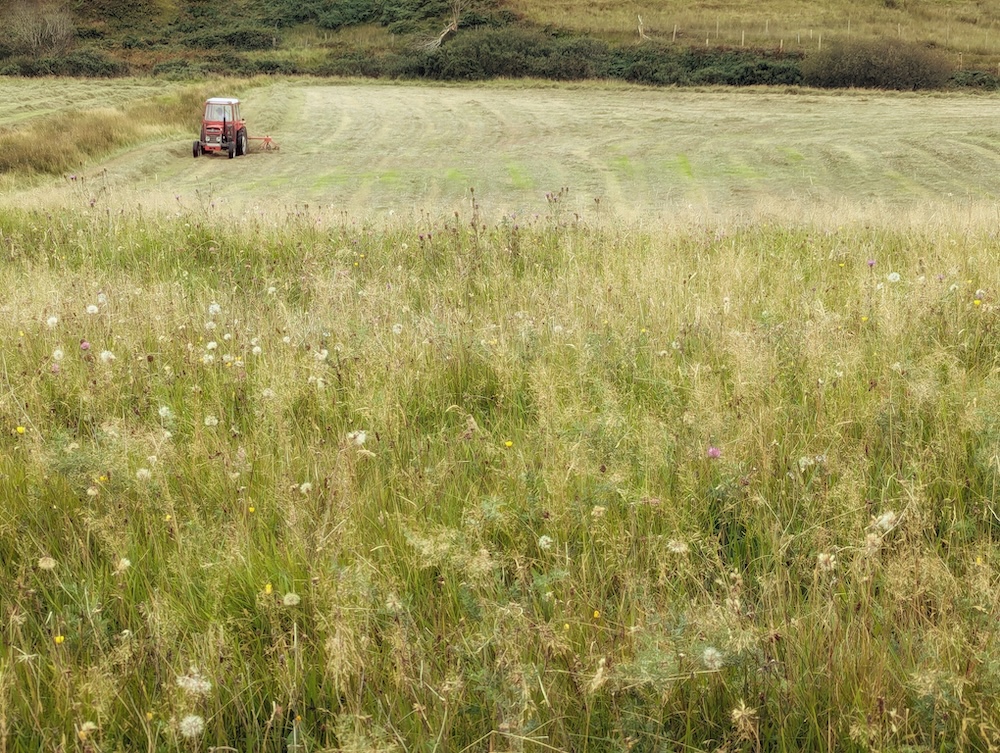
I try to make progress with writing. On our 44th wedding anniversary we drive to Diabeg and enjoy a special lunch at the Gille Brighde. Heather is blooming early and the air tastes of honey. The sequence of flowering which took me a decade to observe and understand, is being upended. Our croft meadows are thigh high, dense with grasses and wildflowers. The weather deteriorates. Storm winds howl, rain pours. Everything is drenched and flattened. R finds a stunned guillemot on the beach standing in a circle of coffee-coloured foam. He drives to Ullapool to deliver the bird into the safe hands of a wildlife expert. R has never met anyone so in love with wild creatures, he says. Another spell of settled summer holiday weather brings the next family troupe. The kite flies again. Sandcastle design is improving – there are bridges and tunnels and moats. Colletes floralis bees flurry in the dunes. Their humming is almost as loud as the children. Our hay meadows are cut three weeks early. Over several days, the children watch crofters and tractors at work, cutting, tedding and baling the sweet riches.
September
A few mornings of sharp showers and rainbows. The last family gang returns south. We’ve used up almost all my crafting supplies. Paper, card, ribbons, tape, glue and paints were used to create houses for mice, tiny books filled with stories of fairies and witches, crowns and pirate hats, chain after chain of paper dolls, flowers and trees, skeletons and ships. I feel like a wrung-out dishcloth but wouldn’t have it any other way. The house is empty of noise and bustle but the handiwork of three months with active little ones hangs from every window and door. For some reason, the fridge is covered with golden hares. Indoors mirrors the messy loveliness outdoors where profusions of late blooming grasses and wildflowers fill ditches, line field margins, cluster on the peats and riverbanks. Some are early summer species reappearing alongside scabious and fading knapweed. The abundance of seed-fall makes me hopeful for the future. Like grandchildren accumulating memories and absorbing knowledge, the croft is storing information for future years in the seed bank of soil.
October
A late harvest of potatoes is a surprise. Neglected over the busy summer, the small plot carried on, responding to the rhythms of soil and season. We bag the potatoes as fast as possible. A big storm delays our holiday to the Outer Hebrides. Eventually we sail and I watch an enormous swell of milky green sea fractured by diving gannets and dolphins. We roam beaches with more photographers than birds, others empty of all but whispers. We visit 5000-year-old standing stones and tiny fragments of crofting townships hidden inside a landscape of boulders and peat. This is a fierce and wildly beautiful place. Prehistory is ancient rock and peat; history is rust and bone. Back home I see the same things. Fenceposts, bleached by a summer of sun, are femurs and tibias; wires are ties holding the body together. Surrounding peatlands are burnished with gold, copper, bronze. So much shiny colour, my eyes ache. Everyone enjoys autumnal woodlands but let me take you to a peat bog in autumn! Samhain is a ‘thin’ time. My grandmother always talked of spirits passing between worlds, through veils thinned by magic. Soon it will be time to tell my grandchildren about ghosts and fairies, about their heritage, losses and all.
November
The weather grasps and tightens. Heavy grey clouds scud in from all compass points. Kelp and bladderwrack pile high in great tangles. Birds gather to pick at the bounty. A white-tailed sea eagle is spotted regularly. Raptors and ravens ply the margins between shore and croft. We sit at the sea-log-seat on Opinan beach and watch a wren flit back and forth to the seaweed. I’ve never seen them there before. Nor have I seen them seek food amongst bladderwrack and mermaid’s tresses. There are more rainbows than hours in a day. Squalls and downpours are interspersed with intense golden light, spells of clear pale blue skies and red-hot sunsets. The Northern lights fold themselves up and unravel like my spools of coloured ribbon in the hands of three-year-olds. I try to photograph the Milky Way and fail. We hang a glorious image of a star-lit Callainish stone circle in the lounge, an anniversary present to ourselves. Snow comes and goes on the summits. Wind direction changes and winter rides in on Arctic air. Then we’re completely swallowed by white, even here, so close to the sea. The sky, in contrast, is a dark Prussian blue.
December
We head south through dark downpours. The grandchildren are filled with Christmas excitement. The volume of life is at maximum. One by one they succumb to a series of viruses. Grandmothering becomes nursing as well as cooking, playing and storytelling. Crimson tinsel draped on pine reminds me of my friend and my mother, both lost at Yuletide. I cuddle the baby. She’s nine months old now and bursting with smiles. I think about life, and how intense joy is so often partnered by profound loss.
*