Gwennie Fraser recalls an autumn day wrapped in gossamer.
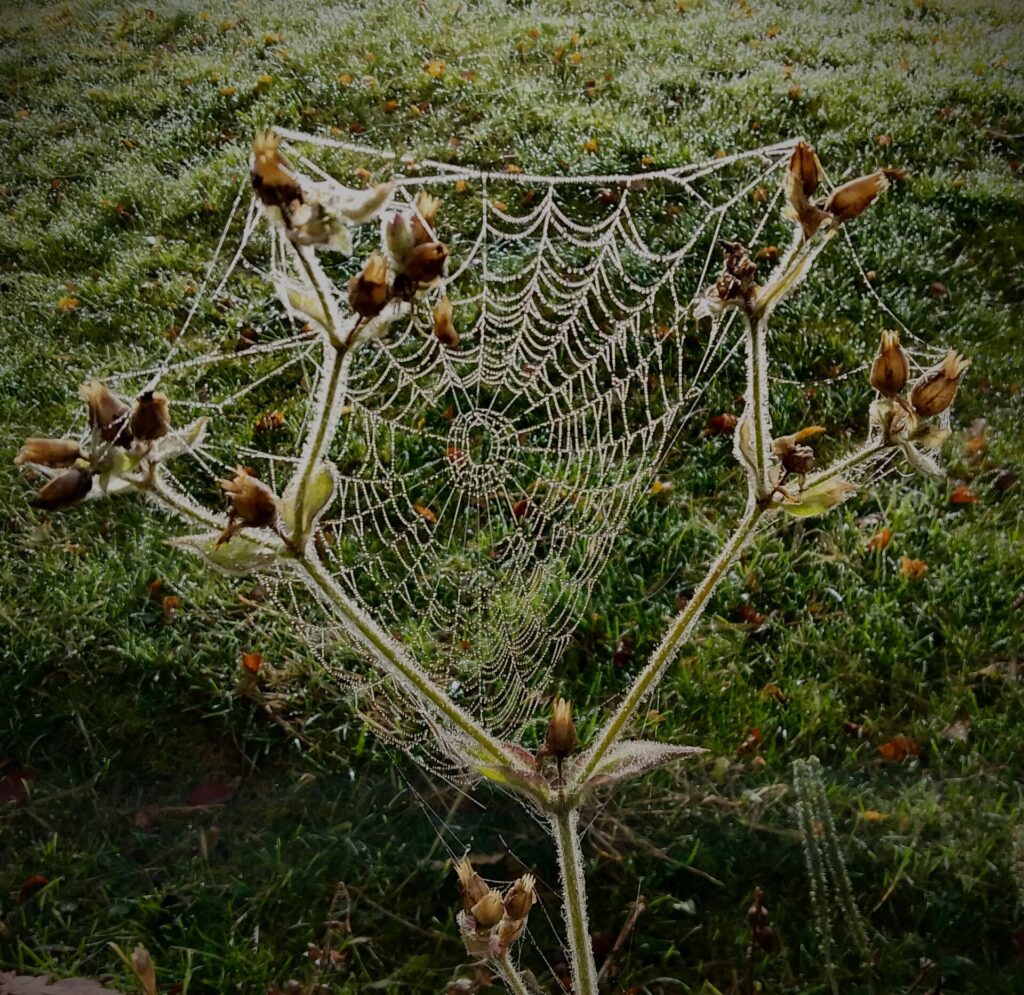
Photo: Simon Fraser
Autumn morning,
Dunterley Fell,
Northumberland.
29th September 2025
The night work has been done. This morning, I have stepped out into a silvered world. There are glistening threads of spider webs everywhere. Strung between each fence post in the garden, the webs hang like a panel of crocheted Remembrance Day poppies, filling the wire mesh with a delicate circuitry and lacing the gaps of every possible structure. Beyond, the field glitters in a shimmering cloud of woven silk.
It’s as if everything has been wrapped in gossamer — a shining parcel secretly delivered into the cold dew of an autumn morning. Fog still hangs over the fields in a thick blanket and trees behind the house loom dimly out of the woods in a soft light, infused with rose petals of a hidden sun.
Walking across the garden, I discover that each windowpane in my studio has also been adorned with a delicately hung spiral, as if these recesses could not possibly be neglected in the thoroughness of such a great endeavour. And so I find myself looking out through this panel of fine thread-work on to the field which has also been strung in its own net of overnight lace, and it feels as if I too am somehow being spun and woven into all this exquisite embroidery.
The webs are beaded with dew, each a work of art, dangling in the tussock. Grasses, bowed by mist, are tethered by billowing lines of silk. Each blade offers itself as a scaffolding for ornamentation. Orb webs hang like baubles between reeds. Hollows in the field are slung with the tissues of sparkling hammocks. All that lies rough and ragged has been made ethereal. Even spent thistle heads stand bejewelled in a new pristine glory.
In the stillness of morning, the field stretches out in a blaze of diaphanous beauty, the activity of countless spiders revealed. Wonders of natural engineering shine droplet by droplet — models of perfect execution, spellbinding in their translucence. I am dazzled by this multitude of glistening wires. My eyes dance in a million reflective pixels, and I feel the field as a wave of light breaking over me.
As I sit looking out, it comes to me that it’s not enough to know that there can be a million or more spiders per hectare in a single field, or that spider silk is the strongest known material made by a living organism, that a single strand is five times stronger than an equivalent strand of steel, or that a Boeing 747 could be stopped in its tracks by a pencil-width strand. Or to interpret what I am seeing as just a passing phenomenon — multitudes of webs that were already there simply made visible due to a combination of mist and fog, low-angled light and the transparent nature of silk.
It’s so much more than this. The field is drenched in wonder this morning. It seems an absolute miracle amidst relentless news of war-torn savagery, daily updates of genocide on our phones, climate collapse and all the deeply toxic divisions, tensions and uncertainties of our times, that it is still possible to walk out into a morning pearled by an incalculable number of small beings. And for a few minutes, to feel liberated and awed by this warp and weft that stretches into every corner of the field in infinite abundance.
The whole spectacle seems both an invitation and a necessity to stop and be still, to step out of the tyranny of the morning “to do” list. Could I dare instead spare a few moments to be immersed in the glorious spangle of this illuminated field and also become backlit, even temporarily, in my own being? I ask myself, why should I be overruled by any other urgency, if witnessing something as vital and transient as this can also be such a precious part of being alive? Why would I not allow time to pause and admire these works of art that have been hung throughout my garden, there to be gazed at and wondered upon, as if I were strolling at leisure in any other art gallery, dawdling and pondering and peering more closely, bathing in the wonder of creativity that is untethered from time, letting imagination be in freefall, soaking up the grace of possibility to pause, step back and contemplate the beauty, elasticity and tensile strength of spiders’ silk?
It seems even more a radical act of sanity to look out on the field this morning and that the vital work of thousands of spiders should be worthy of my attention. So, this is how I choose to begin the day, as acorns ping on the tin roof of the studio above me, and I hear the clicking of a wren in the bracken and the far-off screeching of a jay in the woods. The spiders can be my breaking news. Their headlines can crawl through my awareness on endless repeat. And I will willingly accept their offer to be flushed with delight, and for a few precious moments at least, rest my awareness on the beauty of spider webs and the absolute miracle of the world that we share with countless small creatures.
*
Gwennie Fraser lives in Northumberland National Park. She writes about nature, place and belonging. She is currently working on a collection of reflections and field notes gathered from wild edges of the UK. She was awarded a commission by Hexham Book Festival in 2019, ‘Exploring Rural Realities’. Some of her work has also been published on the John Muir Trust website in ‘Wild Moment’, and her poem ‘Single Track, Coigach’ was part of the Trust’s 40th anniversary Creative Freedom exhibition in 2024. You can follow her on Instagram here. Find a previous piece for Caught by the River, on the Northumbrian Uplands’ diminishing population of curlew, here.