Kicking off our annual series of end-of-year musings, Jill Hopper reflects on 2025: The Year of the Sparrow.
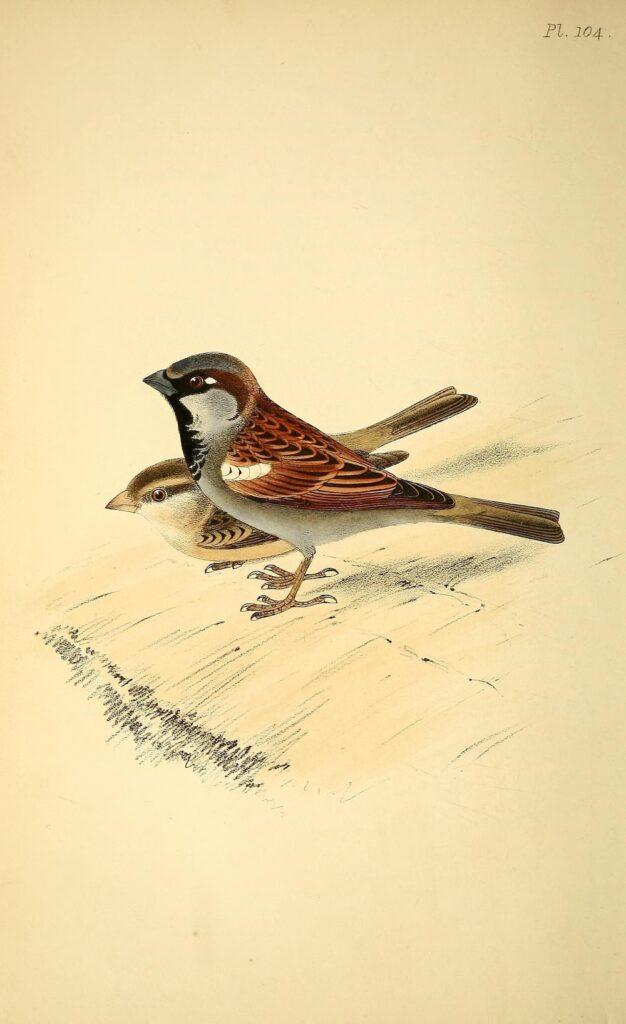
From ‘Coloured illustrations of British birds, and their eggs’, London: G.W. Nickisson,1842-1850, via the Biodiversity Heritage Library
When I look back, I’ll think of 2025 as the Year of the Sparrow. Our London garden is patrolled by cats, so I’ve never felt comfortable putting out food for the birds; it seemed too much like setting a trap. But this year I cracked. I hung a wire feeder from a branch of the cherry tree and put a birdbath next to it. Then I stood back and waited.
The sparrows didn’t take long. Within the hour, a group of ten or twelve had descended in a cloud of cheeping (they really do say ‘cheep’) and perched on the fence, waiting for their turn to try out the wild bird seed mix I’d bought for them. A nearby climbing rose, overgrown with jasmine and ivy, provided a shelter where they seemed to feel safe.
The flock soon became a fixture, visiting several times a day and lingering for ten minutes or so each time. How could such small creatures eat so much? I found myself topping up the feeder every morning as well as replacing the water in the birdbath. If I was in the garden when they arrived, they tolerated my presence, carrying on as if I wasn’t there. The biggest compliment a wild creature can pay you.
In general I don’t much like anthropomorphising animals; giving them cute names and constructing narratives for them seems an affront to their dignity. But it was hard not to see the sparrows as personalities when they were so ever-present, so insistent. They moved around the enclosed rectangle of terraced gardens in a noisy gang, keeping up a running commentary of chirps and making the feeder spin wildly with their take-offs and landings. After eating, they hung out in the rosebush, preening and seemingly chatting to each other in a softer, lower tone. When on occasion I filled the birdbath a bit too full, they would settle in a ring round the edge, trying to gauge if it was too deep for them, puffing out their wings in preparation. Once one went in, the others would take courage and plunge in too, and sometimes three or four of them would be in there at once, a chaos of brown feathers and droplets.
I started to feel responsible for them. In the summer, when it didn’t rain for weeks and the garden turned to dust, I fretted about going on holiday; the flock had got used to a reliable source of food and (most crucially) water, and I hated the thought of leaving them stranded. I asked a friend to come in and cover for me.
We’ve got to the end of the year without any cat-related casualties, as far as I know. But one morning a few weeks ago I heard the sparrows burst into an outcry I’d never heard before: a collective panic call, high volume. I rushed to the window in time to see a large dark shape burst through the cherry tree and veer off into the sky. Sparrowhawk. I hurried into the garden but couldn’t see any spilt feathers. They’d escaped, but it was close.
The scare doesn’t seem to have put them off, for which I feel relieved and grateful. With the sparrows around, the garden feels inhabited in a way it didn’t before. It feels alive.
*
Jill Hopper’s memoir, ‘The Mahogany Pod’, is published by Saraband.