Landscape historian John Gray shares notes from a year-long walk around the South Circular.
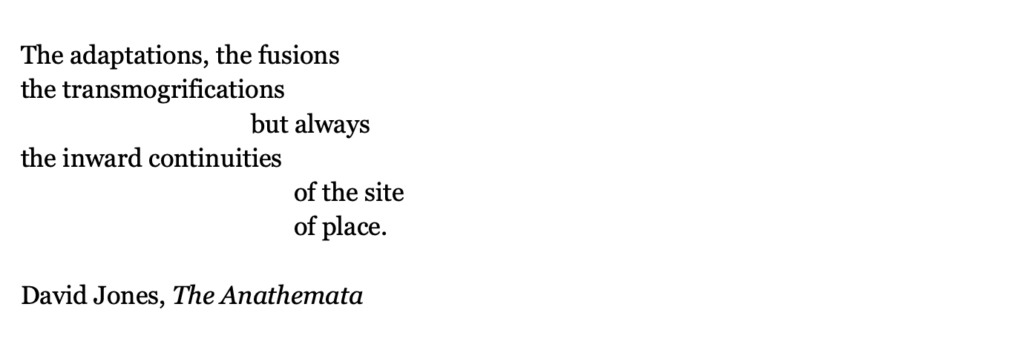
3 January: Woolwich Ferry to Woolwich Common
We want the kick-off to feel epic, so we walk under the river, then take the Free Ferry back from the north bank to the south bank of the Thames, to Woolwich, where the South Circular starts and/or ends.
The temperature is just above freezing and the sky is a flawless blue. There’s a hint of sea in the air. Stood intrepidly on the deck we can see the cowls of the Thames Barrier spaced across the river and beyond them, far to the west, the shining towers of Canary Wharf. In front of us is the Woolwich waterfront, once a forest of cranes, now a wall of glossy apartment buildings.
We disembark and follow New Ferry Approach to a busy roundabout overlooked by a half-timbered pub with a streamline cinema behind it (today the NEW WINE CHURCH): Mock Tudor and Art Deco, twin emblems of 1930s suburbia. Opposite them is a grand red-brick building, reminiscent of a modernist town hall (Greenwich, Hornsey) but which is in fact another interwar cinema (today the CHRIST FAITH TABERNACLE). Here, between the two old cinemas/new megachurches, the South Circular begins.
It sets off uphill as a purpose-built dual carriageway, with a strong air of midcentury utopianism. But the grass at the feet of the flat blocks is patchy, crisscrossed with desire paths and dotted with outcrops of defunct white goods and builders’ refuse. The querulous traffic advances in fits and starts. First day back after the holiday.
We climb until the long, gentle slope begins to level out. On the corner a Victorian pub has been tinned up, with print-outs taped to the doors: IRIDIUM ENFORCEMENT. What sort of name is that?
At the base of a tall tower block a young tree and a plaque mark the spot where Lee Rigby was murdered. The tree is hung with wreaths, tinsel and tangled England flags. Then the back end of the Royal Artillery Barracks, where Rigby was stationed, all razor wire and old tyres.
Here, the South Circular is joined by the Grand Depot Road, which comes up the hill from the centre of town. After the two roads meet, as abruptly as it began, the dual carriageway ends, throttled to two lanes of crawling traffic. The bathos is palpable. But this is an important juncture. For the first of many times, our road picks up an ancestral route.
Woolwich has been a port since time out of mind (“The tall Phoenician ships / stole in…”) The name is Saxon, ‘wool harbour’, but it’s older than that: an Iron Age settlement, maybe a fort. There’s evidence of a ferry here since the middle ages, but we must assume there’s always been one. It’s just the most logical place. Deep into the hinterland but still easily accessible to seagoing vessels, just before the whiplash curve of the Isle of Dogs (tough to negotiate even with wind and tide in your favour) finally turns the estuary into an inland river. Good footing on both sides of the river, and good access to the Dover Road, for centuries if not millennia the country’s most vital thoroughfare, the thread linking London to the continent.
This was the old way up from the port to the common. Cleaving to the contours of the hill, it picks its way along a ridge of higher, drier ground, then on to the great road. A topographical map of the area shows how economical it is, perfected by countless successive generations. Like water, the ancient trackways always found the quickest route.
Here, then, we begin to discern the mystery and the majesty of the A205. Unlike its putative counterpart north of the river, the South Circular was not purpose-built as an orbital highway but rather cobbled together out of existing thoroughfares, in a sort of infrastructural bricolage. Many of these roads were themselves highly storied, often preserving the original routes that the Anglo-Saxons trod among their hamlets.
Contrary to those who dismiss it as a humdrum highway, or a grab-bag of disjecta membra, the road is a unique and extraordinary phenomenon, South London’s creation myth told in concrete and tarmac.
We arrive at Woolwich Common, all raw-boned and wild in the hazy dusk of this truncated midwinter day. But things are looking a little bleak, so we head back to Rose’s for a pint.
15 March: Eltham Common to Catford
The Progress Estate. An architecture that fetishises a particular vision of early-modern English life: half-timbering, slate and gables. Mock Tudor, in a word.
LOVELACE GREEN. Even the name is ersatz.
Real greens were called things like Pig Shit Green.
Not one single English village green was ever named for a poet.
But the Progress Estate is now more than a hundred years old
so has itself become an artefact.
Age has given it the authenticity it aspired to
when it was first built, raw red bricks
outraging the meadows of Eltham.
The plane trees brandish their arthritic fists at the grey-blue sky. It’s lovely and warmish, but the tree shadows are troughs of dry cold.
A stone plaque set into the pavement marks the place where Stephen Lawrence was murdered, 22 April 1993. A crime for which justice still has not been served.
The Yorkshire Grey roundabout. Eltham Green, a patch of grass which still maintains the organic, irrational outline of an actual village green.
The eponymous Yorkshire Grey was once a handsome interwar pub
but is now a handsome McDonald’s.
It was a prominent venue for unlicensed boxing,
site of the brief, notorious bout between
Lenny ‘The Guv’nor’ McLean and Brian ‘Mad Gypsy’ Bradshaw in 1986.
Villain vs. Traveller, the two sides of the SE London underworld.
It was also a concert venue.
Nazi punks Skrewdriver played there on 12 September 1992,
following what came to be known as the Battle of Waterloo.
They played songs including ‘Hail the New Dawn’, ‘Johnny Joined the Klan’, ‘Free My Land’ and of course ‘White Power’ to an audience of over 500. Standing here now I can
imagine them, spilling out of the pub
to sprawl on the verges and roundabout, skins and casuals
huffing Bostik and tossing empty beer cans
and fascist salutes at passing cars
some of which honk back.
It’s important to remember that this was going on.
Just like that. In the open.
After a Victorian railway bridge
the road really becomes a motorway,
hemmed in on both sides by wooden fences and jerrybuilt walls
in places patched up where a car has smashed into them.
The traffic’s chunter, the raw apathy on the drivers’ faces, the fumes…
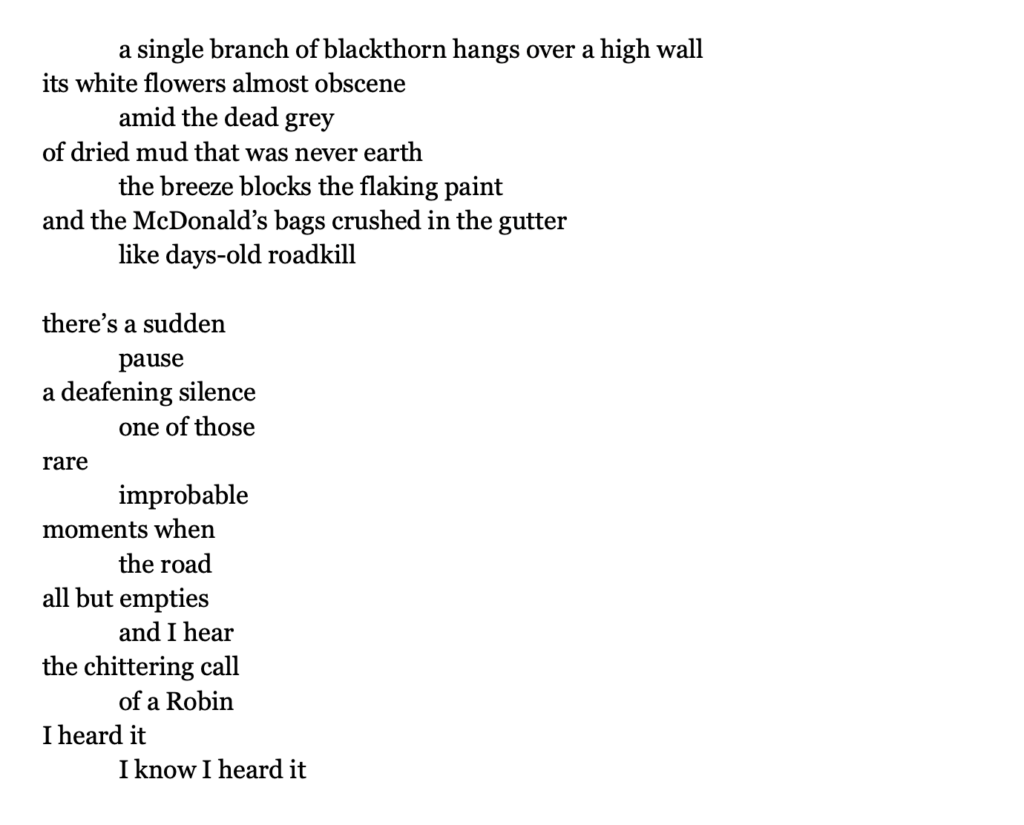
1 August: Catford to Tulse Hill
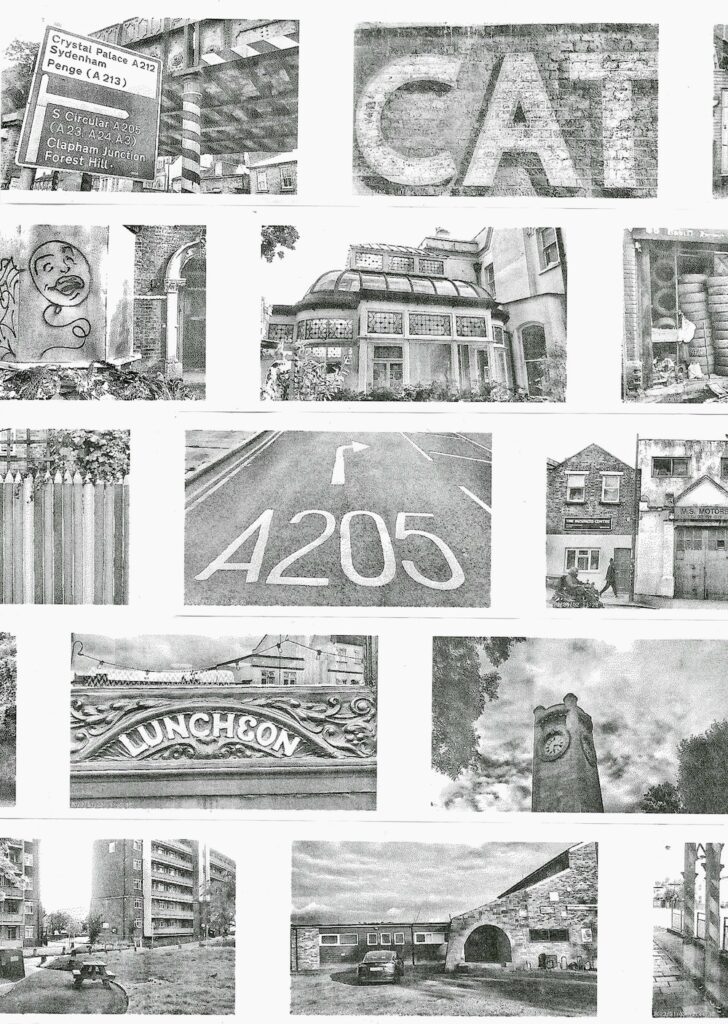
A small selection from SCROLL ZINE. Edition of 1, continuous roll of thermal-printed photos
17 October: Tulse Hill to Wandsworth Town
Crossing Clapham Common, an avenue of plane trees accompanies the road, planted at least 100 years ago. As I step onto the common, my eye catches a flash of cobalt blue on the earthen pathway that runs between the twin rows of trees: a tiny fragment of Victorian transferware pottery. A few metres further on there is another. After that I keep my eyes glued to the ground. By the time the road leaves the common I have collected a handful of disparate shards, both blue and green. I had to dig one out with a twig. I guess these fragments are from when this avenue was first laid out, and the trees planted, possibly part of a layer of rubble and broken crockery put down to help with drainage on the notoriously waterlogged common. These bits of crockery then worked their way to the surface, the way that they do. Alternatively, the top layer of the path was progressively worn away, revealing its substrata. Another possibility is that they are traces of a huge rubbish dump. Commons were often treated as informal landfill sites.
Passing through the centre of Wandsworth, I pause outside W.G. Childs & Sons, an old-school tailors, as I’ve often done before, to admire the frontage, a ready-made archaeology of vernacular lettering from the past hundred years, from the florid threshold mosaic to some sober interwar typography, and even what looks like 1980s cursive at a jaunty angle in the glass of the doorway. On a whim I go in and am met by the fifth and, it seems, final Mr. Childs, a charming, courteous and knowledgeable man who gives me a potted history of the shop. I get the impression I am not the first local historian to have wandered in. He points out a crack in the mosaic threshold, from when a bomb fell next door.
28 November: Wandsworth Town to Kew Green
“un point d’équilibre, une forme d’évidence”
Vincent Périat, Atlas Inutile de Paris
Chinese takeaways of the A205 (east to west): Happy House; The Bamboo Garden; New Tung Kong; China Express; Taste of China; Golden City; Hong Kong Garden; Chinese Tonight; A Bite of China; Z One.
Various aliases: John Wilson Street; Grand Depot Road; Woolwich Common; Academy Road; Well Hall Road; Westhorne Avenue; St. Mildreds Road; Brownhill Road; Plassy Road; Sangley Road; Rushey Green; Catford Road; Stanstead Road; Waldram Park Road; Waldram Crescent; London Road; Lordship Lane; Dulwich Common; Thurlow Park Road; Christchurch Road; Tulse Hill; Hardel Rise; Streatham Place; Atkins Road; Poynders Road; Cavendish Road; The Avenue; Clapham Common West Side; Battersea Rise; North Side Wandsworth Common; Huguenot Place; East Hill; Wandsworth High Street; West Hill; Upper Richmond Road; Upper Richmond Road West; Clifford Avenue; Mortlake Road; Kew Road.
Total length: 20.5 miles.
Rivers crossed (vanished and extant): the Quaggy and various of its tributaries; the Ravensborne; the Effra; the Falconbrook; the Wandle; the Beverley Brook.
Cemeteries crossed or skirted: Greenwich Cemetery; St. Mary’s Cemetery, Wandsworth; Putney Lower Common Cemetery; North Sheen Cemetery.
Roman roads bisected: Watling Street; the Weald Road (now disappeared); Stane Street; the ‘London–Brighton Way’ – i.e., all four of the major routes south of the river.
Tube stations: East Putney.
Boroughs crossed: Greenwich; Lewisham; Southwark; Lambeth; Wandsworth; Richmond upon Thames.
Common land crossed or skirted: Woolwich Common; Eltham Common; King George’s Field; Eltham Green; Clapham Common; Wandsworth Common; Barnes Common; Kew Green. Lovelace Green was never a green. Rushey Green has disappeared. Dulwich Common has disappeared, but lives on in the name of a stretch of the South Circular.
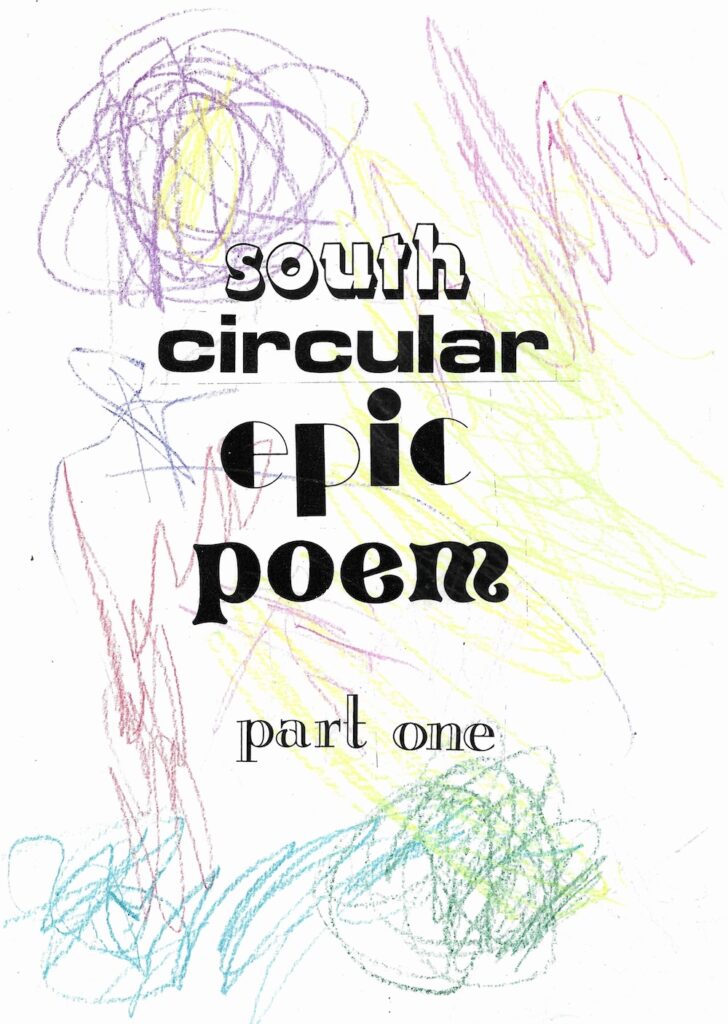
Cover page of the first and only installment of a projected epic poem, never to be completed. Edition of 5. Letraset, typewriter, xerox. Intervention by Nina.
*
John’s excellent zines tracing the history of South London’s commons can be found in our shop.
Follow the South London Landscape History Instagram account here.