Plant an oak for hope: Lally MacBeth looks back over a year of finding acorns, and helping them take root.
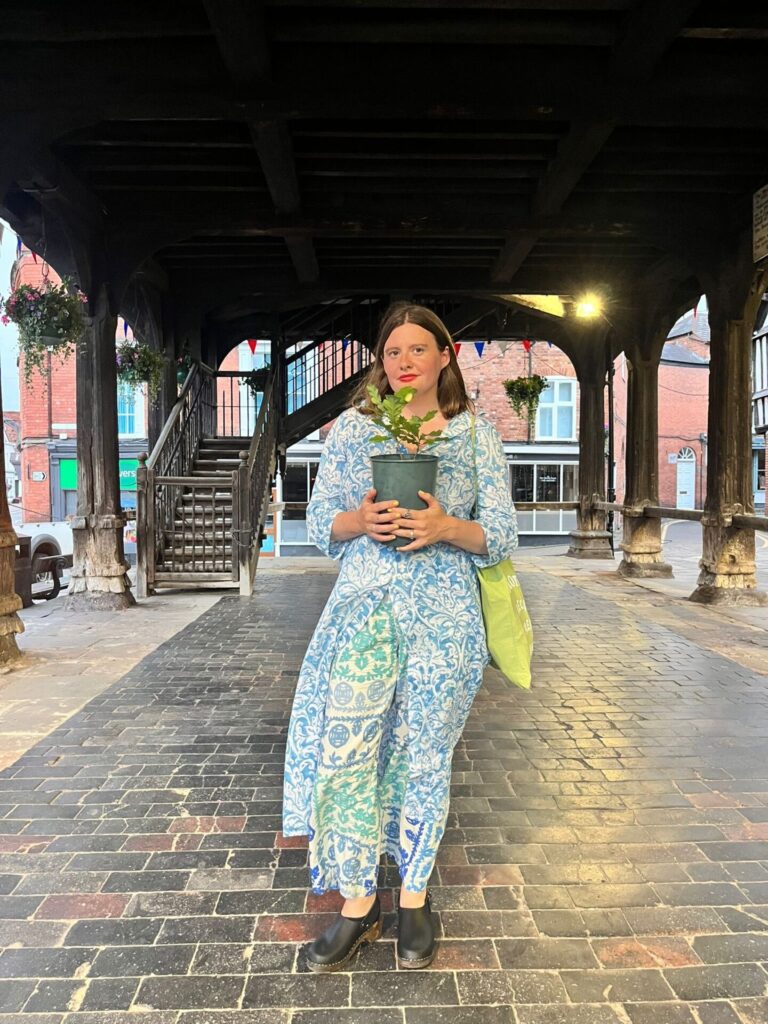
I am once again in a year of oaks. Last time this happened an oak died and two were born, and the year culminated in me carrying two tiny newly born oak saplings the length and breadth of the country before placing them in my garden.
This year has been different but no less oak-infested. It is a mast year. In a year where I have travelled more than I thought humanly possible the oak has become a symbol of strength and resilience. In a year where I have had to temporarily relinquish a home it has given me hope that I, like the jay or the ant or the liverwort, will find a new place to inhabit. A new place to establish roots.
In early June there is a heatwave and Matthew and I find ourselves at Ledbury Poetry Festival. I’m there to talk on a panel with Zaffar Kunial and Rebecca Tamás. After the talk each of us is given an oak sapling. Mine has a little bubbly cocoon attached to one of its leaves. I take the oak with me to the pub and then to eat a pie with the other poets. We carry it with us back to Cornwall, and sit it on a bench. Matthew labels its pot with a felt tip pen: ‘Ledbury Poetry Oak’. We start talking about oaks a lot. Later that month I am commissioned to write a poem for a friend, Lorna Rees, who is working on an artwork called Canopy. I decide to write about an oak. I can’t get out of my head that they’re home to over 2,500 species. It rattles about. I think of them like protective mothers fending for their acorns but also for all the other animals and plants that take up residence in their branches.

I’m not sure at what point in the year we start collecting acorns but it is Matthew who first begins the pursuit. When we are out walking, I turn and find him bent over a hedgerow, scrabbling about beneath leaf mulch trying to find his bounty. At first, I am resistant — do we need more acorns when we don’t have a home to place them in? Soon however, I too find myself bent double, scraping the mud back from the floor, looking for the crunchy shells. Searching for roots.
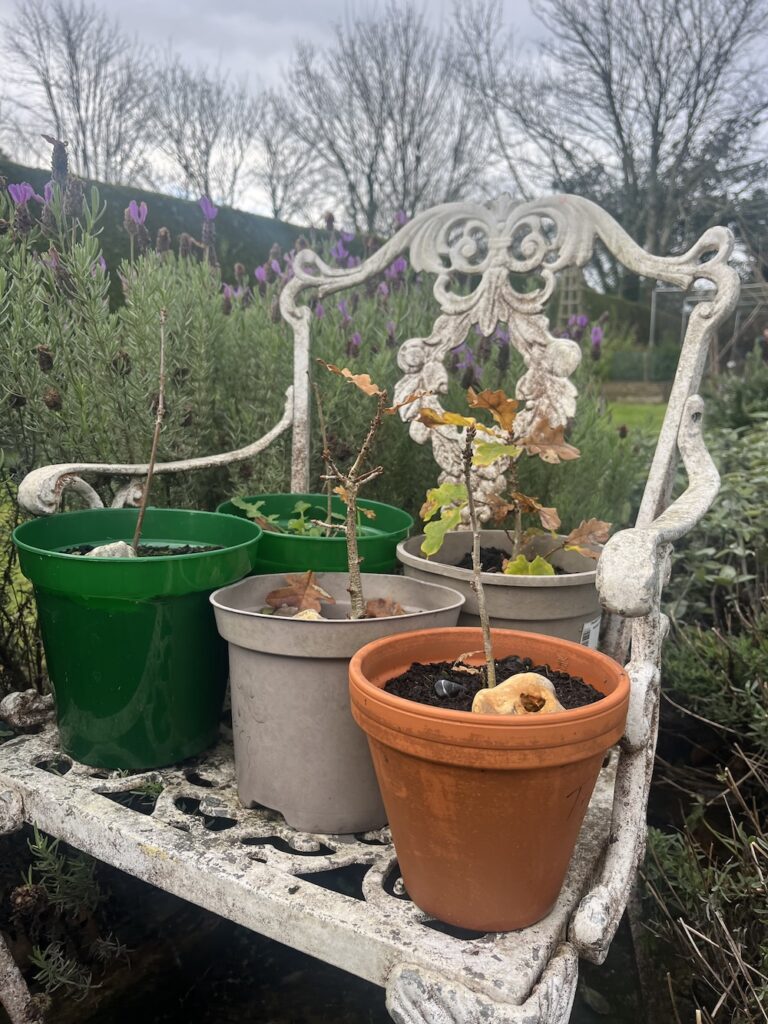
We have knelt at the base of oaks and clawed through clods of earth, all in hunt of acorns. The best ones are when the outer shell has slightly split and a tiny protruding pale root has started to wiggle out. When we return back to the house, we put them into pots with the roots lightly touching the soil, and then we wait in the hope that the roots will work their way down into the earth and take hold. That they will find a new home in their pot.
Along the way we decide that perhaps we should start recording where we collect the acorns. We make notes: a country lane in Cheshire, The Lost Gardens of Heligan, on a grass verge by the Druid’s Head pub at Stanton Drew. Ancient oaks from across Britain. Each pot gets a label of where it came from and whether it’s a Turkey oak or English oak (also known as a pedunculate oak).
In September Matthew has his car MOT’d and we find ourselves wandering the back roads of an anonymous industrial estate on the outskirts of the city, searching for something to fill the time. Amongst the storage containers and garages we stumble on a green lane that leads to seemingly nowhere, and there at its entrance is an oak tree. Our hands go to the floor and search. We return to the car with overflowing pockets.
Matthew shows me how to pot up the saplings once their roots have grown long enough and they have started to sprout a shoot. I marvel that oaks can start as something so small.

We go to an oak planting day at The Lost Gardens of Heligan. The King has donated 3 oaks to be planted in remembrance of 80 years since the end of the Second World War. Oak is the symbol for 80. Some children from the local school plant one of the trees and whilst they’re planting they are asked, “Do you know where an oak comes from?” One of them answers, “an oak seed”. It takes three more goes before one child quietly says “an acorn”. I think of Jackie Morris and Robert Macfarlane’s project on Lost Words, and feel worried that an acorn is a distant and strange thing to a 10-year-old. I can’t even remember learning that an acorn became an oak, but I must have somewhere.
We meet Zaffar again in October, this time in Hebden Bridge. I mention the poetry oak. It still lives but it has started to shed its leaves. The cocoon lived on it all summer and I watched it intently, hoping to catch whatever hatched from within it. I woke one morning and found it had disappeared. It had flown (perhaps…walked?) from the nest.
Our family of ancient oaks has now grown to a small nursery. We tend them. Each pot has a hag stone in it collected from the Dorset coast where Matthew once lived. That is where the oak that died lived, and in a way tending these new oaks and placing a piece of Dorset beside them heals the wound of having let an oak die.
There are now hundreds of roots. They are all in pots. All waiting for somewhere, sometime where they can properly bed in. Waiting for a place to truly call home.
*
Lally’s book, ‘The Lost Folk: From the Forgotten Past to the Emerging Future of Folk’, was Caught by the River Book of the Month for July.