In 2025, Nicola Healey discovered a perfect poem.
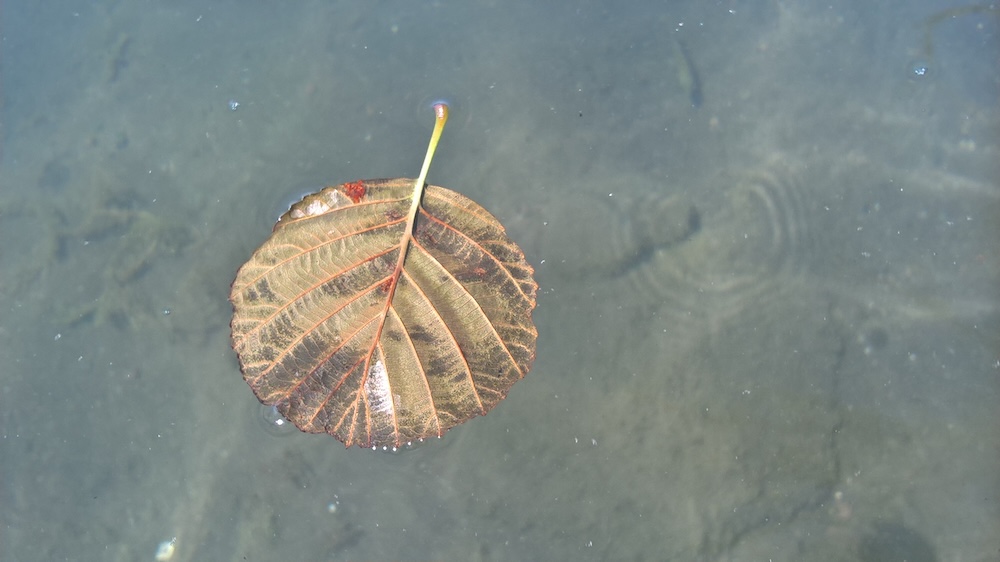 Alder leaf floating on the water, by Tulumnes, licensed via Creative Commons.

Lately, I am not often truly moved by poetry. I can recognise and admire the deep technical accomplishment of a poem, but a poem’s resonance is completed by the reader – the magic and meaning, even the transcendence, comes from the reader’s feelings being sparked into being. Without this, as S. T. Coleridge said of the sky and the stars and the moon, ‘I see, not feel, how beautiful they are’ (‘Dejection: An Ode’).
In September, I came across the poems of Mel Pryor, after a friend mentioned her to me, and, for the first time in a while, something shifted. She was highly commended in the Poetry London Prize 2020 for her moving poem ‘Evening Scene’ – an unusual poem on sibling loss that strikingly, almost aggressively, combines the domestic with the elegiac, and is haunted by the lost brother. The poem’s taut, vivid lines capture the boiling-pot fury of grief:
Into a lamb and apricot casserole
I am stirring my brother’s rage.I must do this for him because I am in his apartment
and he is dead.
I looked for more poems by her and found ‘Alder’, a poem from her pamphlet Drawn on Water (Eyewear, 2014), which led me to buy her pamphlet. For me, it is a faultless poem; I was taken aback by how good it was. I could both see and feel how beautiful it was. Despite myself, I kept returning to the poem to read it. Lines from it drifted in and out of my head over the subsequent days and, very quickly, unconsciously, I almost had it by heart.
I keenly awaited the arrival of the pamphlet (it took a month to arrive, but never mind). ‘Alder’ forms the penultimate poem to this pamphlet, and in just ten short lines – two gently despondent sentences – Pryor achieves so much (a reminder that poems are often longer than they need to be, and that to write a short perfect poem is true mastery). The whole poem is so delicately rendered and seamless it feels like a breath on the page. The lines unfold casually, with great natural fluidity, yet are full of import. Few poems have this lightness of touch. As Sarah Wardle writes in her endorsement of Drawn on Water, this ‘is breathtaking and uplifting, and makes one want to have written’ these lines oneself.
The poem’s opening phrase ‘Hoof-pools brim’ is wonderfully immediate and precise – instantly recognisable (if you live, or have lived, in the countryside), concisely redolent of the hoof-prints cows and horses make in mud, which then become little hoof-puddles after rain. The specificity, and assonance, are captivating – she could have just said ‘puddles brim’, and the enchantment would have been lost. Subtly, we are shown the animal’s past presence, just as the speaker was. Then: ‘the berry hedgerows / unload the notes of birds whose names / I can’t recall’ – the unusual verb ‘unload’ suggests a psychic burden, almost an irritation, rather than an aural joy; while the speaker’s inability to identify, or rather remember, the birds’ songs is the first real indication that all is not well. Meanwhile, a flooded ditch is ‘thieving the sky, the frantic clouds, / the reflection of an alder tree’ – the pointed words ‘thieving’ and ‘frantic’ again suggesting an agitated friction, rather than harmony, with nature.
This is no pastoral musing; the poem is taken to another, contemporary level with Pryor’s sudden inclusion of scientific, physiological imagery: the ‘reflection of an alder tree’ is envisioned as ‘a single cerebellum nerve cell’. Introducing such a scientific word runs the risk of being a bit distancing, less immediate, as the reader has to process what ‘cerebellum’ is; it works, however, as it is an exquisitely accurate image: the dendritic structure of a bare winter tree is exactly like a magnified neural cell (looking online, the ‘Purkinje nerve cell of the cerebellum’ looks like a miniature winter tree floating in water). With this conflation of tree and brain imagery, there is a sense that, in looking at the tree’s reflection in this watery ditch, the speaker is looking into her own mind: stuck, helpless and confined, in the ditch herself; potentially drowning, Ophelia-like. But as Beckett said, ‘when you are in the last bloody ditch, there is nothing left but to sing’, which the poem does, like the unnamed birds ‘unload[ing]’ their notes from the hedge.
Kathryn Maris has said that Pryor has ‘the intellect of a scientist, the ear of a musician and the heart of a poet’ – all three qualities shine through in this poem. The cerebellum image also reinforces the poem conceptually: the cerebellum part of the brain is responsible for integrating sensory information, and coordinating and regulating our movement and balance – and this is a poem that revolves around subtle movement, mental and physical – movement across the land, movement away from, and beyond, the self. As Pryor writes in a later version of ‘Alder’: ‘I’m on the path to Horseshoe Hill / to get myself away from self’.
Probably my favourite part of the poem (other than those brimming ‘hoof-pools’) is the closing three flowing lines:
It’s clear these days I’ve been too much
inside, though the mind is a changing thing,
can change like alder drawn on water.
The perfectly judged line break after ‘much’ opens an extra meaning: the speaker ‘these days’ has been ‘too much’ – too much for herself? For those around her? She has also spent too much time indoors, rather than out and about among these minute visions of nature, now being thrown into sharp, reproachful relief. And she’s ‘been too much / inside’ herself, her head – withdrawn, lacking connection with the world and with others, suggesting a period of isolation or depression. The pamphlet’s blurb describes how Pryor ‘addresses our struggle against the instinct to withdraw emotionally from the world’, a struggle that is encapsulated in this poem.
The wonderful final two lines of ‘Alder’ are where the regenerative hope lies. Pryor reprises the brain imagery: ‘though the mind is a changing thing, / can change’, indicating both the brain’s neuroplastic potential to alter itself – to make new synaptic connections – and also the right to change one’s mind, fluid and free as ‘alder drawn on water’. Fittingly, I like the way the elegant word ‘alder’ is one consonant away from ‘alter’. I also felt, in this image, an echo of Keats’s famous epitaph: ‘Here Lies One Whose Name was writ in Water’. Both poets’ phrases are a reminder of the essential transitory, ephemeral nature of life (and that we are fundamentally made of water – approximately 60%, apparently).
There are a few slight changes to this poem in Pryor’s first full collection Small Nuclear Family (Eyewear, 2015); I’ve written about the earlier version of the poem as it is the one I first came across and which had settled in my mind. The fact that the poem was later slightly altered by the poet is itself an embodiment of how the mind – and poetry – ‘is a changing thing, / can change’, is more water than fixed. (The way this poem made me go from a generalised poetic disillusionment to engagement is further proof that ‘the mind is a changing thing’.)
I was wholly moved, in more than one sense, by ‘Alder’, probably at the level of the cerebellum – moved emotionally, moved to write, moved to be outdoors. I’m grateful to this poem for reminding me of what a poem can do. The poem now floats among my brain cells, ‘like alder drawn on water’.
*
Nicola Healey’s first poetry pamphlet, ‘A Newer Wilderness’, was published by Dare-Gale Press in 2024 and won the Michael Marks Poetry Award.