As she looks back over 2025, Sally McEnallay thinks of the sea.
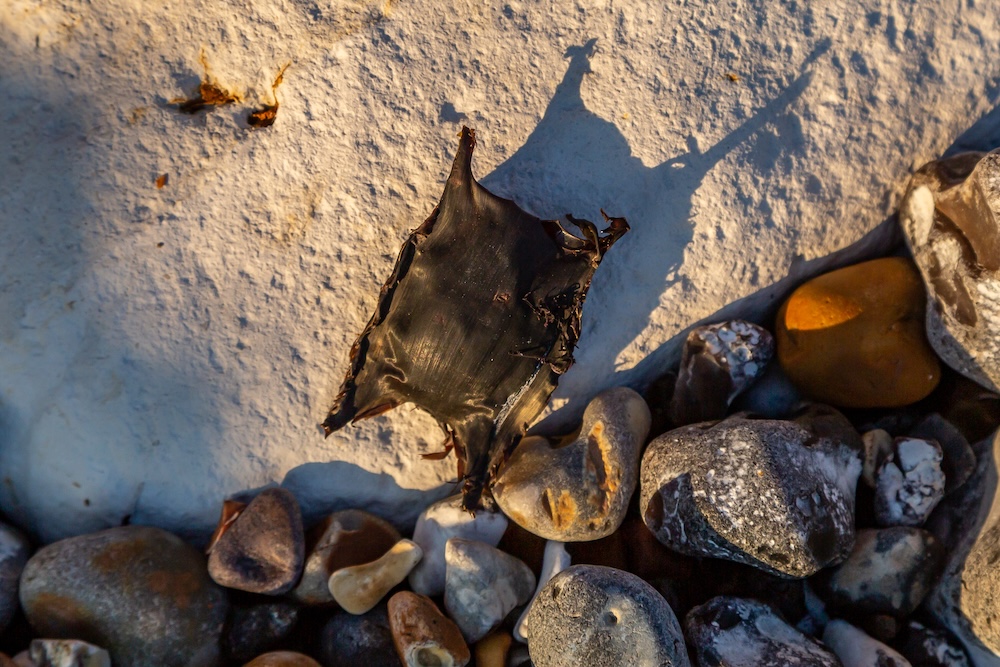
A mermaid’s purse, washed up on a pebble beach in Sussex. Photo: Lemanieh
Change in a Mermaid’s Purse
I wade thigh-deep in the freezing ocean through mats of slithery brown kelp. The warm waters of the Gulf Stream are out there somewhere just beyond my swimming ability. It’s August but the wind chops the waves into cold slaps making Helene, who trails behind me, shriek at every splash, her arms raised above her head in surrender to the Atlantic. Helene is my French exchange and she has been here for three weeks and four days. This is her first Scottish beach and Dad has driven white-knuckled up and over the switchback roads of Bealach na Bà to Applecross to show her the dramatic beauty of the West Coast. He and mum are hunkered in the dunes balancing a frying pan of spitting sausages over a camp stove while we are sent for a swim. So, I bend my knees and launch myself forward, suppressing the yelp that rises in my throat as I hit the freezing water. I thrash out to a clear space beyond the seaweed and try not to think about jellyfish. Then I spot a shape, half buried in the sand, black and about three inches long. At first, I think it must be a mussel shell or a piece of sea coal, but it looks strange alone there on the seabed. I hold my nose and kick down towards it. When I resurface, I am holding a mermaid’s purse. It’s almost perfect — three of the curly end-pieces intact and only a slight tear on the rim where the baby skate has hatched. I stand up and shout to Helene, waving my treasure in the air. But she has her back to me and is already striding furiously up the beach wringing seawater from her hair. Dad waves. Lunch is ready. I slosh back through the seaweed, stuff gritty feet into bauchly tennis shoes without bothering to tie the laces and crunch up the sand. Helene is wearing sunglasses and my Dad’s fishing jersey and shivering dramatically. Our only beach towel lies in a sandy heap at her feet. I raise my eyebrows at Mum.
‘Helene left her towel in the car,’ Mum says firmly. ‘Here, use this.’ And she thrusts the raggedy dog towel at me. I saw at my goose-bumped shoulders while Dad hands round thermos cups of Heinz Cream of Tomato Soup and white rolls stuffed with scalding sausage. Our Basset Hound gazes up at us mournfully as hot fat drips onto the sand. On the drive home I try to interest Helene in the mermaid’s purse but she wrinkles her nose and stares out the window. The soft summer light illuminates the rigid set of Dad’s jaw as he manoeuvres back down the hairpin bends to Loch Carron. Three days later Helene flies back to Paris and the Gitanes-toting biker boy who broke her heart. Mum suggests we stay in touch but doesn’t push it.
*
The Indian Ocean feels like warm broth. Seawater slops down my snorkel and my eyes sting. The current sucks me backwards across the sharp coral which is much closer to the surface than it appears through the distorting lens of my mask. Weaker swimmers like me have been given garish pool noodles to help us float, but they constantly pop out from under us and threaten to escape into the protected marine park. The swirling current makes it difficult to follow the guide without bumping into an idiot with a GoPro. We are snorkelling on Ningaloo Reef off Australia’s West Coast and it’s nothing like the photos. The coral looks like burnt cauliflower and the only colour comes from bright blue starfish that dot the ocean floor as if dropped by a toddler from a tourist boat. What life there is is sepia. A ray slides under a rock shelf, his tail stirring the sand into clouds, and tiny translucent fish hang in curtains as we flail across the top of them. The guide points out a zebra shark hidden in the seagrass, its mottled skin perfectly camouflaged as flecks of light and shadow. We float above it all in a fat neoprene slick.
I read somewhere that coral blooms in bright colours right before it dies. It seems we are too late for these fireworks. Last February Ningaloo, together with the more famous Barrier Reef suffered simultaneous marine heating events that fatally damaged their coral ecosystems. Most coral species begin to bleach at about 4 degree heating weeks (DHW) but readings four times this high were measured on reefs as remote as Rowley Shoals in the far northwest on the marine border with Indonesia. On the Barrier Reef the damage was recorded across a 100km stretch between Townsville in Queensland and the tip of Cape Yorke where heavy rains had already flushed torrents of fertiliser-contaminated water and silt hundreds of miles out to sea. The damage creeps up the food chain and sharks are also vulnerable to warming seas. Many species of small shark, like the zebra shark on Ningaloo, produce egg sacs like the mermaid’s purse I found in Applecross that summer. As the water warms, the hatchlings’ metabolism rises; they hatch too soon and too small and less able to survive larger predators or migrate the long distances they need to travel to reach their breeding grounds.
As I child I spent every summer on the West Coast of Scotland, the land of the shape-shifting selkie. We would often see their seal selves gazing at us from beyond the rocks, but I never met a real-life mermaid until this year. A is a poet who writes on special waterproof notebooks while submerged in the sea. She is a foreign correspondent on assignment to interview the inhabitants of the undersea kingdom. Although she has travelled widely, she spends most time close to the Scottish coastline, sometimes only metres from shore. She often works at night, slipping into the inky water in her wetsuit to hang in the ebb and flow. Her subjects are ordinary — anemones, barnacles, crabs, sea cucumbers — and her poems are local and precise. She talked about how soothing it is to be held by the dark water, to be afforded the privilege of entry to this watery world on equal terms. Returning to the human kingdom can be a shock. Once she emerged from the sea after midnight, her head full of undersea images, her body still swaying to the rhythm of the waves, to find a strange man standing above her on the wharf. In a scary reversal of the selkie story he was holding not her sealskin but its opposite — her bag containing dry clothes, a towel, her phone and keys — as she shivered on the margin between land and sea.
The sea can kill us but collectively we are the ocean’s most deadly enemy. In November tens of thousands of tiny black plastic bio-beads washed up on Camber Sands in East Sussex. Within hours locals were on the beach with rakes and sieves trying to separate these toxic pellets from the storm wrack of seaweed in which they hid. Two days later Southern Water admitted that the beads had been flushed out to sea from a broken filter at their Eastbourne water processing plant. Just last year the Sussex Kelp Recovery Project celebrated the return of Blue Mussels to the Sussex coastline and expressed the hope that these shellfish beds would provide anchor points for the regrowth of the underwater kelp forests that are key to so many marine species. Except the toxic bio beads from this recent spill will absorb algae and nutrients and be sucked in by the blue mussels and snapped up by seals, fish and seabirds. Always this push and pull. People work hard to protect the sea — raising money for research, scraping bio beads out of wet sand, campaigning, lobbying; then other people flush poison into the ocean, shrug and walk away.
This winter I am taking swimming lessons for the first time since primary school. I have rinsed my memory of verruca socks, fankled tights and coming last in every single swimming gala. I have no illusions about speed or style or any ambition to surf mad breakers or dive for treasure. I am just learning to float rather than flail. If I can relax into the sea’s retreat with my eyes open and my breath steady, I am more likely to spot the signs of the tide’s return. Mermaid’s purses are rare these days, but I need to believe that they can be found if you take the time to look.
*
Sally McEnallay is a writer of narrative non-fiction and memoir who hails from Scotland and currently lives in London. She is interested in exploring the relationship between human and non-human nature in the hope that it has a future. When not writing she is often to be found walking a spaniel or reading three books at once. Follow her on Instagram here.