As our seasonal reminiscences continue, Ysella Sims recalls a 2025 of growth, decay, and merging seasons.
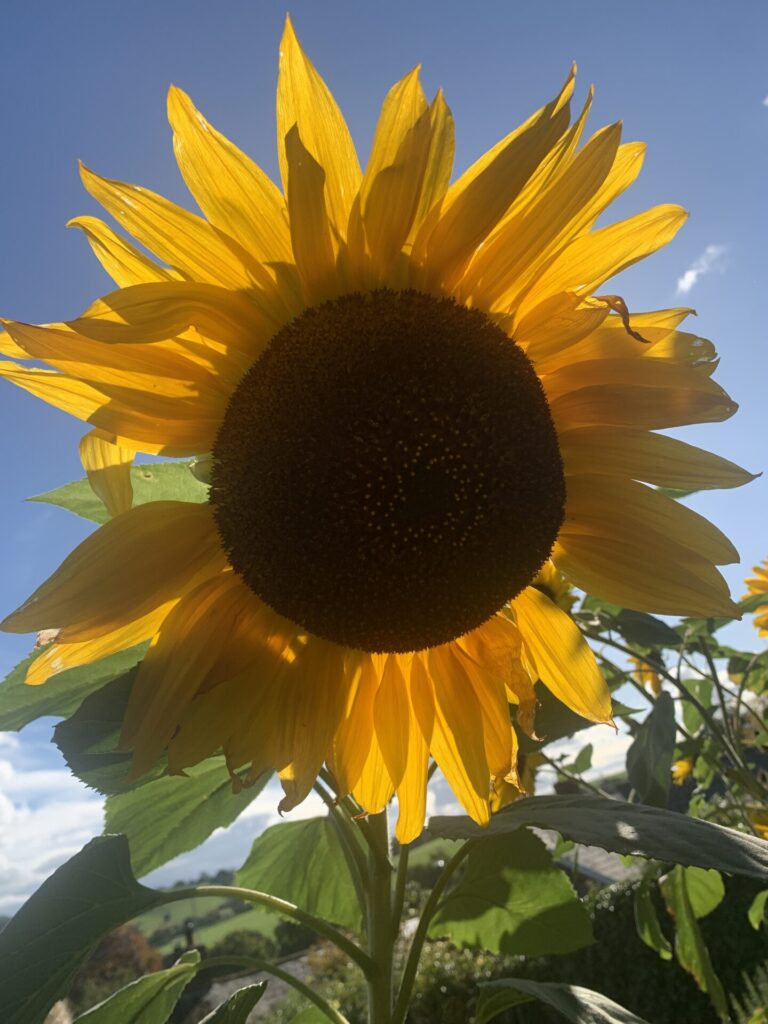
July
A tiny black ant tightropes the blue perimeter of my shallow-curved bowl, its surface smeared with blackcurrant and yoghurt. At my feet scarlet pimpernel — a cure for madness and melancholy — wind through wonky paving slabs. The sky is blue. In the lean-to shed, roofed with red tiles, a blackbird sits on her nest, balanced between a pair of perishing waders and rusting tools.
Below, in the courtyard, in another shed, its interior striped with guano, a pair of swallows take it in turns to sit on their second clutch of eggs. Their youngsters wheel in and out noisily, skimming through windows, passing so close I can feel them.
The days are long and indulgent, the nights short and heady. In the borders, golden rod, corncockle, and self-seeded poppies flower with the intensity of a seized opportunity; miner bees funnel in and out of barely-there holes in the lawn. Cinnabar caterpillars wriggle up ragwort while butterflies — peacocks and tortoiseshells — skip over cosmos and buddliea and bees bury their heads like face-planted drunks.
We’re in the middle of the second of four heatwaves of the summer. I’m jubilant at the idea of summer, of heat and light and growth. But the ground is cracked and local papers carry images of fields on fire. In Portugal, my friend posts images of their burned out new beginning, land razed, trees reduced to blackened stumps.
“We go again”, she says.
By day, buzzards wheel overhead among the semaphore of swallows and screeching swifts, while in the orchard the hens scratch laconically for slow worms. They make the treadle clunk, raising an alarm call when the sparrowhawk hurtles through to pick a sparrow from the mulberry tree. It’s a numbers game.
Down by the river at Fordton I stand on the pebbly foreshore as Coop splashes in the water. Sandmartins make a bewitchment of the glistening water and swaying purple balsam; they are fireflies, sprites, as fleeting as thoughts. I lie on the sunhardened bank of the Yeo, feeling the sandmartin’s flight and chatter, smelling the dry grass. They’ve burrowed long chambers in the sandy banks to hatch their young, and I want to burrow alongside them, to know how it feels to be safe and cocooned, to emerge at the right time into the warm and light. Along a little way, where the river curves, a rook has come down to drink, her parliament cawing and calling to her from the shimmering trees.
There is a sense of the end days, but perhaps it’s just me. Walking back, I pick up bits of plastic from the path to feel useful.
Autumn has come early as the seasons merge.
“We don’t have seasons anymore,” I hear a farmer say, “just extreme dry, or wet.”
It’s been too dry for the grass to grow and he’s used up his sileage reserves during the summer. He’s culling his older cattle before the winter. Others are doing the same.
I visit my mother in Somerset and we walk across familiar fields, the sun hot on our backs like we’re at the beach. The fields are tinder-dry, bleached. Seeds snap, crackle and pop. There are little pools of wildflowers — convolvulus, hawksbit — amongst the gold and white.
“I’ve never seen the grasses without seeds on,” Mum says, “everything has fruited and flowered so early this year”.
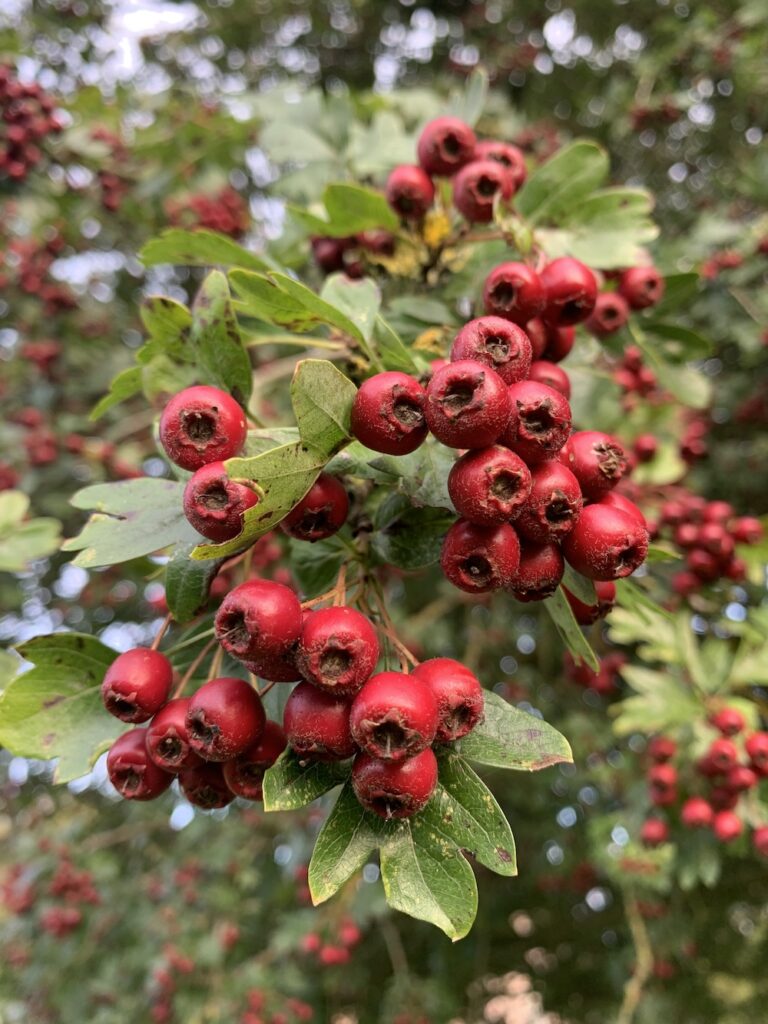
We talk about the trees shedding boughs, how acorns, blackberries and conkers are already dropping, how the tops of hedgerows are crimson and purple with elder berries and hawthorn. In the wood the moss is dry and the dog’s mercury is wilting. But back out into another field and there’s the smell of hot earth, of dried grass, a view of green hills dried to yellow; a Georgian farmhouse, corrugated roofed farm buildings, a Victorian church on the horizon, and a sense of timelessness.
September
It’s early — a nudge past 8am on a Sunday, and the air has a new edge. There’s a silver glow in the trees, a mist hanging in the valley. It’s quiet except for the rumble of a lorry on the Tiverton road, the sound of cows calving and calling to each other in the fields, the first peel of church bells. In the lanes the hedges have been flailed, stripped of their berries, fruits and seeds.
The shadows are lengthening. After August’s brown the garden is relieved to be green and fleshy again. But it’s lush without promise, soggy and leaning. It’s beginning to sulk and I’m trying not to join in.
In the orchard I sit on my haunches to eat an apple, cold and crisp, picked from a black, lichen-knotted, stem. A silver float of mosquitoes and wasps dance around a carpet of apples. Blackbirds flit between the branches of a straggly elder and I wonder if they are my babies from the summer. This is the place to find the amber sun on autumn mornings — it comes through the trees’ canopies, in the gaps between towering nettles, brambles and the flowering ivy, phallic and alien. This is the place of worms and beetles burrowing and chewing, of new life made from spent stems and promise. I heave chicken droppings from the hen house, piling them onto the compost heap to speed the cycle.
The swallows have gone — the courtyard is quiet of their bustle and swoop, their perpetual toing and frooing, their playfulness and celebration. The skies are quieter too — only a few housemartins remain in the hot air spirals. This morning I saw a little boy, his hands concealed by an oversized blazer, walking alongside his dad to the bus. He looked so small, and I felt for him, caged after a summer of childhood.
December
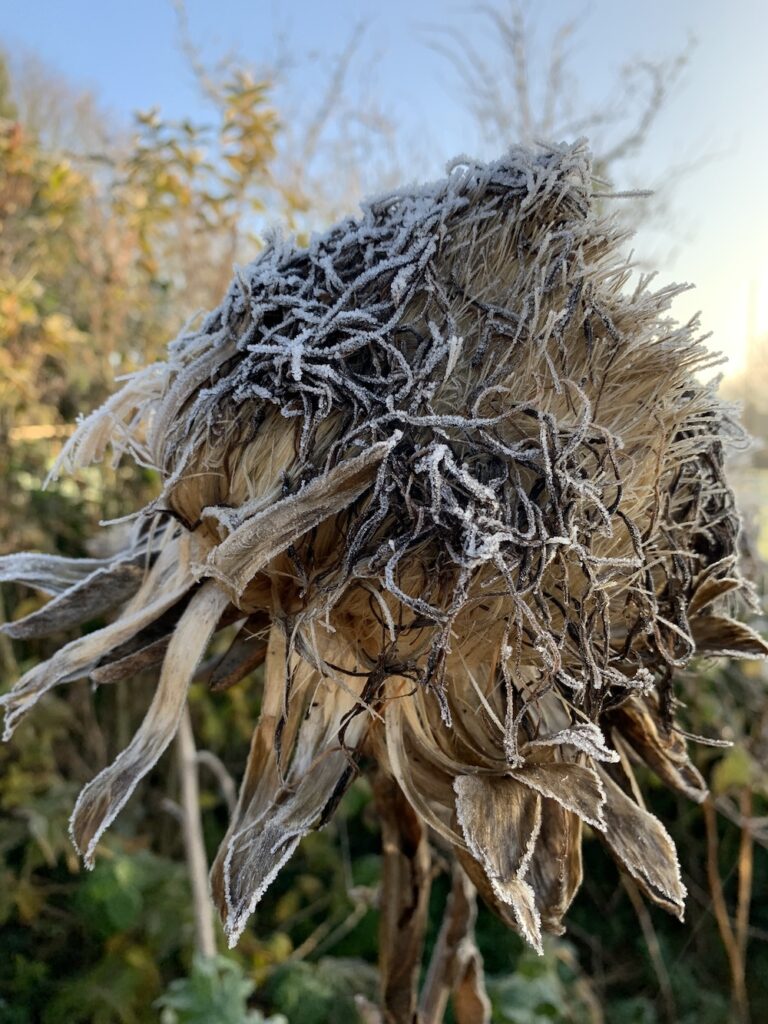
This morning there is a freezing fog. Awake at 3am, I open the door to let the dog out. I feel a wall of cold air and think of the tiny lambs shivering in the marshy field at Shobrooke.
At 8am the sky is blue above the hanging fog across the valley. The seed heads and tall stems of summer — cow parsley, sun flowers, artichokes — sparkle pewter and silver.
I take the chickens warm porridge and listen to the peck, peck of their beaks in the china bowl as I fill the bird feeders with mealworms and corn, and spread sunflower seeds in the little tray for the robin. A blackbird catches her wing on a rose thorn in the hedge. She squawks and flaps until she’s free, takes shelter among the scarlet berries and thick dark of the yew. A pair of mistle thrushes appear, bending the yew’s branches and displacing a shower of icy crunch from its soft fingers. The sparrows, blue tits and robin gather from their night time perches, the stoic pigeon watching from the top of the cypress.
It’s the season for hibernation, for composting all that’s gone before, waiting for the light to return and reveal the shape of what comes next.
I think of my friend in Portugal, turning back towards the warmth of the house.
“We go again”, I say to the birds.
*
Ysella Sims is a writer, poet and performer whose work explores identity, belonging and our connection to place. Based in the rural South West, she writes from the edges, seeking connection in the in-between. Read more at ysella.substack.com.