In 2025, for Annie Lord, love and grief took the shape of wreaths, potato prints and frost flowers.
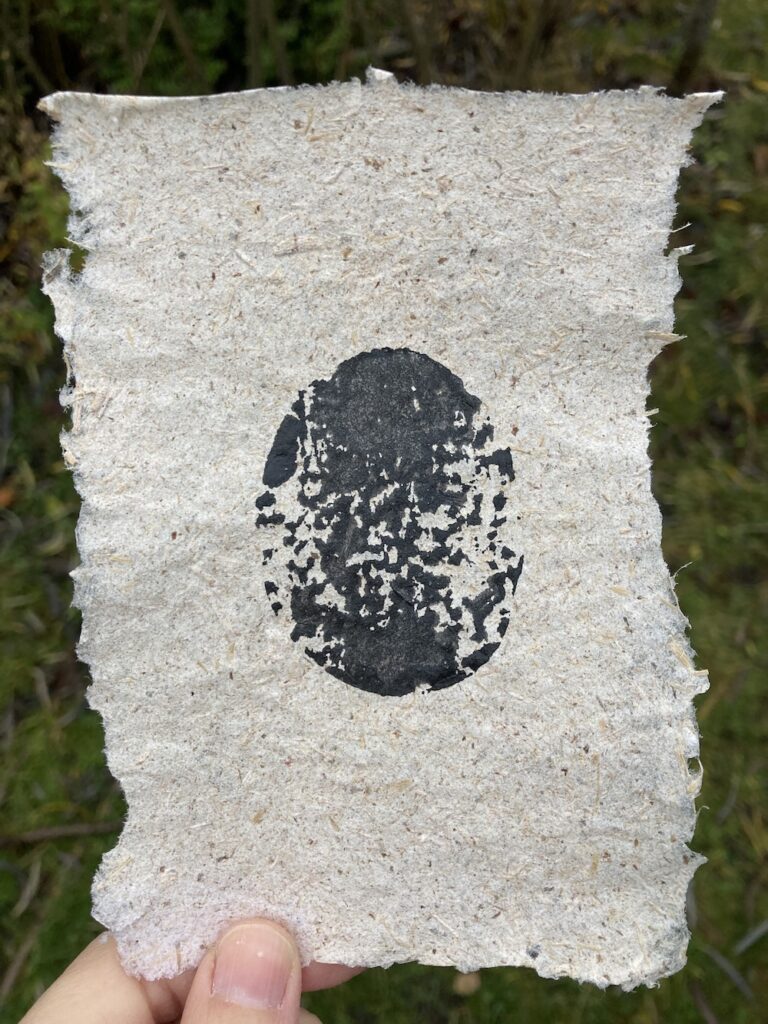
The Circling Year
The year began with a circle; a wreath laid upon my mother’s coffin. A handful of willow stems cut from my garden, twisted and bound into a ring, wrapped in moss, and covered with foraged ivy, pine, alder and broom.
I gathered the greenery on an overcast morning, taking my favourite route to the river. A recent storm had toppled a tree, blocking the footpath. I pushed through the undergrowth, continuing further. I wore waterproof trousers, heavy-soled walking boots. I could not say that I was happy, but I was content in my task. Walking home, a packed bag of foliage swinging from my arm, I was reminded of the comfort that was to be found in holding a bundle of branches.
My mum had died, and I could no longer tend to her. She did not need tea or pain relief, an adjusted pillow or a hand to hold. My hands needed something to do; and so, I made her a wreath. I wove my love into a circle and brought it to her.
In the foyer of the funeral directors, I handed over the wreath to the woman behind the desk. She complimented me on my work, asked where I gathered the foliage. Another staff member came to join us, and while she and my dad went over the details of the service, I watched as the first woman ran her fingertips across the wreath, absorbed for a moment, in a world of greenery.
*
For the last two months of her life, my mum Wendy was cared for at home. A hospital bed was delivered, and positioned right next to the windows so that she could look out to her garden. Each time a doctor or nurse visited they proclaimed surprise at this green space, tucked into a courtyard in the centre of the city. The carers that visited daily marvelled at the apples on the trees. They were so red, so bountiful.
One day, I asked mum if it made her sad when the leaves began to fall. She reassured me that it didn’t. I remembered a previous conversation, where she’d spoken of the satisfaction of autumn. It was a time for planning, for planting bulbs and living in expectation of what was to come. Leaves would fall, a period of dormancy would descend, and then, as always, spring would return. Only this time, she would not be here to witness it. Neither she nor I said that last bit out loud.
The funeral was held on a Friday morning in January. Afterwards, aunts, uncles, siblings, cousins and nieces, gathered at my parents’ flat. Despite the cold, I was drawn outside. The garden, in its winter guise, was beautiful. Evergreen shrubs brought colour. Tall, crisp brown stems crowned with seedheads punctuated the beds. My attention was caught by a flash of white, low down on a stem. A flower? A plastic bag? I got closer. It was ice, curled in delicate ribbons: a frost flower. Moisture in the hollow stem had frozen, the bark split and fissured as the ice pushed outwards. These frosty petals would last as long as the temperature stayed below zero.
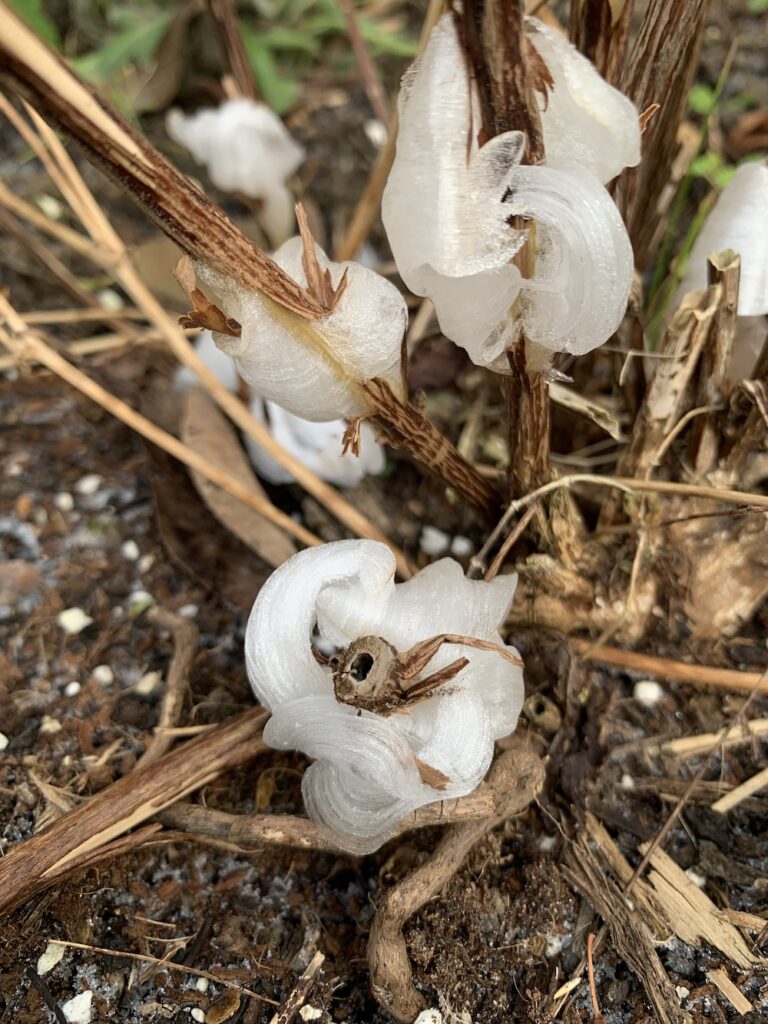
Throughout the afternoon I took a procession of family members to visit the frost flower, all of us bending low to the ground to admire it. Afterwards I sent a message to a friend, telling her that the frost flower felt like a gift. She asked if I had found God, and I told her no. I thought of my mum, and the way she found wonder in the world, right up to her dying days. This was my gift; not from a God but from an upbringing which encouraged close attention.
*
After the funeral, we brought the wreath back to my parents’ flat, and placed it on the outdoor table. It stayed there for several days before it was composted; separated into individual stems, the willow cut into pieces. A circle broken apart.
During my mum’s final weeks of life, there was rarely a time when a bunch of flowers wasn’t present on the sideboard. Small posies of calendula, lavender and coreopsis gathered from my own garden. A bunch of wildflowers gathered by the women my mum worked alongside in the community garden. Golden yellow chrysanthemums from the neighbours, a beautiful bouquet of oranges and red blooms bought from the local florist on the day of her death. All these flowers were gently rotting down; their vibrant colours fading, shifting into a harmony of brown, taupe and ochre. A compost heap filled with love and grief.
My mum enjoyed every aspect of gardening, but she loved compost. This was where the real work of the garden happened. A constant, evolving cycle of death and renewal, rot and sustenance. Sat beside her in the hospital, I showed her a picture on my phone of three bags of compost, harvested for the first time, from my own heap. She looked upon it with pride.
*
For years, mum tended an allotment. Hers was not a neatly delineated plot, but continually on the verge of overspilling. She grew potatoes and peas, lettuce and radishes, planted fruit bushes, apple trees, a quince and a greengage. In summer she harvested currants and raspberries, spent days processing them into jams, jellies and cordials.
After she died, we knew we couldn’t maintain the allotment. After months of stalling, on a bright November morning, I turned the key in the gate, walked up the pathway and into her plot. Inside her shed, everything was as it was before she became ill. Her tools, her raincoat and over-trousers, packets of seeds and the sign that proclaimed this to be, “Wendy’s Shed”. In this space, it was as though nothing of the past year had happened. No seizure, no diagnosis, no four months of illness. No death.
We had arranged to meet mum’s allotment neighbour. She hugged me, told me how much she missed Wendy. I had worried that by leaving mum’s plot untended, we were being a nuisance. That the bindweed and couch grass which, left unchecked, would spread into neighbouring plots, smothering other people’s carefully tended crops. What I hadn’t considered was how it felt to garden next to a plot which was notable for its absence. How a patch of ground could hold so much grief.
Hanging on the wall of mum’s shed were three small bundles of plant fibres. Each one was palm-sized, the fibres twisted into circles and loosely bound so as not to unravel. I knew these were the work of mum’s hands. That she had gathered and dried the plant stems before processing them into fibre. I didn’t know what she had used, perhaps daffodil leaves or the curling tendrils of bindweed. They were made from plants at the end of their life cycle, which would otherwise have ended up mulched down on the compost heap. It was a skill she had only recently learnt. For a woman who was rarely without a piece of string to hand, it was the perfect pastime. I took these precious objects home with me. I wanted to keep hold of this evidence of mum’s handiwork, her interest in plants expanding into what could be made from them after they had finished flowering or been cleared from a space.
*
We live in multitudes. Our bodies might be constrained to a single location at a time, but in our minds, we are often elsewhere. From her hospital bed, mum sometimes spoke of the allotment. There were potatoes there, ready to be harvested. She held onto the thought of them; twinned her mind with the potatoes, buried under a blanket of earth. After she fell ill, she never had the opportunity to return to the allotment. The potatoes remained in the soil.
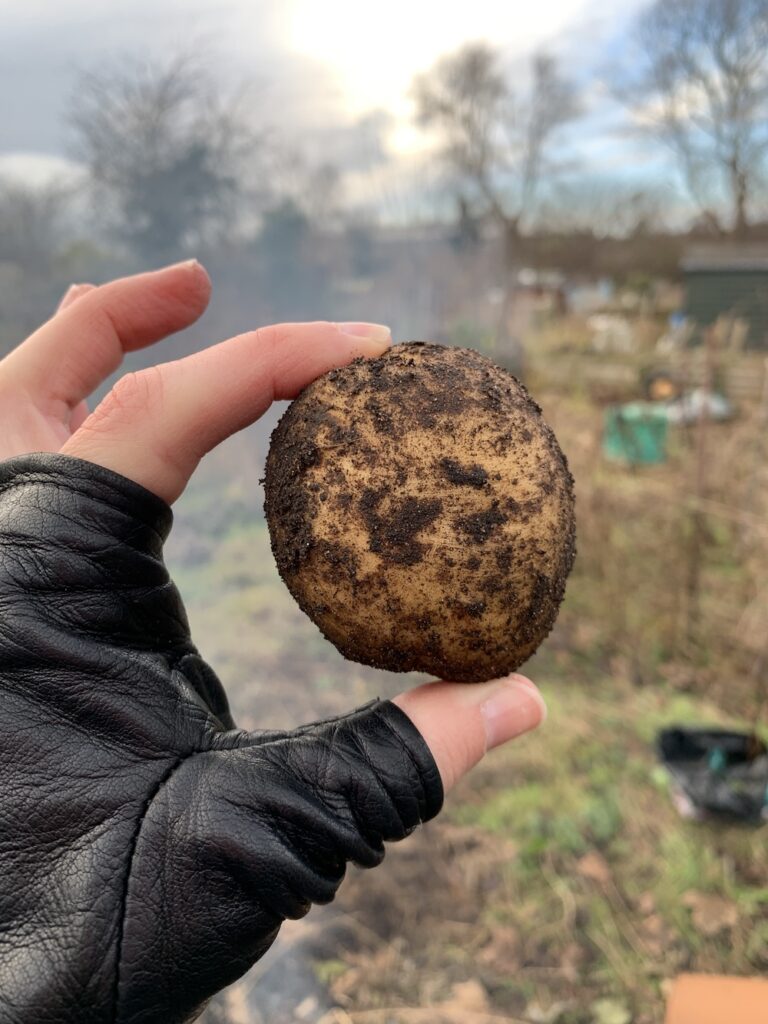
On my final visit to the allotment, I tipped out three bags of earth. These were the potato bags, untouched for well over a year. The first contained a tangle of nettle roots, the second gritty compost. The third held a single potato. I brushed the earth from it and tucked it into my bag.
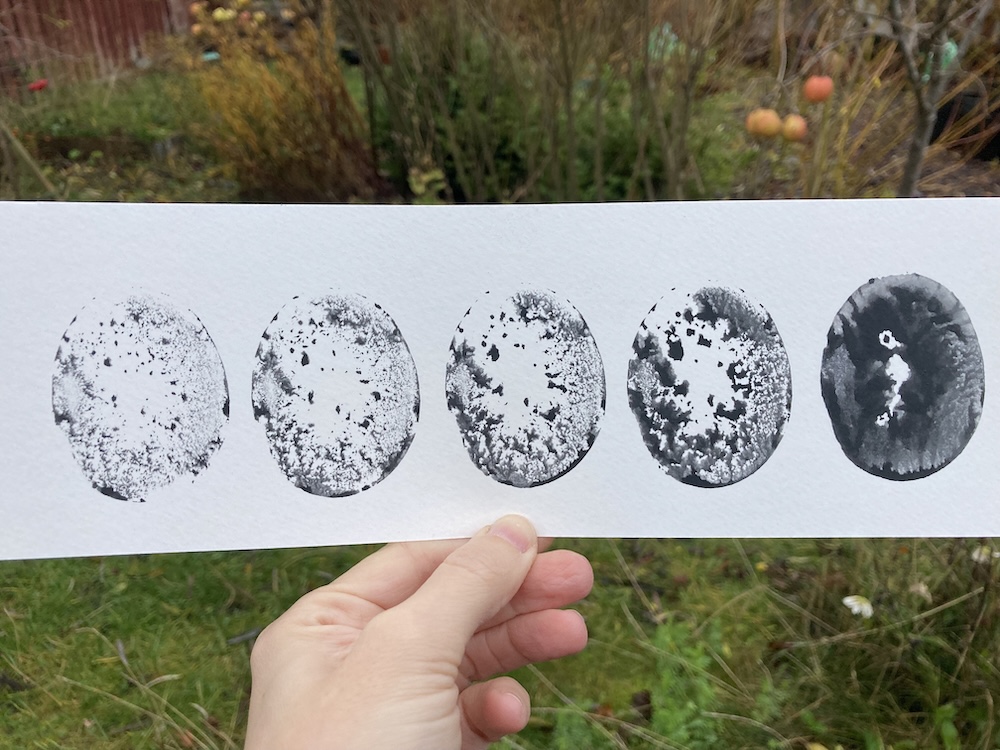
Back home, I cut the potato in half. Inside, it was perfect. Paintbrush in hand I slicked ink across the cut surface. Pressed it down onto a sheet of paper then lifted it to reveal a dense, black oval. Pressed down once more, a lighter imprint this time round. I continued, again and again, filling page after page with potato prints. The ovals shifted and transformed in front of my eyes. The potato’s imprint became a waxing moon, a row of beans, a set of scans, the inside of a skull. One single potato which held so much.
*