From the Isle of Skye, Bethan Roberts shares a 2025 of lighthouses and sheilings.
I’d been trying to go to the lighthouse for months. Neist Point, Skye’s most westerly point. As one of Skye’s tourist hotspots it’s out of bounds in the summer months – a long single-track road snarled up with campervans. Into the winter months, circumstances haven’t aligned, around work, childcare and the weather. I sometimes envy the holiday makers, at liberty to explore the island – their playground. Skye still comes to me slowly, in glimpses. I know its playparks, toddler groups, the place where all the kids have their birthday parties, its famed beauty spots less so.
*
Instead of going to the lighthouse, I pick up Virginia Woolf’s novel To the Lighthouse, published in 1927. It’s set on Skye, and depicts the Ramsay family holidaying there, with ‘the hoary Lighthouse, distant, austere, in the midst; and on the right, as far as the eye could see, fading and falling, in soft low pleats, the green sand dunes with the wild flowing grasses on them’. Huh? I might not have been out and about much, but this is definitely not Skye. For Woolf describes not Skye at all, but Cornwall, where she spent all her childhood summer holidays – at Talland House in St Ives. There’s no clear reason why Woolf chose to transplant Cornwall to Skye as the setting. She’d never been, but knew and loved the writings of Samuel Johnson and James Boswell about their celebrated journey to the Hebrides, including Skye, in 1773. ‘The Hebrides are very angry’, she wrote to a friend after the publication of To the Lighthouse, and told Vita Sackville-West of how ‘an old creature writes to say that all my fauna and flora of the Hebrides is totally inaccurate’.
To the Lighthouse makes the shape of the letter H. This was how Woolf drew it in her notebook – ‘Two blocks joined by a corridor’. The opening chapter ‘The Window’, set on a September evening, and the third ‘The Lighthouse’, a September morning, are the two blocks, joined together by the middle chapter, the corridor, ‘Time Passes’, which spans ten years during which the holiday home stands empty – ‘So with the house empty and the doors locked and the mattresses rolled around’. I’m reading this chapter when I come across the latest statistics relating to short-term lets (holiday homes) on Skye. There are 1558, 1188 of which are classed as potential dwellings. Of new homes built last year, 18.8% are already holiday lets. Woolf described To the Lighthouse as an elegy, and reading this novel in the winter months, I find there to be something particularly elegiac about the extended, poetic description of the empty house, a holiday home out of season, with ‘shrouded jugs and sheeted chairs’. ‘Nothing’, Woolf tells us, ‘could disturb the swaying mantle of silence’ that takes hold of the place. Silent, ghostly, empty buildings, 1188, ever proliferating across the island, while people struggle to find a place to live here.
To the Lighthouse was a huge success and with the money she made from it Woolf bought a car. In June 1938 she finally visited Skye with her husband, in, I like to think the same car she brought with the proceeds from the novel, transporting her to its purported location. ‘Well, here we are in Skye,’ she wrote in a letter, ‘and it feels like the South Seas – completely remote, surrounded by sea, people speaking Gaelic, no railways, no London papers, hardly any inhabitants.’ Ah, remote, that adjective so often applied to Skye, the source of as much ire as creative responses among folk who live here. ‘Rural, not remote’ is the slogan. I’ve definitely been guilty of describing Skye as remote, stemming from subjective experience – remote from family and friends, from familiar places. Step aside from your own experience (if you’re not from here) and it doesn’t take much for Skye to become the centre of the world, rooted in and radiating a rich culture of song and story.
If Skye is actually Cornwall in To the Lighthouse, then even when Woolf is on Skye she still insists on its sort of elsewhere-ness. ‘Believe it or not, it is […] so far as I can judge on a level with Italy, Greece or Florence’, she writes. ‘Remote as Samoa, deserted: prehistoric. […] Hardly embodied; semi-transparent; like living in a jelly fish lit up with green light.’ There is a lack of a tangible, grounded sense of Skye – indeed it’s ‘hardly embodied’, although the evocation of the lit-up jelly fish is beautiful. She finds Skye not entirely ‘deserted’ (although there was indeed a population low in the 1930s, the clearances compounded by losses in WWI) – she records encountering the ‘nice red headed brats’ of the MacLeod clan at Dunvegan castle, and how ‘the old women live in round huts’. Yet for Woolf, the interest and beauty of Skye is ‘almost entirely colour, very subtle, very changeable, running over my pen, as if you poured a large jug of champagne over a hairpin’. Skye gives her the sense that ‘one should be a painter’. In To the Lighthouse the character Lily Briscoe is painting a picture, in ‘all its greens and blues, its lines running up and across’, albeit not one of place. Lines and colours run across pens and canvases and postcards.
Woolf’s layering of western points, Cornwall, Skye, one atop the other, prompts me to think through my own relationship to the west, and with the west, comes ‘Celtic’, comes matters of language, branching into Irish, Scottish Gaelic and Manx – Goidelic or Q-Celtic languages – and Welsh, Cornish and Breton – Brythonic or P-Celtic languages. I grew up in northeast Wales, borderlands, and with that comes an uneasy relationship to place. My mother English, my father Welsh. But we’ve always headed west, my dad with his roots in northwest Wales, in the Conwy valley. He’s a Welsh-speaker, but didn’t pass the language on to me and my brother. It’s a familiar story up here too, the loss of Gaelic. The colonial lies. The language will hold them back. The language has no future. Moving to Skye has in a sense brought me closer to Wales and to Welshness, or perhaps has brought home to me more persistently the deep connectivity between language and place. I’d always thought I’d move back to Wales, finally learn the language properly. Here, instead, I start Gaelic classes, and ride the various waves and surges of closeness and absence, longing, belonging, unfamiliarity, loss. Lostness.
I had most of my own family holidays as a child in Anglesey, Ynys Môn, the island off the northwest coast of Wales. My parents first took me when I was six weeks old and I’ve been to the island at least once a year since, perhaps missing a year here and there. Anglesey will always be imbued with that glow of childhood memory, to me. Golden sandy beaches, slate-blue seas, gentle green rolling farmland, shelving down to dunes and across clifftops. Hedgerows knitted with hawthorn, ancient sites, gorse. Snowdonia, Eryri, beyond the fertile flatlands, protective. I took my daughter in the summer, caught her too running in that golden glow, it glancing off her, a mirror held up to the past. Time passes. I wonder how her connection to place is being written, growing up on Skye, her Gaelic better than mine.
*
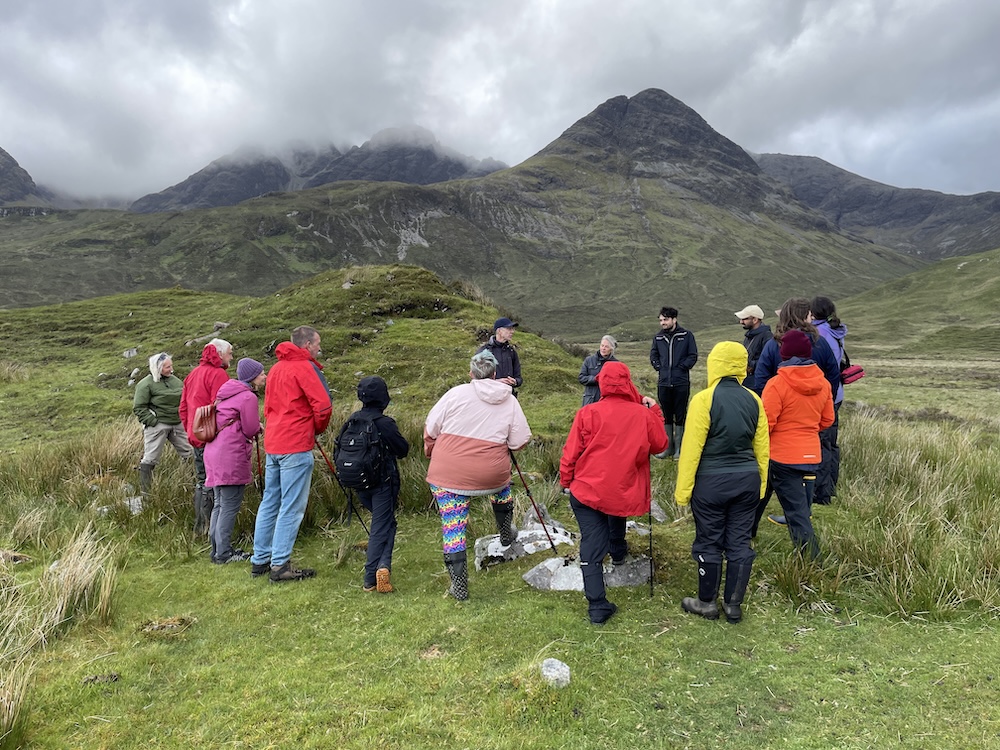
While I didn’t make it to the lighthouse, I did make it to the sheilings this year. Shielings were something I’d come to hear about living on Skye but I didn’t really know much beyond the name. I signed up to a walk organised by local organisation ATLAS Arts to Àirigh na Creige, ‘the shieling of the rocks’, in May. The walk was led by landscape archaeologist Michael Given, and Eilidh MacKenzie, a musician, visual artist and educator from north Skye. The walk is given the name ‘the soil remembers’, and we learn how the soil holds the memory of the way the land has been used in the past. The walk starts near Torrin, a beautiful part of Skye that feels sort of secret, accessed by an easy-to-miss turn off from the main road at Broadford. The road snakes down to Elgol, curving tightly around the top of loch Slapin, the bluegrey shape of Blà Bheinn, outlier of the main Cuillin ridge, stamped on the horizon to the west.
We learn how, sheiling, àirigh in Gaelic, is the name given to the summer pasture and little turf and stone bothies used during the summer months, where livestock were taken to pasture, while women and children lived in the little bothans, milking cows and processing milk into butter and cheese. Eilidh tells of how Gaelic oral tradition remembers shielings culture fondly, a welcome change of scene and routine. We’re led to the site of the shielings at the flat valley bottom between the head of loch Slapin and the base of Garb-bheinn, rising grey to green to meet the sky to the fore of Blà Bheinn, the stream, Allt Aigeinn, running down. Over seventy structures are recorded here. I would have totally overlooked this place, but Michael shows us what to look for and how to identify the sites, through the vivid bright green patches of grass, despite the decades of disuse, still verdant from all that manure. As Eilidh notes, it’s a colour described by the Gaelic word gorm, seen differently through the lens of language. I can’t help but compare this experience of green with that of Woolf, her ‘jelly fish lit up with green light’. This green, gorm, grounded, a tangible sense of the past, the memory of how the land was used held and seen in colour.
Later in the year, Eilidh’s exhibition of Skye shieling culture opens, ‘ùir-sgeul | earth story’. It’s beautiful exhibition, bringing together a large variety of materials, the fruits of extensive research and deep care – songs, stories, maps, archaeological reports, as well as materials found at sheiling sites. Eilidh’s own artworks also form part of the exhibition, in which she uses pieces of peat, heather and bogwood. It is the ultimate art of place. I’m much better at interpreting words than visual arts, but the colours, dominated by browns, greys and blacks, are those of earth, rock and stone. I see the way the soil remembers, the bothans then and now, the Gruagach stone, the deep connection to and understanding of place, of stone touched and felt, known, lichen, and the mountains rising too, rock on all scales, from all sides.
In her excellent chapbook accompanying the exhibition Eilidh recalls sitting in a shieling bothy, which she likens to ‘being in something of a portal’. She writes:
It’s a tangible connection to a bygone time of which almost nothing else remains. […] The last people to shelter within the walls of these huts would have had a relationship with the land that was built on generations of indigenous knowledge and communal living, and understood their animals and environment in ways we are no longer required to learn. The sense of loss in these terms feels overwhelming, and not just the loss of the indigenous knowledge and language so intrinsically connected to place, but a way of seeing and being that was completely shaped by belonging to the land.
Her exhibition captures Skye’s sheiling culture from the brink of loss, holds it in the present. She also writes of how such aspects of Skye, in danger of being forgotten, are overlooked by the shiny machinations of mass tourism today. Nearly five years into life on Skye, I’m still a tourist, really. Glad I never made it to the lighthouse. Glad I made it to the sheilings.
*
You can read Eilidh’s chapbook (to which this piece is indebted) here.
Bethan Roberts is a freelance writer, researcher, and editor living on the Isle of Skye who enjoys thinking and writing about nature, literature, music and film. She is the author of ‘Nightingale’ (Reaktion Books, 2021) and is currently working on a book about life on the Isle of Skye.