2026 will be the year of looking to your neighbour, writes Cally Callomon.
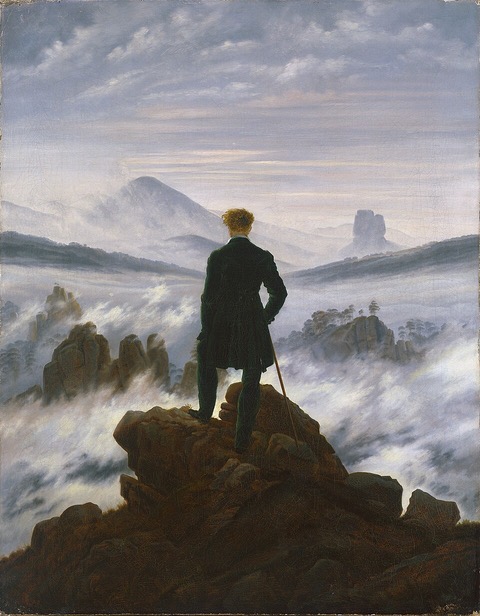
Shadows, Reflections and Ponderings above the sea of fog
or
Flashes From The Archives Of Oblivion
(How things actually do fall apart — but only if we allow it)
30 nine-year-olds sat at their desks in Primary School, me at the back, and we listened to Miss Raine ask us who we thought ‘They’ are in response to someone suggesting that “they should ban them from the toy shops”. Thus Miss Raine introduced the concept of there being no ‘they’, no us-and-them. Only us. A life lesson learned — two words henceforth to be used judiciously; both ‘They’ and ‘Should’.
Breakfast, a week later my father tried to explain to my older brother that the red plastic toy soldier that was included in the Kellogg’s Corn Flake box was not actually ‘free’, that we had paid for it over all the previous Corn Flake purchases. “But it says it’s free” argued my brother, who never understood. He went on to be a financial consultant arranging mortgages. A life-lesson learned: nothing is ever free.
Teatime a week later my mother quizzed why I thought The National Front was making the world a better place and I had no answer for that. Politics was big at our table. A life lesson learned: we must embrace the otherness of others.
My mum ran a tight household budget. I wanted to borrow money to buy a cassette recorder so that I could tape concerts. The parents never loaned me a penny, I had to save up my paper-round money, buy it outright and now I have cassettes of those bands I surreptitiously recorded, copies of which I sold to classmates and a life in the music industry followed. (Strangely none of my pals wanted the recording of Can at The University College London “it’s just drumming” they said).
A life lesson learned: Home taping wasn’t killing music.
I probably learned a few more things at that age where a developing brain is open to ideas, influence and imagination, before the great shut-down of our thirties forgot so much of it and we failed to acknowledge the privilege of a welfare state, of health and happiness, of not having our houses demolished by pilot-less drones.
2025 — this was the year of a country wanting something for free: lower taxes yet more public spending. The Americans would say “go figure” or “do the math(s)”. If we don’t get this we will blame ‘them’ and we’ll make the world a worser place.
This last year seems to be the time when things that were threatening to fall apart fell even further apart. We have benefits creaking at the seams, benefits my parents fought hard for which we sold off on the open market whilst we built nuclear power stations and railways we cannot afford, yet seem oblivious to the needs of communication and how simple these could be if only my Suffolk home could get a ‘phone signal more than one blob, could stream things beyond a buffer and could get a DAB signal for the wireless that didn’t keep submerging into an audial fishtank. I then tell myself not to say that “they should…”
We make our own entertainment.
Author, broadcaster and MP (before he saw the folly in that) Rory Stewart’s new book Middleland concerns itself with his early days in Westmoreland where he worked as a reporter on a local level. Like my Suffolk a county of dissent, Westmoreland is a place so cut off from The Central Government Of They one has to think and act along local lines. He writes how a local community knew it needed more homes (not ‘housing’) especially for those who were just starting families, and so the local community chose the site (making it harder for objections) approved the planning, and built the homes using local labour, before setting up their kids to live in them.
I dearly hope these are not seen as rungs on the obscene ‘housing ladder’ not ‘starter homes’ but are seen as homes forever. Stewart goes on to describe the much needed, and oft-disregarded localism as a way to run a household (like my mum) and thus to run a community, town, county, country, and, yes, a continent we somehow still call Europe.
By doing that we may see migration as a world problem, one that has existed for millennia, the solution and accommodation to which has to be solved on a global, yet local level, much the same as the perils faced by our environment — which must include humans in that misleading word ‘nature’. As long as we see outsiders as others we are doomed.
Not long after I was nine I got to see Roy Harper play for free (it WAS free, it said so in the Melody Maker) in Hyde Park. The rest of my sixty years has been spent with Harper at my side. He’s a good deal older than me but he managed a second leg of his farewell tour this year. Though I had tickets for his Birmingham Symphony Hall concert — the usual rowdy celebration of all things Roy — I somehow managed to see him in a tiny pub in Clonakilty beforehand. Something I won’t ever forget.
As I get older I find music suits pubs better than almost any other venue. Where I am we are surrounded by fantastic thriving pubs, so many of these pubs host sessions in them, ‘big’ names drop by to play, and if this local intimate setting is our substitute for some vacuous arena on an industrial estate then I know where I’d rather be.
To get into these pubs requires no ‘dynamic pricing’ ticket, no internet scramble, no bag search, no queue at an overpriced ‘merch’ table, no jostling for beers at London prices, no pillock next to me on his phone checking his share prices, and no missing the last train home complete with bus replacement service.
Somehow the year’s fog grew denser. A welcoming embrace with the ever-thrilling recent Burial release of Comafields / Imaginary Festival. At three minutes shorter than Nick Drake’s 28-minute epic Pink Moon, Bevan the Burial makes music with the listener uppermost in mind. This is true folk music, the sound of south London in collaged shrapnel and indistinction once again served up as an enigmatic soup.
When desperation sets in and we crave clarity, sometimes the opposite reassures us that the solution is up to us alone. 2026 will mean look-to-your-neighbour — keep it local on a global setting.