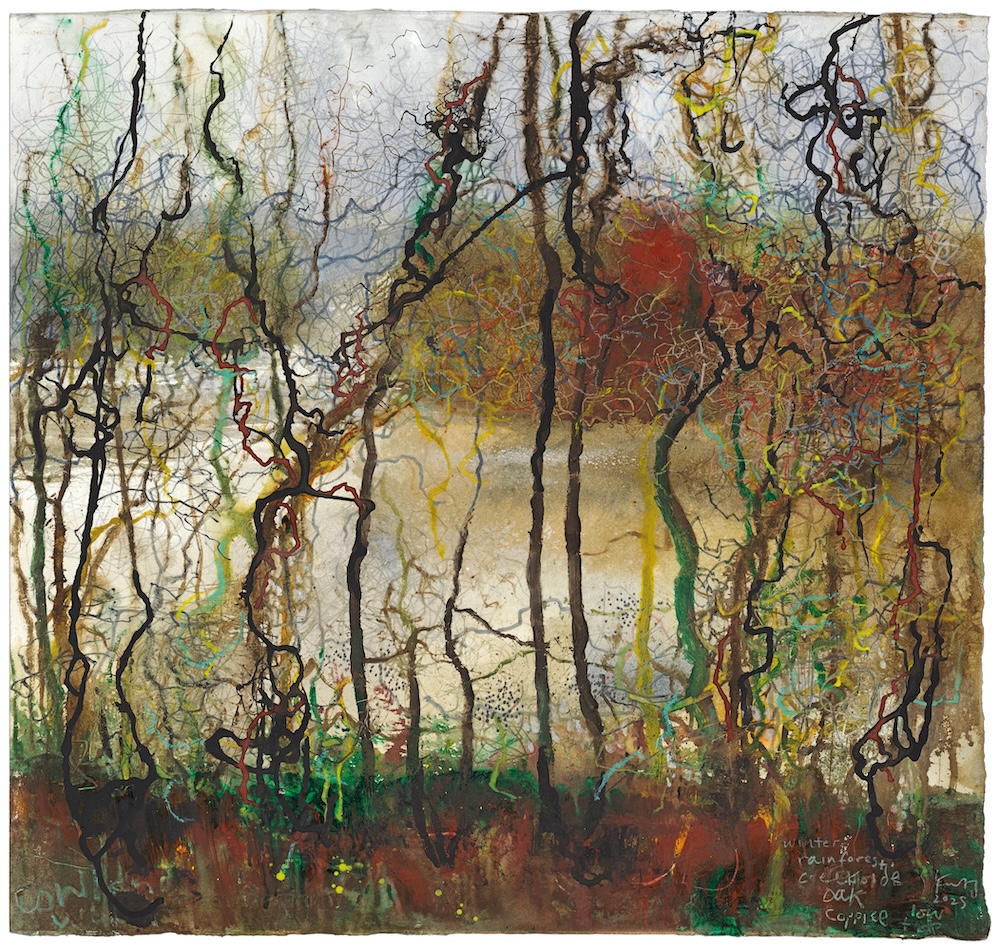
Bird song, river mutterings: Kurt Jackson looks back over a year painting the flora and waterways of West Cornwall.

This year we have again concentrated on the meadows on our smallholding in Cornwall by reseeding, hay cutting and grazing to create beautiful multi-coloured spreads of richly floral fields alive with insects and birds.
This became one of my subjects, to paint time and time again, with the sea’s backdrop and the grandchildren running through.
That incredible array of flowers in the landscape this Spring, just outside the door and on our walks, marked a memorably floral year, and in a way some immediate personal relief from the seemingly endless dark shadows of international war and upheaval and the desperate climate crisis.
A veritable plethora of wild blooms were on display; the Cornish hedges, verges and cliff tops were so vibrant this year that I wanted to acknowledge this phenomenon with the Seaflower exhibition. I painted sea asters, the sea cabbage and sea orache, the two gorses and the four heathers. I shone a light on the everyday ‘weeds’ and the rarer and less noticed species, and I visited the only colony of Sea Daffodils.
Sea daffodil
We met before
In those warm dunes
By another sea
On another shore
Where I was a visitor
Just like those moths
That fluttered around you
Attracted by your slender pale beauty
Spectral in the balmy nights
Glowing like moonlight
You were christened here
In our down to earth Cornish ways
Like some bog-standard bloom
Cut for the vase
Ignoring your fleeting ornate fancy
Your continental lily exoticism
Stepping just onto our coast
From those far away haunts
Unlike the determined snails
That want to remove every fluorescence
Graze you away like some plain salad
And despite the heavy stepped tourists
The beachgoers who only see the sun
And the sea
I welcome your presence to our shores
Appreciate the effort you made
But do wonder why you bothered to come at all.
And throughout the year I also studied one particular group of flowering plants that decorate the hedges everywhere I look – the foxglove. Alive with bees, architectural and decorative but wild; self-seeded and marginal they became another series of paintings for a future exhibition.
Another subject matter that marked 2025 for me was The River Fal, which is one of the great Cornish water courses. I have wandered up and down and along this river painting and drawing for the last few years. Most widely known at its estuarine end where the deep ria is busy with yachts, large international ships and the traditional oyster working boats, the inland stretches are less visited or seen. Like all my river projects these bodies of work are essentially a series of connected creative experiences threaded together. I wrote as I wandered:
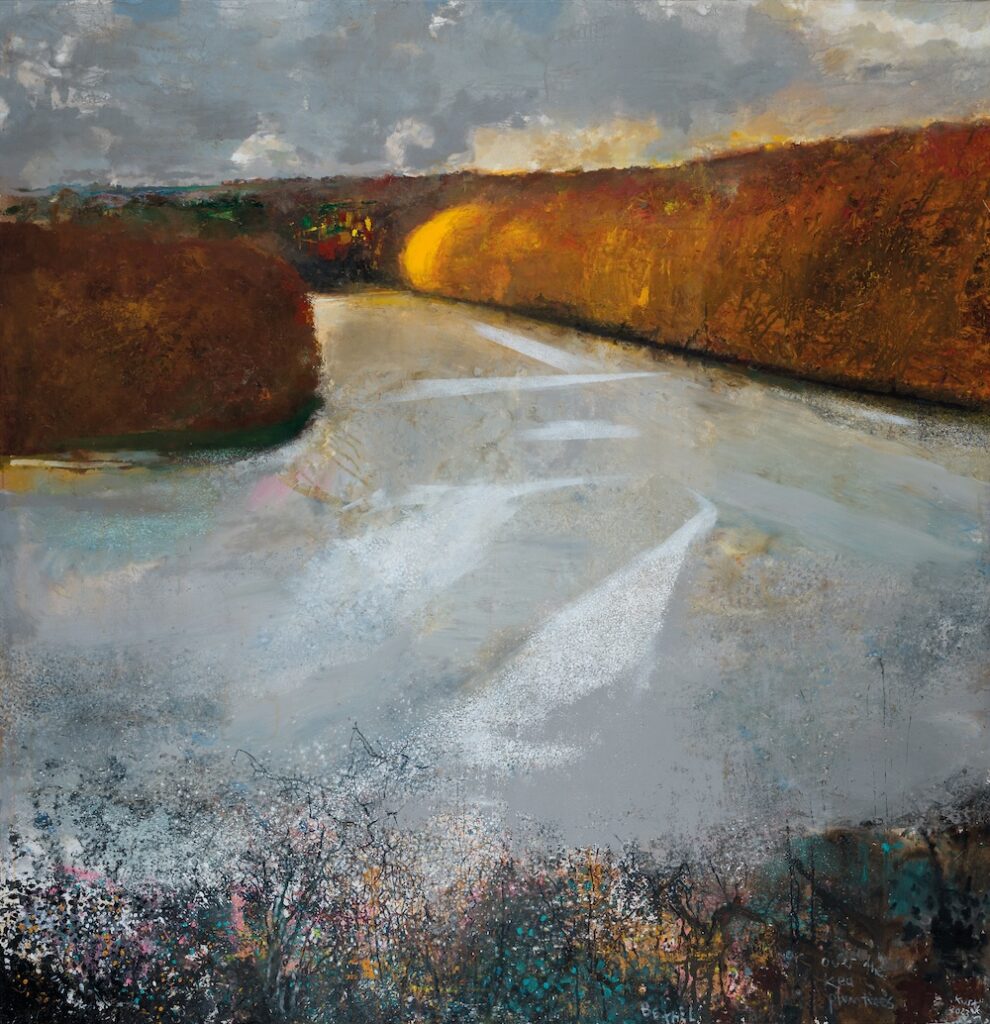
‘We spent days alone on the shore at Halwyn. This stretch of the river sweeps wide in a huge arc of a meander between the high brown wooded bluffs. Very few houses or fields show, just the dense dark oak, ash and holly hanging above the waters. The river reflected the grey skies, the mirrored surface changing constantly in shifts of tone, pattern and contrast. Bands of light on dark or dark on light, speckles and dashes with streaks of brightness and shadow between, come and go, glide away to reappear elsewhere.
This wide lake-like mass of water was a moving light show on the river’s patinated metallic plain. And that was what I tried to capture and hold with my canvas and boards and paints, putting the pigment on and scraping it back to the exposed white again repeatedly. The King Harry Ferry clanked back and forth in the distance but the silence between was powerful, portraying the emptiness and solitude. A gull screeched, a crow cawed revelling in the acoustics of the meander. A cormorant’s flapping of wings half a mile distant seemed clear and close; sounds carry across still empty waters.’
‘Lucy’s Beach: the rain was coming in but I found some shelter by sitting on a shelf of rock at the back of the beach, just under some overhanging elm branches with the jutting cliff hiding me from the prevailing wind. Like most of Flushing the exposed foreshore was a mass of moored small craft of mixed shapes and sizes, all connected by a cat’s cradle of ropes and chains lying on the seaweed and shingle. I painted Falmouth opposite, all those terraces and lines of roofs and houses, pale through the haze of rainfall with the grey waters of the river in front, the surface ruffled by the strong winds making the boats jostle and fidget, swiveling at their moorings, while their masts clinked and played metallic tunes.
I met an ex-soldier who had been digging for clams at the low water mark who wanted to share with me his stories of the horrors of fighting in Afghanistan; the shellfish collecting was therapeutic for him, relieved the PTSD but he had a lot on his mind. It was distracting for me, suddenly hearing a first-hand account of war and death, made me question my own purpose, giving me thoughts of futility and politics, global perspectives and my late Quaker father’s preoccupations with peace and anti-war. My visitor eventually walked on, leaving me with a gift of his clam rake so I could try it for myself one day. I returned to trying to make sense of this place, with a head full of conflicting thoughts racing around my mind. I buried myself back in my daubing, scraping and scumbling, ‘raking’ the paint to get somewhere that could sum up my place on this wet foreshore of grey, pink and brown in the driving rain.’
The Fal rises in China clay country and carries its heavy load of clay substrate through Cornwall’s agricultural and nature-rich hinterland. As well as painting the topography and life of the river I also wanted to work with this clay, the bed of the river. A shovelfull of grey jelly-like bank clay provided me with more than enough material to work on a series of ceramics.
Cornwall’s (and the UK’s) only tea plantations grow along the banks of this river at Tregothnan and I felt I needed to engage with this unique agriculture with this project. By chance a three tonne batch of dried tea leaves was deemed below par and not good enough to sell as a beverage and kindly donated to my ceramics. Once burnt, the tea leaves’ ash was then ground down to make a small amount of powder, just enough to make a glaze.
My river clay made a fine porcelain and the tea leaves a silky grey-green glaze to make a number of River Fal tea cups and saucers.
The Jackson Foundation in St Just is currently showing the results of my Fal riverine wanderings: paintings, drawings, ceramics and jewellery.
Our annual pilgrimage to Somerset for Glastonbury Festival was delightful this year. The combination of good weather and a great lineup. Being on the Pyramid Stage next to Burning Spear ticked a lifelong wish of mine. Ever since I was a teenager in the 70s I’ve revelled in Winston Rodney’s passionate gravely croonings with the familiar heavy bass and horns. Painting and drawing at his feet with 100,000 reggae-loving punters swaying and skanking out front was one of the highlights of my nearly three decades of being the Artist in Residence at the festival.
Living in West Cornwall the sea is my constant neighbour and appears in much of my work as subject, setting or influence. I live not far from Land’s End and have for many years been intending to visit the other Land’s Ends in Europe to paint; those headlands of the Celtic Atlantic, and with that in mind I chose to travel to the Spanish Land’s End in Galicia, on Cape Finisterre; the end of the Camino de Santiago pilgrim routes.
As we left the village of Fisterra and headed towards the end of the Cape, we started to see the pilgrims, in couples or single, straddled along the sides of the road, all heading in the same direction. They all carried backpacks, some with the scallop shells swinging from them, others with small wooden crosses around their necks; you could feel their weariness as they approached the end of their trek. And then, when we reached the car park at the very end of the road, the numbers increased, tourists and pilgrims gathered, loud with conversation, busy taking photos, selfies and discussing the view. Out on the tip, the crowd stood around on the foot-eroded bare rock by a stone cross with the immense blue Atlantic as a backdrop. A swallowtail glided by and a swift soared above the ocean. Voices from every corner of the globe were merged by the sea breezes in the hot glare of sunlight. It felt like a hot version of our Lands End, the same rock but different plants and beautiful green wall lizards and Spanish butterflies, but the same population of people, an international mass all gathered together with the same intention to get to this place of nowhere and stare into the blue yonder.
Back at home, we are all aware of the state of our rivers and seas through the daily news feeds alive with stories of the abuse of our coasts and waterways. I contributed to the Surfers Against Sewage day of education and campaign with their Plastic Free Seas for Schools day. With some lively workshop films and classes, we discussed biodiversity, ecology, the pollution and how to try to respond by campaigning and making visual art and writing.
I have finally completed the River Lymington series of paintings ready for St Barbe Museum and Art Gallery in Lymington early next year. For such a densely populated part of what itself is a densely populated country, and like all our rivers in these times, the Lymington River is facing challenging pressures; however this river of the New Forest has somehow survived and maintained a refreshingly healthy condition as well as a valuable wealth of biodiversity.
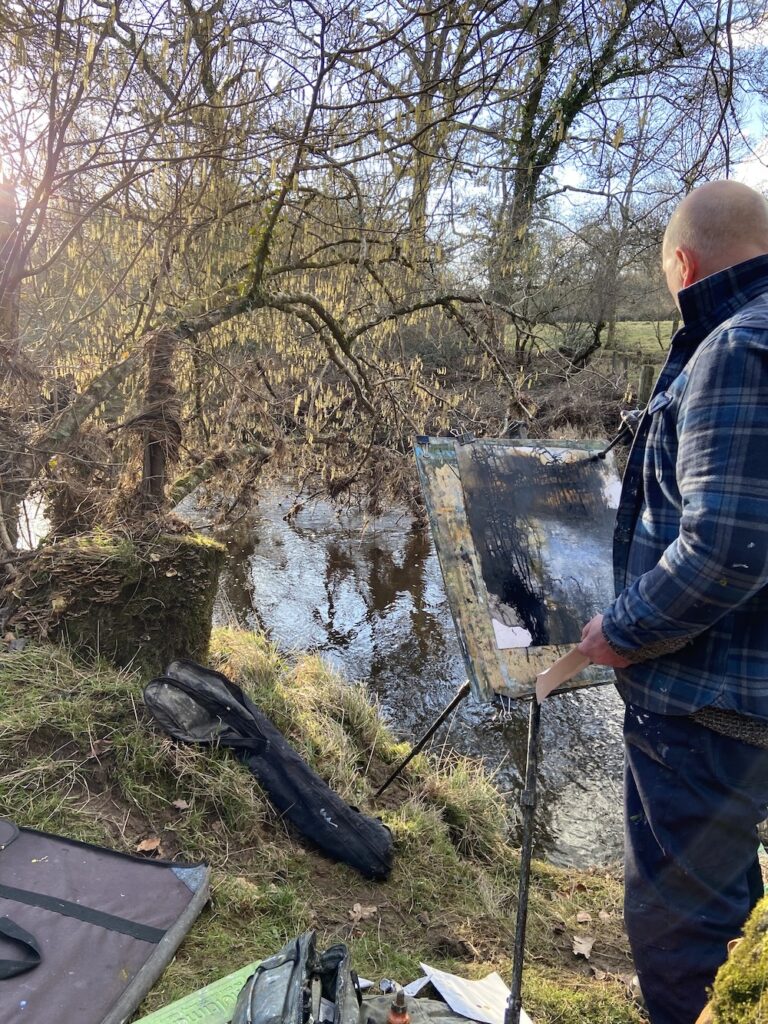
I found this watercourse provided me with the rich and varied material I revel being immersed in. By far the majority of these paintings were created in situ, that immediate involvement and experience being essential both for my inspiration and for a collaboration with the location.
As usual Caroline’s company and involvement in this artistic journey has been both vital and an inbuilt part of the equation in making what became a delightful and fulfilling chapter in our lives.
Roydon Woods
With eyes closed
500 years had not passed
My upturned face bathed in Autumn sunlight
Washed by tree-leaf-rain
Feet sunk in deep churned mud
A mushroom scent of forest fungi
Buck grunts, commoners’ cries
Bird song, river mutterings
That was all I heard
Until then a Sunday morning motor bike din
Shattered my little dream
Screaming urban through the forest
To link my country to his
And drag me back to the now.
And so, the year approaches its end and it’s time for me to dig out my ancient nativity costume, ready to take part as one of the ‘four kings’ in the St Just nativity play. Along with my son-in-law and two of my grandsons, we practice a few lines and look forward to this delightful annual community event along with the real sheep that always poo on stage and the real baby Jesus that always cries so loudly. It’s always a spectacle, both unpredictable and fun.