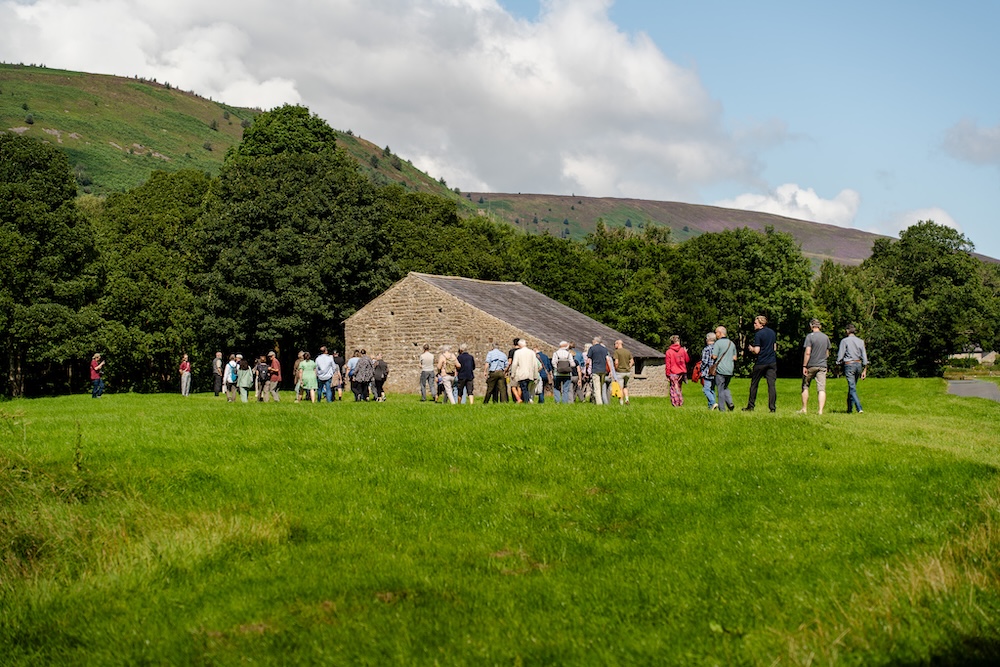
Rob St John considers how archival material informed his Are You Lost? project — a 2025 series of community-minded film, sound and textile installations across the Forest of Bowland. Photos: Ray Chan.
A tradition worth passing on: John Weld, ecology and community in the Forest of Bowland
Adapted from the Lord of Bowland lecture given at Browsholme Hall in the Forest of Bowland in October 2025 reflecting on learning from historical archives to shape socially-engaged artwork as part of the Are You Lost? project.
This year I’ve been working with the John Weld archive – held at the Harris Museum in Preston – as part of my Are You Lost? project. Weld was a Victorian landowner, antiquarian, naturalist and painter who lived at Leagram Hall in the Forest of Bowland, Lancashire. Born in 1813, he made detailed written and visual records of both the local area and the places he encountered on travels across Europe. One document has been of particular interest to me – and to the communities I’ve been working with – a notebook titled: The Flora and Fauna of Leagram and Neighbourhood. Written through the mid-19th century, this ledger – a collection of field notes, sketches and paintings – reveals his naturalist’s eye and artist’s sensibility coupled with a keen awareness of Bowland’s changing landscapes.
Its first line reads: ‘Fifty or sixty years ago many birds were common in this district, that are rarely met with now. Many usual winter visitants then, are very casual, or more than rare occurrences at present. The universal use of guns, the general discontinuance of corn cultivation, the reducing much woody waste, and marshy land to comparative cultivation, with the great preservation of game that now exists, encouraging the destructive instincts of keepers especially of late years, are amongst the principal causes of all but the total disappearance of many kinds, and of the greatly reduced numbers of others.’
The first theme that stands out is Weld’s use of ‘met with’ as a way of describing his encounters with the natural world. There’s something quite charmingly modest and reciprocal about the phrase, which recurs throughout his ledger. And related, a second theme is the sense of uncanny contemporary resonance. The idea of shifting baseline syndrome – that each successive generation tacitly accepts an increasingly degraded version of their local environment – is a central theme to contemporary landscape thought. But here we hear directly from Weld that this isn’t solely a modern phenomenon – that even two centuries ago communities were witnessing a deadening of Bowland’s ecosystems as a result of human activities. So the Weld archive encourages us to look again at Bowland’s landscape, to ask: what has been lost in our encounters with the natural world, and what might be recovered?
Weld’s ledger begins with birds of prey. Describing sea eagles, peregrine falcons, merlins, red kites and marsh harriers across Bowland, Weld’s proto-environmental ethic is filtered through an aristocratic civility and unease with the way in which biodiversity in the landscape is being lost. He writes, ‘some have been very common whilst others in late years, have only been rarely met with. A war of extermination against all the tribe has been latterly carried on, too successfully by the gamekeeper, by means of his ever-ready gun and by different engines especially pole traps.’ There’s a tension here. Many birds – even tiny ones like the wheatear and goldcrest – appear in Weld’s ledger after being brought to him by gamekeepers for identification after being shot. So the agent of their destruction is also the envoy of their description. Weld has the collector’s zeal of many wealthy men of his age, and his writing communicates the implicit idea of a landscape in need of documentation: his ledger a cabinet of Bowland curiosities.
There’s a beautiful sense of local naming for wildlife in Weld’s writing. The kestrel is the ‘windhover’ (also the title of an influential poem by Gerard Manley Hopkins, who studied and taught in Bowland in the 1870s); the great grey shrike (which creates its own larder of insects by impaling them on hedgerow thorns) is the ‘butcher bird’; the grey heron is the ‘Johnny Gant’, the ‘Long Neck’, or, for some unknown reason, ‘Frank’. And Weld has a rich descriptive turn of phrase for telling stories. When discussing a sparrowhawk he writes – faintly absurdly – that, ‘a fine male was taken in the drawing room at the hall September 16th 1877. It had dashed through a pane of glass, shivering it to pieces, a case of hummingbirds near the window was probably the cause of the intrusion.’ However, the impact of the modern invention of grouse shooting in Bowland – part of the wider British aristocratic fashion of ‘Balmoralisation’ popularised by Victoria and Albert in the mid-to-late 1800s – is rarely far from the surface. Weld writes about owls of all sorts – long-eared, short-eared, barn and tawny – and corvids being, ‘very common all through the district in my recollection but will soon be almost extinct as far as this neighbourhood is concerned. Through the rapacity of bird collectors, and the indiscriminate zeal of gamekeepers, killing everything that in their opinion might possibly be hurtful to their charge.’
Weld documents birds no longer seen or heard in Bowland like the corncrake, the golden oriole and the bittern, and highlights the abundance of those whose numbers had dropped, such as the house sparrow. He also notes the arrival of unusual migrants like the gannet, or solan goose. He writes about finding a gannet asleep in a field in November 1872 after a gale, its six foot wingspan looking, ‘like a small drift of snow in the sunshine.’ He continues, ‘I was enabled to steal up to the bird and seize it by the neck, and with some difficulty, succeeded in carrying it home.’ There’s something quite daft and tragic about this picture: a throttled gannet, its wings like a gleaming snowdrift being carried across the fields, back to the manor to be added to the collection. These documents of Bowland’s wildlife are so specific and strange that they seem almost mythological, when really, they resided in the memory of those who met with them just a few generations ago.
Weld’s writing hints at the prevailing attitude to wildlife in Bowland at the time. He cites a monk from nearby Whalley describing a church erected at Chipping after the departure of the Romans, suggesting that the ‘neighbouring country was a frightful wilderness of impassable forest full of foxes and other wild beasts.’ There’s a neat etymological link here. The word ‘wild’ in modern English evolved from variants of weald and weld in old English, denoting a wooded or untamed area populated by wild animals. Weld is appropriately named to survey a landscape which, while rich in biodiversity, was having its wild nature dulled by human stewardship. The monk’s words remind me of the language used in the descriptions of the enclosures across Bowland through the 16th and 17th centuries, which commonly refer to the fells as ‘upland wastes’. It was in this period that the opportunistic and often anti-authority demarcation of farmland – patterns of land tenure we still know today – took place in a process known as ‘assarting’. Weld writes that the wildcat was, ‘not infrequently met with 35 years ago,’ below Fair Oak fell, a last refuge from the gamekeeper’s strict control. Similarly, he describes Wolf House at the foot of Parlick fell: a respite for travellers from remnant populations of wolves, which could be shot through an aperture in the door. One local story goes that the last wolf in England was chased from the Bowland fells and killed at Humphrey Head on Morecambe Bay sometime in the 15th century. Regardless of this tale’s accuracy, the traces of a wilder Bowland remain in its non-human names: Wolfhole Crag, Cat Knot, Kite Clough, Foxdale Holds, Wolf Fell, Boarsden. And likewise, in Weld’s writing, we glimpse the historical ebb of the wild and the waste in Bowland: how they have been framed, and how they have been tamed.
Weld’s writing also evokes a historical soundscape of Bowland: where the nocturnal summer song of the nightjar echoed across Longridge Fell; the bittern boomed in marshes which had yet to be drained; and the corncrake croaked in farmer’s fields and meadows. But this isn’t solely a nostalgic reverie for a lost world: Weld’s writing documents the shifting use of Bowland’s landscape, and the ways in which nature moved with it. In addition to the rising persecution of wildlife in the mid-to-late 19th century he also notes the biodiversity which has disappeared with changing agricultural practices. He describes the decline of birds like the common partridge and jay which benefited from the cultivation of corn in the area – a process that declined following the repeal of the protectionist Corn Laws in 1846 by Robert Peel, himself the son of a Lancashire farmer. Nearly two centuries later, projects across Bowland are exploring the potential of regenerative and nature-friendly farming approaches to help farmland biodiversity to recover whilst supporting sustainable livelihoods in communities squeezed by rising costs and isolation.
These dynamics resonate with deep historical research undertaken by John Porter and Mary Higham in the 1970s and 80s, the long-term ecology work based on pollen cores by Anson McKay in the 1990s, and the recent archaeological work undertaken by Rick Peterson: all of which in different ways reveal the shifting dynamics of Bowland’s landscape through history. Porter and Highams’s work highlights the interplay of people and nature across Bowland since the 1500s: the clearance and ordering of the landscape for the royal hunting forest; and its subsequent marginalisation and spontaneous rewilding, too far from the urban court to be of regular use. For all that the modern imagination of Bowland might be akin to a static picture – empty fellsides and quiet villages in a state of living history – these historical accounts, like Weld’s, reveal a landscape that has never really stayed still. And the memory maps drawn by hundreds of people in village halls, shopping centres, workshops and walks across Bowland in Are You Lost? attest to this idea of a storied terrain: the places where communities explored, trespassed, proposed, skinny dipped, gathered, grew and harvested, spotted rare birds and flowers, came out to their family, fell in love, campaigned for access, bivvied out, marked where their ashes will be scattered, and experienced “life changing intimate moments amongst the bilberries,” amongst many others. Then, as now, Bowland has never been blank space.
Weld’s own sense of specificity in documenting the natural history of Bowland reminds me of a country vicar, writing more than a century earlier in Hampshire, whose archive has become so influential that it has never been out of print. Published in 1789, Gilbert White’s The Natural History and Antiquities of Selborne is regarded as a founding document in modern ecology. Like Weld, White surveyed the ecological intricacies of his local landscape in a manner which might now be called citizen science. Unlike Weld, White’s archive found wide public attention, drawing praise from Charles Darwin among others. In an era of ecological crisis and climate emergency, this sense of close attention to the fluctuations of people, place and wildlife shown by both Weld and White is vital, both in documenting our changing world, and in helping tell powerful stories about the need for its conservation and restoration. In Weld, we have a very local inspiration for this task, and my work in Are You Lost? suggests that this spirit of curiosity and attention has a valuable role in helping communities connect to Bowland’s landscape. As one attendee at a workshop said – so poetically – of this process, “the first step ripples out across lifetimes.” And as the wider project has suggested, public access to landscapes like Bowland which have historically been closely guarded by private ownership can help foster new forms of attention, care and responsibility towards their flourishing in the future.
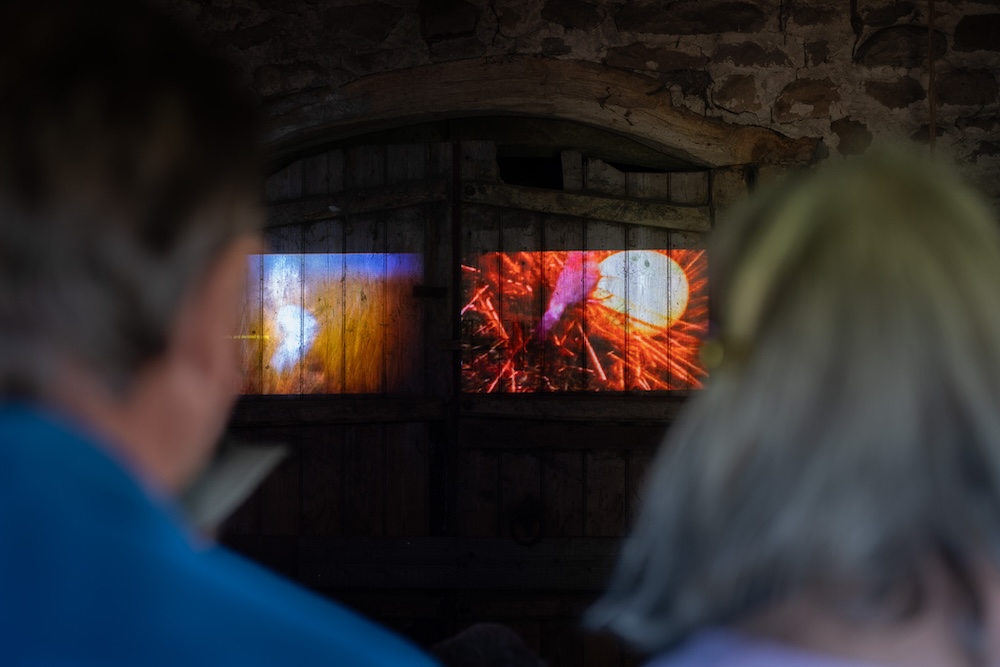
The Weld archive shows how people and nature ebbed and flowed across Bowland in the 19th century, in particular the patterns of ecological diversity and abundance in relationship with changing land practices across farming and grouse shooting. These dynamics reveal a landscape always on the move. As such, the Weld archive undercuts the narrative which legitimitises the bulk of environmentally damaging activities in Bowland – the burning of the fragile moorland and peatland; the trapping, shooting and snaring of non-game ‘vermin’; the secretive wildlife crimes imperilling birds of prey like the hen harrier – based on a seemingly-timeless imagination of grouse shooting in the landscape. By working with historical archives, we see that this framing – so dominant, and scaffolded by invisible strata of capital and privilege – is the product of only a brief moment in the deep landscape history of this place. This insight resonates with the contemporary work with communities in Are You Lost?, which has engaged a significant and well-informed public, both across and around Bowland, who would seek to see its management shifted towards more environmentally just and democratic forms, and to ask difficult questions about how it is managed, and for who. You can hear these community perspectives and voices in the film we made together and toured across Bowland this summer.
The Weld archive also highlights how plants, birds and animals which have been largely lost from contemporary imaginations of Bowland – like the corncrake, bittern and sea eagle – are commonly met with, just a few generations ago. Perhaps if we can take inspiration from the archive when thinking about the future of Bowland, the imperative is not about restoring the landscape to some pre-industrial baseline, but instead to learn from a dynamic past to collectively shape how it might flourish in the future, both for people and for nature. I often think about the abundance of Weld’s world when on the depleted fells; where the only sound is the rustle of the Molinia grass and occasional clatter of a grouse. I wonder how they could be more: a sponge for water, carbon and life of all kinds; a life-support system for the environmental, social and economic pressures of an increasingly stressed world. As another community collaborator said in a workshop on Bowland, “this is a place steeped in memory: can we allow it to dream?”
Something I’ve learnt in this project is that encouraging wider public access to Bowland’s landscapes can help cultivate new forms of imagination, openness, and accountability in how they are managed. And learning from the past can help guide this work. Archives can help us get under the skin of a place, even when we might not be able to get there ourselves. Archives are themselves landscapes: joining up threads of time and space; always open to being remade. Navigating them with new communities helps us unearth connections and glean visions; to expand the frame of what this place could be, and for who. Weld’s fine-grained attention to the dynamics of wildlife, people and place in Bowland formed the basis of an early conservation ethic rooted in care for his local environment. We find communal forms of this ethic in citizen science, community ownership and rights of nature movements that are helping bring landscapes back to life across the world today. As the work in the Weld archive in Are You Lost? suggests, fostering a deeper sense of place and belonging through engagements with the past can help shape productive and democratic imaginations of the future. We might call it an ecology of hope. As workshop collaborator Zainab Maria writes of Bowland in Home in the Hills: A Manifesto, ‘let this be an invitation: to slow down, to listen, to ask what kind of future might grow from care, not control… To belong is not only to take from the land, but to give back. To tend, to listen, to share. That may be the beginning of a tradition worth passing on.’
*
Are You Lost? was a series of film, sound and textile installations across the Forest of Bowland which explored the diverse voices and perspectives of the communities that live around the area. A series of temporary installations were shown across the National Landscape in 2025, both in accessible venues and more remote, largely-unused spaces.
It was produced with the Forest of Bowland National Landscape and Lancaster Arts, and commissioned by Nature Calling, the first national programme of new art commissions by the National Landscapes Association.
Explore films, podcasts, writing and resources from the project here.
The John Weld collection is held by the Harris Museum, Art Gallery & Library, Preston. It is also being interpreted by artists Ian Nesbitt and Ruth Levene in new work.