As a yet-to-be-built bungalow beckons, Sean Prentice concludes his relationship with a mysterious field.
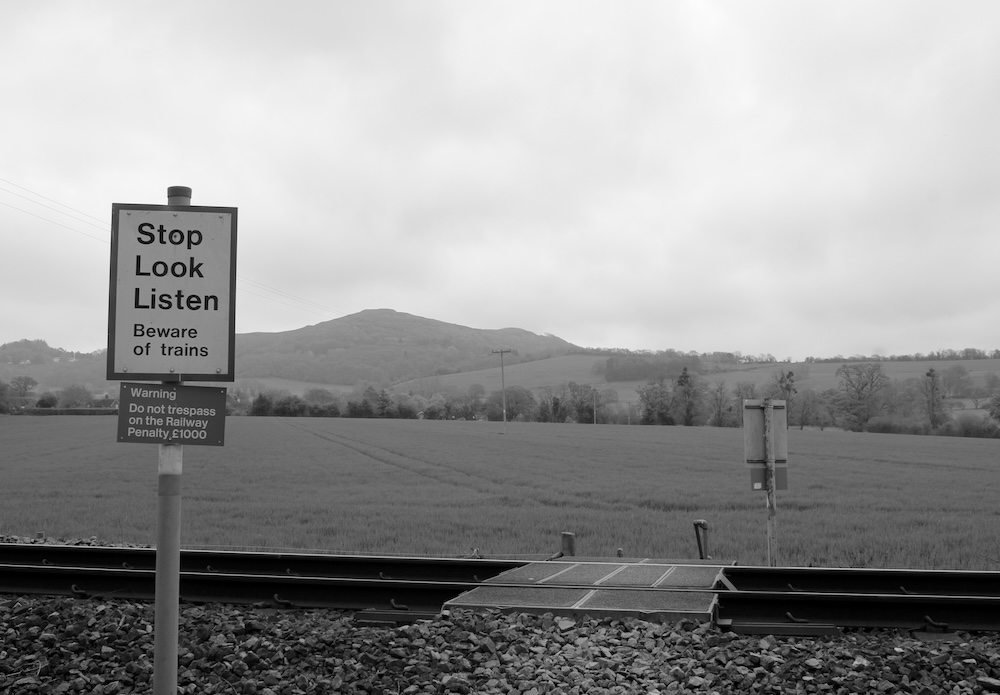
Dog-Walking On Faerie Soil
The man that ploughed the ley would never cut the crop.
— T. D. Davidson, The Untilled Field, Agricultural History Review. 1955.
There are in or near Worcestershire a great many fields and other places of the names “Hoberdy”, “Hob”, “Puck”, “Jack” and “Will” …
— Jabez Allies, On the Ignis Fatuus: Or Will ‘O’ the Wisp, and the Fairies, 1846.
In the last twelve months, as I enter my sixtieth year, as my disability progresses, as my mobility fails more certainly, a yet-to-be-built new build bungalow beckons, more insistently, and I begin the process of uncoupling from the slightly damp mudstone cottage, built in 1873, where I have lived for a decade longer than I have lived anywhere else ever. As part of this stilted farewell, which like all life changes is a variety of mourning, I have decided once and for all that I have to ignore a field — or rather to ignore The Field, to finally say, after all these years of unpredictable and confusing behaviour on its part and frustrating attempts at communication on mine — “this is the end for us”. The field in question isn’t much to look at — a standard issue agricultural space fringed by hawthorn and blackthorn, boggy at the farthest corner, and bounded at one edge by the Worcester-Hereford line, yet it seeps a rare order of liminality. The location itself, on the edge of the village bounds, beyond the remaining boundary oaks, lends itself to be another order of periphery, as a space between the everyday and down-to-earth and uncertain supernatural worlds. During the fourteen years of being its neighbour the field has oozed enough unplaceable strangeness to make me wary and suspicious of its true identity and possible intentions. The familiar becomes unfamiliar just beyond our back hedge. Walking the bounds of its almost-square I have on occasion become temporarily unstuck in time, I have heard discorporate voices at my shoulder and strange, unplaceable music. I have questioned both where and who I am.
The field is named as Jack Field on the 1841 tithe map of the village. I already knew enough to wonder about that name. There is of course Every Man Jack, Jack Tar, Jack the Lad indeed Jacks of all Trades and although once upon a time every John was also nicknamed Jack I had an inkling that the Jack of Jack Field wasn’t a person at all, at least not a person in the strictest sense. Jack Field always puzzled me. In the adjacent Broadley Ground, where the shorn wheat stumps crunched underfoot, each harvest brought to the surface fresh shards of long broken crockery. I have two pickling jars full of this field-edge flotsam — blue and white, the odd piece honey-coloured slipware — evidence of harvest repasts gone by — but I seldom find ceramic or anything much at all to indicate human agency and industry in Jack Field and surmise that it had rarely been cultivated or laboured-upon before living memory. Thumbing through a copy of George Ewart Evans’ The Pattern Under the Plough I find a reference to survivals of the belief that certain uncanny fields within the parish should be left untilled, and that these fields ‘sometimes called Jack’s Land’ carried a taboo. I think of Jack in the Green, close kin to the Green Man, and his association with fertility rites, a bringer in of plenty — and that givers in folklore are often takers also. Jack, within this context, I learn, was the generic name afforded to many of the sprites, imps, and other members of the Secret Commonwealth that might slip into human form bestowing good fortune or alternatively cause all manner of mischief. So it was understood that not to exploit the “fairy soil” of such land was a due, a deal made on behalf of the whole community to appease capricious supernatural forces and in so doing safeguard against havoc and mayhem, mischief and misfortune. I research further and find that the practice of sacrificially offering up land in this manner — in many instances on a farm by farm basis — was, in other parts of the British Isles, also referred to as the Goodman’s Croft, Gudemen’s Fauld, and Goodman’s Fauld. Clooties Craft, Jack Craft were other variations. Here the word croft for enclosed farmland is as much Middle-English as Scots and the old time Gudeman doesn’t contain the adjective good with an anachronistic spelling but the Anglo-Saxon noun god — the Germanic Guda. Meaning I think that the Gudemen’s Fauld was once really the god-man’s field, a field belonging to a supernatural being. The church and parliament preferring a different god-man crusaded hard to stamp out these practices throughout the sixteenth and seventeenth centuries, particularly through the use of hefty fines but also by the threat of invoking laws pertaining to witchcraft. Ultimately it was economic pressures and which forced farmers to risk paranormal calamity and cultivate all available land and the practice dwindled and then died a death during the course of the nineteenth-century, with any remaining unworked field falling foul of the Cultivation of Lands Orders enforced for the duration of the First World War. It is possible to see the Enclosure Acts of the early nineteenth-century as an action which extended to the eradication and enclosure of folk beliefs along with the commons and earlier field systems. Now Jack Field, perhaps like the whole of the countryside, might be described as a “post-supernatural landscape” although only in that the supernatural has been pushed aside, trampled, and forgotten, in favour of secular common sense and measurable financial concerns.
Earlier today I attempted to walk our dog in Jack Field. A good portion of it is presently out-of-bounds, divided by an ever-shifting latticework of temporary electric fencing, and the right-of-way down along the stream to the railway line has been churned up by so many sheep. The cold clay is waterlogged and slippy and half-rotted beets from the year before stick out of the soil like tiny bleached skulls. It is unsafe underfoot and I am already irked when I meet another dog-walking villager coming the other way, his own dog one of those overly enthusiastic breeds, and he and I fall into discussing the weather (which until the day before yesterday had been “mild for the time of year”) and also the sudden absence of access through the neighbouring fields, and he concludes “O’ well never mind…I’ll circle ‘round…join the footpath over there…” gesturing a semicircle “makes no odds…” and yet it makes significant odds to me. More than I can say as I hobble on. More than I have vocabulary for. The landowner believes, perhaps understandably, that Jack Field is his, but it isn’t. The farmer believes equally that the soil he leases from the landowner is his to cultivate or graze as he pleases, but he’s also mistaken. If land can be owned at all then that ownership resides elsewhere and beyond our ken.
Now, as I write on this cold and wet afternoon, with an early fire in the hearth, I am already partially elsewhere, partially ensconced in that soon-to-be-bungalow-land, and with this shift comes an acknowledgement that my relationship with Jack Field is coming to some kind of natural — or extra-natural conclusion. I have perhaps, like I accept the inevitability of my physical decline and a future wheelchair usage, accepted when it comes to Jack Field I am left with far more questions than answers — an ending without closure. And in the same manner I have inadequate language to describe the nature and nuance of my disability as I experience it over time — so will not even attempt to, I will also not attempt to describe who or what I once met crossing the field in the first light of morning in the that first year here. Suffice to say that the fellow I encountered on that occasion was more foliage than flesh and blood, and he wasn’t walking a dog.