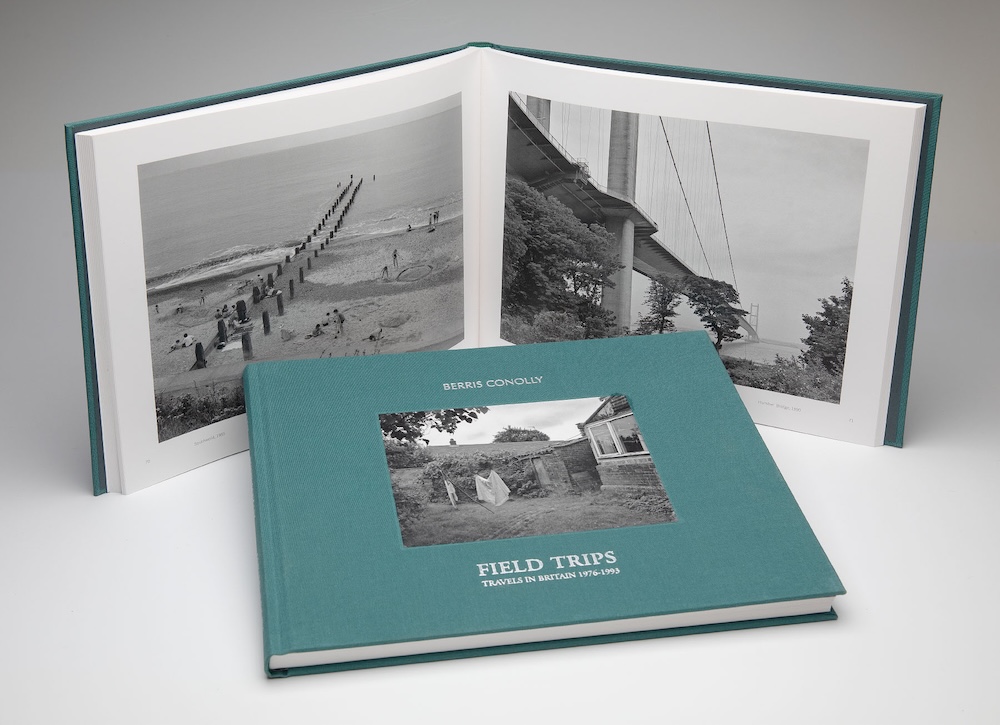
Berris Conolly’s arresting photographs are proof that there is nothing so distant and strange as the recent past, writes Travis Elborough.
In about 1981 or thereabouts, I was given, or possibly inherited, a camera from some family member or other. It was an aged Kodak Brownie 127 of questionable vintage whose curved black Bakelite body and cream plastic shutter button and winder knob made it look like an art-deco radio set, though it hailed from the 1950s or early 60s.
The most basic of point and shoot cameras and sturdy enough to suffer whatever my 10/11 year-old hands could throw at it, this Brownie, despite its obvious datedness when Space Invaders and Disc Cameras were all the rage, became one of my most prized possessions. For the next couple of years it accompanied me on whatever excursions we subsequently made.
For reasons of parsimony and the fear that I’d just waste the then seemingly more expensive colour film, my parents would only buy me black and white stock.
I was under strict instructions too, to take as few photographs as possible. Which given that you only got 8 frames per roll rather limited my photographic output to about one snap per excursion.
But I still have the first photograph I ever took, a dinky square job with white borders, that preserves the monochrome impression of hulking great Highland cattle with horns that could helmet about two dozen Vikings. This picture, just about in focus and actually not bad for a first attempt, was taken at Killerton Park in Devon during one of the many summers we spent in the West Country, as often as not staying with my grandparents.
After running a pirate themed eatery in Polperro in Cornwall called The Jolly Roger, they had by this time moved to Lyme Regis and established a B&B along scarcely less nautical lines and named Bramcote after some boat.
But my memories of this period are forever, I was going to say, coloured but, of course, the reverse is true, de-coloured arguably, by the few precious black and white pictures I have of those vacations and outings. And as poorly shot and out of focus as many of them were, it is how I see those times in retrospect and it is, in turn, partially what I find so arresting about Berris Conolly’s photographs.
For here, if you like, are documents from a yesterday that I remember so well but had almost begun to doubt ever existed at all. It’s proof perhaps that there is nothing so distant and strange as the recent past. These are places out of time and a time now long out of place. Haunts could easily be an alternative title, for there is often something genuinely ghostly about the lost world they show, with even a washing line in Norfolk appearing to be possessed by wraiths and a graveyard of tyres at Hampole outside Doncaster that could very nearly be skulls.
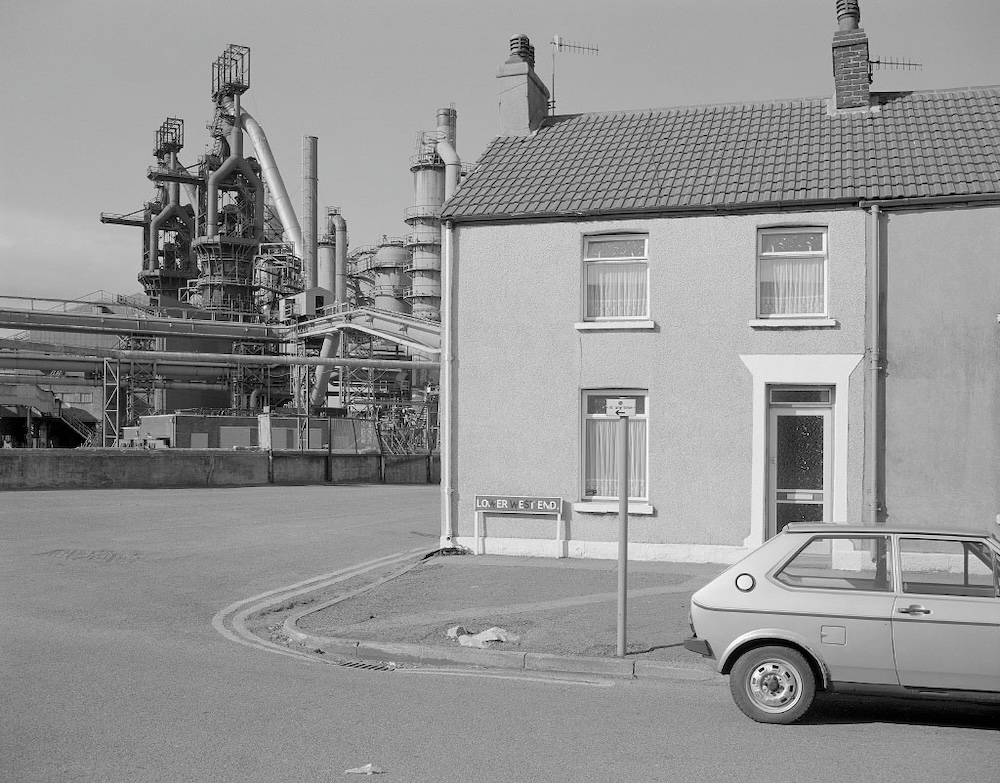
The time frame of these pictures runs from 1976, with its famously hot summer of water shortages and infestation of ladybirds soundtracked by Kiki Dee and Elton John’s ‘Don’t Go Breaking My Heart’ right up to 1993 and the height of rave, the doldrums of John Major’s Conservative government and the horror of Noel’s House Party and Mr Blobby. In between is a nation, and one largely depicted obliquely here, turned upside down by Thatcherism and deindustrialisation, council house sales, consumerism and containerisation. Though the latter is glimpsed in the image of Tilbury from 1985, twinned with a photograph of Port Talbot steel works from three years later, with what looks like Inspector Morse’s vintage Jag parked up outside. And indeed the cars which stud many scenes here are often the clearest indicator of what era we are in. The boot of a Ford Escort Mark III at the edge of a frame, for instance, carbon dating us to the days when sat nav was still largely the stuff of science fiction.
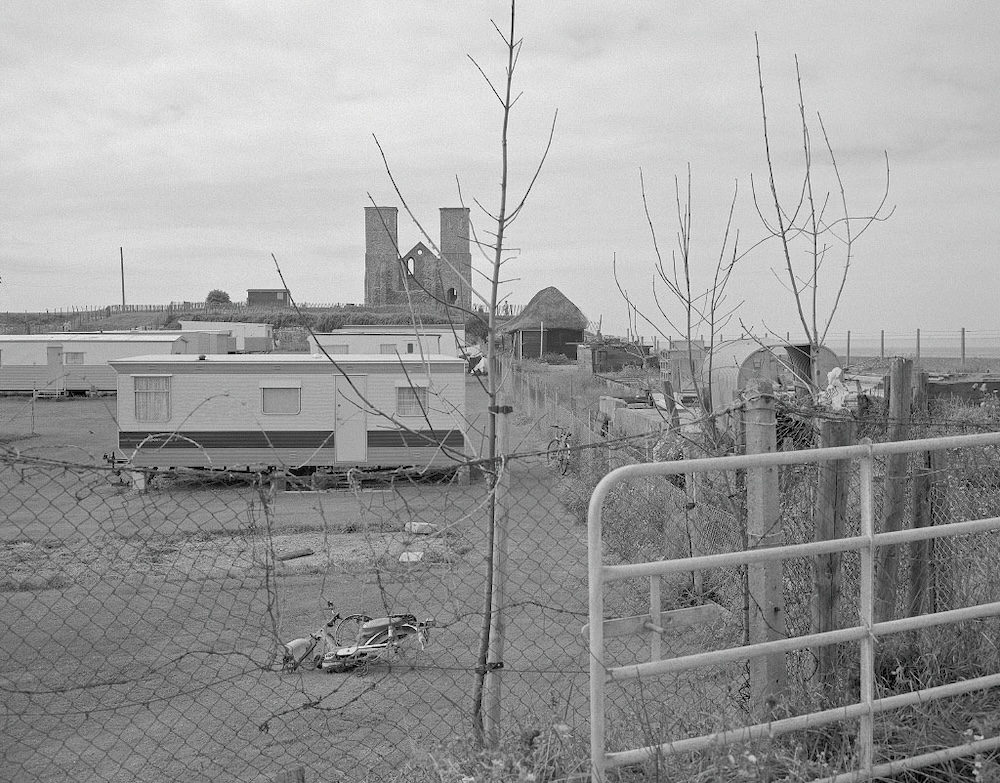
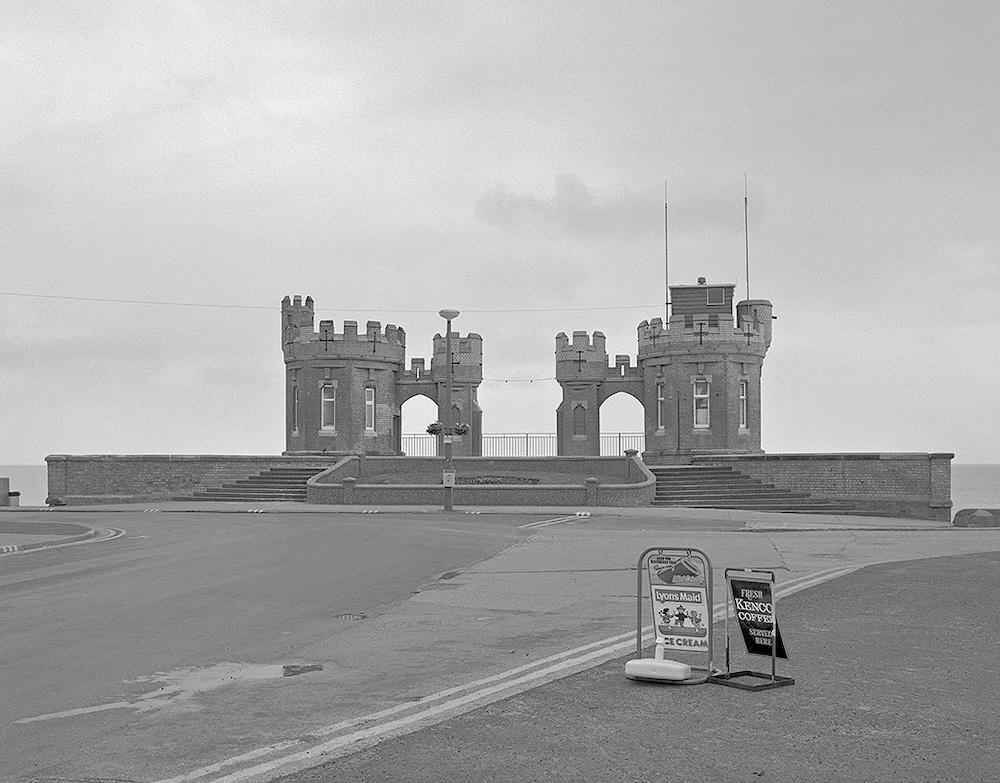
People appear only fleetingly in Conolly’s vistas and usually in the middle to far distance. One exception is his image of the front at Great Yarmouth which foregrounds three older ladies sitting on a bench, their heads wrapped in plastic hoods to keep the inevitable rain at bay. Behind them, however, is the incongruous alien presence of a life-size drawing of Darth Vader underscoring that while the sea itself might be sublime, Britain’s beach resorts are frequently, and delightfully, ridiculous. Static caravans, fences, rusting signs for Lyons Maid ice cream – these are the true sights of the seaside these pictures remind us of again. And just round the corner from the Royal Crescent, Bath’s beauty lies in a telephone junction box.
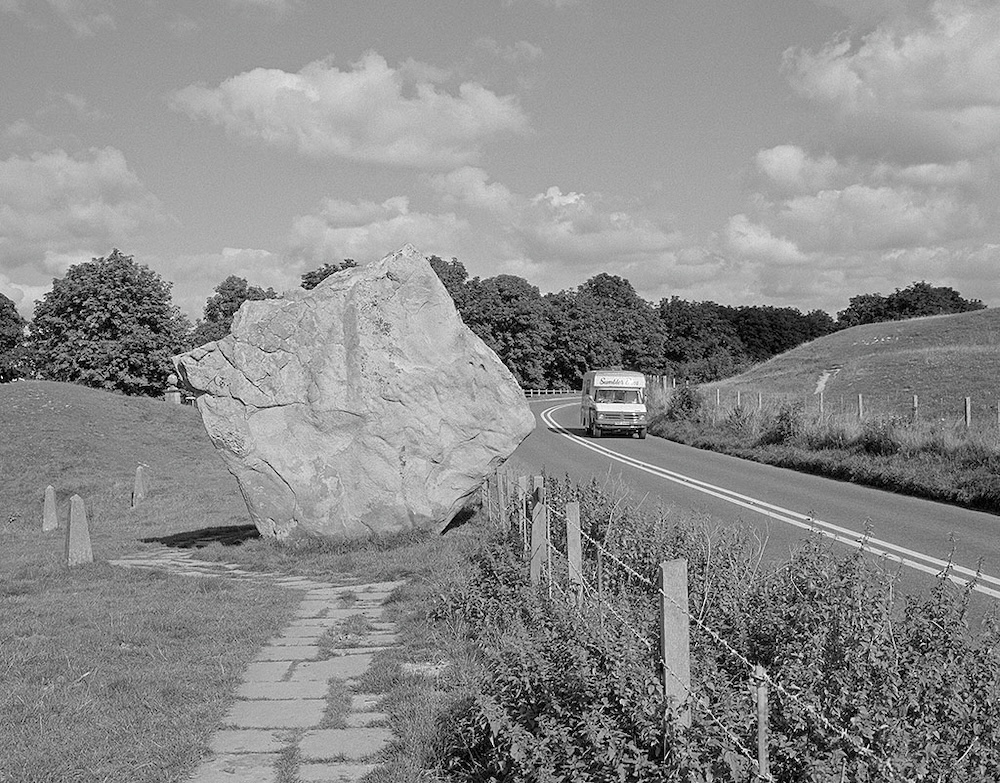
Broken wood gates (marked ‘Private’), and topiary alike in the late twentieth century countryside landscapes of Conolly uphold the invidious work of the enclosures acts of two hundred years earlier. The stones at Avebury similarly come braided with concrete posts and barbed wire, and this ancient monument complemented by a passing butchers’ van, ley hunting by British Leyland, if you will. (Though I think the vehicle in question is actually a Bedford…) Nevertheless, there is a touch of Alfred Watkins’s own photographs from The Old Straight Track about Conolly’s images of the byways of Wales and Devon.
Yet Conolly has a penchant for the symmetry of curving paths, culs de sac and streets that loop round on themselves or peter out with the suggestion of dead ends; more literally in the case of the A625, a tarmac-rucked roadway across the Peak District at Mam Tor fatally curtailed by constant landslips.
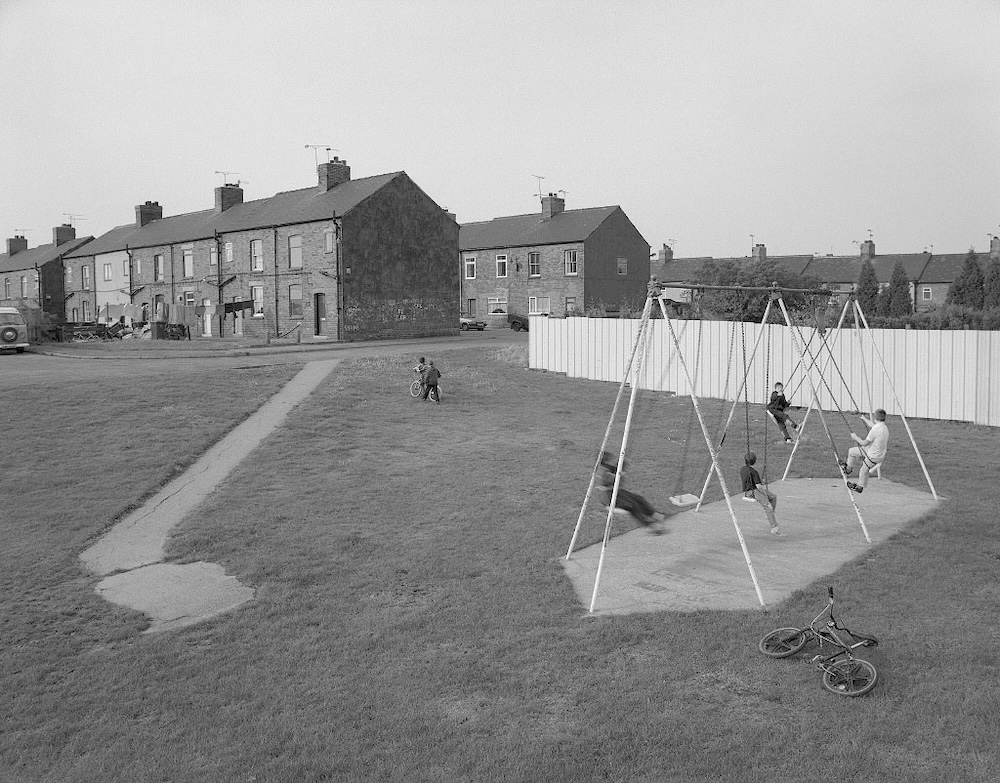
But elsewhere surreal directional signs and road markings seem to direct us to nowhere or nowhere in particular. A path to a playground in Arkwright Town in Derbyshire appears to give up the ghost before reaching its destination. Somewhat prophetically as it turns out, since all of the children Conolly snapped gaily playing on the swings in this former Coal Board mining town would later be moved out and the whole place levelled due to methane leakage.
Contrary to L P Hartley, the past, as Geoff Dyer has rightly observed, is not a different country at all, it is very much this country: Britain and there’s no getting away from it. But here is a place of landlines, phone boxes and overhead pylons rather than wind farms, 5G masts and QR codes. The physical analogue present had yet to be subsumed by the digital, distant and virtual.
A bulky video camera wielded by what looks like a tourist, if notably kept at a safe distance from the Royal Albert Docks by a stretch of the Mersey and a hefty iron chain, is about as high tech as things get. If again possibly another harbinger of our current times where no landmark is free from the attention of phone-wielding visitors. The footage from Conolly’s field trips, on the other hand, is all about the legwork and has the mileage to show for it too.
A day out, three or four decades on, takes us to another time and another place entirely, something we call history. What we choose to learn from it is anybody’s guess, but it’s well worth making the journey.
*
Extracted from Travis Elborough’s introduction to ‘Field Trips: Travels in Britain 1976-1993’ by Berris Conolly, published by Dewi Lewis and available here.