April’s Book of the Month is Zakia Sewell’s ‘Finding Albion: Myth, Folklore and the Quest for a Hidden Britain‘ (Hodder Press). In this month’s paid subscriber-exclusive author interview, Zakia speaks to Tallulah Brennan about enacting rebellion and dissent, finding stories in the margins, and the importance of confronting complicated relationships with England. Find a special extended extract from the interview below.
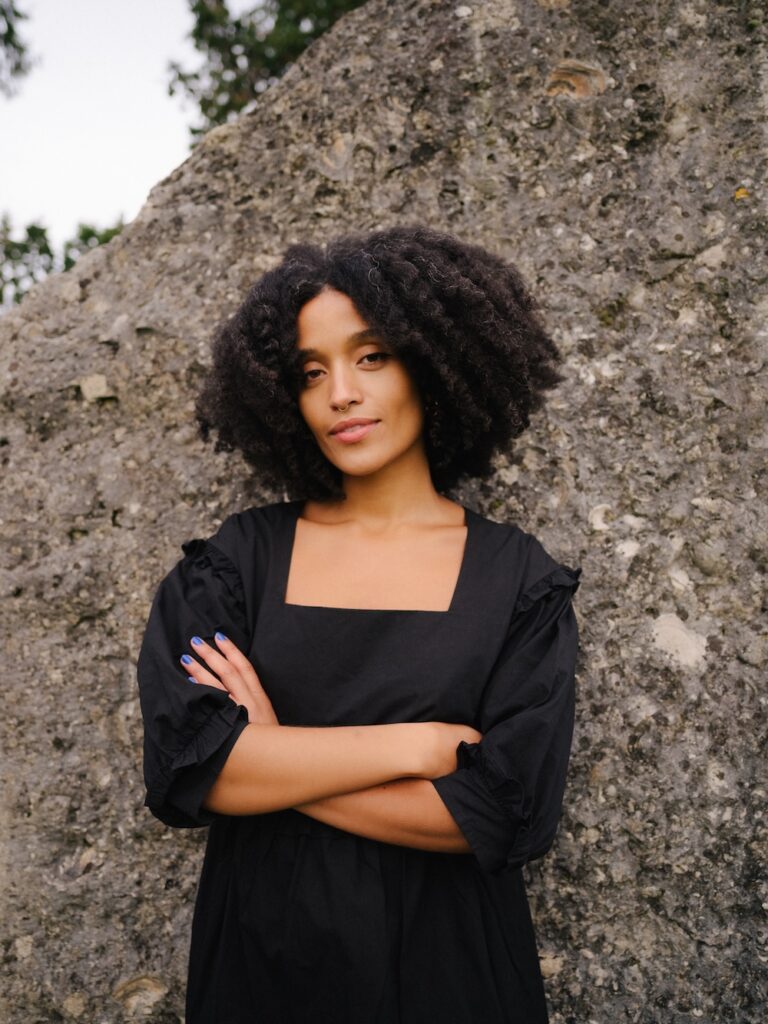
Zakia Sewell, photographed by Buster Grey Jung
A couple of quick-fire questions to start.
You note in the book that there is something quite specific about geographically isolated communities. For example, folk customs have remained very strong in Cornwall, with some of its inhabitants citing living at the land’s end as a reason connections between people have remained so strong. I wondered how you relate to this as someone who lives in a place defined by its vastness and huge number of people — but also as someone who has experience of quite the opposite, in rural Wales?
I was lucky to have a split screen, or a kind of double experience of growing up. At my family home on the outskirts of West London, I was allowed to cycle around my block of flats but not really go any further. I lived in incredibly close proximity to people in a council block, and yet didn’t really know any of my neighbours. That experience contrasted with my time spent with my grandparents in Wales, in a township called Laugharne in Carmarthenshire, where there was a real deep sense of community. That included longer term residents with a generational relationship to the place, along with newer incomers — it was a community bound together by pubs, and the carnivals that happened every summer, and the ‘common walk’ which happened every three years, which I write about in the book. There were all of these community events which really bound people and gave them a sense of local pride. I feel very lucky to have had that experience, and also the experience of visiting the Caribbean. Where my grandparents are from, Carriacou, similarly, there is a real sense of island pride. And again, if we’re thinking about isolated communities, Carriacou is tiny, it’s 7 miles long, and each village has its own traditions and customs and its own distinct sense of identity. So, I suppose the book draws upon my experience of all of those places, the urban and the rural, the sense of community here in Britain and that in the Caribbean. This is very much the perspective from which the book is written.
There’s a moment in the book in which you write: ‘When I’ve not left the city for a while, I find it’s easy to forget there is moist, damp earth beneath the concrete; that the hills of Highgate and New Cross were once covered in grass and wild flowers, or even forests, roamed by wild boars and wolves.’ Are there daily rituals or routines you have which allow you to connect to the land despite the ease of forgetting you describe?
Forcing myself to get out for a walk. It’s very easy, when we’re busy running around in our city lives, to forget to pause and take time to notice the natural landscape. For much of my life, I barely looked up to notice the trees were in blossom, or that the leaves were withering. One of the lovely things about starting to follow the wheel of the year, albeit in quite a gentle way, has been to reroot myself in seasonal shifts, and to mark them. Even if it’s in a small way, like making the effort to step out and go for a walk, or doing a little ritual with friends. It’s made me so much more aware and made me feel so much more closely connected to those seasonal shifts and cycles, which, even if you’re in the centre of a big city in London, you can access.
*
In the book, I find it really interesting that you find a story which flows both ways — you visit the Ivory Bangle Lady, for example, in York, but you also write in your chapter on Notting Hill Carnival about finding an image of Jack in the Green in the National Gallery of Jamaica. As you write, this refutes the idea that folk culture is confined to rural villages of Britain, but there’s another almost opposite truth too, which is that Black history is found in many other places than urban centres, whether it is in Cheddar, Suffolk or York, in the remote countryside, or in small towns. Did you set out to write with this two-way direction in mind, or was it more organically formed from your research?
No, I don’t think it was conscious, but I suppose one of the wonderful things about folk culture — whether it’s stories or older songs which have been passed down orally through the generations — is that these are traditionally the expressions of marginalised people; people who have been excluded from the academies and institutions who’ve had to find other ways of expressing their identities or their culture, or stories. That means that when we look at the folk song repertoire or traditions, often we find narratives and perspectives that trouble the dominant narratives and complicate simple visions. So that was something that happened quite organically throughout the book, whether that was looking into the history of the Notting Hill Carnival and the origin story of the Trinidadian Carnival and discovering that it began as an exclusively white form of entertainment for the planter class, which complicated my idea of the carnival as a distinctly Black Afro-Caribbean tradition, or as you say, finding that image of Jack in the Green in Jamaica in the 19th century — a quintessential English folk character. Or indeed, the tales of struggles and poachers fighting against gamekeepers. What we find are stories that are complex, and entangled and to me, far more interesting, because as you say, they reveal multiple truths.
One of the most compelling parts of the book, for me, was how attentive you were to what lies beyond England. You write about the discomfort of attributing some kind of mysticism to Welsh identity, and you mention Matthew Arnold, who had this idea that the Celtic race were inherently more spiritual than the ‘rational, industrialised Anglo-Saxons’. There’s little point in the ‘envy’ you describe, which drives some to claim some Irish, Welsh, or Scottish ancestry, if the Welsh harp is actually Italian, or the supposed traditional dress actually has little grassroots substance to it; these identities are also in flux, or not as straightforward or ‘pure’ as we might imagine. If we think with the St George’s flag say, which is in fact Genoese, do you think the reality of how patchworked our identities are, is actually an antidote? If we’re all made up of conflicting, or complicated pieces?
Absolutely. I think this is a theme that emerged in the book, without it being predetermined as something I wanted to thread through. Often, when we take a look at some of these national symbols and forms of folk culture that supposedly are indigenous and expressive of something ‘pure’ and ‘authentically British’, they’re often a lot more mixed up than we might think. That to me is what’s exciting. As someone of mixed heritage, with connections to both Britain and to the Caribbean, I’ve always been drawn to these combinations and clashes, and fusions of culture. When Cecil Sharp, the godfather of English folk, started folk collecting in the late nineteenth and early twentieth centuries, he was concerned with finding folk expressions which were, in his eyes, authentic or pure. He wrote about the Moorish influence on morris dancing as being somehow a polluting influence, instead of a fascinating creative, generative collision of cultures. So, absolutely, making visible the mixed-up-ness of our culture, and our identities, and finding symbols that can help us to celebrate that is absolutely one of the antidotes and challenges to the kind of toxic and exclusionary conceptions of identity that are getting a lot of airtime today.
Liz, a Pagan living in Glastonbury, believes Paganism is on the rise in part because of patriarchal and abusive structures. I hadn’t expected to find so many examples of how folklore can be used simultaneously as a liberating tool, and as a way to subdue women, to keep them in their place as it were. An example that really stuck with me was on May Day, young maidens were encouraged to wash their faces in the sunrise dew, to maintain their ‘youthful complexions’. Or your retelling of the history of Morris dancing, that it was taught at the Espérance Club for the working class women living in the slums of King’s Cross. So, I wanted to ask how much the question of women’s role in folklore, and in its reinvention, led you in your research for this book? Or was it less intentional than this, and these were stories you picked up on the way?
While writing and researching I felt it was important to cast the net wide and to represent an array of different experiences and perspectives. It’s very easy to replicate exclusionary practices or to somehow replicate power dynamics that exist in society in our writing if we’re not careful. Most of the people I interviewed were women. I don’t know if that was necessarily a conscious thing but it ended up that way. You give the example of Mary Neal, and that was an important inclusion for me. Including her story was not necessarily integral to the argument I was trying to build in that chapter, but it felt really important to highlight the woman who was so influential on the development and revival of Morris dancing, but whose contribution is largely overlooked.
It was really serendipitous the way that I discovered her. I was at Cecil Sharp House doing some research, and on the bookshelf underneath his bust was this book about Mary Neal. It was fascinating because he gets a lot of airtime when we’re thinking about English folk, and yet, when he first started folk collecting, it was the songs, rather than the dances that he was drawn to, and, in fact, Mary Neal was one of the first people to champion the dancing. She saw that it had this healing or transformative power, and set up the incredible Espérance Club with a fellow suffragette, and got working class women in King’s Cross to learn the Morris dances to empower them. A lot of people see Morris dancing as a solely male dance, or something that only happens in rural villages, and yet here is this story of working class girls in inner-city London, totally at the centre of the Morris revival. It’s when we look at peripheral stories, stories which have been consigned to the margins, that we get a more interesting picture.
*
Sign in or subscribe via Steady to read this interview in full.
Zakia Sewell’s ‘Finding Albion: Myth, Folklore and the Quest for a Hidden Britain’ is out now and available here, published by Hodder Press. Read an extract from the book here.
Zakia will be interviewed about Finding Albion by Emma Warren at next month’s Elmley event on the Isle of Sheppey (where she will be also treating us to a couple of hours behind the DJ decks!). More details and tickets here. Lunker-tier subscribers were emailed a 20% ticket discount code last month.