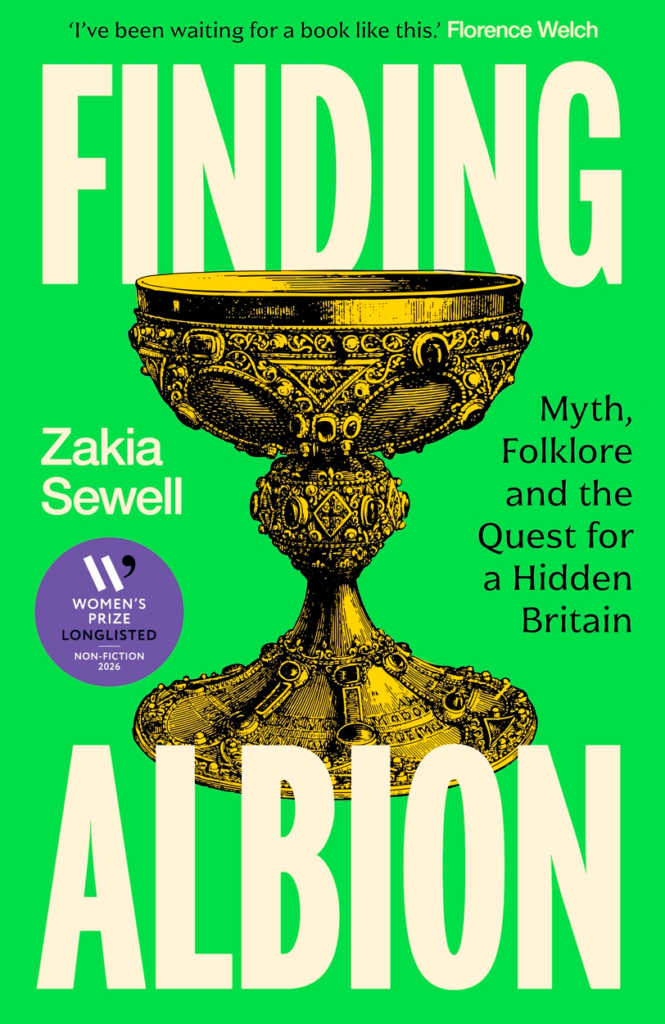
April Book of the Month has been Zakia Sewell’s ‘Finding Albion’. Dalia Al-Dujaili reviews, finding a richly textured exploration of identity, belonging, and cultural inheritance in contemporary Britain.
I first met Zakia Sewell in 2023, when I chaired a conversation between her and the artist Marianne Keating for ACV Magazine. This was just as my own book Babylon, Albion had begun taking shape. I told Zakia about my book, and that I was deeply moved by her Radio 4 series Finding Albion whilst embarking on my research. Zakia’s work arrived at such a pivotal point in my life; I was beginning to truly untangle the knotted weeds of my British and Iraqi identities, and my place within my beloved British countryside and landscapes. I wanted to understand how I could see myself as British whilst wholly and proudly being someone with roots in a former British mandate, Iraq.
Britain, and Britishness, does not have to be synonymous with the Empire. Instead, Britishness could be ritual, folk dance, and mythology. This was the kind of Britain I was more interested in being a part of.
Having adapted the radio series into a book of the same name, Finding Albion offers a richly textured exploration of identity, belonging, and cultural inheritance in contemporary Britain. Blending memoir, cultural criticism, and musical history, Zakia interrogates what it means to feel rooted – or unrooted – in a country whose identity is itself layered, contested, and constantly evolving. The “Albion” of the title evokes an ancient, almost mythic version of Britain, yet Zakia’s journey is grounded firmly in the present, shaped by migration, memory, and the intimate influence of family. Through this interplay of past and present, the book becomes both a personal search and a wider cultural inquiry.
Zakia’s book starts at a gig by the British folk band Pentangle in 2008 – where her “obsession” with folk music and British folk culture began. ‘Like the old myths of Albion,’ she writes, ‘their otherworldly folk songs seemed to emanate from a very different kind of Britain to the one invoked by anthems like ‘God Save the King’ and Rule Britannia’, or by the Union Jack. These folk songs had little do with glorifying the empire, the military or the monarchy – they were alternative stories of Britain, told from the ground up.’
When reading, I was surprised by how similarly I express the sentiment in Babylon, Albion, where I lament ‘Britain’s attachment to historic symbols of Britishness such as our national anthem, which glorifies a royal rule over the nation’s people.’ But I shouldn’t be surprised; Zakia and I have been subject to the same kinds of narratives our whole lives, growing up as girls of colour within landscapes and cityscapes that didn’t always seem to love us back.
At the heart of Finding Albion lies Zakia’s mixed heritage, born to a mother from Carriacou and an English father, and her attempt to reconcile these different strands of identity. Rather than presenting identity as something fixed or easily defined, Sewell portrays it as fluid, shaped by experience, geography, and emotional connection. Her reflections move between childhood memories, family stories, and moments of self-discovery, creating a narrative that feels both deeply personal and widely relatable. This duality allows the reader to see how individual lives intersect with broader questions about nationhood and belonging. If anything, personal and emotive language is something Zakia could have drawn even more on at these anecdotal asides.
Music plays a central role in Sewell’s exploration. Drawing on her background as a broadcaster, she uses folk traditions, radio archives, and contemporary sounds as a lens through which to examine British identity. Folk music, in particular, becomes a powerful symbol throughout the book. Often associated with a nostalgic or exclusionary vision of “Englishness,” Sewell reclaims it as something more inclusive and dynamic. She highlights how folk traditions have always been shaped by movement and exchange, specifically with the Caribbean and West Indies, challenging the idea that culture can ever be pure or static. In doing so, she redefines Albion not as a closed, homogenous space, but as a site of continual transformation.
Her response is not to reject the tradition, but to reposition herself within it. As she reflects on songs like ‘The Cuckoo’, introduced to her by her father, there is a sense not of borrowing but of mutual recognition: the music belongs to her as much as she belongs to it. This reframing subtly dismantles the idea of cultural ownership, replacing it with a more reciprocal understanding of cultural participation.
I found most fascinating the parts where Zakia details how music introduced her to the practice of Paganism, Britain’s Celtic, pre-Christian spiritual practice which centred around the earth’s seasons rather than monotheism. As she notes, Christianity in the UK is fast dwindling, but Paganism is one of its fastest growing religions. It makes me wonder what that says about the current cultural zeitgeist that (mostly) young people find themselves in. What are they yearning for in place of a so far disappointing or unsatisfactory story of Britishness?
Crucially, Zakia situates folk music within a much broader history of migration and cultural exchange. Rather than treating it as an untouched relic of the past, she highlights the diverse influences that have shaped it – from jazz inflections within British folk revival bands to the contributions of musicians of mixed or diasporic heritage. These examples, such the olde English inspirations for today’s Notting Hill Carnival from the traditional ‘fayre’, complicate any attempt to define folk as purely “native,” revealing it instead as the product of ongoing cultural entanglement. Even forms often imagined as quintessentially British, such as sea shanties, are shown to carry traces of transatlantic exchange, shaped by Caribbean and West African musical structures. In this light, cultural traditions appear less as fixed inheritances and more as living processes, continually reshaped by migration, trade, and encounter.
Zakia’s exploration also intersects with wider critiques of British identity, particularly those that address the lingering effects of empire. The concept of “postcolonial melancholia,” articulated by Paul Gilroy, provides a useful framework here, describing a persistent attachment to imperial narratives that obscures more complex histories. As thinkers like Ben Pitcher suggest, such attachments often sustain exclusionary visions of national identity, built on selective myths of the past. Zakia’s work challenges these constructions not through outright rejection, but by exposing their partiality – demonstrating that what is often presented as a unified national story is in fact only one version among many.
For nerds of everything decolonial, Finding Albion is rich, in-depth and well-researched. For those less familiar, this journalistic format could have benefitted from Zakia’s warm voice – the one we love hearing on BBC Radio 6 – and though her sense of humour pops up occasionally (‘absolutely my kind of party’), I finished the book wanting to get more of a sense as to why Brits should be invested in such Neopagan stories or narratives around cultural exchange. Zakia’s conversation with Nadia Shaikh, for example, who contributed to the Right to Roam movement, tugged by necessity on my heartstrings.
Ultimately, Zakia’s work suggests that to move forward, Britain must be willing to loosen its grip on singular, mythologised versions of itself. Something I myself have been longing to encourage through my own writing, understanding how Albion might welcome and inform an Arab identity such as my own, rather than dilute or compete with it. Tradition, in Zakia’s hands, becomes not a static inheritance to be defended, but a resource for imagining new forms of collective identity. By foregrounding the multiplicity of influences that have always shaped British culture, she opens up the possibility of a more inclusive and dynamic understanding of belonging – one that recognises that the story of Albion has never been singular, and was never meant to be.
*
‘Finding Albion: Myth, Folklore and the Quest for a Hidden Britain’ is out now and available here (£23.75), published by Hodder Press.
Zakia will be interviewed about ‘Finding Albion’ by Emma Warren at next month’s Elmley event on the Isle of Sheppey (where she will be also treating us to a couple of hours behind the DJ decks!). More details and tickets here.
Dalia Al-Dujaili is a British-Iraqi writer, editor, publisher and curator based in London. She is the founder of HIKMA Iraq and of The Road to Nowhere magazine. She has bylines in The Guardian, Dazed, GQ, The Face, Rolling Stone and more. She is the author of ‘Babylon, Albion: A Personal History of Myth and Migration’ (2025, Saqi Books). She has been featured in Dazed – including on the Dazed100 – Vogue Arabia, AnOther, NY Magazine, PhotoVogue, Stylist and more. ‘Babylon, Albion’ is out in paperback on 9th July.