Mark Mattock swaps sparrows in his London garden for hummingbirds in LA.
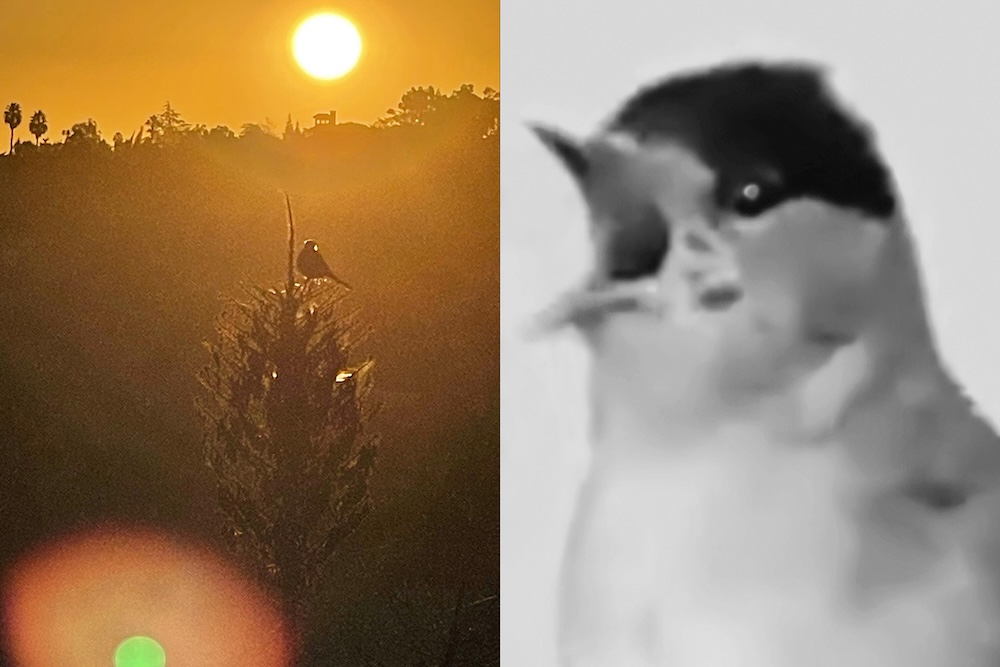
“The arc of the moral universe is long, but it bends toward justice” — Martin Luther King Jr.
‘”Life feeds on negative entropy” suggests that living organisms maintain order and complexity by utilizing [free] energy from their environment, which allows them to counteract the natural tendency toward disorder as described by the second law of thermodynamics’ — Erwin Schrödinger, What is Life?, 1944
I stop breathing, clench teeth, pull the powerful catapult rubber back along my outstretched right arm until my thumb knuckle gently brushes my earlobe. Stare back along it, past the pale blood drained tip of my other thumb pressed so hard against the weapon’s metal frame; holding it steady, to fix the puffed up woodies in the cold bare-bone ash branches, dead in the centre of the alloy ‘U.’
I let go to pick up my steaming coffee from the kitchen counter. An innate yet powerful ripple that began on a bunked-off school day just passed through me and beached in the soft-toned plumage of the pigeons. Some warped residual instinct. Once a hunter, a bird-nester, always… a watcher, a seer, a finder. It’s how you learnt to see, notice everything, feel it. Connect it, connect to it. Hone it like a hawk. Even from the kitchen window, daily. It’s grounding.
Another doomsday grey, cold, wet, morning. Up in the ivy above Sparrow Bush a blackcap plucks another matt black berry and chokes it down. He then suddenly, clearly locks onto something invisible at which he leaps and snatches out of the air. A micro-speck of rare winter insect protein. Below him in the wiry, twisting tangle itself the sparrow flock, now thirty plus strong, fills the drab morning melancholy with natter and chatter, their incessant chirping and fidgeting heats the cold gloom with feather-warm sound rays. It’s hard to conduct a head count, it’s more a breast count as this is all you can really see of them in the kaleidoscope of muffled earthy hues. The posse has grown exponentially from a shy two or three just a decade ago. One of the cited factors in their catastrophic decline is our obsessive horticulture, the constant neutering of nature: pruning, cutting, snipping, clipping, weeding, tidying; now taken to extreme — annihilation by concrete, gravel, paving and astro turf. A study showed house sparrows stop breeding when their numbers no longer constitute a flock, so social and gregarious are they. The proof in front of and around me, the unkempt bushes, privet and bramble, allowed to run amok, have become a community centre. It sounds like sitting on the steps at the entrance of an old village hall youth club. The cat is never a threat.
It’s a total uplift returning home on a depressing winter day to hear them all, in the tall ragged privet out front from the end of the road. Like passing a house party. The sparrowhawk hears them too. I saw the fierce little musket just the other day, hounded by corvids. My visible breath seamlessly merges with the steam billowing gently skywards into the dead still air, from the coffee cup that has melted a wet hole on the ice-rink-table top draped with a cloth of slapped-on leaves, in the colours of iced vegetal decay. Thousands of feet above me, a vast amount of the same stuff is being expelled with jet force across the clean blue from the vent of a tiny blinding-bright metal tube. The robin, glowing like a bird on fire, is baring his full breast towards the morning sun that is surely backlighting the unseen object of his desire — or foe — in the ivy hedge. A flock of redwings now cross under the blue like hot sparks from a forest fire. A starling hollers in complex code from a redundant TV aerial. The sound of an approaching helicopter returns me to Christmas in LA.
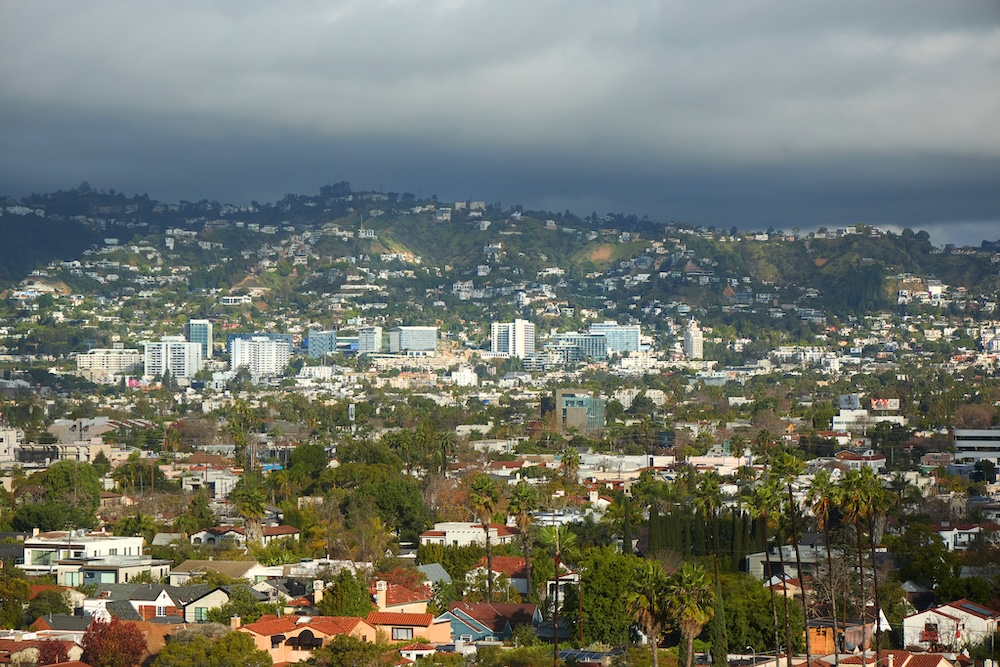
I’m up on the eleventh floor watching the [Waymos] below. Down on the street, in the sunlit gap cut into the deep shadow between two houses, on whose foiled flat roofs multiple small chimney vents troop like morning fresh mushrooms, a smart-dressed commuter climbs into the passenger seat of one of the creepy driverless robotaxis. As she slams the door, buckles up and is carried away, Parrot Lady emerges from her house across the road. The big green parrot with a feather kippah of yellow sits on her arm like some deranged psychedelic falcon, in her hand its bowl of exotic fruit.
My kitchen and bedroom windows, now over five and a half thousand miles. away, have been replaced by this small balcony. My urban garden now a huge segment of LA spread out all the way to the Hollywood hills; I can even see the snow-capped San Gabriel Mountains on the eastern horizon. This morning the pied LAPD helicopter crosses high above the silver flat-tops early. Behind it, on the prime real estate slopes, windows angled perfectly in reverence to the rising sun, shine like nuggets of pure gold, glinting through the cool morning haze. The smears of pink and purple in the distance, floating across the seamless spectrum of blues, dissolving as the tops of the highest palms catch fire and more windows burst into flame in succession downhill. The distant top of the red brick Cedars Sinai hospital now lights up. In the NICU ward of the nearby paediatrics building my sweet, tiny, brand new perfect grandson, yet to be brought home.
He’s beautiful, he’s fine, he was impatient and arrived a bit early, but in the dystopian La La Land of big pharma and insurance profit ‘it’s better to be absolutely sure.’ He’s in good hands, but not ours. Below I follow the shadow of an American crow slipping across sun blasted walls, as sharp and as black as the bird casting it. I’m startled by a tiny projectile that’s just suddenly rocketed straight up from somewhere below and stopped unnaturally dead still right out in front of me. Before it registers, it’s a small drone spying into the apartments; but it is silent. Then near-ultrasonic peeps emanate from it: it’s a hummingbird, displaying. I don’t know if it’s Allen’s Selasphorus sasin, or Anna’s Calypte anna. It disappears again at warp speed. But whichever, I can add it to my garden-balcony-bird count, now listing a pair of peregrines, red tailed hawk, black vulture and sharp shinned hawk, which could have been a Cooper’s hawk, they are very similar; a pair of ravens aerially courting. Down in the tree-lined streets and shrubbed-up yards: black phoebes, yellow rumped warblers, house finches.
It’s mid morning, bright, warm. Movement below catches my eye. A large sulphur-yellow butterfly is strobing in and out of the hard shadows cast by the trees lining the street: palms with huge drooping centre-parted leaves and long fringes, Indian laurels whose heavy, half-exposed buttressed roots constrained by the heavy curb stones and pavement look like polystyrene boxes of squid. With her phone Parrot Lady is taking a shadow selfie of herself with the bird. Maybe she imagines they are falconer and falcon. Moments later a monarch butterfly follows in the fragmented wake of the cloudless sulphur. It couldn’t look less like Christmas, which it is in a few days. The tiny man is finally allowed home for it. Pure joy. I saw a butterfly on Christmas Day. I’m near sure an American painted lady Vanessa virginiensis. Its larval food plants are cudweeds, pussytoes and everlastings!
All was sodden on New Year’s Day. The dirty saturated grey sky almost touched the top of the highest palms. It prepared us for home. From the bedroom window cold white futons of frosted shed tops floated in a loose convey between the back garden boundaries. A thick-furred fox ran along the top of the one immediately in front, its breath suddenly swirling around its wet jet-black snout when it halted to glance back. A giant full moon glowed a cold-shine platinum in the cold pink of dawn. Jet lag is worse on the return. The sparrows fluffing and preening deep in their burning bush lit by the morning rays were loud, even through the double glazing of the kitchen window. Their shadows blasted onto the column of ivy across the garden revealed more of their presence than they themselves. Their infectious exuberant, joyous, racket reminded me of what the brilliant Gen-Z Uber driver, Alexia, ended one of the best cab conversations ever with: “remember, clowns and community kill nazis.”
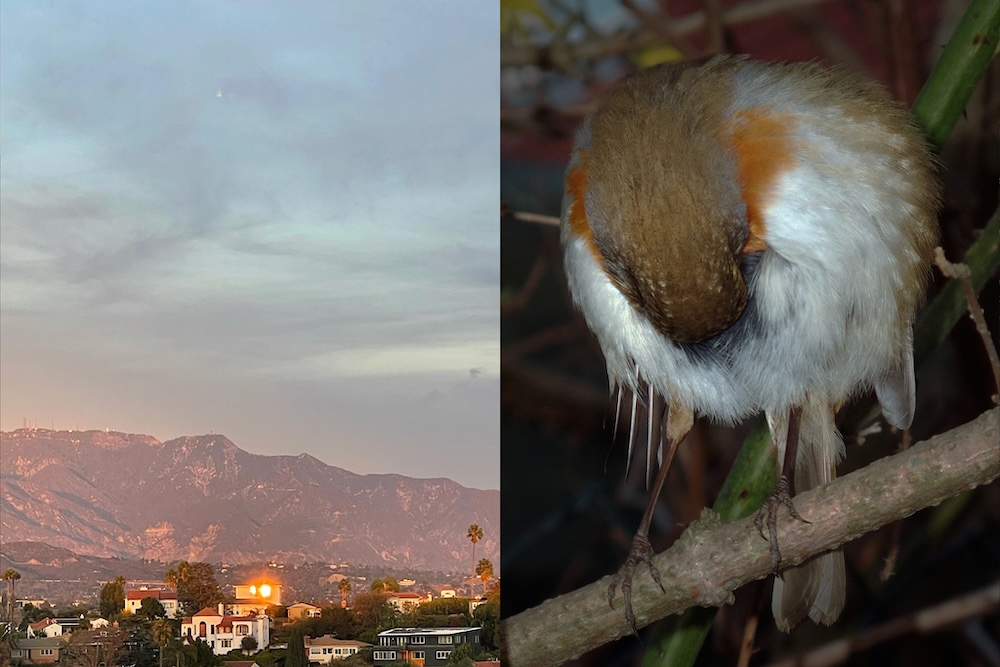
Following a succession of dull days, a promising sky of unstained blue. The blackcap — one of them, there are now two — plucks and swallows another ivy berry, the colour of the bald corpse of a long lost tennis ball, and takes a moment to let it settle before flitting over to perch atop the snarls and twines of the greening strangle bush. It bathes peacefully in the weak warmth of the sun. His eye shines impossibly bright. Through binoculars I see the tiny sun burning fiercely at the rim of the abyssal black little orb pinned to his black beret. In the skeletal thorn spinney, on some of the twigs, a prismatic constellation of minute hanging crystal bowls magnifies the swelling blackthorn’s flower buds within. One of the droplets, as a result of the smallest movement of my head, suddenly bursts, burning-oxyacetylene-torch bright; pulsing blue, red, green, like a distant star. Directly above me a pair of goldfinches pluck individual ash seeds from the hanging bunches of what look like spare propellers. The bladed seed held tight to a boney twig with a spidery reptilian claw, to shell the meat end. The nipped off blades flutter quietly to earth. Satisfied, the red-faced birds, looking like little vampire finches that have just sipped from a pool of blood, rest on the highest twigs and stare menacingly into the morning sun. Then ‘twitter off’ up the gardens.
Back in Sparrow Bush a Dunnock — formally a hedge sparrow — is letting off, full rip, steam spilling from his orange gape. Merlin bird app hears a goldcrest. I do too; I can still clearly hear this frequency. It’s quieter than the hummingbirds. I find it in the coils of jasmine on Ivy Tower, its burning lighter-sparks crest giving it away. It makes the nearby blue tit look huge. A glowing white spot moving in the deep shade of the far corner, like a cursor on a computer screen, turns out to be the white cheek of a great tit.
I put the lid back on the compost bin, then turn to scan the little wood. Bluebell spikes pushing up through the soft rotting leaf carpet already. Stands of candlesnuff fungus, Xylaria hypoxylon, on some of the decaying logs, like miniature facsimilies of scenes I saw in Pacific Palisades. Some of the logs I’ve inoculated with turkey tail spore yet to fruit. A lost miniature umbrella poking up for attention; the delicate intricately ribbed and crumb-dusted cap, curling up at the edges, of a coprinellus, an I’m-not-even-going-to-try-to-indentify inkcap mushroom. The garden’s mycorrhizal fungus network ever expanding, or more likely showing itself via the various fruiting bodies now that much of the ground has been long left undisturbed. It has already included shaggy parasols, wood blewits, and a very tasty agaricus species; jelly ears on the buddelia.
I’m not doom scrolling, it’s bearing witness — unbearable witness to endless atrocity. Every morning, on my phone screen, on millions of phone screens. New horror films, and pictures, and words, and reports and denials and lies and complicity; and, ‘the appalling silence of good people.’ Rage: rage shared, rage reposted, rage amplified. I make for the kitchen window, scream silent apoplectic rage. Again. Stare into the wilded garden, looking for salvage, for emergency, temporary, rescue. Deep breath, hold several seconds, release slowly. Keep looking because you know that somewhere just out there, even in the oppressive bleak winter dim, there is something to grab hold of, to pull you desperately flapping from the glutinous slick of the darkest pessimism like an oiled seabird. There always is, always was, always will be. It’s your go to; however bad, you know it’s there, you’ll see it. You grasped it long ago, early in life, it’s ingrained, it’s survival; it’s nature. Nature is hope, promise, shelter, nurture… fight or flight, whichever is right. Just out there is something that reminds you you’re not ‘what-can-I-do-I’m-just-a-grain-of-sand.’ but that you are a grain of sand that, with other grains of sand, make deserts, dunes and beaches — demos, uprisings, boycotts, protests, intifadas and rebellions.
Resisting. Garden by garden, street by street, block by block, field by field, forest by forest, desert by desert. Or ocean by ocean if you see yourself as just a drop in it.
A large soft limp leaf suddenly rises from the ground and dives into the ivy hedge half way along the left side of the garden — I know what it is but I can’t believe it until it happens again, which it will. A pair of lubricious wood pigeons snogging the beaks off each other above. The robin selects another soft umber rag of a leaf and dives back into the same spot in the hedge. She’s building a nest… it’s still January! But then, but then, I spot the blackcap searching meticulously for something among the dried hogweed stems and I’m even more shocked when he clearly finds it. He picks his selected dried strip of grass and flies off over the fence with it. Minutes later he returns to search for another bit.
He’s building a cock nest (male blackcaps build cock nests to present to females in the hope she chooses to lay in it). But, and again but, it is the end of January. He is supposed to be a summer migrant. He used to be. Like chiffchaffs used to be, like red admiral butterflies used to be. I understand what I’m seeing… life, life without bounds and constraints, life being life. An inextinguishable force. Light at the end of the tunnel. Never give up. No time like now.
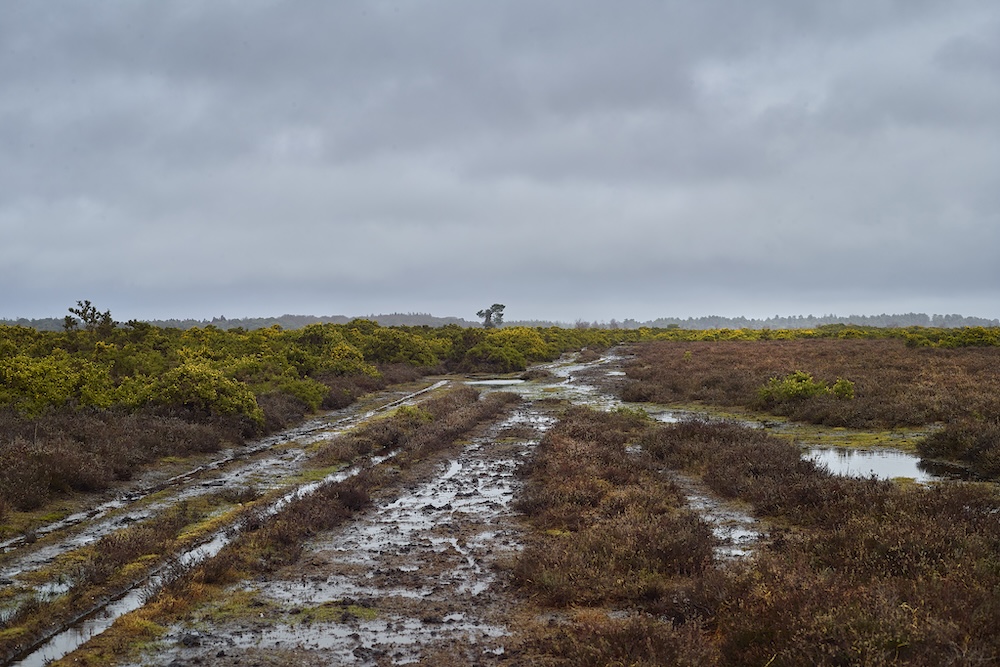
The long dull lingers, day after day. I’ve just returned from four days roaming the sodden New Forest, the last refuge of wild ancient England. Splashing in delirious bliss through soaked woods and waterlogged heaths, mile after mile. The whole vast space beginning to reverberate with anticipation and impatience, readying to be flocked back into full English summer volume by the returning Africans: Congolese, Senegalese, Ghanaians, Nigerians, Mahgrebis; those that survive the impossible journeys in an increasingly hostile climate, the gunmen of the Mediterranean, the disorienting light polluted nights and the fog of electromagnetic radiation. The garden is two or more weeks ahead of the forest, making it a bit like a private viewing, or listening. I’m overwhelmed by this morning’s dawn chorus. If I shut my eyes I could be back in the forest, so many of the same species. I check Merlin’s recordings on my phone, compare this morning’s with one from the forest, unbelievably fifteen species matching.
At the top of one of the ashes, above the blackthorns in the far corner now firecracking into snow white bloom, at the end of the hard-trodden path sinking under the heaving spring green, is the militant black-bereted scrub warbler in a full-on mesmeric flow of defiance, spitting his hyper contagious optimism. This hardcore little bushmaster ahead of the pack, got himself all set up already, his turf claimed, stamped in song; cock nest waiting. The robin sitting on the eggs in hers already. It’s way too early… or is it?

*
Mark Mattock. Artist. Photographer. Publisher. Rabbit Fighter. @the_rabbit_fighters_club