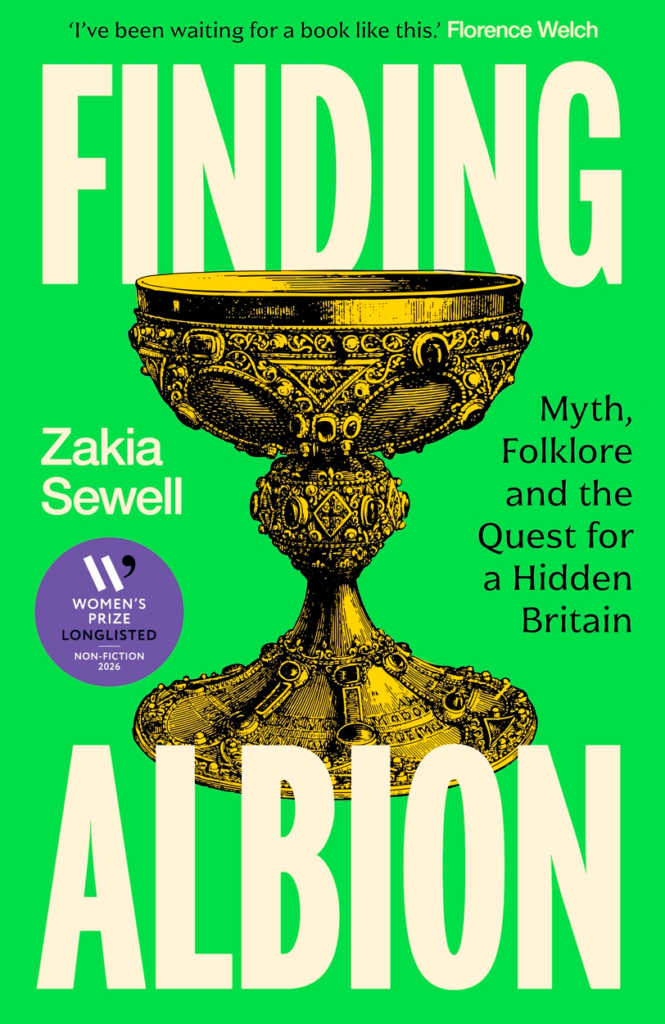
An extract from Zakia Sewell’s ‘Finding Albion: Myth, Folklore and the Quest for a Hidden Britain’, our April Book of the Month.
The story of Albion was once essential to people’s understanding of the founding of the British nation. It is at the centre of one of Britain’s oldest origin stories, recorded by the twelfth-century cleric Geoffrey of Monmouth, who chronicled Britain’s early history in his famous Historia regum Britanniae, or ‘History of the Kings of Britain’. According to Geoffrey, Albion was a dark and lawless land inhabited by a race of giants until the arrival of the Trojan hero, Brutus, who wiped out his oversized foes and colonised the country, renaming it Britain. Although Geoffrey of Monmouth’s ‘history’ is now seen as a work of fiction, his British origin story was held as fact up until as late as the sixteenth century. He didn’t, however, offer much detail about Albion before the arrival of Brutus, or how its beastly giants came to reside on the island. Over time, other scholars and poets endeavoured to fill in the gaps, inventing the story of ‘Albina’ and her thirty sisters, daughters of the Syrian (sometimes Greek) King Dioclisian, who were known for their extraordinary beauty, and their disobedience.
According to legend, Albina is commanded by her father to submit to her husband, but she refuses and, instead, she and her sisters decide to murder their spouses in the night. The sisters are found out and are exiled as a punishment, forced to sail the seas until they reach an uninhabited island, which Albina names ‘Albion’. For a while they live in freedom, enjoying the island’s fertile valleys and cool spring waters, becoming attuned to the cycles of nature, and learning how to hunt its wild animals. But their utopian existence only lasts for so long. The sisters begin to pine for male company, and are seduced by devilish incubi, with whom they make sweet demonic love, before giving birth to a monstrous race of giants – the last of which are defeated by Brutus, founder of Britain.
It may seem surprising to us that one of Britain’s earliest origin stories imagines the island’s first inhabitants as a bunch of Syrian immigrants arriving in small boats to start a new life. Of course the story is fictional, but I find it curious that, in these early stories, Britain is imagined as a place of refuge for outsiders; it seems at odds with more exclusionary visions of who we are as a nation today – Britain as a ‘fortress’, for example, or ‘hostile environment’. I was certainly never taught this myth at school. Like so many other aspects of our past, the legends of Albion have been consigned to the margins of our national story; left to languish in obscurity in favour of other, more popular collective myths. Such as the myth about Britain’s great empire and how it brought democracy and civilisation (not forgetting the railways) to nationsaround the world, the myth of Britain more or less single-handedly beating the Nazis, or the myth of British supremacy – stories that conceal a far more complicated reality.
Personally, I feel a lot more at home with the tales of giants, incubi and ancient refugees than I do with these more recent myths about empire and power. Both are part-fantasy, and yet the newer myths about Britain still have so many people held in their thrall.
*
Zakia will be interviewed about ‘Finding Albion’ by Emma Warren at next month’s Elmley event on the Isle of Sheppey (where she will be also treating us to a couple of hours behind the DJ decks!). More details and tickets here.
‘Finding Albion: Myth, Folklore and the Quest for a Hidden Britain’ is out now and available here (£23.75), published by Hodder Press.