A week away from our event at Elmley Nature Reserve, Tallulah Brennan catches up with Newton See of the Margate-based FLINTS sustainable sea kiosk about foraging, community enterprise, and the intertidal zone as a site of knowledge, ritual and exchange.
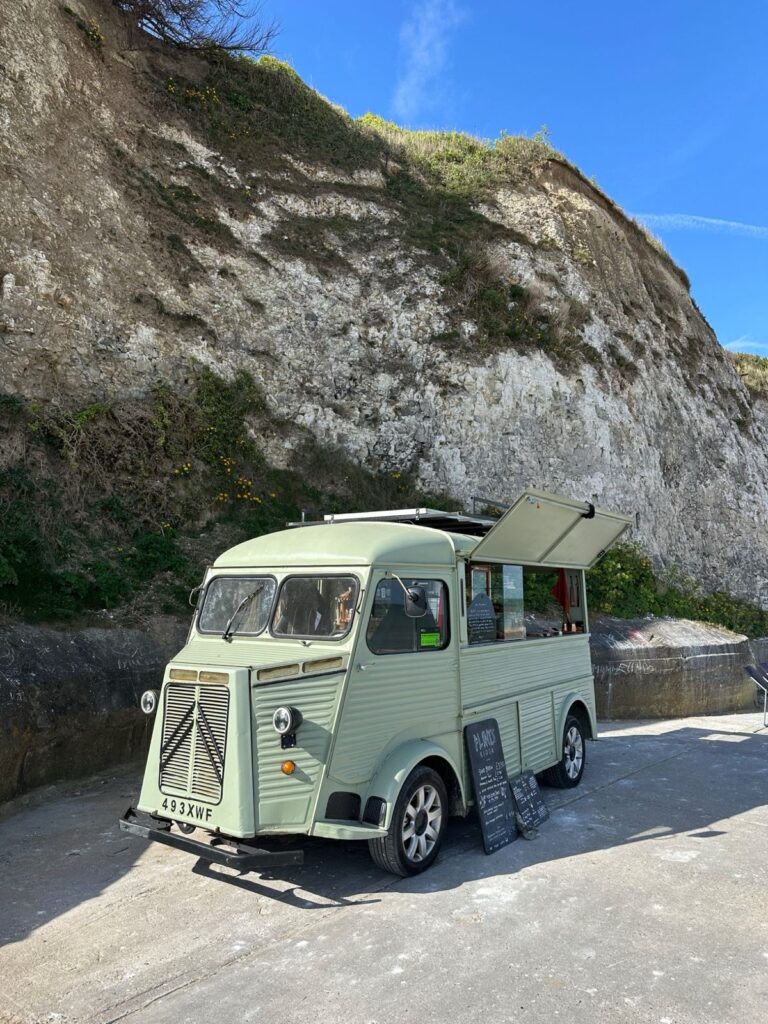
When you introduced yourself to me, you described yourself as both a ‘land mariner’ and an artist. Would you be able to explain what these roles mean to you, and how you bring those together at the kiosk?
When I describe myself as both a ‘land mariner’ and an artist, I’m speaking about a practice rooted in long-term, embodied engagement with coastal environments, particularly the intertidal zone as a site of knowledge, ritual and exchange. The ‘land mariner’ aspect comes from a very practical, repeated presence on the shoreline. Each week I’m down on the beach, reading tidal conditions, wind direction, and the subtle shifts that come through being in the same place over time. It becomes a kind of lived data collection, knowing how the strand line will form, how constructive or destructive waves will shape the beach, whether we’ll have space for a full session, and how those conditions will shift seven days later as the tides turn.
I often joke that I’m reading weather systems I can already see on the horizon, out across the North Sea, knowing how long a cloud will take to arrive, what it’s carrying, and how the wind will move. That repeated observation builds a deep familiarity, which is very much aligned with permaculture principles, observing, analysing, and responding. That extends into seasonal and ecological awareness. Noticing migratory birds arriving, the first swallows sweeping low across the beach feeding on emerging insects, or shifts in marine life. Recently we had a seal pup resting directly in front of the kiosk for a full day, which was both humbling and a reminder of the wider ecological systems at play. In that instance, we worked alongside organisations such as the British Divers Marine Life Rescue, and we rallied local volunteers to provide early awareness for dog walkers and beachgoers, helping to protect the seal while it rested. So that ‘land mariner’ role is about being in relationship with place through time, repetition, and close attention.
Have you been to Cockleshell beach at Elmley, and what opportunities did you find through a forager’s eyes, if any?
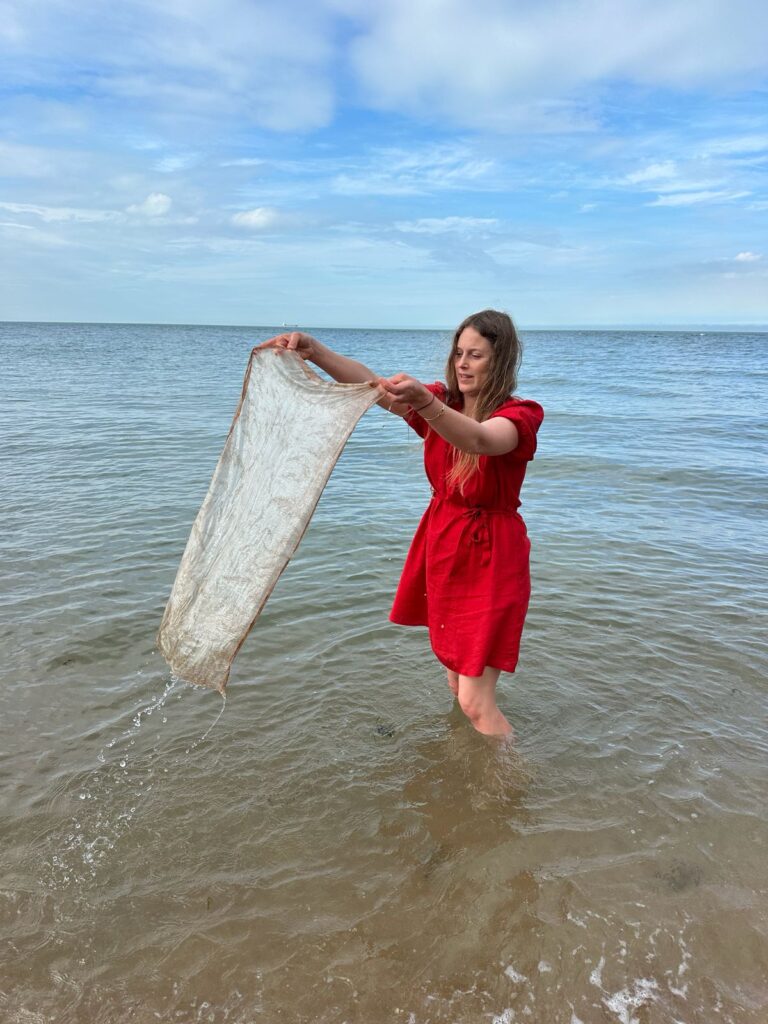
I recently went with my seven-year-old to experience Cockleshell Beach at Elmley, as a way of understanding the landscape and how it might relate to what we do through FLINTS. What became immediately clear is how strongly the landscape asks for a different pace and presence. My work tends to respond dynamically to place, and in a setting like Elmley, that response becomes quieter, more observational, allowing the environment itself to lead. There’s a hide overlooking the beach from where you get a full sense of the marsh and estuary opening out. When we visited, there were nesting lapwings, hares moving through the grassland, and a range of visiting birds across the marshes. I was very aware of the need to respect the seasonal rhythms of the site, particularly during nesting periods when certain areas require distance and protection. That sense of boundary is part of the experience, understanding when to step back and allow nature the space it needs.
From a forager’s perspective, even approaching the area, there were familiar plants: cleavers, sea beet, nettle, mallow, bramble, hawthorn, and blackthorn. For crafting, there is also sedge and rush, and moving into May, we would expect to see wild carrot, sea purslane, sea lavender, and sea rocket emerging. There is a clear opportunity to work with some of these plants both for edible use and for craft, but always within the context of careful, minimal and respectful engagement.
What stayed with me most was the scale and openness of the landscape, and the way it encourages stillness. It’s a place that naturally draws you into observation, rather than interaction, and that feels very aligned with the deeper intentions of FLINTS’ work.
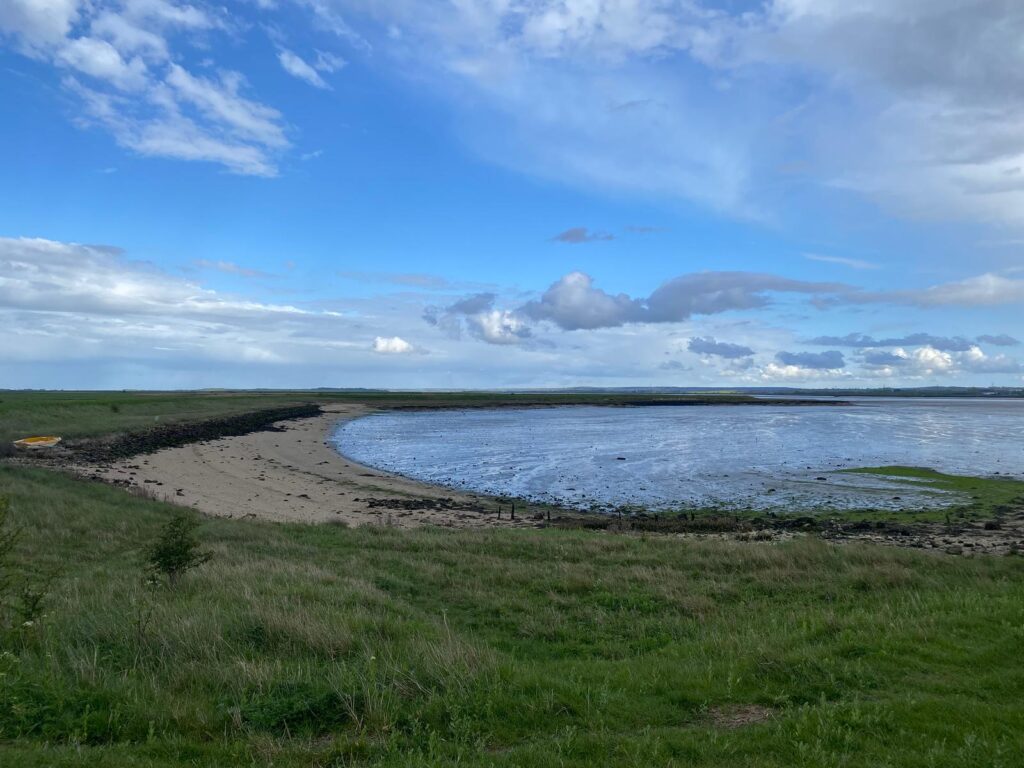
You mentioned Alexis Pauline Gumbs’ book, Undrowned when we began our conversation. ‘I respect you as so much bigger than my own understanding’, she writes. Though she’s writing about the sea, this can easily apply to the feeling at Elmley, as a nature reserve which is in transformation. Would you say that it’s a conscious choice that your work is placed within landscapes that feel so much bigger than the human scale?
That idea of conscious breathing, of choosing when to surface, feels very present in my work. In our sessions, I often work with counting waves and visualisation from the shoreline, inviting participants to extend their awareness outwards, towards our mammal cousins who travel far offshore, sometimes moving through spaces like the wind turbine fields where fish stocks are able to recover, before returning to rest along our own coastlines, on the sandy dunes and marram grass. That relationship between breath, movement, and return feels like a living metaphor for how we navigate systems. Not all systems deserve participation, and part of the work is learning when to surface, when to withdraw, and where to place your energy.
At FLINTS, this translates into how we structure care. We actively pursue funding to remove financial barriers, ensuring that participation is accessible to a wide range of households. We work collaboratively with other community organisations because this kind of work cannot exist in isolation. Care expands through relationship.
FLINTS didn’t replace my creative practice, it transformed it. It became a space where empathy, care, and ecological awareness are not separate from creativity, but central to it. So being in landscapes that feel larger than us is not accidental. It’s a conscious positioning. These environments remind us of scale, of interdependence, and of our limits. They ask for humility, and in doing so, they open up different ways of relating, to ourselves, to each other, and to the systems we choose to be part of.
I noticed you called the kiosk a ‘much needed coastal clinic’. Can you explain how you are able to provide well-being through herbs and tinctures, through food and drink as medicine?
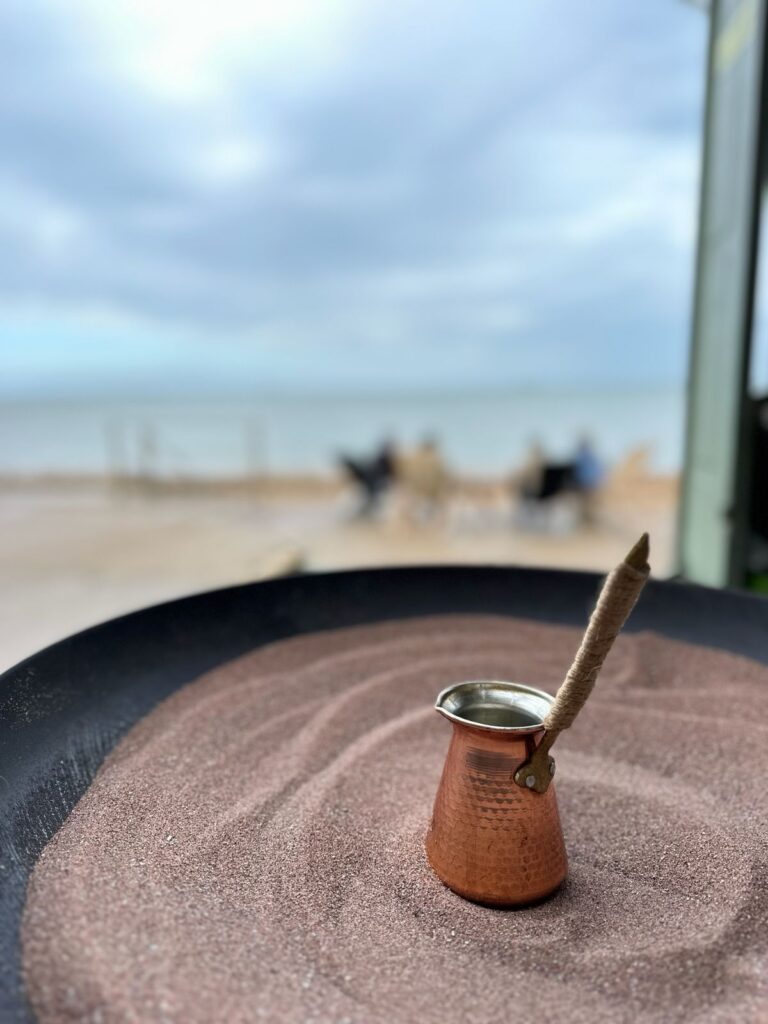
Unlike faster-paced kiosks, we encourage our guests to go slow. Each person in front of me is a question. It’s not a fixed menu experience, it really responds to what that person needs at that moment. We don’t do takeaway cups, and we don’t centre the usual coffee culture — not centring caffeine as an efficiency tool, but as something that can sit within open-hearted connection. People sit down, often in the deck chairs, and there’s an invitation to pause, to not be on phones, to just be there. From there, it becomes intuitive. I might check in with where someone is in their cycle, or what state their body is in, whether they need something to calm, to ground, or to support a sense of rest from cortisol. A lot of what comes up in conversation is how much modern life pushes people into cycles of stimulation and stress, and how little awareness there is around how to support the body through those states.
There’s also a wider unpicking happening around menstrual cycles. Many people haven’t been supported to understand them, or have been encouraged to override them for productivity. So part of the exchange is simply bringing awareness back to those rhythms, and how different plants can support different phases, something I’m still learning myself. The herbal teas are blended individually. We use plants like lemon balm for soothing what I call the “head gremlins”, sage and rose for clarity and emotional reconnection, and fennel and fenugreek, which are both supportive for digestion as well as breastfeeding and milk production. We also offer more general blends, giving people a moment to stop and think about what they actually need, and to reconnect with the idea that these are the plants we have been collecting, eating, and medicinally foraging with since the beginning.
The food follows the same ethos. We serve seasonal, wild foraged cakes, depending on what’s available locally amongst the hedgerows and woods, or growing at Windmill Community Gardens or Margate Wild Honey when it’s in season. Hetty Bax also contributes incredible foraged elements, recently things like honeyed, candied alexanders stems, which sit alongside the drinks as part of that seasonal offering.
Daisy Beau has also created a moon time tea, supporting the body during bleeding, which is another example of how this is a collaborative space, shaped by the knowledge and practice of the people around it. A lot of people open up in that space, often because they feel seen, and because the pace allows for that kind of exchange.
Finally, what first drew you to Elmley and this event? How does it align with your work, and what is it that most excites you about the weekend?
I’ve always admired Elmley Nature Reserve from afar, and it’s been on my wish list to work more closely with the Elmley team. The depth of care in how they hold that landscape is incredibly inspiring, and something I would love to work towards in Thanet along our SSSI coastline.
To be part of the ecological and arts gathering alongside Caught by the River and Elmley feels like a natural alignment with my practice. It’s exactly where my work has been leading, into spaces where ecology, creativity, and community come together. It’s an honour to bring FLINTS into that context and see what unfolds through that kind of collaborative space. I’m really looking forward to meeting an expanded circle of new friends and like-minded, ecologically driven people, and, if I can find a moment away from the kiosk, to learn from the incredible range of artists and practitioners in the programme, which already feels very rich and full of promise.
*
Newton will be serving drinks and food from the FLINTS kiosk at next week’s Caught by the River weekend at Elmley. Full lineup and ticketing information here.
Follow the FLINTS kiosk on Instagram here.
A café working with foraged ingredients, the FLINTS kiosk benefits FLINTS — an emergent learning project and space at Newgate Gap beach. Find out more here.