From unfurling green tips to cuckoos and nightjars, Spring reasserts itself on Kirsteen Bell and Annie Worsley’s respective crofts.
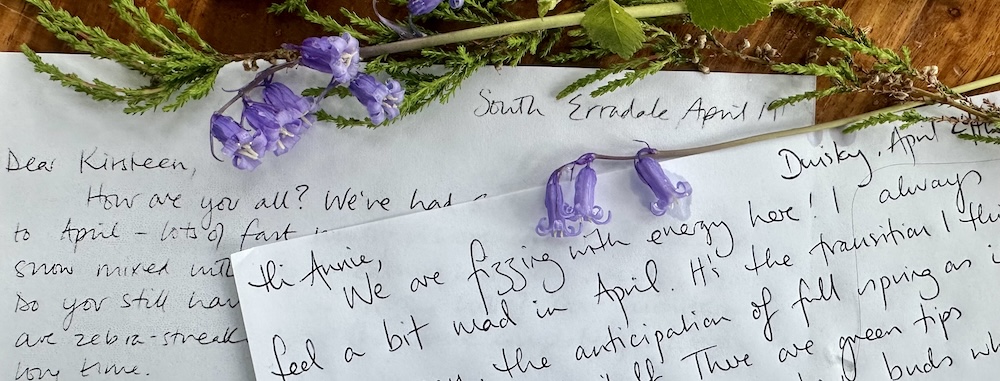
South Erradale, April 19th
Dear Kirsteen,
How are you all? We’ve had such a cold wet start to April – lots of fast-moving vicious squalls of hail and snow mixed with much calmer but very dreich days. Do you still have snow on the hills? Our mountains are zebra-streaked but they were completely white for a long time.
I’m longing for spring. Seeing images of flowers, blossom and green leaves further south has made the yearning worse this year. (Perhaps it’s my age!) Although our fields are still bleached of colour, the heather brittle and trees bare, I love the anticipation of spring, waiting for signs – the first bee, a cuckoo returning home. I think it’s my favourite time of year, the one seasonal transition which, although it comes to us so late, arrives with powerful and distinct suddenness, probably because we’re so close to the sea, open to the elements and storms funnelling down the Minch. I’m thinking now of the geographies of your valley, loch and mountains. Do the hills and woods protect you and your croft from the worst weather?
It has been bitterly cold; spring seems so far away. But a few days ago, I spied my first heath violet next to the Seaweed Trail where it cuts across steep coastal moorland, a tiny purple light in all the pale grey. And then, on a single coltsfoot flower, a moss carder bee. Signs of spring at last. What do you look out for in Lochaber?
All the recent rain and snow melt raised water levels in the river so for a while we couldn’t check on our young woodland. Eventually R. managed to wade across. The trees were doing well, he said, covered with buds. In the smaller enclosure on this side of the river, I was horrified to find several little oaks had suffered damage. A few piles of droppings gave the game away. Somehow, deer had managed to get through a wind-damaged section of fence. Thankfully, each wee nibbled tree still had plenty of buds but for a while I was hot tempered and cross.
Kirsteen, this morning I woke to the sound of a cuckoo! For me, cuckoos are the signal – this first lone voice tells me spring has arrived. The wind dropped in the early hours, the dawn chorus rushed in through our bedroom window (always open no matter the weather), and to accompany the pan-piping, another surprise – the wild cherry by our front gate has erupted with white blossom. After breakfast I stepped out to breathe in the deep rich scent of bog myrtle and listen to the sound of the grand old tree bustling with bees. This explosive burgeoning of flower, leaf, hum and cuckoo-song is simply wonderful. And it is warm at last.
Annie x
*
Duisky, April 24th
Hi Annie,
We are fizzing with energy here! I always feel a bit mad in April. It’s the transition I think, as you say, the anticipation of full spring as it begins to reassert itself. There are green tips starting to unfurl from the purple birch buds while there’s still snow in the north wind. We are protected a little by the trees and the hills, though conversely that also means we get spring a fortnight after the sun-facing slopes over the loch.
It is the cuckoo I look for most too, it feels like a herald calling up through the land with light on its tail feathers. I think I heard your cuckoo this year. I usually expect our cuckoos around the 21st of the month – that is, the birds that settle into the woods here for the season; however, I heard my first cuckoo on the 17th, a solitary call, then all went quiet again. You wrote two days later so perhaps that’s how long it takes a cuckoo to fly from Lochaber to Wester Ross?!
The windows are always open here too. My husband and I have a bit of a window dance going on, where he wanders around shutting them and I sneak around behind him opening them again. It is at night I love it the most, cooried in under the blanket with a breeze on my face that more often than not carries the kwik and hoo of tawny owl pairs from the birchwood. I am positive I heard the squeakier clips of tawny chicks too, despite not being able to spy a nest.
The big annual highlight of the evening chorus is the nightjar. Only one, and only once, but what a star it is. I couldn’t figure it out, why I heard it just that single time and never again each year. That early cuckoo has finally made the connection for me. I guess the nightjar is another regular traveller across our croft, putting in a brief appearance before he moves on. As ground nesting birds they would be unlikely to stay; there have always been too many inquisitive dogs on the croft for the woodland to be safe territory.
I do remember my father-in-law coming in on April evenings to tell me he’d heard it. He didn’t call it a nightjar though, and I can’t for the life of me remember what he called it. I’ve searched for all the Scottish folk names for it, fern-oul, gait chaffer, pirrin bird. None spark any recognition when I replay them in my memory of his Highland lilt. It occurs to me now he was more likely to have used its Gaelic name, or some variation – when I look them up neither seem right either. Gobhar-oidche, night goat, cuidheall-mhor – I’m not sure of the direct translation. Big wheel? Big spinning wheel?
Annie, I’ve just gone down a YouTube rabbit-hole comparing the sound of a spinning wheel to the nightjar call, and sure enough, it is the same ticking whir.
I asked another writer friend recently how he approaches using simile and metaphor in his writing on nature, and he said that above all else he values accuracy, that poetics comes from attention. The Gaelic is a perfect example of that: cuidheall-mhor a perfect recreation of the echo our crofting predecessors would have heard. Single pane windows letting in the haunting modulating whir of the nightjar, yarn twisting through the wooden wheel and spinning bobbin resonating in reply from within.
Deer here too, as usual – the buggers have knocked down our hen coop, so the flock are currently enjoying extra free range until we get round to fixing the fence. Have the stags at least left you a pair of antlers in fair exchange for your sapling tops?
Kx
*
South Erradale, May 20th
Dear K. No antlers yet!
I love the idea of a cuckoo stopping off on your croft on its way here. Coming all the way from Africa via a grand tour of Europe with a pause for rest in Lochaber. Yes! Yesterday, I watched a hollering male flounce about, and then heard the snarling giggle of a female but couldn’t spot her. However, there are no owls; at least, we haven’t seen or heard any on our croft. A keen birder in nearby Opinan has filmed owls in his garden, so they are about. And no nightjars either. We hear snipe winnowing – I love their otherworldly haunting melodies out over the bog – and there are bats aplenty swooping round our heads as soon as we step out of the door, but I’ve never heard a nightjar here. What a magical moment it must have been. And the Gaelic names conjure up such mystery. I remember an old tale of nightjars stealing goat’s milk but didn’t know about the linguistic connection to spinning. I listened to a nightjar’s call online and yes, it does sound like a spinning wheel clicking and clacking. Is cuidheall-mhor – big (spinning) wheel – their song, and gobhar-oidche – night goat – their alarm call?
I must tell my friend – she has taken up spinning wool, encouraging local crofters to supply fleeces from their different breeds. She and other local women clean, card and spin the wool, and then knit jumpers as gifts in return. L. has become so skilled she has organised demonstrations of spinning for locals and tourists at the museum in Gairloch. I must ask if she or any of the other spinners have ever seen or heard a nightjar or know of its Gaelic associations to spinning wool.
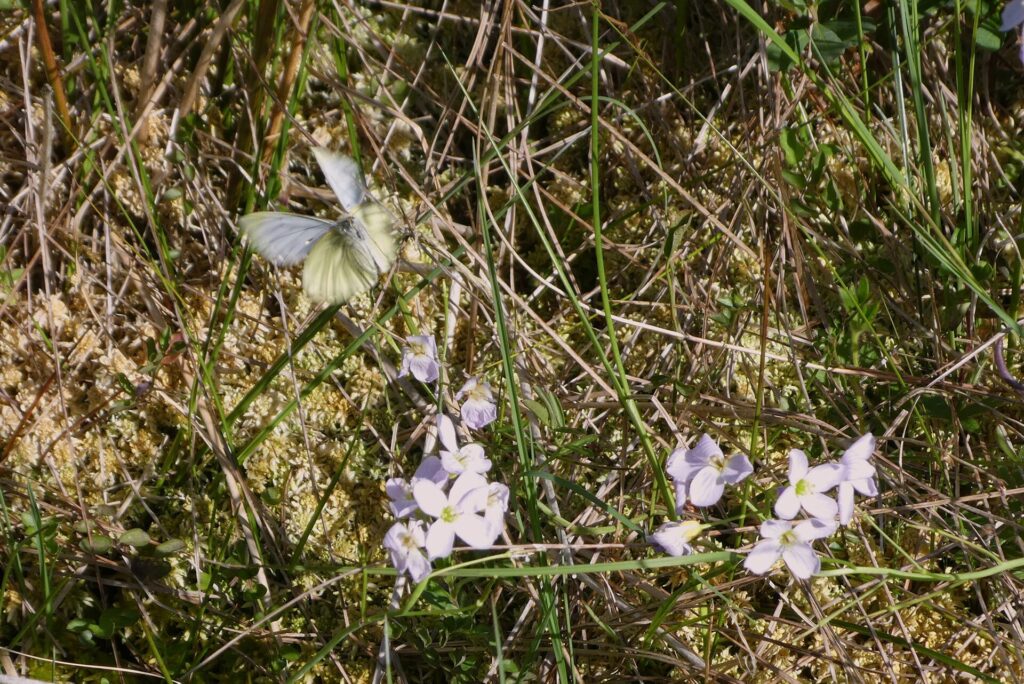
The greening of our valley and local hills is underway – so many greens and all so bright – and a sudden outburst of wildflowers. Cuckoo flowers are much more plentiful this year. Are they known as gleòrann in Gaelic? There are several English names – Lady’s smock, mayflower, milkmaids, fairy flower. My mother always said they were associated with the fae and shouldn’t be picked. I wouldn’t dare and, in any case, they look so beautiful among the grasses, mosses and myrtle, pale pink flowers dancing in the wind accompanied by cuckoo-song. They are loved by butterflies too.
It’s not long now until the summer solstice. There is plenty of wild flowering to come – cotton grasses, red clover, yarrow, yellow rattle, orchids (especially the orchids) and many more. And the anticipation of our hay meadows in full sun, grasses nodding, insects humming, is almost too overwhelming, but I don’t want to wish the summer away before it’s begun. Every day is precious.
With love, A xx
*
Duisky, May 27th
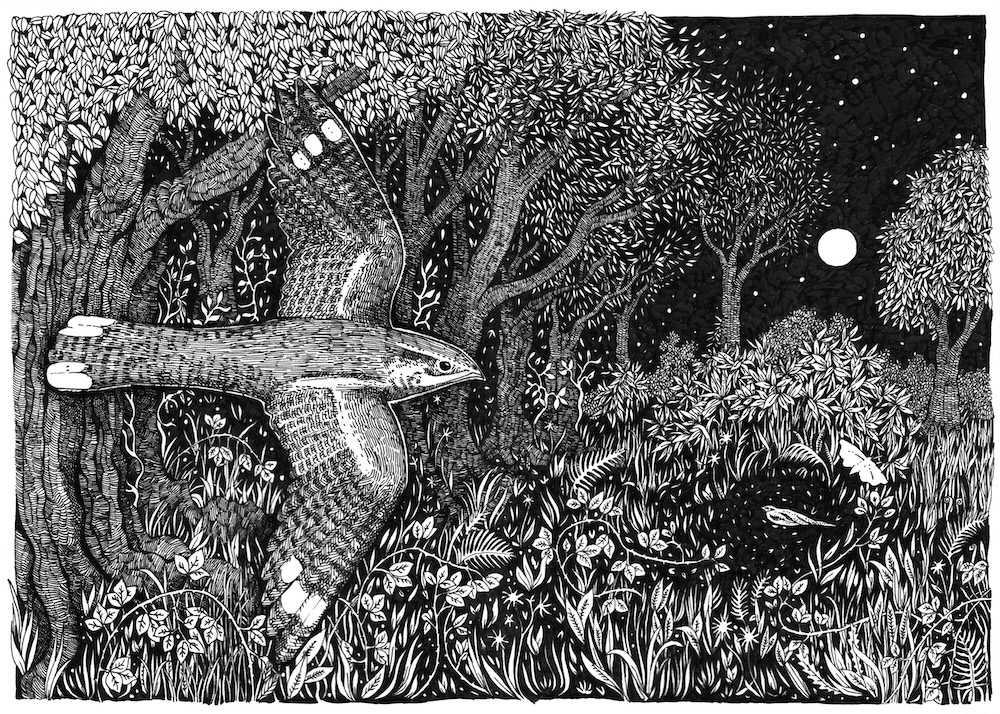
Annie, look what I found: I had to send this nightjar by Alexi Francis to you, along with a wee wildflower and bird update from our own croft.
My morning alarm is redundant as it’s preceded by a chorale of willow warblers, wrens, blackbirds, great tits, blue tits, meadow pipits, siskins, and even redpolls. The top note of raven remains the most persistent in pulling me from sleep earlier each day (I might end up closing the windows after all to get a lie in.)
The birds themselves are mostly hidden now by the full leaved canopy. Staring long into the woods sometimes gifts a wee tree creeper scooting up an older sister birch. And every shaded slope, beneath all the green-gold hazel and shining birch leaves, are thousands of tiny purple bluebells. So many that their delicate scent rises over the damp earth and sweet leaves.
Some carry the whitened periwinkle tones of the Spanish bluebell, spearing tall into the spring light; other patches are the deep violet of common bluebell, nodding back down to the warming soil from their curved stems. Common bluebells made uncommon by their abundance. The teeming woods remind me why I pause on re-introducing livestock. Not just because the flowers are toxic to animals – why they’re left alone by the deer I suppose. Even if cows wouldn’t browse them, still they would trample them. Your descriptions of your hayfields are so enticing, and heavier hooves would create pockets of potential for new seeds, for more diversity in the understory, but – like your fae protected cuckoo flower – I am reluctant to break the spell the bluebells cast.
Have you read The Tree House by Kathleen Jamie? If not, I’ll send you a copy so you can read ‘Speirin’, the poem that lives in my heart all May. Speirin, seeking out. That’s what we do, isn’t it? Find these pockets of brilliance and life whose return is a revelation each year. Ach, let me just write out the poem for you, I can squeeze it in.
Binna feart, hinny,
yin day we’ll gang thegither
tae thae stourie
blaebellwids,
and loss wirsels –see, I’d raither whummel a single oor
intae the blae o thae wee flo’ers
than live fur a’ eternity
in some cauld hivvin.Wheesht, nou, till I spier o ye
Will ye haud wi me?
I almost risked the faeries’ wrath to press one purple bloom into this card. I can’t bring myself though to take them away from those light-flecked woods, to flatten those delicate papery curls. We’ll just need to gang thegither here next year.
With love,
Kx
*
Kirsteen Bell is a Scottish writer of narrative non-fiction and sometimes poetry. All her words are gathered from the croft in Lochaber where she lives, and the surrounding Scottish Highlands. Her writing and reviews can be found in such places as Paperboats, Caught by the River, The Guardian Country Diary, The Lochaber Times, and Northern Scotland Journal. Kirsteen can also be found at Moniack Mhor, Scotland’s Creative Writing Centre, where she is Projects Manager and Highland Book Prize Co-ordinator.
Annie Worsley is a writer, crofter, grandmother and geographer with an enduring love of the Scottish Highlands. In 2013 she and her husband moved to the crofting township of South Erradale near Gairloch. While her husband was a community pharmacist, Annie worked on Red River Croft. She began a blog about life on the croft and then wrote essays on nature and environment for various publications including Elementum Journal, Women on Nature, the Seasons’ Anthologies edited by Melissa Harrison, Caught by the River and Inkcap Journal. Her first book about life on Red River Croft and the natural history of Wester Ross, ‘Windswept: Life, Nature and Deep Time in the Scottish Highlands’, was published by William Collins in 2023, and is out now in paperback.
Nightjar illustration printed kind courtesy of Alexi Francis. See Alexi’s contributions to Caught by the River here.
‘Speirin’ printed kind courtesy of Kathleen Jamie, taken from ‘The Tree House’ (Picador Poetry, 2009). See more of Kathleen’s work on Caught by the River here.