In addition to sending paid Steady subscribers monthly interviews with authors of our Books of the Month, once a quarter, we invite a different writer to share their most favourite and pleasurable moments of the season. This month, Kerri ní Dochartaigh delights in Spring’s cracking open.
Read an excerpt from the piece below, and log in or subscribe via Steady to read in full.
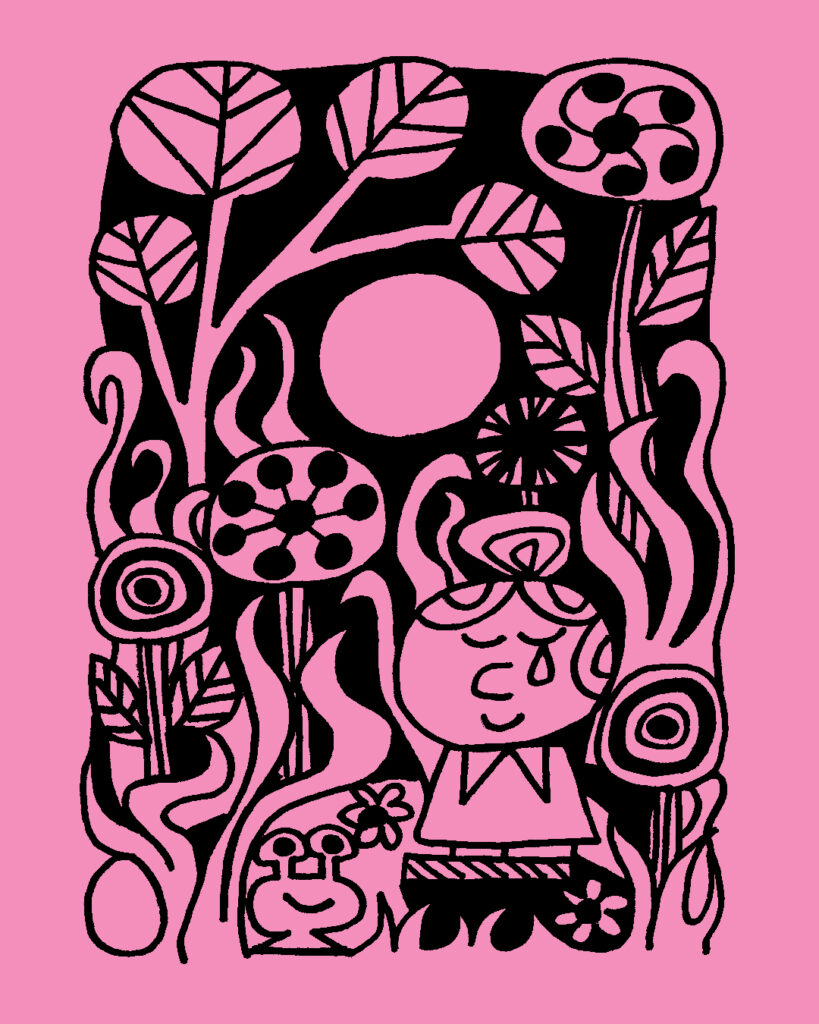
Illustration: Adam Higton
It starts with a gentle cracking open, so soft and quiet you could be mistaken for thinking you had imagined it. This cracking open happens, like all good and beautiful things, slowly: bit by tender bit.
It begins in the way of all potent beginnings: with a small, delicate seed.
It begins in the way of all sacred beginnings: with a strange, wild story.
In spring, we give ourselves back to the earth.
In spring, we allow ourselves, once more, to trust in the potential of seed.
In spring, we allow ourselves, once more, to trust in the power of story.
And what are the seeds we sow in spring?
What are the stories we tell in spring?
The spring I gave birth to my first child was a spring unlike any other I had ever known. It was a global pandemic, and the UK and Ireland were experiencing, for the second year in a row, the kind of spring I always thought only existed in vintage children’s picture books, or in old stories handed down from elders to us young’uns as a way of keeping the magical past alive. But, no – it turns out this beautiful, bruised earth of ours still offers us those kinds of springs.
Springs that can change a life; heal a wound; create a future; leave a trace for all times.
When spring returns to us all, we are returned to the earth – our original mother, in a way we may feel we have not experienced, since the moment she left us – almost a full cycle ago.
We are, in myriad ways, returned to joy.
You likely know of that old saying, that a person cannot be sorrowful, not really, when spring is moving on the earth. I won’t say that I agree with this wholeheartedly, but I do know that spring offers us a way back to somewhere – a place we can’t quite name, and in this place, we are able to find something once more – something we may have taken, for quite some time, as lost. And I think that thing we are able to access once more is something perhaps even more impactful than joy, something that runs deeper than hope. Something that feels ancient, ancestral, full of wild healing.
That spring I became a mother; I had sown seeds into the earth beneath my feet in a way I never had before. Barefoot; sun kissed; full of fear and excitement; increasingly taken by the ways in which the earth, this planetary home of ours, still holds in her delicate, folds the ability to surprise me to my core.
To surprise us to our core.
To startle us; to settle us; to soothe us.
I remember, most of all, the shock of the light.
How, at a time that felt so dark and uncertain, the resounding image was lightlightlight. Those pandemic springs were so bright! Such tender reminders of all that is good about this our shared home. How we explored and learned; sowed and tended; harvested and loved. Oh, how we fell into spring, in those days, right when we needed her expansive joy more than ever, it could be said.
I sowed seeds, flower seeds – poppies, love-in-a-mist, cornflowers.
I sowed seeds, grass seeds – sheep’s fescue, hare’s tail, quaking.
I sowed the seeds that would become the garden of my motherhood, and it was the thing in my whole life I most cannot imagine not having done. It changed me, to grow that garden that spring. It changed me as a person, a woman, a writer.
It made me a mother.
That spring, that garden.
What potent power there can be in small, cyclical, quiet things.
I stood in that garden, right when spring was at her fullest, and wept with gratitude to live on a planet that still welcomed our hands in her soil. To live on a planet that still offers us something as jubilant, as joyful, as spring. To be a passenger on this sturdy, black-velvet-space faring vessel; the best home any of us could ever dream of.
*
Log in or subscribe via Steady to read this piece in full. Paid subscriptions enable us to secure the future of Caught by the River, in exchange for perks such as exclusive monthly published content, a perpetual discount in our Bandcamp shop, and discounts on tickets to our events. More information here.
Kerri ní Dochartaigh is the author of Thin Places (Canongate, 2020) and Cacophony of Bone (Canongate, 2023) both listed for the Wainwright Prize for Nature Writing. She has written for the Guardian, the Irish Times, the BBC, Winter Papers, and others.