Spring surges, squirming and unstoppable, into Mark Mattock‘s “feral’d” NW2 garden.
From Snow bush to May bush
‘God speaks in the least of creatures.’ – Cormac McCarthy, Blood Meridian
The spectrogram at the top of my phone screen looks like a post of some giant artwork. A wild untamed Turner landscape in charcoal. It’s a visual rendition of the audio signals of this morning’s dawn chorus weirdly photocopied. Some ghostly fossilised echo of the garden from deep time, eons before bricks, concrete, sterile roses, creosote, EMFs and heavy particle pollutants. I’m learning to decipher it, I can see wren and house sparrow for approaching cat. They look like they’re bursting from an abstract expressionist depiction of blackcap’s thorn spinney. His dribbling song further annotated by the cold drizzle tapping on my face. A series of tall thick dark verticals follows like an unfurling of a ceremonial bonnet of black feathers — the caws of crow at the top of the big ash.
What’s he saying about me? This bird’s song is not calming. Very recent AI analysis of crow vocalisations reveals that crows have syntax, grammar, and talk about us, describe individuals of us to each other, can hate some of us; trashing our egocentric arrogance that complex language is unique to us. Suggesting — surely — that all birds do; all creatures, all life. Yet more recent science revealing plants also communicate in sound, scream when cut, chopped, pruned. Science like this makes total intuitive sense, feels instinctively right. What if we could hear a fresh-mown lawn? The horror.
Fifteen species have collaborated on this morning’s orchestral mural so far, in just fifteen minutes. But almost every morning Merlin (the identification app) suggests a bird that simply is not possible; or maybe just, an extremely remote chance, it’s the idea of it. In the last couple of weeks: cetti’s warbler, melodious warbler, meadow pipit, black redstart, kingfisher, redpoll. An app imagining an alternative ecosystem? I know what what it’s suggesting looks like. I doubted it hearing a song thrush, as it’s been claiming it has all week. I couldn’t hear it, couldn’t find it, searched the bare trees on my limited horizon with binoculars. This morning I have to take it back, there he is, on top of the big ash, bathed in red spectrum glow, on crow’s king twig; loud, bold, operatic, defiant.
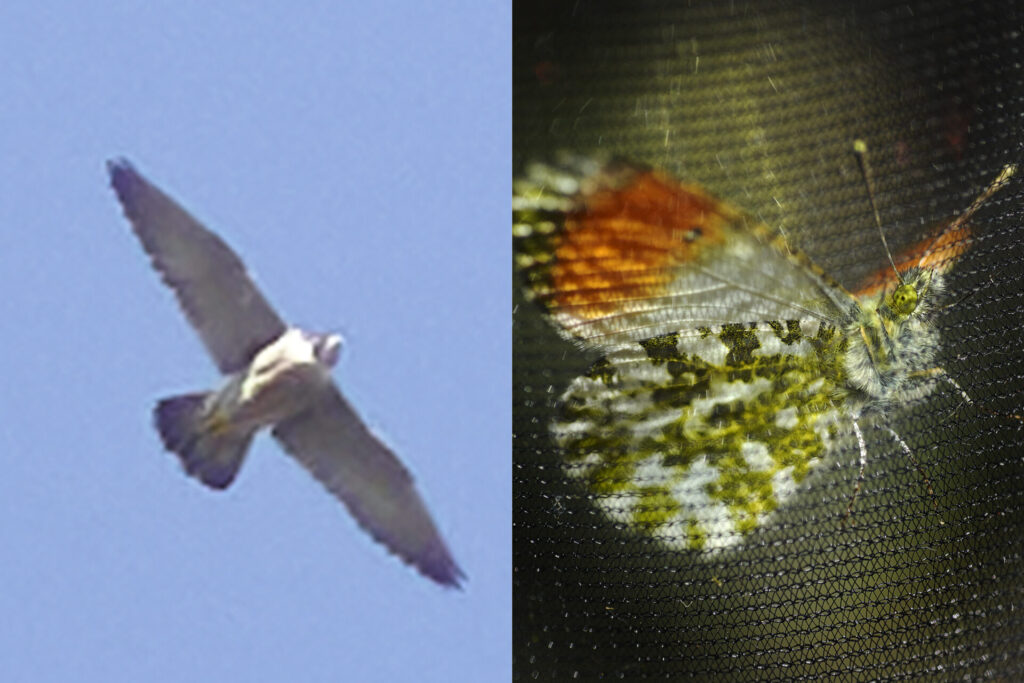
I lean forward to check the phone beside my feet on the rust-scabbed garden chair again. Now at the top of the chart… a peregrine! I instantly flush with thrill, I know this is likely. It’ll be somewhere high up there. I’ve found them before when searching the sky for the first swifts. Classic raptor this time of the year; a male posing. I look for it through my floaters and the bleached-bone ash branches. It’s somewhere in the vast immaculate blue above them; above this garden, this street, this borough, this city. I rest my binoculars on my eye sockets, letting gravity help steady them, and scan the open sky — nothing. Then, in the mosaic of branch-broken sky, yes, there he is, pin-sharp in a soft-edged shard of it, the radiant peregrine. So high he’s a mere speck, no more than a glowing mote. I dwell a moment on how he probably can see the thames estuary and how suddenly small then that makes the world. Surely he’s too high to be heard? I move fractionally and lose him. I find him again minutes later, he’s descended a thousand or more feet. Transcendental, the thrush’s acoustic vocals now cinematically soundtracking the soaring falcon drawing circles in clean, pure, invisible wake across the empty urban Sunday airspace, purifying it with unadulterated wildness as he continues to spiral eastwards on the first thermals. Then the blackcap opens up, and now it’s truly beyond: a song thrush, blackcap mash, mix, duet that doesn’t really work but jeez! Mesmeric. The lucent lyrical clarity; every note, every phrase of each bird. So much to say.
In the waning luminance at the furthest reach of the outdoor wall light which I’d just switched on, two demonic spectral bipeds dancing face to face in some hallucinogenic trance. Skanking on thin satyric legs, eyes glowing, split wide sharp-tooth serrated gapes coughing spittle into each other’s mouths. The horny pogoing foxes too high to give shit about me. This usually goes on, nearly every night this time of the year, at the front of the house. They have a vulpine version of a crack house under a massive tarpaulin of bramble that was, long long ago, the front lawn. This bit of the project gone very wrong. It was intended as a massive bee success. I know dunnocks and long tailed tits had nested in it. It provided kilos of blackberries and the simple perverse joy of seeing the disgusted looks from passing nature-averse neighbours. But underneath in the rank subterranean sub-rubus gloom, on the bare hard fox-trodden ground, a growing fly tip of fox fancies and takeaways: grotesquely swollen disposable nappies like giant sea slugs, collections of premium cat food packaging, giant sore-coloured ox bones, soiled and scorched foils, assorted chewed plastic, ancient and recent.
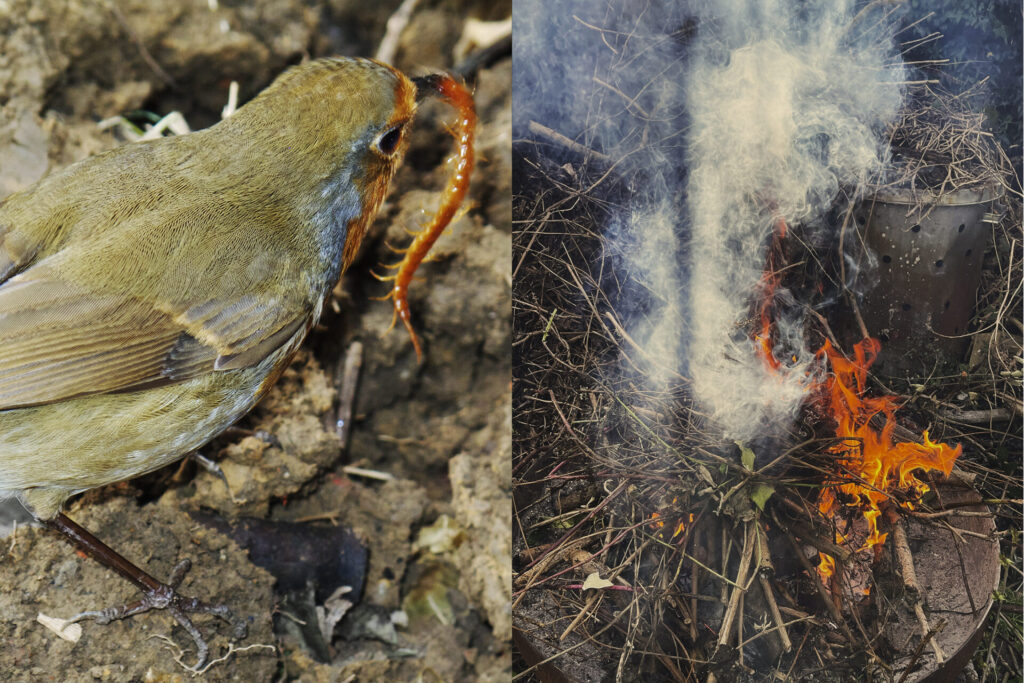
A squirming knot of sickly spaghetti-coloured centipedes geophiliidae geophilus pinched tight in the beak of the robin bouncing around my boots. So close I can see the wave motions of the bristly-legged fringes as they writhe like vaselined elastic bands. The drastic total clearance of the bramble jungle has been ‘kerching’ for the pair. It looks like their second brood nest is somewhere in the neighbouring front garden, the first brood fledged a few weeks ago. They’ve been at my feet for the last few days snatching up countless small worms and assorted invertebrates — healthy soil. They seem to burst from out of the ground like trap-door spiders, on any prey I disturb or unearth, almost completely invisible until they move. The front garden now a miniaturised facsimile of devastation, a portion of clear felled, grubbed out amazon, or Congo. The privet hedge like the stark receding edge of the dense rainforest, the absolute boundary where the bulldozers stopped. From the neighbour’s it must look like the roadside buffer strips left by logging ‘operations.’ Inspired by the destroyed garden of a halted house renovation on the opposite side of the street, I’m going to leave it and allow. That garden bloomed spectacularly for a couple years. ‘Reweeded’ by itinerant wind travellers: an encampment of pink-dipped rosebay willowherb, giant piercing metallic thistles with fur crowns plucked by goldfinches, ragwort with its striped fruit of cinnabar moth larvae; dandelions, sow thistles, hawksbit. From dormant seed resurrected by disturbance and exposure to full spectrum photosynthetic light: poppies, ranunculus. The eternal camp followers: nettles, docks, forget-me-nots, oxeyes, grasses various, the scarlet pimpernel himself. It’s paved over now; there isn’t a single leaf, blade or blob of living green.
The foxes have expressed their contempt for my had-to-do-it by ‘venting’ scent markers all over the new space. To be expected though, all that bare earth for fox and feline must be like a row of portaloos at a festival. I was accusing an unidentified disgruntled neighbour of letting their dog on it until I saw the size of the dog fox one early morning playing chase with the reluctant vixen.
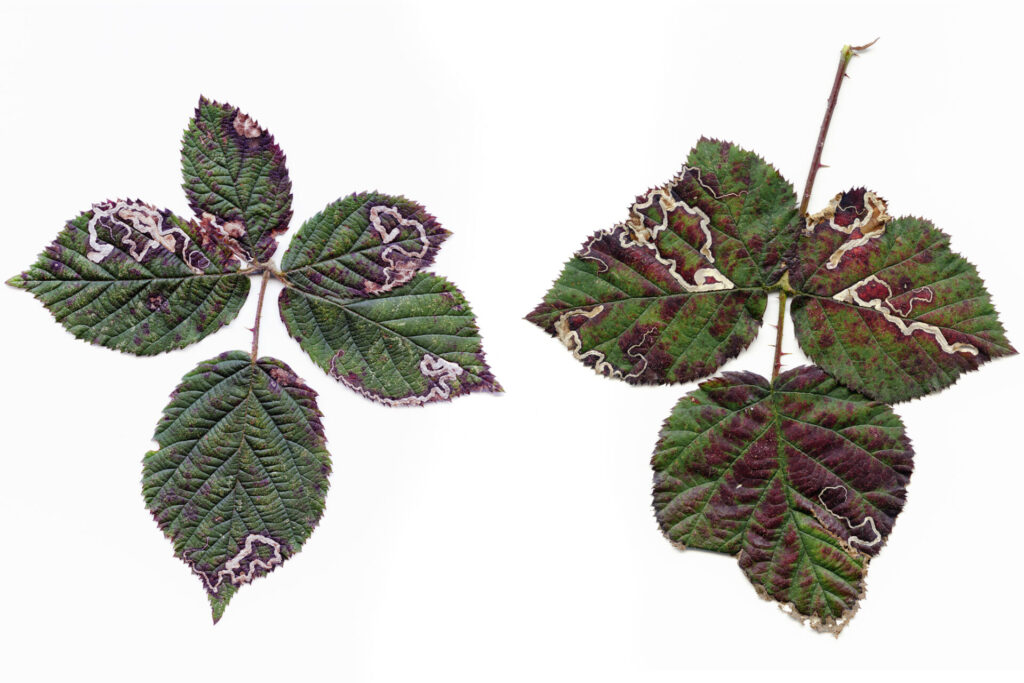
The intestinal larval routes of last year’s leaf miner moths stigmella aurella glow bleached white, raw red and magenta on some of the old hard dark green bramble leaves. They’re like tiny tapeworms shat from small birds, creating incredible intricate objet d’art with calligraphic depictions of a sacred river. There is something very satisfying about them. They remind me of yellowhammer eggs. The adult moths seem to favour the short puny single shoots of bramble scattered in the ground flora, I find few in the heap of slashed and grubbed-out canes I’m burning off in the fire pit.
It’s too much, I have to get up to close the window. Step into the glare of a cold-pocked metal full moon, resting weightless on the roofs. Notice the tiny emblematic ‘T’ stuck to the window as I count the scattering pin-pricks of stars. It’s a plume moth, Emmelina monodactyla. No one ever acknowledges the first moths of the year. From the cavernous shadow at the end of the garden, the creepy wailing and yelping of carnal frenzied foxes. They’re doing our heads in.
It took over a week for the magpies to complete their big stick dome nest. I watched the whole build. The site seemed to have been chosen by committee. The pair began soon after a gathering at the top of the ash — a whole clergy of zealot pied haggisters in black hoods.
I didn’t think it was going to work, they didn’t seem to be able to get it started, at first every stick bought in and placed dislodged a previous one. But over the days it became clear how intelligent the assiduous birds were. How they were clearly seeking particular sticks as the dome progressed, searching for the next bit to the 3D puzzle. I watched them testing strength and pliability of each stick. The way they juggled, particularly large long pieces, grappled with the neck-twisting weight to find the fulcrum (clearly showing corvids much more intelligent than dogs) before manoeuvring the selected piece through the canopy. They stole some of the finer twigs from the wood pigeon’s nest in Ivy Tower.
Outside, bright warm day, above us the female magpie is begging the male, relentlessly; wing fluttering like a needy chick with short grating calls of feigned hopelessness.
“What’s that about?” I’m asked.
In David Attenborough speak:
“It’s the female magpie pestering the male. Basically she’s saying feed me and fuck me, the nest is done, what are you waiting for?”.
Spring surges unstoppable like ocean tides; in waves, some barely discernible, but not today. Today is the seventh wave, crashing into the garden in spume and spray of light and heat, in wings, petals and leaves, in shrills and trills. An ethereal ménage a trois of whirling whites spirals combatively in the thermal rising from the heaving duvets of luscious greens, on which ladybirds shine like scattered drops of fresh spilt blood. I’m not in the city, I’m in a magical scene from Studio Ghibli. Blackbird warbles drunkenly. Flakes of sky — holly blues — flicker like wind-loosened birch leaves around alkanet and forget-me-not and are then wafted up Ivy Tower now tiled in polished pangolin scales of dark green radiating leaves. Droning hang-out-tongue hairy footed flower bees, carder bees, tree bees, early bees oscillate the warm, pollen-tainted air with soothing buzz and humming. Dropping down a scale, a confusing medley of narrow-waisted Hymenoptera (bees, wasps, ants, sawflies) fidgets, trembles, cruises, searches, tastes, prowls, soars, darts, pounces, floats through, over, under the kaleidoscope of leaf, blade, and flower head. Shamefully I can hardly name any, even those familiar.
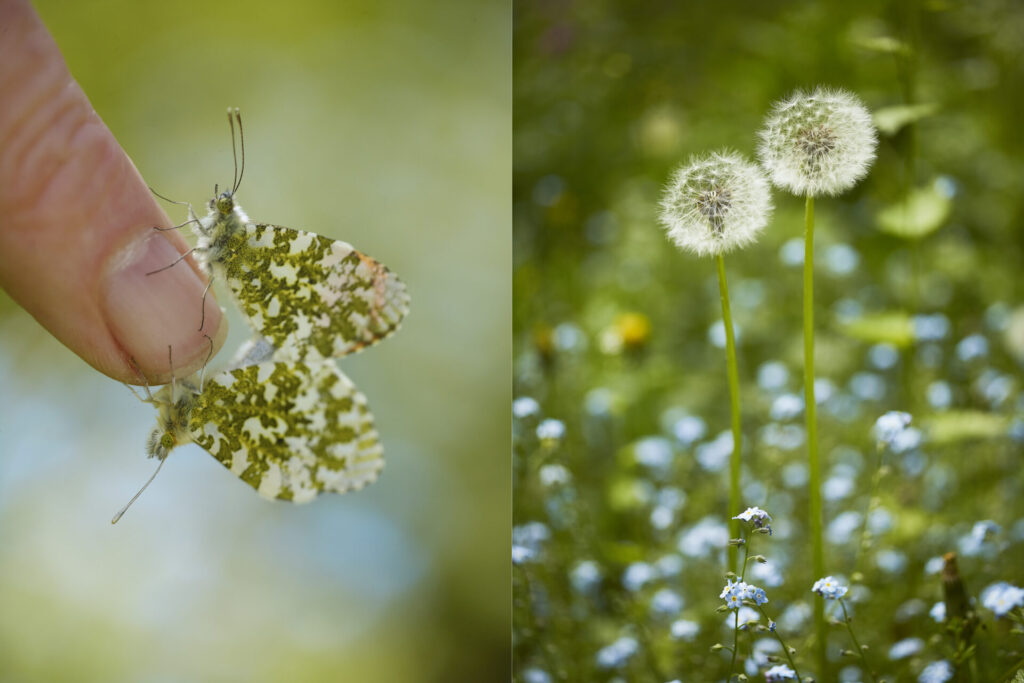
The female orange tip drops out of the frenetic dance onto a garlic mustard leaf. As the male orange tip and ambitious male green-veined white continue to harass and body bump her she lifts her abdomen high towards them in a pheromonal butterfly fuck off, I don’t need you anymore.
For sure I know her, we met a year ago, either here in the garden or along a hedge. She would have then been a tiny ribbed millimetre-high orange rugby ball sat pert on a flower stem of garlic mustard. Hidden just below the cluster head of small blooms which I would have pinched off and put in a small plastic box to take her home, or indoors, with me. I can’t pass a patch of garlic mustard in April or May without looking for them — orange tip eggs. It’s a seasonal ritual, goes way back, has profound meaning, association — nostalgia, connection, healing. I would have regularly checked my boxes on the kitchen top. On seeing the egg had disappeared but knowing she was still there — now a near impossible to find micro caterpillar — I would have added a fresh mustard head with its developing seed pods. Orange tip larvae are cannibalistic, it’s why you only usually find one egg per flower head. Having carefully deposited an egg the female probably leaves a pheromone message that it’s been taken. I would have renewed the food plant every few days, until she turned green and near disappeared again, totally camouflaged, mimicking a swollen seed pod. Transferred her next to a whole plant stem in water, placed in a nylon netted cage with others, careful no plants touch, until some chemical, hormonal timer suggested she stops because it was time. I would have found her poised upside down like a tiny cobra, loose silk strapped to another stem or roof or side of the nylon cage. If incredibly lucky I would have watched her split open and squeeze from her old catsuit and warp and harden into a weird, legless little extraterrestrial’s boomerang. I would have placed her with the twenty or so others outside in a sheltered corner and all but forgotten her. Until a couple of weeks ago when there she was, losing patience with being jostled by the males she’d emerged with. They’re all dying to hit the new world after ten months in cryonic suspension, every cell in their bodies having been reconfigured. She remained poised, hanging from the roof netting. The familiar simple observation, moment, never wanes in monumental significance. It’s the same reaction to when, say, you’re shown the new dress she’s just put on for you before going out. The awe of metamorphosis, of unfathomable possibility, the constant of renewal.
The cat has just been swallowed into a heaving mound of lush fecund green, the narrow path now sunk deep into it leaving just a trace, like a karate chop in a lump of bread dough. He is snaking unseen under the dense foliage towards the amphibious-looking robin fledging perched uncharacteristically out in the open on the cherry stump like the garden idiot — a feathered toad with fluffy ear tufts and a stick-on tail flicking. Its parents, suspicious of jolting leaves, let off their rapid ‘tik, tik, tikking,’ hover over the greenery to distract the suspect apex predator. The fledgling launches out over the open garden, just managing to stay airborne, and disappears deep in the honeysuckle, the cat is still stalking, unaware it’s gone.
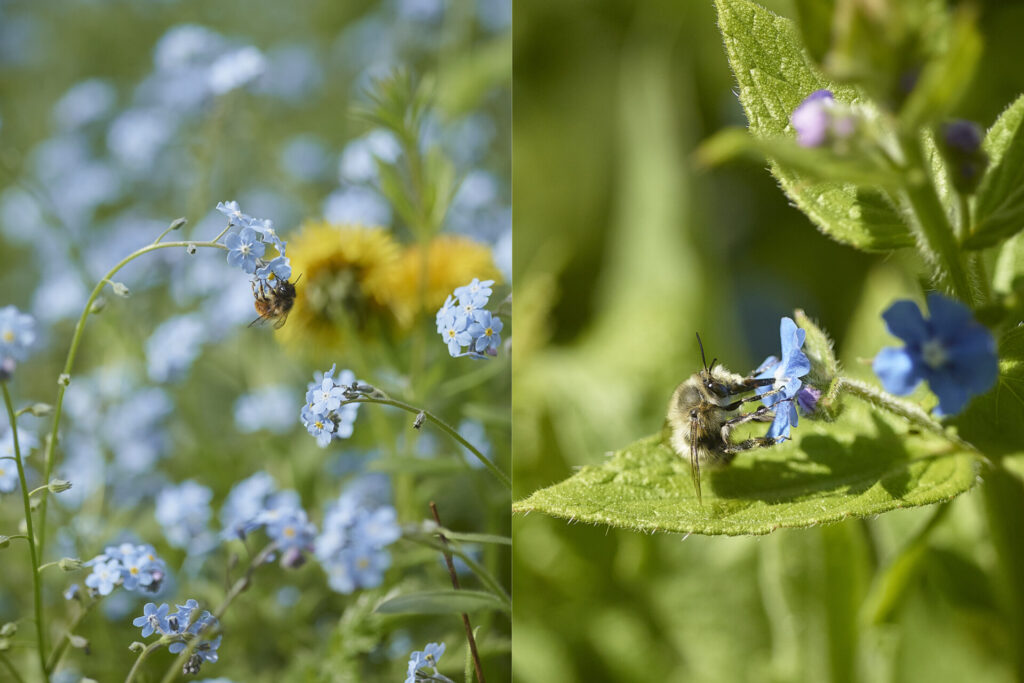
The sun re-emerges from the smeared cloud, and the contrast control is turned back to max. Brilliant rim-lit leaves burning hot flame green, hard shatterings of the blackest shade. The sun’s doppelgängernger on the kitchen window filling the shadows deep in the wall of vegetation where the concrete slabs end, over which a troupe of backlit dancing gnats scribble in some indecipherable script. New dock leafs pierce the knee-high canopy with pointed spear blades of neon chlorophyllic green. Under the glass-topped table, a fox scat looking like an unearthed hawkmoth pupa, bejewelled with a pair of metallic greenbottles. At the back the hawthorns have bloomed properly for the first time like the blackthorns a couple of months ago. With enough blossom to perfume the warm heady air with their familiar sweetened funk. Already some browning petals rain-splatted onto the ramsons, bluebells and dog’s mercury underneath. Melodious scrub warbler mutterings from somewhere in the ripe spinney. Two male orange tips on fire over the cow parsley. Immaculate dandelion afros stand proud in the glow, awaiting inevitable ruin. The first swifts scythe and surf heaven, screaming ‘we’re back.’ I don’t look up because I’ve just found the first orange tip egg and caterpillar — but I feel them, their piercing excited shrieks electrifying everything with tentative relief. This is what I envisioned all those years ago.
*
Mark Mattock. Artist. Photographer. Publisher. Rabbit Fighter. @the_rabbit_fighters_club