In ‘Strangers on the Shore’, published yesterday by White Rabbit Books, Michael Smith stumbles through the uncanny psychic landscape of Hastings, exploring the experience of becoming a father and the disarming grief of leaving your youth and its dreams behind. Will Burns reviews, finding a steadfast commitment to the beauty of doubt and ambiguity in the face of a vast and unknowable universe.
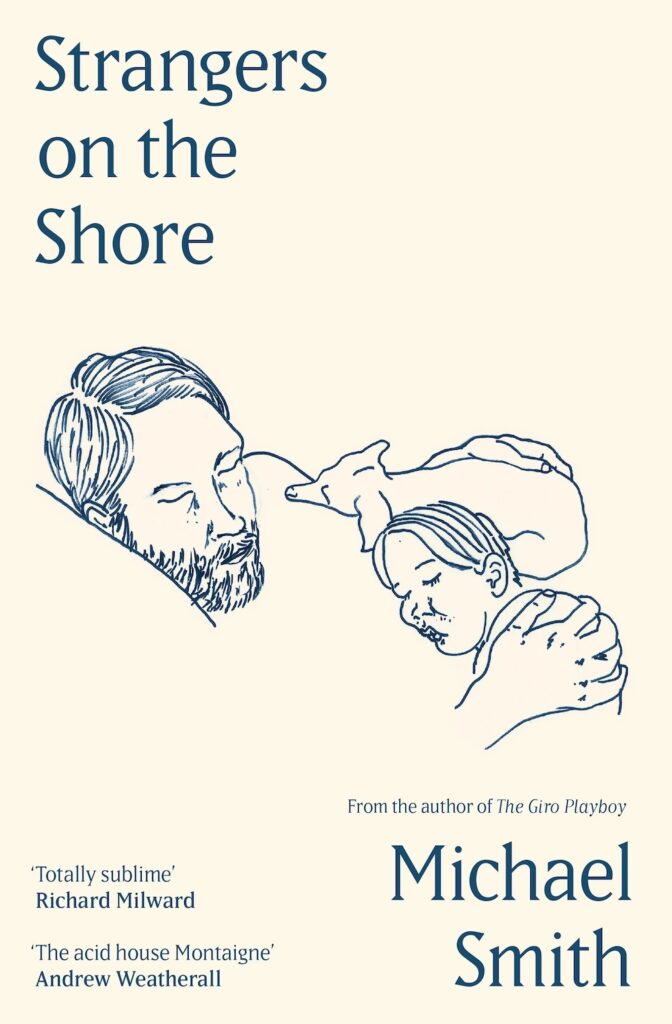
Of course it’s obvious to say a lot can happen in thirteen years — the amount of time that has elapsed since Michael Smith’s last book — but even so, a reckoning up of this specific time span, 2013 to 2026, certainly feels noteworthy. After all, a lot has happened. For the writer, TV presenter, flâneur, artist Michael Smith there has been what we might term the standard issue personal upheaval — the immense shock of fatherhood, the tumult of relocation from a London home that his particular brand of the artistic life can no longer afford, of the unanticipated downturn in one’s professional and creative circumstances — but in this new book, beautifully layered on top of all that, is the substantial weight of the whole country’s collective recent history. Strangers on the Shore positions the author’s existential dilemma across a backdrop of financial uncertainty in the wake of the 2008 crisis, the gentrification of East London, and then, with its inevitable creep, of seaside towns like the St Leonards he finds himself in, the Covid pandemic and its lasting impact and of the specific pressures, cultural, financial, social, afflicting regional English high streets up and down the land.
It’s all done with Smith’s trademark laconic and somewhat bemused flair, but perhaps with a welcome added note, now in middle-age, of palpably genuine anger as well as the usual wistful melancholy and ecstatic indulgence. Smith finds himself removed from a version of the capital that seems almost mythical to him at the time of writing — a place full of dreamers and their dreams, artistic ambition and the pleasures of its fulfilment, adventure, scope, infinite possibility. But it’s a place he visits now, up on the train from the ‘shambling seaside town’ he refers to as home, or, in his rather Lowry-ish line, as ‘this drinking town with a fishing problem’. In fact, Malcolm Lowry might well be an apt shadow figure for Smith’s book – though with a very contemporary kind of post-millennium artisan aesthetic (wine snobbery has never come off so self-effacingly winning as it does here) — there are, after all, the endless ambulations, the slightly cursed luck, the sense of the author, at a certain point in their life, finding themselves at the very edge of the world — though for Smith it’s a town both burdened and blessed with its faded Regency glamour ‘the end of the railway line’ and not a blighted shack on a Canadian inlet – cut off from their own past, their career, their selfhood. And of course there is the drink. Smith is excellent on the dichotomies of a true drinking life, especially those that come with the drudge of serving the stuff up to other drinkers. He’s fantastic on the heady euphoria of communion across the bar, as well as the grind and monotony of playing ‘mein host’. There is an eros for the grape on these pages that can practically be smelled and tasted. Almost every transcendent moment comes with a salutation in a wine glass and it’s this sensory, sensual intellect that allows Smith access to so much of the thinking he does across the geography of his poetic imagination and charmingly esoteric, open-hearted love of learning. And so we learn about the yarchagumba mushroom, an aphrodisiac and a stimulant, we learn about Tawus Melek, the Peacock Angel via the surprise discovery of a local ocakbaşi grill and the owner’s ‘heady Turkish red’. There are digressions into physics, mathematics, history, geography, and Aleister Crowley — even that excursion comes after Smith knocks over a book on the history of chocolate only to find a copy of a book about Crowley’s last days in Hastings that he had once owned and since lost to a drinking accident involving the author Gareth Rees.
Ambivalence of the sort Smith finds in the running of his bar, in his new life of exile and ecstasy, is a sort of battery for the whole book — the frustrations and profundity of new fatherhood, the eros for one’s past and the sheer power of the present, the loss of London and its simultaneous impossibility, the disappointments of thwarted ambition — ‘I used to be on TV!’ — and a newfound freedom from its own peculiar tyranny. Smith handles these multiple double-lenses with the kind of brutal honesty and self-awareness that allows for the quotidian and genuinely comedic gripes and moans of any middle-aged reckoning to find their mark, scattered as they are amongst mind-bending flights of fancy, wisdom and knowledge of every conceivable kind. Perhaps equivocation is the natural byproduct of an author who has made a kind of poetics of mystery, a home for himself in the uncertainty of being — a steadfast commitment to the beauty of doubt and ambiguity in the face of a vast and unknowable universe. Magic, no?
*
‘Strangers on the Shore’ is out now and available here, published by White Rabbit Books.