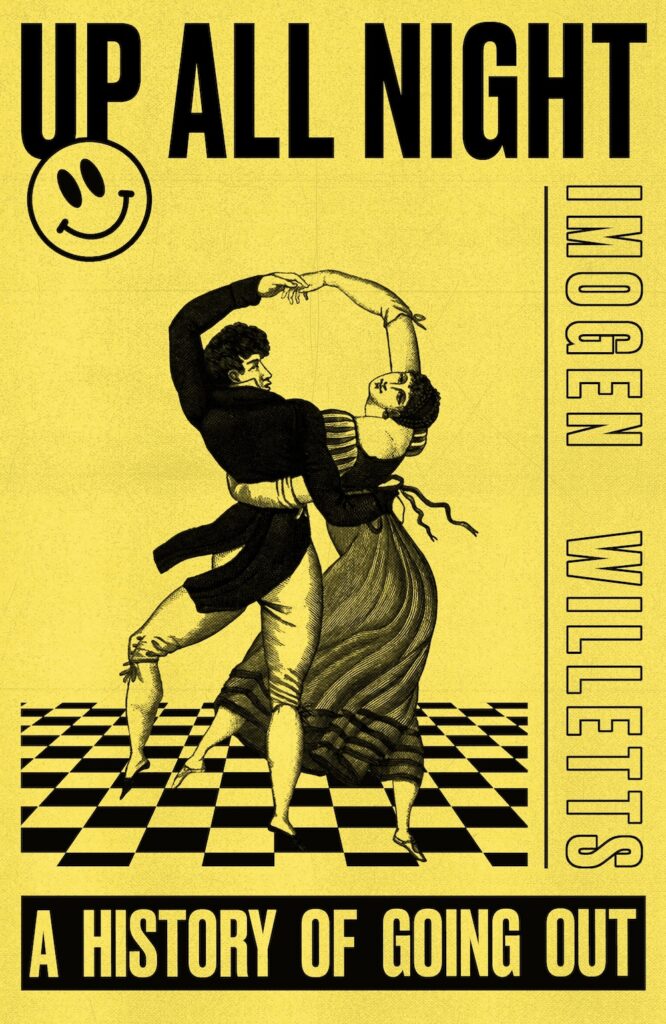
Newly published by Weidenfeld & Nicolson, Imogen Willetts’ ‘Up All Night: A History of Going Out’ is the story of the good times and the great ones. Emma Warren reviews.
History shows us that going out goes in waves. For years it might be at high tide, with a wide array of activity taking place after dusk. And then gradually, or all at once, the night world can go dark. Sometimes this takes place on a national level, for example when war breaks out, or authoritarian rule arrives, but going out can also recede on a personal level: during illness, bereavement, or simply through aging.
Imogen Willetts’ Up All Night tracks a long arc of big nights out by selecting a chronological series of maximally creative highpoints, across the centuries and from across the world. Her stated intention is to reconstruct a series of notable nightlife moments, and to make them accessible to readers through deeply researched storytelling. Her authorial ability to spark connection to collective nightlife feels especially relevant today.
We’re not short of reports showing that UK pubs, clubs and public space in general are in sharp decline (community-owned pubs being a rare upwards line on the graph). Covid broke the chain that led youngsters through grassroots spaces into nightlife for grown folks, and the government’s new National Youth Strategy reported that half of fifteen-year-olds in England spend most of their free time in their bedrooms.
The nightlife tide is demonstrably low, here and in many other comparable places worldwide. Willetts’ jaunty, jam-packed and dynamic history contains plenty of evidence to suggest that this might be temporary because low points are an essential part of her story, with new and energetic waves following enforced quietness. Just as a couple of examples, this rollercoaster ride through time and space includes mafia-run casinos and cabarets in LA and Havana that followed World War II, and the Mutoid Waste Company’s industrial techno raves that flourished after the Berlin Wall came down.
In Up All Night, nightlife relates to ‘commercial and secular environments, designed to offer a variety of pleasures at night’. Variety is the key word here because in Willetts’ world, ‘going out’ extends far beyond the dancefloor. She does spend time in jazz dives, discos and nightclubs, for example NYC’s Studio 54 or Berlin’s Berghain. But this is a history which revels in spectacle and theatricality, happiest when bringing the reader into spaces that have been transformed by imaginative special effects. It’s less ‘a red, light, a basement and a feeling’ as articulated by US house DJ Kerri Chandler – and latterly by our very own Luke Unabomber – and more Punch Drunk through the ages.
She is a sparky guide, and accordingly, starts in an unexpected location: Yoshiwara, 17th century Japan, a ‘flashy pleasure quarter on the outskirts of the shōgun’s wooden canal city’ designed by the shōgunate. Bathed in red lanterns and year-round cherry blossom, it offered entertainment, acrobats, food, courtship and paid-for sex. Yoshiwara offers a unique starting point which allows Willetts to articulate another of the questions that propel her thesis: that nightlife also illustrates the workings of society. In reconstituting nightlife she’s able to explain the surrounding picture: that Japan had a strict four-layer class system and that one socially low-ranking group – merchants – ended up with huge wealth (‘the tech billionaires of their time’), with Yoshiwara as a state response to this particular aspect of social change.
Despite outlining a lost world, this chapter, like many others, contains details which chime with the present. Her description of the guards in a watchtower, logging every arrival and departure to Yoshiwara reminds me of today’s ‘No ID, No Entry’ rules. The requirement to show identification is clearly not about checking people’s ages, because even individuals who are clearly over 25 – double that age, even – have to show their driving licence or passport to get past the bouncers. It’s about logging arrivals and departures, just as in ancient Japan.
As an author, Willetts is drawn to the visual, and not just in the Van Gogh quote selected for the epigraph. We meet hard-drinking Parisian art students in 1890s Montmartre whose takeover of the newly built Moulin Rouge included specially commissioned paintings by Toulouse-Lautrec; costumed fawns, Egyptian mummies and gladiators; and dancers erupting from human-sized eggs: ‘somewhere between a party from the TV show Skins and a night at the museum’.
Willetts’ clear enjoyment of spectacle makes sense. She’s a university lecturer specialising in cultural and urban history, and before writing this book, worked at the Royal Academy of the Arts where she developed their popular Lates series creating large-scale installations and performance. One of these, in 2019, was inspired by the 18th Century Vauxhall Pleasure Gardens where thousands of Londoners would gather at night to walk down tree-lined boulevards, listen to musicians mimicking birdsong in gooseberry hedges, dine al fresco, or attend balls on a site the size of twelve football pitches.
The depth of her knowledge shines through in this chapter, for example when we read about English painter and satirist Hogarth suspending coloured oil lamps from trees in this dolled-up park, creating a ‘trippy, glittering phantasmagoria’, long before the arrival of electricity. Or when we learn that this new form of mass entertainment travelled, with a version of Vauxhall Gardens built in Russia. The country’s first railway line was constructed to take passengers from St Petersburg to Pavlosk where it was sited. The association between trains and the pleasure gardens became so intertwined, she writes, that the Russian word for station is still vokzál.
Before ending in noughties LA, with tabloid photographers chasing reality TV stars into waiting taxis, Willetts squeezes in a huge array of stories. Her explorations into going out make the deep past accessible as she criss-crosses Europe, North America, Cuba and Shanghai. Millionaires, mafia and aristo-celebrities appear repeatedly, along with occasional turns from upstart radicals, particularly in the final quarter of the book – whether they’re Belgrade techno DJs or LA punks at The Masque, a venue memorably described as ‘heaven and hell rolled into one’.
Willetts asserts that nightlife has barely changed since 1995, but I’d be inclined to disagree. One street-up example would be the grimy jazz jams that emerged in mid-2010s London, with live musicians having an energetic effect on packed dancefloors, and which have since spread across the UK and abroad. In the main, though, Willetts has created a compelling alternative history of nightlife; positioning it as the maximally inventive wing of the creative industries.
*
Published by Weidenfeld & Nicolson, ‘Up All Night: A History of Going Out’ by Imogen Willetts is out now and available here (£23.75).
Emma Warren’s latest book ‘Up the Youth Club: A Love Letter’ (Faber) is out in paperback in July.