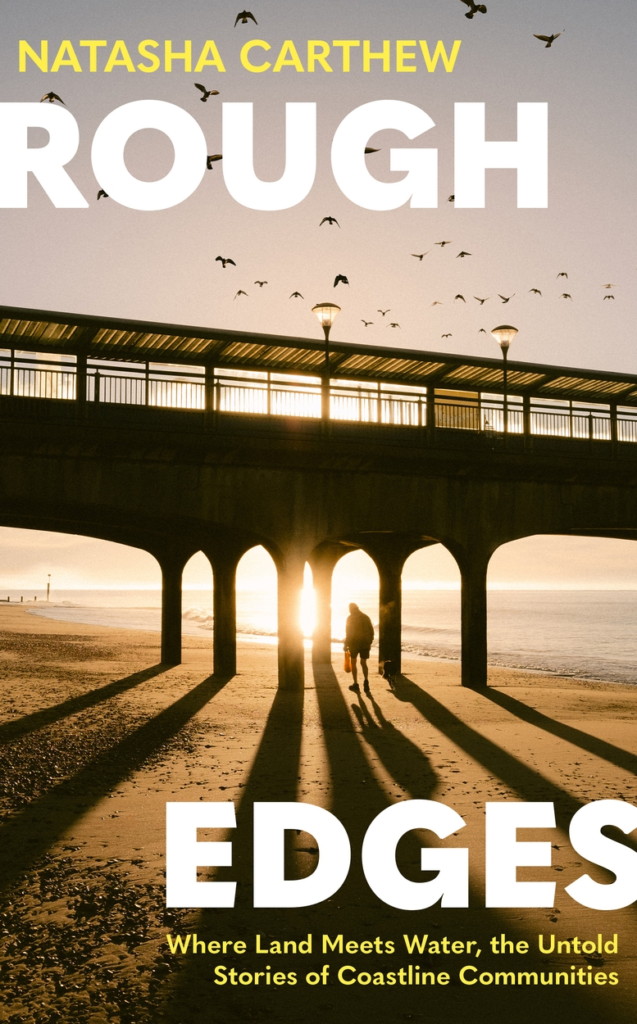
Newly published by Sceptre, ‘Rough Edges’, our June Book of the Month, sees Natasha Carthew explore the villages, towns and cities of our coast, meeting the people fighting to keep these places alive. Read an extract below.
Growing up in coastal poverty, the routes available to me were rabbit-burrow narrow. Very often, they were barely visible between thin-wire briar and thick brick walls. So, from my earliest days, I could be forgiven for not knowing what opportunity looked like, except that I wanted it.
Without our tight-knit council-house community of mostly women, my sense of who I was and where I was meant to go would have been unclear, my upbringing and progress as a youngster a whole lot harder.
The need for community is present in us from birth, as important as food, water, warmth and shelter. When it comes to building the foundation for our ability to survive and thrive, community is what makes the difference, the grounding force that gives us hope, trust and perhaps even keeps us alive. Our need for social connection is rooted deep within us biologically – not just as individuals, but as a species. It drills down into the core of us, bone long and belly deep, it is the nature of us.
In the natural world, community is defined as an assembly of interacting plants, animals and other organisms that repeatedly come together under similar environmental conditions across the landscape and seascape. Our beautiful British coastline is home to a million habitats that house such communities, including those found in cliffs, rocky shores, sand and shingle beaches, sand dunes, mudflats, salt marshes and machair (low-lying arable or grazing land formed by sand and shell fragments deposited by the wind).
Throughout childhood, nature was my constant companion. I was poor in every practical respect of the word, but rich in the colours of sea glass, shells and hedgerow flowers, prosperous in the saline drift of early morning fog and the taste of blackberries in September, potatoes in October and winkles picked off the rocks in summer, all by my own hand.
I’m well aware that, for many, my childhood seems ideal, the thought of long languid days spent playing on the sand, swimming with the tide and gazing into rockpools, but when poverty hangs over you, even when you’re very young and don’t recognise it as such, the feeling of hardship and struggle is never far away, no matter how beautiful your surroundings. Nature, on this journey, a journey of transience and uncertainty carried from childhood, is my trusty sidekick, allowing me to sing into its wind whilst walking unacquainted territory. The unfamiliar becomes familiar with the handhold of a flint pebble on Brighton beach, or the brush of amber sand in my hair along the coast of Northumberland.
Mother Nature – both my protector and my constant, in childhood and throughout my life.
The natural world just gets on with it. When considering that an ecological community is defined as a group of species that are commonly found together, I immediately think of the proximity of the communities of which we are all a part – the ones we are born into and the ones we move into and through. Like seeds, each and every one of us is meant to land and drift.
*
‘Rough Edges: Where Land Meets Water, the Untold Stories of Coastline Communities’ is out now and available here, published by Sceptre (£19.00)