Capturing the physical and psychic states beyond, between and beneath human perception, M. John Harrison’s ‘The End of Everything’ is a kind of ‘anti-state of the nation novel’, writes Will Burns.
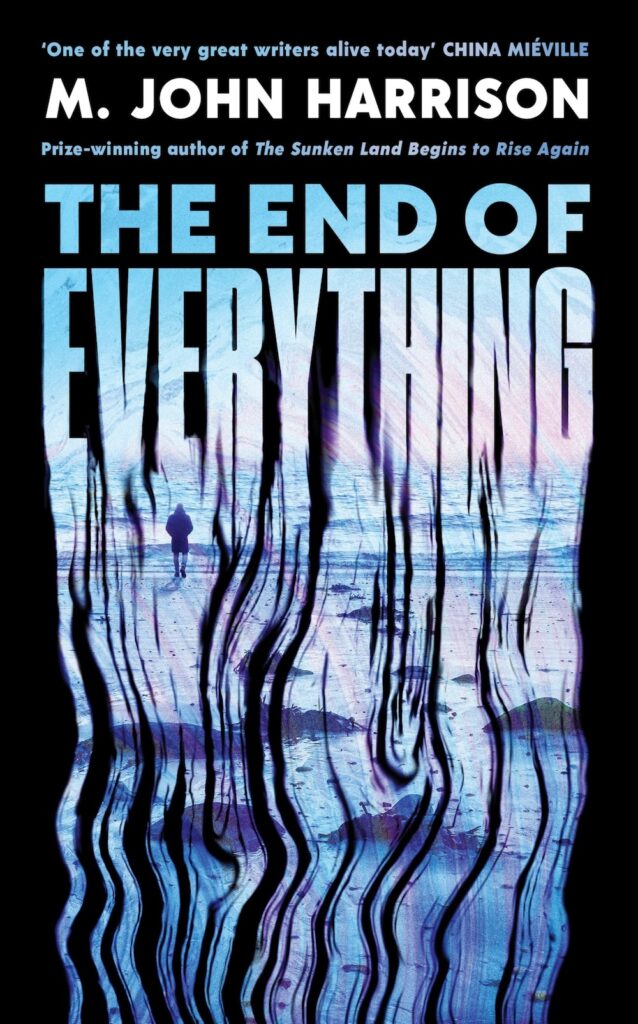
I couldn’t find a way in, didn’t seem to know how to begin. Every time I thought I had a grasp on how to start, the grip on what I’d just read seemed to shift somehow, seemed to move just beyond me, beyond comprehension, beyond memory. I thought about the pages I’d read only a day or so previously and drew a strange kind of conceptual blank. I knew I’d read something, and read it with that peculiar excited compulsion that comes with the best stuff. But my own reflexive language failed me. Maybe something of The End of Everything’s strange, deeply unsettling speculative malady had affected me — maybe, to use Harrison’s own phrase, I was ‘going through a bad patch’ — infected, so to speak, from the pages themselves. It might be said that Harrison’s artistic terrain has always been just this sort of space — the physical and psychic states beyond, or between, or beneath, human perception — perhaps his new book captures that state so perfectly that you struggle to articulate it back to itself.
In The End of Everything, the world has been ‘invaded’ — though that somehow doesn’t quite describe what’s happened either — by an alien culture called the iGhetti, though exactly what has transpired seems slippery, obscure, even up for debate — the aliens may have arrived from the ‘astral plane’, might be a symptom of the internet, of dark matter, they manifest as jelly, as light, they initiate their attack on the City of London, the centre of the commercial — and so, perhaps, the conceptual world, as opposed, say, to the physical world of things. The world of things has changed too, however — continental Europe has been ‘mislaid’ somewhere, and the iGhetti produce the so-called ‘bad patches’ — areas of warped perception where an experience or memory might be fixed and repeated over and over with some subtle change, or where a place might suddenly feel charged with a dense, negative energy, where everything we understand as ‘reality’ — language, logic, space, time — all might just feel wrong. They produce strangely parodic buildings that appear and disappear just as fast, that ape ‘00s vanity architecture’ — the psychic landscape appears to be the iGhetti’s frontline as much as the geographic.
Amongst all this we find Philip Tennant, a kind of beach scavenger who has pulled an alien ‘artefact’ — a constantly shape-shifting, growing thing — from the sea and who knows he needs to get rid of it, and his aunt Marnie, with whom Philip has, at times, lived. Marnie lives in what we can almost picture as a contemporary seaside street, but which has also, in this new world, taken on a kind of lawless, violent communal quality. She’s on the defensive from out first meeting, from vandals and, later, from vigilantes. The pair’s relationship is perfectly suited to Harrison’s disrupted reality — it’s familial, quasi-parental, again, almost recognisable as something we know well. But also utterly strange. This is the nature of Harrison’s material throughout — eerily accurate depictions of so much that might be recognisably ours — the faded seaside hotels, the country roads, the landscape, the English Channel, boat-loads of migrants, the movement of people from cities to suburbs — but all also definitively different, unsettled, violent, parodic — the remains of a society that has become unshackled from the institutions and certainties that propped it up. Both the smartest and perhaps most unsettling thing about the book is how quotidian, how humdrum these seismic shifts seem to be — there are, for instance, acts of terrible violence that occur almost without cause or effect, or care — there are some implications to one such act early on, but they, like almost everything else, can’t seem to be articulated with any certainty or conviction. Harrison’s prose helps — as you might expect of one of our truly great living technicians — deploying as he does a stark, polished, spare style that resists any sentimentality and carries its own unnerving sense of directness.
Of course this articulates the anticipation of a sort of environmental devastation that might seem truly inevitable to the reader, and so politically, culturally important, in the contemporary real world — the ‘end of everything’ of the book’s title, but it’s also notable that Marnie is both an artist and suffering from dementia. There is a certain quality to the book’s active pursuit of obscurity, of slipperiness, of the ultimate inadequacy of human knowledge and conception that seems to be in dialogue with the act of art-making and the experiencing of art — I think, for instance, of the feeling of first reading a poem and how you might make imaginative allowance for a language that has been estranged from the norm — and how that imaginative space becomes the engine of new meaning, of a different kind of knowledge, or understanding. Perhaps the same could be said for ‘parsing’ abstract painting. And that same sense also seems to echo, somehow, the deterioration of meaning that Marnie experiences as her mental faculty worsens — the country here has lost not only a continent then, but a collective mind too.
Harrison called his last book, Wish I Was Here, an ‘anti-memoir’, and The End of Everything is a kind of ‘anti-state of the nation novel’ in similar ways, choosing to absent so much that we might instinctively ask of an appraisal of a contemporary ‘everything’ — there is no internet here, no rolling news feed, no ‘infinite scroll’, no AI (though the ‘artefact’ is certainly a horrifying speculation on that particular direction of travel), almost no politics at all. All of that material, however, feels tangible as a kind of residue, as memory. It’s a book that contains and communicates a kind of essence of a collective psyche and that psyche’s loci — England, the South, the channel coast — and so carries that ‘everything’ of the title even while obscuring it. It’s truly place-writing. And, dreamlike — or nightmarish — that obscurity becomes, in the end, the essential matter of the state of things as Harrison foresees them — collapsed, broken, tired, lost, ultimately unknowable. It might be a bleak view from here at the end of everything, but in the hands of one of our true masters of the craft it’s also a strange and rare pleasure to take it in.
*
‘The End of Everything’ by M. John Harrison is out now and available here, published by Serpent’s Tail (£16.14).