Summer brings moonwort and sea thrift, rain and flame to the Highlands, as Kirsteen Bell and Annie Worsley look for symbols of hope on their crofts.
June 24th, Duisky
Dear Annie,
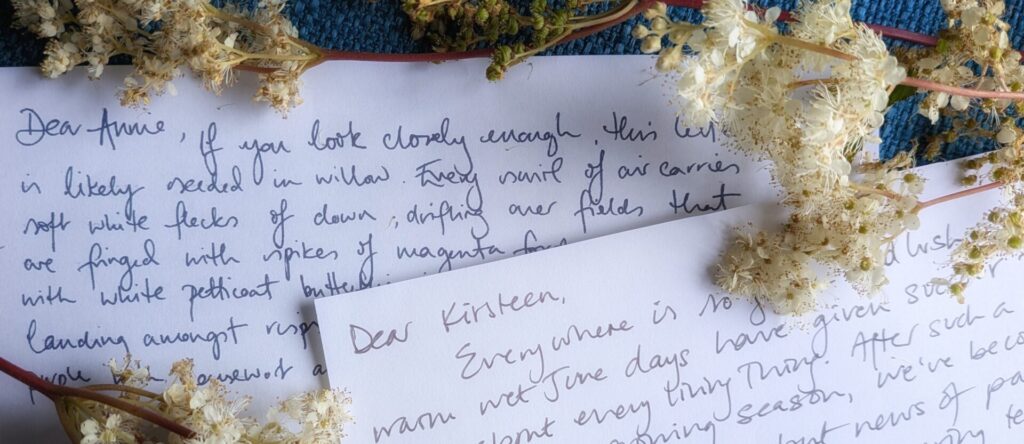
If you look closely enough, this letter is likely seeded in willow. Every swirl of air carries soft white flecks of down, drifting over fields that are fringed with spikes of magenta foxgloves, dancing with white petticoat butterflies in the bog myrtle, and landing amongst risps of grass threaded pink and purple with lousewort and milkwort.
Everything swells green, the woods filling out into their summer plumage. My trousers are soaked up past the knees by long grass topped with cow parsley. Dark smears of soil edged with golden cow-wheat show where the hens have been having their dust baths; I walk with my eyes sweeping for rogue eggs, but mostly I come off the hill with empty pockets and a full page of notes.
In all honesty, I feel like an observer more than a crofter at the moment. I am barely harvesting words, never mind hay.
A friend sends a picture of solstice sunlight glowing through tall curves of foxgloves, followed by another of her basket full of rich flowers in a gathered celebration of sunlight. She had told me at the beginning of the month that she likes to pick flowers late on the solstice; it makes her feel witchy. I had planned to emulate her example. I remember previous Junes spent quartering the wee field, pulling foxgloves in preparation for moving pigs into it. They come up so easily, seeming to have only the barest grip on the earth.
But this June has been so relentlessly busy with work and family life that the solstice passed us right by.
The simple practicality of available time means any crofting activities we do now are always undertaken with a heavy eye on efficiency. June for my predecessors would have been spent managing new calves, moving cattle to summer grazing, maybe getting a bull in. They’d have prayed for settled weather with just enough rain to keep the hay growing. Instead, for us, the long days of incessant rain interspersed with humid heat have been perfect for the polytunnel. It sits at the bottom of a long slope of rush-filled grass. The ground there becomes so saturated I can get away without watering anything. Even the crops we’ve chosen need little input. The raspberry canes I planted a few years ago have now come into themselves, and my freezer is filling with bags of juicy gems to deal with later in the year – when I have the time, ha.
Everything is about saving time. Where once the fields would have been rotavated twice and blanketed in seaweed, now I gather cardboard from the local bike shop to smother the bracken and rushes before throwing on topsoil and soaking it all in rainwater steeped through with seaweed. I do have to buy in a tote-bag of compost-soil. My father-in-law used to say the reason they stopped keeping cows and growing hay was because it was costing them money. Still the choice seems to come down to spending money or spending time.
I know crofters have always diversified their time, working extra jobs to supplement the croft work. I guess that’s what the mussel farm is now for my husband. His long hours are spent on the loch which is an extension of croftland. Instead of seeds and tractors and soil, it’s rope and boats and waves. Rains that would have knocked back hay or barley have diluted the salinity in the loch, weakening barnacles that grip so firmly to mussel shells. Where normally you’d be hard pushed to get them off with a chisel, L. tells me this year he can brush them off with his thumb, making an arduous job a little easier.
Any change imparts a faint hint of worry though, even ones that seem beneficial. Especially as news of relentless dry heat continues from the south. How have you weathered this June?
Kx
*
June 27th, South Erradale
Dear Kirsteen
Everywhere is so green and lush. These warm wet June days have given succour to just about every living thing. After such a cold start to the growing season, we’ve become tropical. It’s beautiful, but news of pale desiccated fields in the south, soaring temperatures, infernos and acres of land up in smoke makes me uneasy.
Like you, we’re mostly observers in June. Watching. Hoping. The hay harvest hangs on the weather as it has done for generations. We need several days of dry weather to cut, tedd and bale, but it’s still too wet, not enough growth yet. Flowers bloom, grasses grow, our young trees thrive. There are butterflies, moths, bees, flies in abundance. The climate crisis feels distant; our wee valley is full of life. I’m relieved we don’t have 30oC heat.
I’ve been re-reading plant lists from the 19th century. In Gairloch and Guide to Loch Maree, published in 1886, J.A. Dixon delivers a comprehensive history of the area with several chapters about wildlife. He lists plants, mammals, birds, fish, and reptiles. (There’s even a table with 94 shell varieties!)
The inventory of flowering plants is astounding – over 360 species. It’s a remarkable archive and one I use regularly. Firstly, it’s a lovely thing to read; secondly, I can compare his numbers to counts on our croft and hereabouts. In truth, there is no equivalence. So much has vanished in the area since the lists were compiled.
And yet, over the last 15 years, species have returned to the croft. Biodiversity is increasing. I know this is a small space in comparison to Highland estates and big farms, but it is filled with possibilities, with opportunities to support nature. Help the natural world and we help ourselves. We must at least try.
The solstice was warm and surprisingly midge-less. We went down to the shore to watch the sunset. No flower ceremony sadly, only a quiet hour or so at the end of a busy day. Stripes of distant cloud, way out beyond the Hebrides, over the Atlantic, added form and highlighted the strange rose-pink light coming from the sea. I’d been counting orchids, surprised to see new arrivals (heath fragrant, broad-leaved marsh), happy to find so many lesser butterflies and small whites. This year there are more than ever. As the sun vanished, a clotted cream sky was ribboned by pink and fuchsia clouds. Orchid colours. An orchid summer solstice! We watched ringed plover parents herd their fluffball babies just in front of us, feathers catching the last pink-gold light. Nearby, where an old ditch emerges from an unused croft, soil has mingled with seaweeds and shells and created a small summer garden on rocks and stones. I even spied a purple orchid among yellow flag iris, scurvy grass, buttercups and sea orache.
The following morning (early enough for me to still think of it as the summer solstice), I discovered another newcomer on the croft. Maybe a trick of the light, or simply good luck, but I spotted a strange looking plant I took to be another orchid. It was moonwort — a tiny fern with half-moon shaped leaves and narrow stem studded with tiny spore-filled globules. I learned several remarkable things: moonwort spends much of its time underground living in a complex symbiotic relationship with fungi; it appears at midsummer but not every year; it was once thought to have magical and alchemical properties; and it was once carried as a protective talisman against evil.
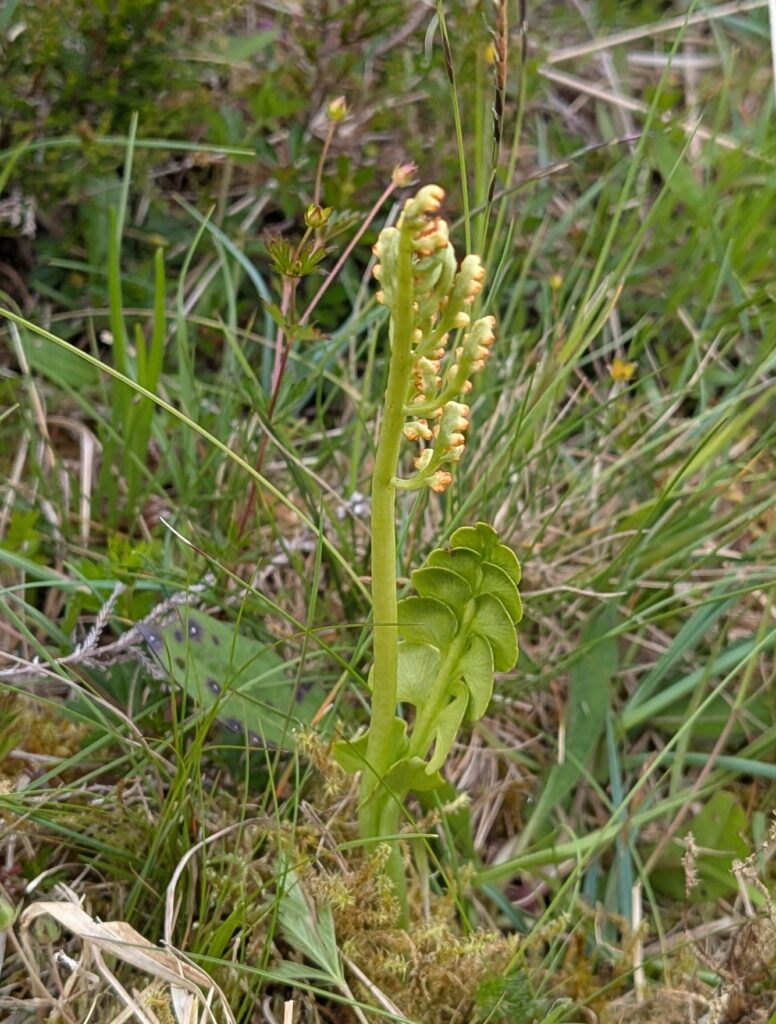
Ecologists describe the presence of moonwort alongside so many orchids as evidence of extensive fungal networks, testament to healthy living soils and flourishing microhabitats.
All magic and alchemy to me.
The orchids will soon fade. Taller species of wildflowers and grasses are growing fast and will become our hay harvest. Weather is key. I’m hopeful for a good crop whilst worrying about heat, storms and the warmest sea I’ve ever known here.
There’s talk of another heat dome further south. Quite what that means for us, I’m not sure. For now, our tropical rains fall and everywhere steams. This strange and troubling summer continues.
With love and in hope,
Ax
*
July 17th, South Erradale
A swift update:
I’ve just seen news about the Cairngorm fires. Usually, we’re fretting about uncontrolled muirburn but this is different. Shocking, worryingly large and spreading fast. Locals say it is so dry over there. Our croft ground and local peats are still moist following the June rains. How are things for you?
Finally, the sun found us. We went again to the Erradale coast to a small patch of sand which comes and goes at the whim of moon-tides. This exposed ‘storm’ beach is mostly made of large sea-smoothed rock cobbles and gravels so the sands are welcome when they return. We had a delicious dip in the worryingly warm but diamond-bright sea. We floated with kelp and jellyfish. Almost a holiday swim.
Since the first small patch of mixed flowers appeared at the solstice, this coastal edgeland garden has spread closer to the sea. Meadow species throng – tall grasses, self-heal, knapweed, meadowsweet. It’s as if the Erradale crofts are reaching into the sea like yours. Plants of deep soil and humus have found footholds in crevices between stones. It’s astonishing. Microclimates in these coastal margins can be ferocious – hot, dry, salty, windswept, deluged – our climate futures encapsulated. Yet nature has created a miniature Eden.
I’ve taken dozens of pictures. Since the solstice more species have appeared – sea kale, wood sage, sea chamomile, sneezewort, angelica, herb-robert, curly dock, yarrow, sorrel, thyme. Such pretty blooms, each with their own folklore and purpose.
While heat and flames destroy habitats elsewhere, the warmth has helped us. But it’s all so precarious.
In Windswept I repeatedly describe the wonders of nature – colours, scents, light, joy. Somehow, this year, the beauty has intensified even as we witness global climate transformation and collapsing natural systems, conflagrations in the Highlands and elsewhere. The wildflowers seem bigger, brighter, more plentiful. I feel guilty writing about them. Our world is beautiful and terrifying.
I wish I had a moonwort amulet.
A xx
*
July 24th, Duisky
Dear Annie,
Yes. Placed as we are in the path of western winds, it used to be that you knew any sunny spell would soon be replaced with an Atlantic depression; rains further ensured by the push of hill and mountain. This new lack of certainty is deeply unsettling when coupled with the heartbreaking news from those eastern moors and grasslands.
I look at the wildfires here in Scotland and in places like Ontario, where my solstice-gathering friend is from, and I wonder again at the impact of taking indigenous human activity out of any living landscape. It’s too easy to imagine just walking away and leaving it to nature is the right thing to do. However, it’s also too easy to say that firebreaks and controlled burning would have prevented what is happening now everywhere. Everywhere, Annie – and yet the same news channels that show the flames of climate change licking all our doorsteps also report an incumbent Prime Minister’s intention to fan those fires with new oilfields.
I don’t have an answer. I don’t believe any one person does. The devastating fires in the Cairngorms are being battled by members of every community that lives in and values that landscape, regardless of their views on how it should be managed. We keep searching for balance in the landscape when perhaps the first step should be finding balance between ourselves.
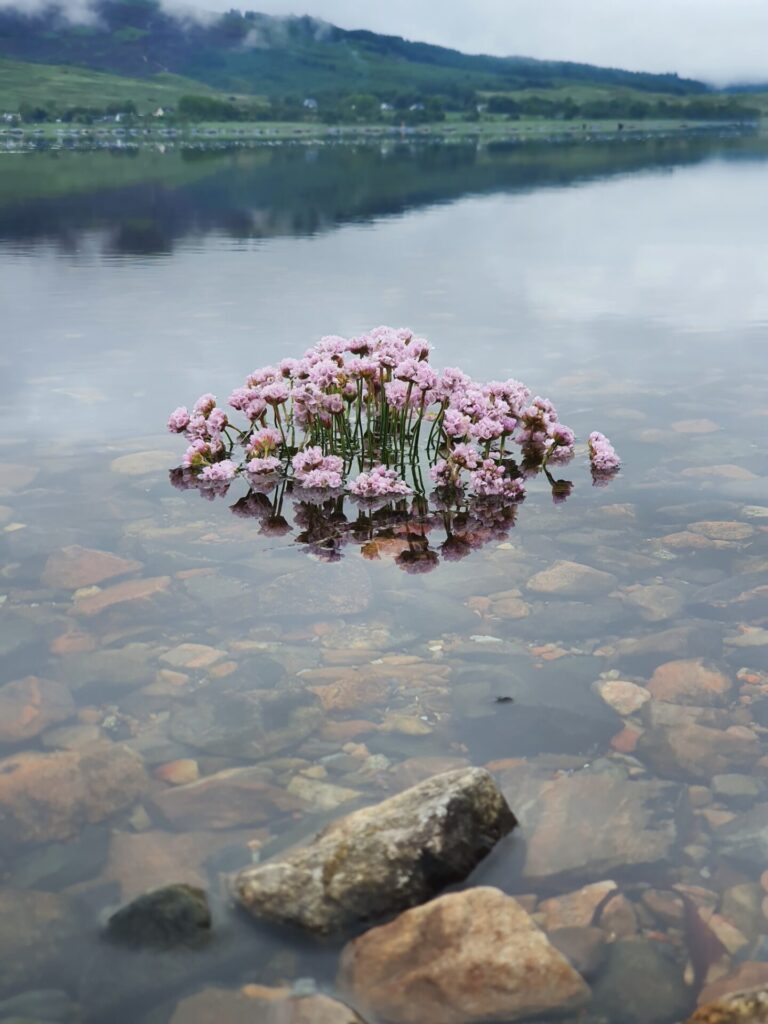
After your last letter I walked down to our hill-girt shore. Despite our foundation of nutrient-lacking glacial moraine, we too have little clouds of meadowsweet, floating above throngs of yellow hawkweed. and the gravelly verge is shining with silverweed.
Below the road, we have had sea thrift in abundance: neòinean-cladaich, daisy of the shore, or tonn a’ chladaich, waves of the shore. They undulate in wide swathes of little candy-floss-pink balls, right down into the loch’s edges. They don’t seem to mind being occasionally swallowed by the tide.
With love,
Kx
*
Kirsteen Bell is a Scottish writer of narrative non-fiction and sometimes poetry. All her words are gathered from the croft in Lochaber where she lives, and the surrounding Scottish Highlands. Her writing and reviews can be found in such places as Paperboats, Caught by the River, The Guardian Country Diary, The Lochaber Times, and Northern Scotland Journal. Kirsteen can also be found at Moniack Mhor, Scotland’s Creative Writing Centre, where she is Projects Manager and Highland Book Prize Co-ordinator.
Annie Worsley is a writer, crofter, grandmother and geographer with an enduring love of the Scottish Highlands. In 2013 she and her husband moved to the crofting township of South Erradale near Gairloch. While her husband was a community pharmacist, Annie worked on Red River Croft. She began a blog about life on the croft and then wrote essays on nature and environment for various publications including Elementum Journal, Women on Nature, the Seasons’ Anthologies edited by Melissa Harrison, Caught by the River and Inkcap Journal. Her first book about life on Red River Croft and the natural history of Wester Ross, ‘Windswept: Life, Nature and Deep Time in the Scottish Highlands’, was published by William Collins in 2023, and is out now in paperback.