Published earlier this month by Bodley Head, Ed Douglas’ big book of mountains breathes living history into immortal landscapes, writes Eben Myrddin Muse.
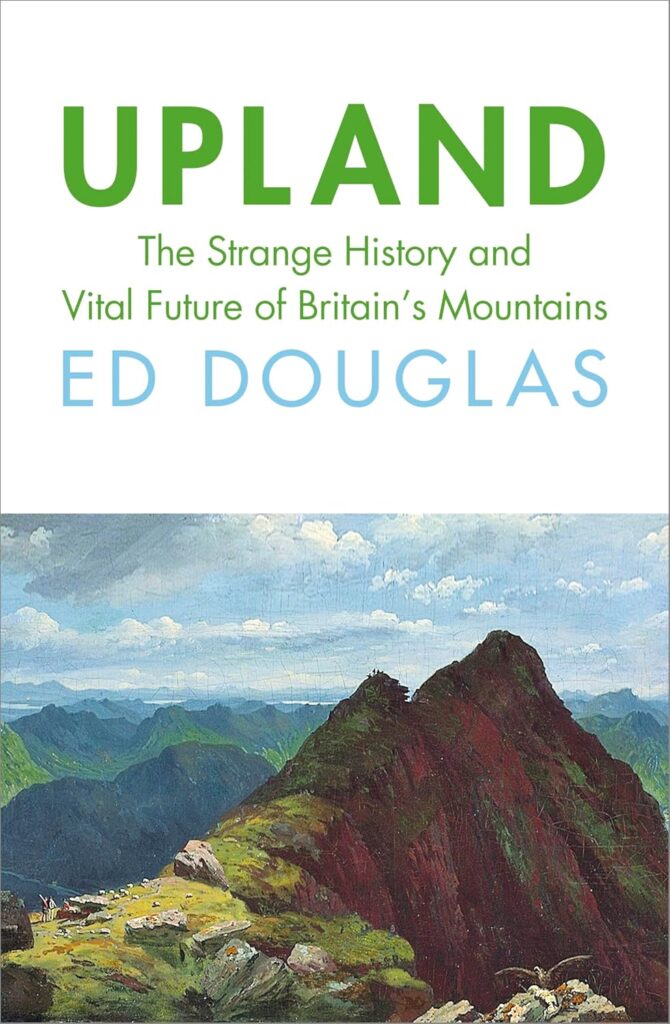
After receiving a review copy of Ed Douglas’ Upland in the post I was, at first, daunted by its size — this is a mountain of a book about mountains. But I needn’t have worried; if you love the uplands of Britain, or wish to become better acquainted with what made them, then this is essential reading. Ed sets a lofty goal from the — to show, in his words, that ‘everything is to do about mountains’. That mountains are political, inspirational, consequential, and that they are, above all else, essential.
‘There is deep human history here, not just rocks’ says an early chapter. But though certainly there are rocks, they are never quite as heavy as you’d have a right to expect — the (more or less) rock chapter ‘Time’s Chord’ is a joy. Douglas frames the big questions that were wrestled over by great minds (and egos) of the age as if we’re in on the puzzle. Upland is always at its best when the human stories bleed through the geology, the flora, the fauna, allowing the reader to relate to and root for these landscapes and its creatures. There are abundant morsels of mountain trivia that sustain interest as we move through epochs and eras, wars and battles, plantations, executions, deforestations, and reforestations.
Human protagonists (and antagonists) are, for the most part (through no fault of the author’s), male soldiers, lords, hunters, priests, surveyors, artists, ecologists, and the like. It is, at times, a sequence of men variously pushing or being pushed around hills and glens by miscellaneous and changeable forces of trade, weather, culture, greed, sheep, and trees. But when history sits up and decides to start recording the other half of the population, I was delighted to be introduced to such remarkable people as the alpinist Emmeline Lewis-Lloyd, or the writer, suffragette, socialist, and mountain lover Hannah Mitchell — such a different breed to the snobbish Mary Wordsworth.
Often, past events and conflicts remind us that many of the challenges of today’s hills are iterative — from the way commodification turns ‘nature into profit at the expense of human souls’, to elitist attitudes toward the general public (rugged country being ‘no place for lowlanders’ is an expression you might have lifted from an Eryri Facebook page or National Park forum meeting today).
Often the reader is teased with reference to poetry or prose from many languages and landscapes, rarely quoted in any length. I found this occasionally frustrating, but entertained myself in the extracurricular quests to find their works — of Waldo Williams, Duncan Bàn MacIntyre, Dafydd ap Gwilym, RS Thomas, and the rest of them. Footnotes also invariably add useful context as well as interest and humour.
If I were to offer a mild critique – and perhaps it is one-eyed of me as a Welshman to do so — it is that while there is a great and anthropologically rich telling of the strife(s) that repeatedly befell the Scottish uplands and left them empty and stripped, the telling of the slow emptying and natural decline of the Welsh uplands is only touched upon briefly. It’s acknowledged that Welsh voices in various eras were not heard so loudly as others, but I had hoped to see more of that story here — somewhat less sustained and bloody though it was. It would have been special to see the stories of the independently quarrying commoners who fought against enclosure (and their subsequent imprisonment and deportation) or the fight against ‘Y Sais Bach’ (the little Englishman, Augustus Brackenbury)’ on y Mynydd Bach in Cardiganshire. In any case, for most of the book, we fly between the three countries involved at a hare’s pace. It can at times be jarring when the narrative thread is yanked away from compelling places and people, but there’s always something on the next page to draw you back in.
I admit, I’d been looking forward to the chapter on shooting estates. The story of how our uplands became hostage to bloodsports enjoyed only by the most elite and wealthy in society is not one that particularly deserves a neutral telling, but the account is forensic — a dispassionate deconstruction of the myth of the noble art of deer stalking and how it was manufactured, alongside other mountain bloodsports. The tale is punctuated by the acts of barbarity that were essential ingredients of the industry’s genesis and development, from the Waltham Black Act and its death penalties, to the list of ‘vermin’ cleared (193 wildcats, 246 pine martens, 48 otters, 27 white-tailed eagles, 15 golden eagles, 18 ospreys, 93 peregrine falcons, 275 kites, 83 hen harriers, and so on and so on). For me, it would have been nice to understand more of the rise (and eventual fall) of the Welsh grouse industry which at one time was so significant in Welsh land use — but you can’t tell every story.
As I read, I didn’t feel a growing thesis bubbling up from most of Upland. But when it finally arrived in the ‘Mountain Futures’ chapter and epilogue, I found that the foundations for one had been solidly laid in previous chapters. As a collection of tales across time and place, Upland isn’t remotely didactic – it is a true history of the mountains we have before us today; denuded of nature, of people, of culture, and unable to hold the water and sustain lowland areas as they should — reduced to ‘drained bogs and toasted heaths’. Sublime shadows of what was, and could one day be again.
The author’s experiences of uplands transformed for the better during his lifetime offer a precious nugget of hope, in the restored forests of Carrifran, and the moorland plateaus of his boyhood stomps. In the plain truth that upland farming has changed many times before, and therefore can again. In the notion that the work of saving our uplands — of returning nature there — ‘can’t be left solely to charities and philanthropists’. I’ll drink to that.
*
‘Upland: The Strange History and Vital Future of Britain’s Mountains’ by Ed Douglas is out now and available here, published by Bodley Head (£23.75).
Eben Myrddin Muse is an emerging writer and campaigner from Dyffryn Nantlle. In his work he explores land justice, Welshness, commons, and nature connection. He has written for The Welsh Agenda, Viewpoint and Climber Magazines, as well as being a regular contributor to UKClimbing.com. He works as a policy and campaigns officer for the British Mountaineering Council’s access and conservation team and is an ambassador for the Campaign for National Parks. Follow him on Substack, Instagram and Bluesky.