Contributing editor Tallulah Brennan heads to North London’s OmVed Gardens to take in Hannah Fletcher’s ‘Photo.Petro.Chemical.Capital’, exploring the entwined rise of photography and the petrochemical industry.
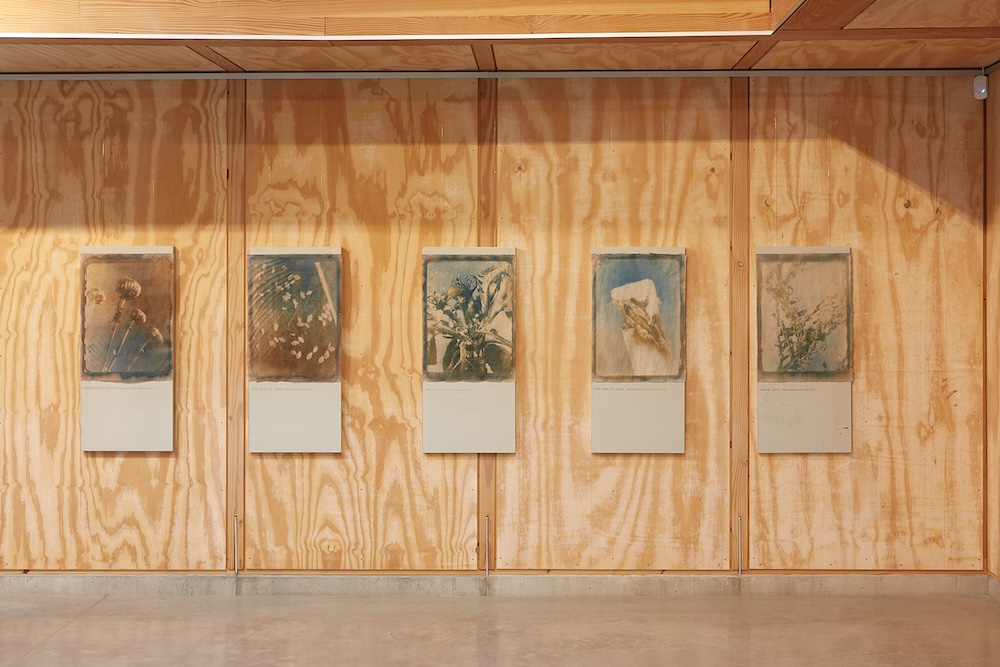
I arrive at OmVed Gardens in the pouring rain. It is June, and so the wildflowers are out, today slain by the downpour, poppies lying low on the ground. I’m primarily here for Hannah Fletcher’s exhibition, Photo.Petro.Chemical.Capital, but in a whistle-stop tour I hold the world’s largest seed in my hands, taste wild strawberries, and meet my first hawk moth. I watch one of OmVed’s gardeners unstitch the moth’s little legs from the nets around a patch of gooseberries and redcurrants — oblivious, at the time, to the drastically different relationship between grower and insect waiting for me inside, on the walls of the barn.
Looking at an incredible curation of photos of vegetables and the pests which adorn them, I realise that this exhibition is the meeting of the two currents of my life. I have one foot in this world of ecologically sensitive arts and culture, and the other in a greengrocer day-to-day. Some of the time I sit at a laptop and the world revolves around rearranging and exploring the words of writers I admire, the rest of the time you can find me chopping off mouldy ends, debating whether purple carrots really do taste different to orange, and cleaning off compost juice which runs down my forearms.
I am always grateful for artists who take an interest in food production; in fact, its omission from nature writing, or from culture generally has always felt to me like a neglect, and one with dangerous consequences. Hannah’s exhibition reminds me why. Photo.Petro.Chemical.Capital tells a hidden history, that of the entwined rise of photography and petrochemicals. What I’m looking at, hung on the walls of this room, is the assembly of photos Shell presented at agricultural shows in the postwar years. I recognise the small white butterfly which immediately takes me to my grandparents’ allotment, but much of the rest I’ve never heard of. I’m looking at onion roots, sugar cane, and much more. The plants which are our lifeblood. In Shell’s hands, it didn’t matter what these creatures attached to the plants were, they were all tarnished with the word ‘pest’. If a farmer did not yet see them as such, with this photography show, they soon would.
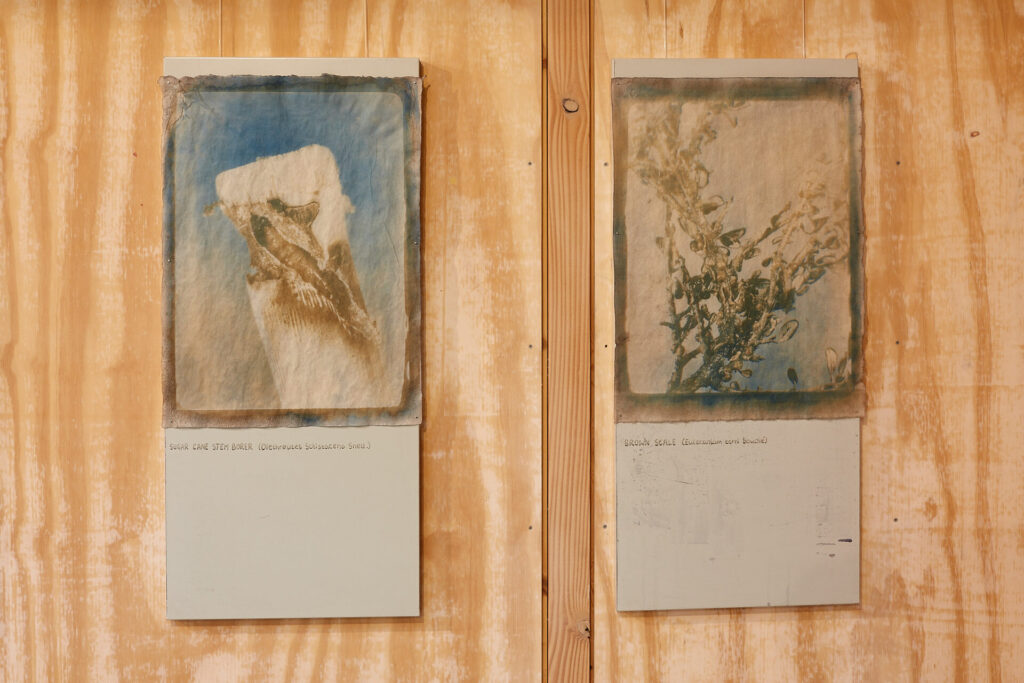
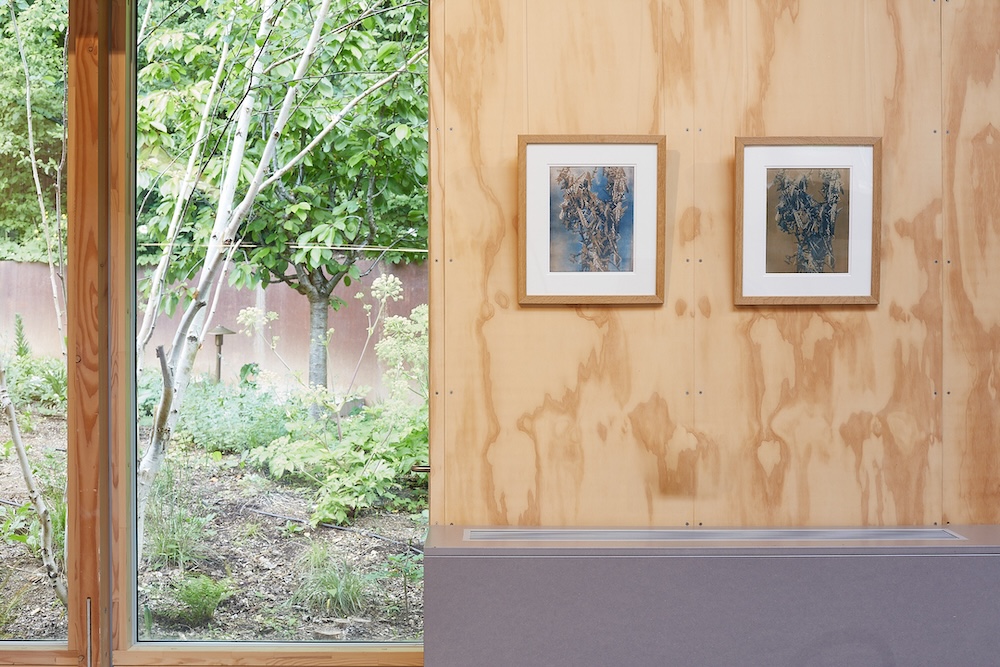
Shell’s original slides for their touring exhibition for farmers would have been reliant on silver, whereas Hannah uses iron salts and botanical toners to produce multicolour cyanotypes. With Shell at the helm, a two-way process was born: photography depended on the fossil fuel industry, and in turn, fossil giants relied on photography and film to sell their products. Hannah tells this story for the sake of photography’s future: if you wanted to know how photography might free itself from fossil fuels, you can look right here. I have always loved the phrase, ‘you have to build the house you’re going to live in’; I realise I’ve come to tour the gallery we might all exhibit in, or at the very least, visit.
The photo that sticks with me most at Photo.Petro.Chemical.Capital is the gooseberry plant. On my way into the exhibition room, we stopped for some berries. I’d been excited, I thought I’d spotted whitecurrants and gooseberries too. I don’t often see them growing, and I don’t really hear of people eating them anymore either. I was lucky enough to grow up helping on my grandparents’ allotment, and I loved them; their little hairs, their timid green, their roundness. Most of all I liked them hot and sweet, having been baked with copious amounts of sugar, underneath buttery crumble, lashings of cream. They had been not only sustenance, but childhood joy. I didn’t expect to see them here in this exhibition, covered in locusts, which Hannah tells me, in a kind of resigned shock, were actually brought to Shell’s agricultural, experimental farm in the UK. Writing in the 1920s, Gandhi had warned about countries like India following England’s worsening fossil-fuel addiction: ‘The economic imperialism of a single tiny island kingdom (England) is today keeping the world in chains. If an entire nation of 300 million took to similar economic exploitation, it would strip the world bare like locusts.’ In another work, complimentary to the OmVed exhibition, Hannah used home-made, low-toxicity methods with a photo of petroleum refineries along the river in East London, developed as reversal. This photo will belong to a collection of slides, performed with some of Hannah’s poetry: MONEY POWER OIL FUEL COMMODIFY CONSUME MAKE SELL PHOTOGRAPH ADVERTISE SELL MORE MAKE MORE PHOTOGRAPH MORE CONSUME MORE. IS THIS LIFE? The words are loud and unbroken and insistent, like the oily imperative they describe.
Over a century later than Gandhi’s warning, the world not quite stripped, but dancing on the edge of it, it is inspiring that Hannah is spearheading a world in which the arts not only opt out of the locust-like impulse, but ask us to be better than it.
Photo.Petro.Chemical.Capital has a clear antagonist: Shell, and the fossil fuel industry as a whole — the scientists who donned lab coats for the sake of its expansion, and the photographers who joined its ranks to spread the poison further. And yet, visiting the exhibition reminds me of the true perniciousness of fossil fuels — I spend a lot of time with organic food because of my job, and I spend a lot of time thinking about the flow of fossil fuels running through my life, so as to unpick it and unstick myself where I can. And yet, this touring circus of propaganda which touched the fields of post-war Britain had been totally unknown to me. It reminds me of the deep disconnect between consumer and farmer, and the pressure placed on the shoulders of people who produce our food in a time of crisis. This world was opened up to me by James Rebanks, who, in his book English Pastoral, writes: ‘There were profoundly important questions about the potential effects of each new technology that it was nobody’s job to ask or answer. There was no mechanism for farmers or ecologists to judge whether a technology or new farming practice was on balance a “good” thing or a “bad” thing, and we really didn’t know when we had crossed the invisible threshold from one to the other.’
There is what is hidden, but there is also what is naturalised. A couple of weeks ago a friend told me that his take on organic food is that it is in fact non-organic food that should be labelled instead. I hadn’t yet seen the exhibition and had accepted his position, offered some musings on the list of ingredients you can find on Tesco oranges (the pesticides living on their skin) and moved on. However, when I’m looking at the small white butterfly, and the maggot-like creature burrowing into the sugar cane, it comes back to me. There is a terrible irony in the fact that the ‘invisible threshold’ at which we transformed into a society eating food riddled with pesticides, and dealing in photography propped up by oil, was also the point at which Shell were making their brand as visible as possible. Perhaps this is the most successful branding exercise imaginable: to dissolve ‘good’ and ‘bad’ until there is only the fact and flow of oil.
Amongst the books on my shelves there is a Natural History Guide which is made by Shell. It has beautiful illustrations and a wonderfully vintage look to it. It was gifted to me since I became enamoured with old Shell advertisements I found either in some of my favourite landscapes, or online, advertising them. It all began with charity shop nature guides, which I noticed were published by Shell. How is it that even to gain some kind of basic ecological literacy, my hands had to get soaked in grease? Then came a visit to Brimham Rocks which took me into the visitor’s centre, a huge poster on the wall which read: EVERYWHERE YOU GO, YOU CAN BE SURE OF SHELL. Since then, I’ve collected postcards in a similar design — the Long Man of Wilmington in Sussex, Bosham West, also in Sussex, and a Graham Sutherland portrait of Kent. Photography was not my insight into the way fossil fuels have infused themselves with the arts and with culture, it was natural history, nature books, guides and paintings of Britain’s iconic landscapes. Shell engineered this association of the natural world with their brand, they naturalised their presence in it. This is why your child can learn England’s natural history from the company which has placed England’s ecosystems on the edge, why you can look at their branding in a visitor’s centre, and feed yourself with foods dripping in chemicals which have genetic consequences we’re still unsure of.
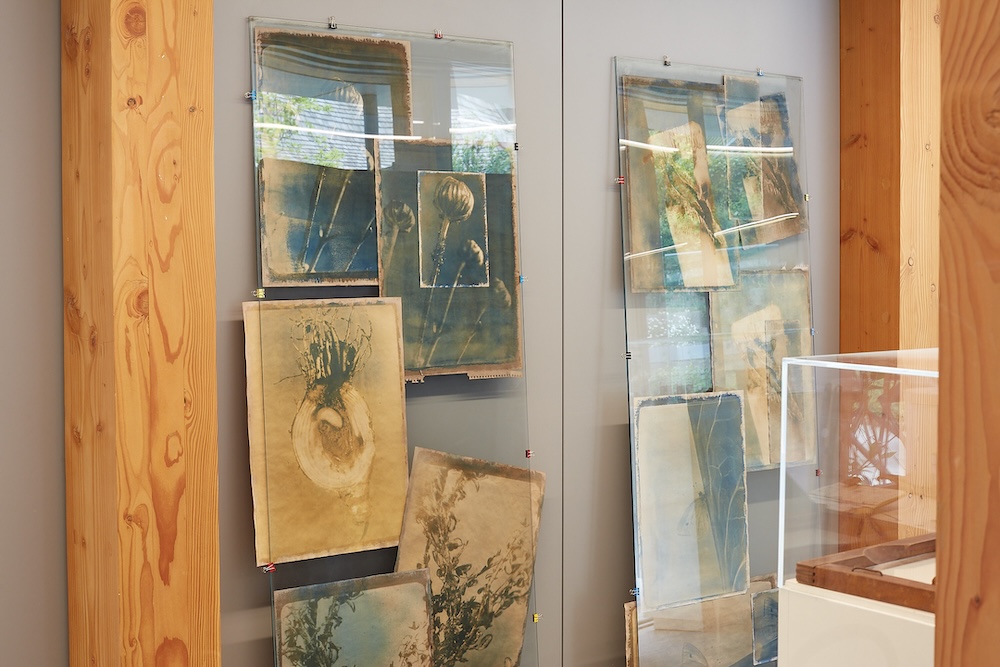
Hannah’s work is world-expanding and hugely important. If I hadn’t been invited to this exhibition, my insight might have ended with the poster at Brimham Rocks or the guide on my bookshelves. I wouldn’t have considered that photography might have its own story to tell, and I would have stayed blind to the implications it has had for the food I eat every day. In these photos, you can find the paradox of modern life. Here are the alien beings whose will to survive meddles with our own. There are people and cultures which have been able to live with this contradiction, but not ours. And this is intentional: these uncontrolled oil giants have placed us in an addictive bind, in a place where even our art suffocates us. The same people who gave us the means to subdue these creatures, insisted on it even, depend on us believing the world is dead, inert, and above all, mouldable to human appetite. Stuck within a photograph, unmoving, subject to the propaganda which gave meaning to the word ‘pest’, and sucked the villainy out of ‘poison’ to make it food instead. Hannah’s work brings my trip here full circle: From the hands of a gardener, delicately plucking out the legs of a hawk moth from a net that allows the gooseberries and redcurrants to grow, but the life which thrives in the air at OmVed to live. All the way through the malign engineering of a fossil fuel giant with a grudge against ‘pests’, and into the hands of a photographer dirtied not by oil, chemicals, poison, but life.
*
Hannah Fletcher is a visual artist, based in the UK, working predominantly across analogue photography. Her practice adapts around materials and environments, weaving photographic knowledge, processes and systems into ecological frameworks. Her work provides avenues through which to rethink photographic futures that depart from capitalist ideologies. She is also the founder of The Sustainable Darkroom, an artist-led, research community that develops low-toxicity chemistries and practices in photography. Visit her website: here.
OmVed Gardens is a greenscape and learning hub in North London that allows communities to convene in nature to spend time exploring our deep entwinement with each other and the more-than-human. More information here.
Tallulah Brennan is a writer based in the North of England, interested in the relationships between humans and their environment, and how they in turn shape each other. She is also a contributing editor at Caught by the River. Follow Tallulah’s Substack here.