Swifts scream joy like fairground goers over Mark Mattock’s “feral’d” NW2 garden.
Just for one day
…in May
Morning is breaking, otherworldly and familiar. Screaming swifts descended from their nocturnal heights slash the first rays fired from the horizon that skim the rooftops and ignite the ash crowns a hot tangerine. Their bladed wings glint in the new blue like sky lures as if teasing monsters below in the dark yet to yield; from which the blinding bright trill of a freshened wren pierces the slouching deep shade with its syringe-sharp syrinx, injecting liquid rippling frisson into the new day; into my nape, the back of my skull. I want to scream a reply, yes wren, yes! The shrieking of the swifts like an eternal summer sound-thread continuously suturing time and place, nature and civilisation; above caves, cliffs, ancient cities, medieval roofs, to now, still just a few hanging on, over my garden, my city.
In the cool soothing air absolutely nothing moves if not disturbed by a bird; not a single leaf, even in the crowns. A jay drops out of nowhere onto the tit box at the back. It is nesting, like one of John Clare’s Rude boys, who in this case knows where to look. It leans over, stretches to peer with its sociopathic reptilian eyes — checking with one then swapping its stance to check with the other — into the nest hole hoping to catch the greediest chick that mistakes the sound of it landing for another food delivery. A creche of starling fledglings rasp from the guttering up above sounding a little like warming up cicadas promising another hot day. Cock sparrow is attentively fertilising his wife in the grape vine that entwines Sparrow Bush. They are lit for all to see by a shaft of sun squeezing through the gap down the side of the house. They were delivering new feathers to the nest just before. It’ll be their second brood. Blackbird is tutting from somewhere near. I don’t see him in the garden so much, he needs lawns. The tight fists of new hogweed umbels unclench in the warm rays that now clip some of them. A mosquito looking for fresh warm blood — mine — bobs apprehensively inches above my forearm. It is right to be nervous. It’s the shock wave of the slap that knocks it out of the air, I see it fall like a miniature icarus but can’t find the crash site.
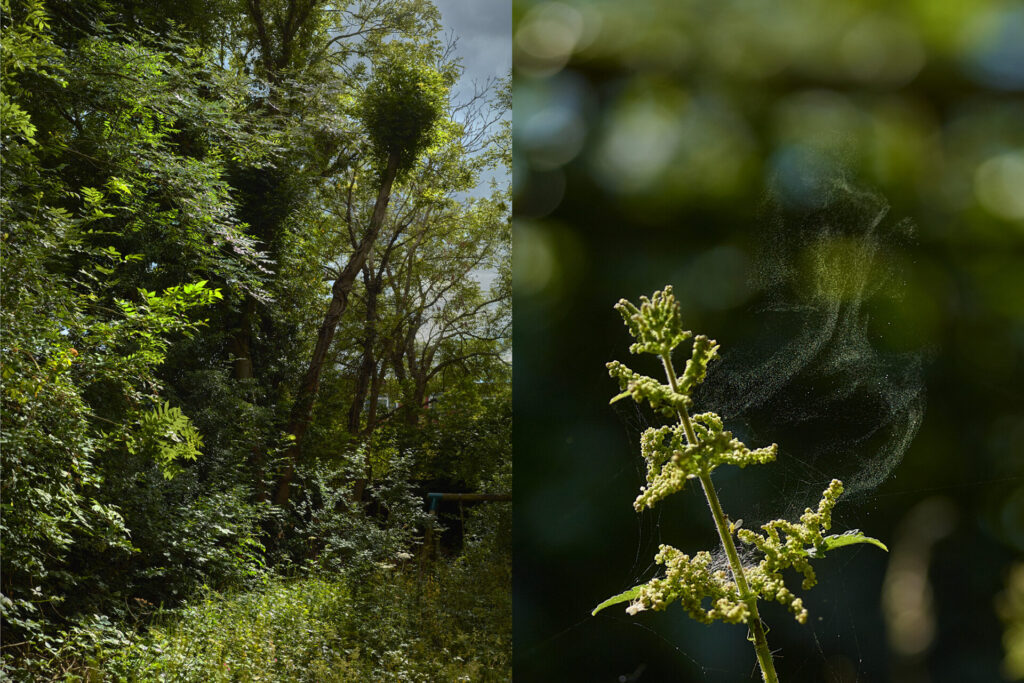
As the sun rises the nettle tops seem to start burning, as if lit by magnifying glass, the flames invisible. The little backlit puffs of pollen look like smoke exhaled in niggling muffled coughs by nervous smokers — they are clearly forced somehow. Among the catkin-looking flower heads tiny orb webs made by the new crop of garden spiderlings glisten. Translucent little juicy green blobs of aphids that fatten blue tit and sparrow chicks, are beaded along the stems nominally protected by the plant’s hypodermic spikes pinging bright like glass splinters. Strange red and black ladybird pupal ‘pods’ lay like alien aphid traps adhered to some of the leaves as I search for tiny red admiral eggs. The blackcap drops a tune.
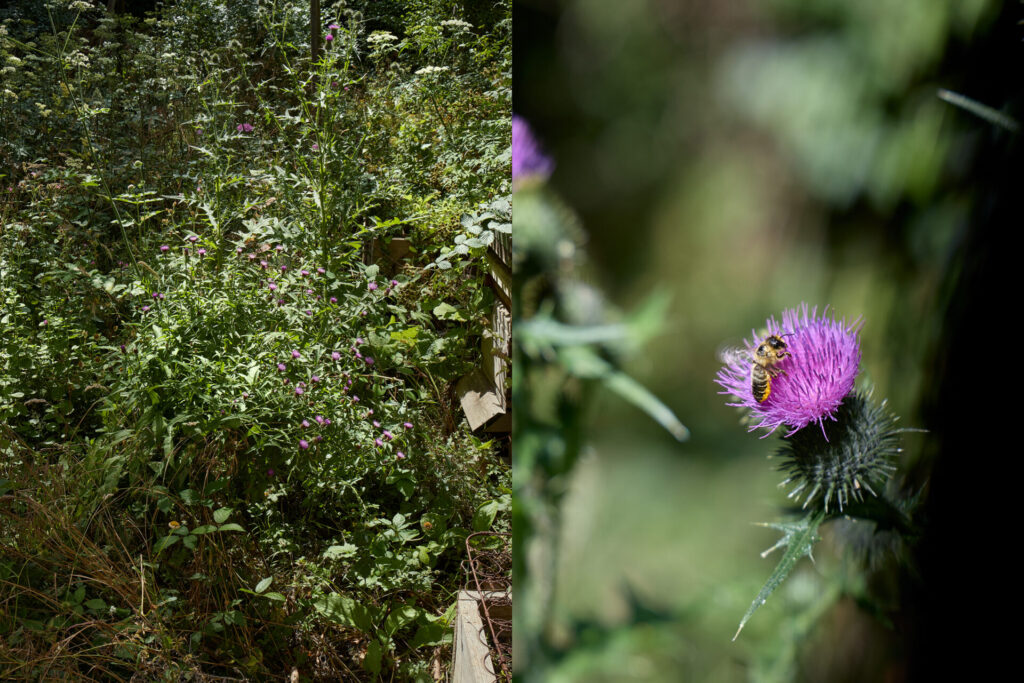
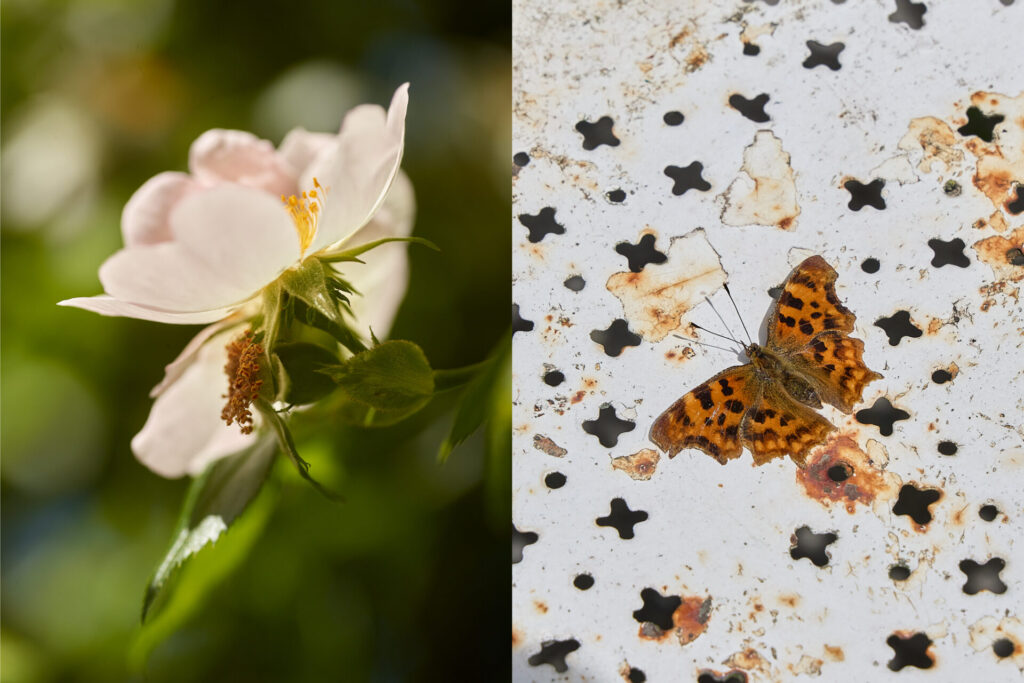
Insect activity gets underway as the sunlight penetrates deeper into the vegetation, shattering perspective and dimension into a mosaic of dappled light and shade from which the first speckled wood, whose pale yellow and buff brown wing patterns mirror the effect, launches an attack on a passing coal tit fledgeling. A heavy white tailed bumble bee, still woozy in the cool temperature, crash lands on a bramble bloom that immediately collapses in pink petals, the bee falling with them as if through floorboards, to join the heart-shaped feral rose petals shrivelling like giant snowflakes into brown burnt slush on the patio slabs around my chair. Green viewed whites flit in and out of sun pools that now hum continuously in bee frequency. An erratic rust-coloured moth stumbles into a ray cutting across the cow parsley — now gone to seed — and gets mugged by the speckled wood. It drops out of the sky into the umbelifer canopy as if it was avoiding a bat. A long deep red matchstick with delicate filigree wings helicopters cautiously onto the miniature crane-head seed pod of herb robert, its delicate lobed leaves now the same colour as the damsel fly. A sign of nutrient stress.
While I’m in the kitchen brewing another coffee the robin lands on the sill of the open window. By the way its head is poised it is obvious it has spotted one of the very camouflaged orange tip caterpillars — seventeen at the last count — in one of the bunches of garlic mustard in old gherkin jars on the window ledge. It flees as I walk up to it. Checking, I spot the first caterpillar already leaning back from a stem, poised like a question mark, held by thin silk belt, as it slowly pumps itself up to split open and wriggle out of its last catsuit of skin, revealing its new look as a pupa. As I step back out into the slowly warming peace a crow is cawing agitatedly, the familiar call that crows make at the sight of a raptor. Almost unbelievably it’s a buzzard. As it swerves and ducks the relentless harassment the sun catches the beautifully barred silken primaries. It’s the first I’ve seen this far ‘in town’. A buzzard over this garden! Wild.
The neighbours are awake; barking dogs, loud speak and cigarette smoke once again officially mark the end of the transcendental dawn. The transition actually happens undetected, something to do with light and background noise; the passing of the hypnotic, magical and miraculous into the scary familiar of another morning, and another potentially temperature-record-breaking day.
…in June
The shade yet to dissolve, the sun yet to reach the back of the garden, but already it is warm enough for the red admiral refuelling in the exploding buddleia under which I’m sitting to return repeatedly to the moribund nettle patch, to search for a decent leaf to lay another egg on. It is joined by a comma. A pair of fledged robins bounce around the patio with the same motion as a ping-pong ball dropped inches above the slabs. From the thin joins between ooze dandelions that look like strange green starfish. Plenty of moisture still underneath the paving.
The wood pigeon couple purr sedatively from deep in Ivy Tower. It’s a groan sounding like some melodious stomach rumbling. Rose ringed parakeets in the ashes screech gratingly loud and vulgar. Hard to find, they are the same green as the lanceolate leaves. The evocative call of a distant wood pigeon is answered by one of the pair above me. Swifts scream joy like fairground goers. Otherwise dawn is much quieter, the passerine choir syrinx sore and worn out. The figwort flowers right next to me stare like little burgundy and yellow miss kitty emojis.
A sunbeam finds a straight line through the house, as if it found the windows left open for it. Into which, inches in front of me, an amber glowing speck materialises momentarily then disappears, then rematerialises two feet higher. Then under my big toe as if hanging from it. Next it’s six feet above me. I’m mind blown by the tiny spiderling traversing huge space by invisible means. Dropping on an invisible bungee elastic, ascending in micro jerks an invisible rope, the illusion revealed only by the occasional iridescent flash of its micron-thick silk line swinging imperceptibly across the narrow ray. Can it feel, with its microscopic hooked feet on the silk strand, the aircraft roaring high across the blue abyss, the violent slaps and deadening thuds of pigeon wings against pigeon breast, hard enough to dislodge feathers, of the stare crazed woodies brawling violently in the ash over sparrow bush; can it feel my breath? Can it detect the carbon dioxide, nitrogen oxides, aerosols and soot particle emissions falling on us both? Maybe some stick to its web?
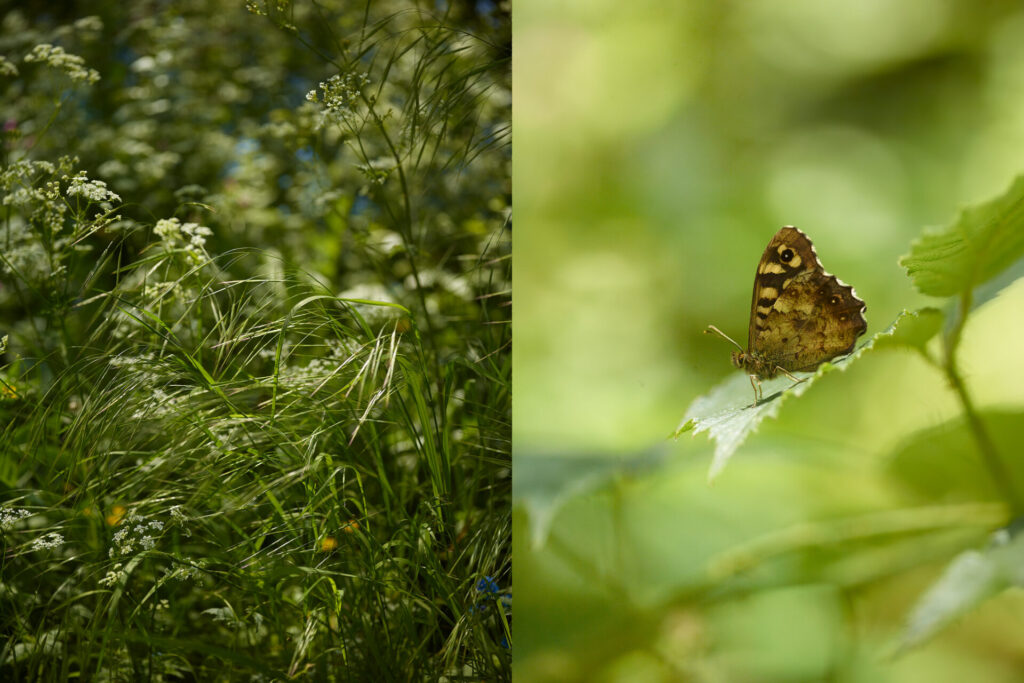
The temperature rises. The thick air now rank with the corrupting nose-burning scent mix of jasmine and vulpine musk. At the base of Ivy Tower a steady hyper-slow snow fall of jasmine petals, replacing those of the feral rose, thawing into crisp slush. I stare into the orange sun-blazed canopy of a million lighter-flame leaves against which the blue of the sky is intense. After twenty seconds I shut my eyes to see the psychedelic negative. The burn creeps down the boles evaporating the shadows and ignites the waist-high jungle of umbellifers, buttercups, ox-eye daisies, knapweeds, meadow sweet, mallows and thistles. A speckled wood that has been sitting closed wing on a bramble leaf, peeping at me with its forewing eye, suddenly launches out over the hogweed saucers that recede down the garden, rising as if to hurdle the old wooden swings frame. He and his rival lock in combat and spin relentlessly in a mini vortex of rising heat.
Around the moment the sun reaches its zenith a sudden gentle gust of the Peckerwood mistral nudges the ash tops; the hazel leaves flap pathetically, the thorn bushes shiver. The heated breeze wafts the warm pig-piss odorant from the hogweed, on the clustered floreted plates of which there is now frenetic insect activity: houseflies, hoverflies, assorted Hymenoptera. The temperature is peaking at fucking hot, unbearable. To unshaded eyes the garden jungle now a blinding, retina-damaging phantasmagorical kaleidoscope of green: dull green, dark green; matt green, saturated green, bright green; bleached, glaring,
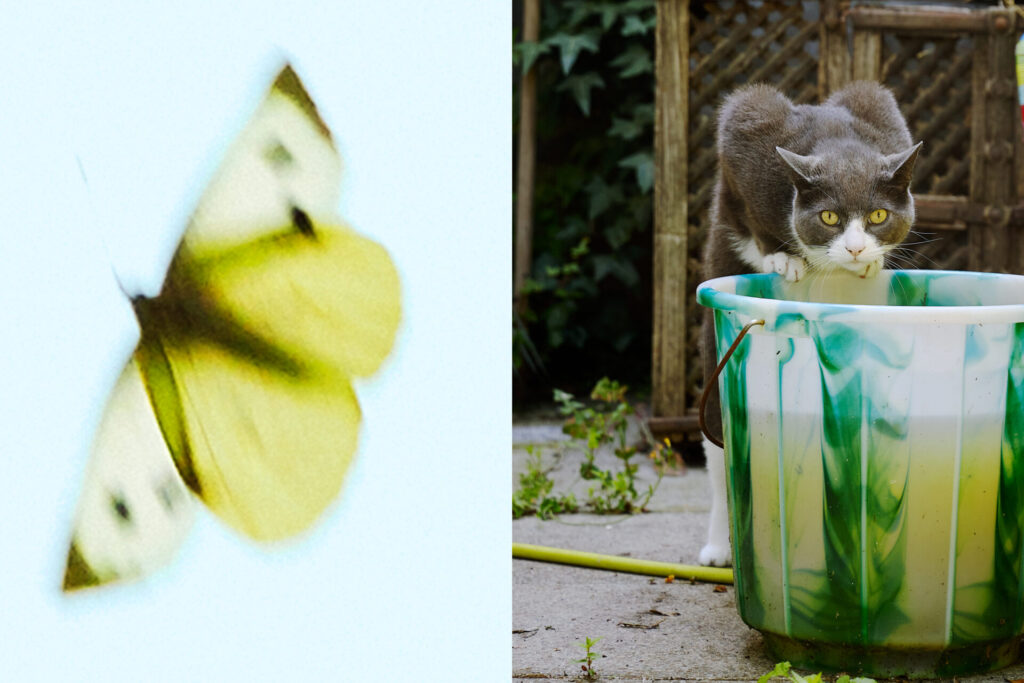
translucent, phosphorescent, neon, chlorophyllic. Haloed small and green veined white butterflies fluttering among it all in search of non wilting mustard leaves to deposit their eggs under add to the disorientating dazzling brilliance.
Ox-eye daisies droop flaccidly under the direct sun, I can’t remember ever seeing hang-headed ox-eyes. Among the softer foliage leaves hang limp, alarmingly, like wet flannels. Some are already scorched beyond revival. They won’t perk up once returned to the shade of the trees by the sun as it continues its arc across the deceiving blue. Other species are safe now, they successfully raced to seed like the runt poppy on the patio that didn’t even bother with leaves, just the reproduction ‘bits.’ Job done.
The afternoon is too hot to sit outside. Relentless oppressive heat, air dead still and without breath. As I get up to go in I catch sight of the first gatekeeper butterfly over the hard-headed knapweed flowers. It is the last species — bar one very rare and not counting second ‘brooders’ — to emerge in the year. It is not a loud or extravagant species; it would be insulting to call it a small brown job, but its appearance is as significant as the arrival of the first swifts that scream summer. A butterfly equivalent of a blackcap, quintessential creature of the hedgerow. Its presence in the garden a bit of a mystery, it was here before
its ‘feralling.’ Nothing quietly shouts summer’s peak, high summer, than gatekeepers flitting up and down dusty lanes, over parched grass gone to seed, over bramble domes.
…in July
Three species of blow flies write invisible nonsense in frenzied calligraphy inches above the fetid mucilaginous slick tinselled in slug slime that was vented or regurgitated last night on a patio slab before settling to gather around the remaining solids — bee torsos, moth wings and other unidentifiable insect integument — to syphon the nutritional sustenance before the sun of another 30°C plus day dry seals it beyond benefit. Was it the cat’s or the fox’s?
I only recently realised that I often share the rejuvenating morning peace with the vixen. I spook her yet again from her Moses basket of flattened, cane-coloured cow parsley stems on the way to the compost bins. As she flees, crashing through the brittle umbellifers, she dislodges the seed in showers that sound like dry rain falling on the crisped leaves and mosaically shattered ground. The baked earth like a firing gone wrong. I reach the compost bin, lift the lid releasing a hot putrid funk from a rancid soup of fermentation and decomposition. A fruit fly’s heaven. On the rim, a threatening leap of big slimy carnivorous leopard slugs, four of them. I pull up some of the garlic mustard whose completely desiccated leaves could almost be supermarket-own-brand cereal, to add to the peelings and trimmings before I replace the lid. A posse of twittering long tailed tits suddenly surround sound me. As I look for them among the thorn bushes I catch sight of the big sloes that I could see from the kitchen when they were pale green and obvious. They are now deep burgundy and purple, and big, and tempting. I pick one, put it in my mouth and squash it, already wincing at the expectation of its dry astringent singeing bitterness. There are kilos of them pulling down the branches. They are not sloes. I was always suspicious of two of the blackthorns I ordered a few years ago! But I’m sure they were sloes last year! Now they are deliciously moist and sweet despite their size. Prunus cerasifera — cherry plums, or some hybrid with prunus spinosa. I gratefully accept the unexpected bounty is a reciprocal gift from this liberated space and fill a colander with them leaving plenty for the community: feathered, furred, exoskeletal.
Back in my chair I watch the confused cat follow, with intense concentration, helping it along with its paw, a green bush cricket with its scimitar blade ovipositor hopping like an emergent froglet towards the nettle bed, which is now a scorched disaster zone. Shrivelled crisped leaves glazed with the crusted slime of desperate garden snails. Equally desperate commas and red admirals have repeatedly visited the patch to deposit their tiny indistinguishable ribbed eggs on any remaining green leaves. I’ve collected a
good few.
I look away from the screen. The cat is at the window. From his jaw protrudes a long stiff little leathery tail, a pair of skinny little hind legs kicking fruitlessly, the wood mouse still running. He looks at me with contempt, “yes I have another one.” I was watching Afternoons of Solitude by Albert Serra. An unflinching full gamut portrayal of bull fighting: its absolute extremes of ritual and tradition, twisted reverence; unfathomable cruelty and sadism; breathtaking beauty and appalling brutality. Suddenly the smears of the mouse’s blood on the concrete slab is the same as the smears of the blood of the murdered bull dragged away
still kicking across the sand of the ring. Cormac McCarthy said “In the Spaniard’s heart is a great yearning for freedom, but only his own. A great love for truth and honour in all its forms, but not in its substance. And a deep conviction that nothing can be proven except that it be made to bleed. Virgins, bulls, men.” It’s not just the Spanish is it? Don’t we all know by now, it’s all of us. Tomorrow Spain will play a corrupted game against Argentina and I will march yet again — AGAIN — in stifling record-breaking heat with thousands of good decent people against a genocide. A GENOCIDE. All is connected.
The cat runs off with his prey as I slide open the patio glass door. I switch on the outside light. I’m genuinely surprised by the sheer amount of moths ghosted in the heady glare, dancing, levitating around the buddelia cones as if without gravity. Even with the city’s light pollution stars are visible, twinkling in the hot clear night sky, billions of years old light that has only just reached, some of which from stars that no longer exist, they burned up.
In a few days I leave for a burning Mediterranean.
*
Mark Mattock. Artist. Photographer. Publisher. Rabbit Fighter. @the_rabbit_fighters_club