Ysella Sims revisits the moments — and personal ruptures — of a former life between the rivers Tavy and Tamar.
This piece comes with a content warning for pregnancy loss.
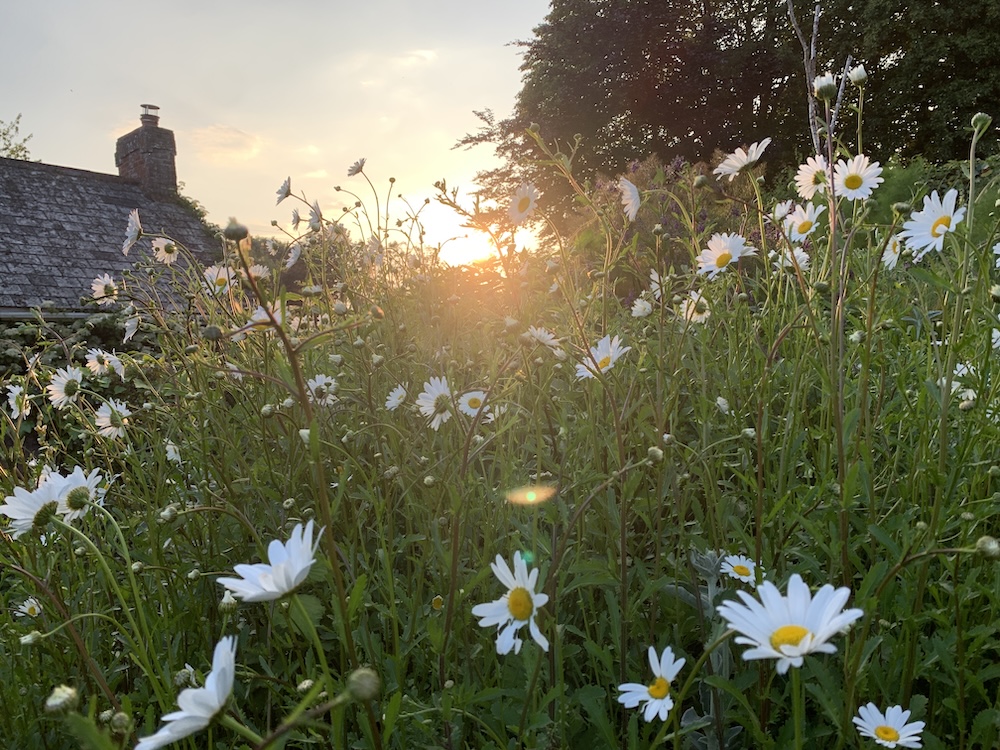
Anniversaries have a way of rooting us to a moment, inviting us to compare that one with this. In April 2026, as our timelines filled with flashbacks to the political ruptures of 2016, we headed back to our first Devon home in the Tamar Valley, pulled there by an instinct to revisit the moments — and personal ruptures — that had drawn us there a decade before.
Before we moved away to Devon we’d lived, together and apart, all our lives on the same greensand ridge in the dry south east, shuffling variously along a wooded valley threaded by the rivers Tillingbourne and Mole. Our move, to a granite landscape shouldered by the rivers Tavy and Tamar, had been its own rupture.
Had I run the way that my great grandfather Sandosham had run from Sawyerpuram, from Ceylon?
Travelling back to the Tamar Valley from Exeter we passed thick drifts of cowslips growing on the sides of the A30.
***
I am a five year old girl in a Peugeot packed with siblings and tents moving towards a wet Cornish field to push baby teeth into stone walls for fairies to find, thrilling to the sea thundering below like a pantomime villain, like the Padstow oss;
I am a nine year old brown boy in Edwardian frills — picking cowslips on a Norfolk mire, watching the cowslips shine in my pale cousin’s hand, pushing mine into hers;
I am a just-woman in combats and a spaghetti strapped vest, waving at trains from a common, chasing chalkhill blues with my tow-headed boy
***
The travelling is a remembering, a piecing together; there is the dark circle of beech perched on the sloping hill, the banks of gorse flaming in the startling April light, there the pub shaped like a highwayman’s carriage, the defiant engine house on the moor. The road bends and curves like a fairground ride. Crossing the open scape of Dartmoor, I watch cloud shadows chase its vastness. Time unwinds as we drop down towards Tavistock, and I wonder if we are going back to our old home, the coffee cups still in the sink, the dinks in the cushions where we’d sat last night.
Reaching our old village I search ahead for the house as we crown Bedford Street, bracing myself for a gap where the tree should be. As we park outside the Edgecumbe, I can see that Bere Alston is as we left it. A slow motion Sunday morning, people are moving between the Co-Op and their cars. The bookshop, closed up and stuck with pages of cartoon scrawls and the hairdressers and post office are unchanged — lustreless, even in the spring sunshine.
What had brought us here, ten years ago, so far from Surrey’s soft hills, copses, streams and meadows, its fast flowing roads and chichi farmshops, so far from all the people who loved us best? Perhaps, like foxes going to ground, we’d needed somewhere to curl up and lick our wounds from the gin trap.
We walked back up Bedford Street, wary of signs of our neighbour, expecting her to leap from the shadows, a woman who’d spat at me in the street and screamed at her daughter.
We reached the white exterior of our old home, a Victorian terrace at the end of a row.
And there it was in the front garden — our tree for our not-to-be boy.
***
Do you really want to know? asks the nurse down the phone in the weeks after the sonographer’s room fell to a hush and we are conjured to a side room with a hard blue vinyl sofa, a box of tissues on the table.
Carefully pruned, the tree’s branches are cupped hands reaching upwards on orange stems, new lime green buds on its outstretched fingers.
Its trunk is silver and solid — ten summers, springs, autumns and winters of growth — the shape of him inside us.
Our silly boy, my husband says, his shoulders starting, almost imperceptibly, to shake.
***
The Linden Tree
But what about the tree for the-not-to-be-boy
they ask in low voices when we tell them we
are moving on. Will you untangle your grief from
the roots, buttercups and devils-bit
– carry it away to some new place?
What about the way he knelt
on the winter-drenched soil,
he, who didn’t cry all the time that you
could not, would not, stop?
What about the way the bark glows
orange in the January dim
red in April’s full bright
– spring’s new light filling its
heart-shaped leaves lime-green
like a communion?
***
Later, we leave the car at the station and climb down a once familiar hill — through wild garlic, celandine, bluebells and dappled light; through the messiness of the moss and trees to Tuckermarsh Quay. For a thousand years a ferry carried passengers the 100 metres or so across to Cornwall from here, stopping shortly before we arrived. Like children left in the car at the pub, we would stand on the bank of the Tamar, looking across to Calstock’s quirk and edginess, its Friday night hum. But our idea of keeping a canoe tied up on the bank was laughed off by the locals,
“It won’t stay there long,” they’d said. “There are still pirates in Calstock.”
Now we could call a solar-powered ferry to fetch us from the other side.
“Stay there”, says Will the skipper, “I can see you.”
We climb, over scaffolding poles and a pile of barriers, down to a small plastic jetty wobbling in the water. The dog follows us sceptically.
I look across to Calstock’s stagger of brightly coloured houses and boat sheds, its terraced gardens and glassy arts centre stretched into a steep granite slope. For generations smugglers brought their booty up river from Plymouth Sound where the Tamar rushes out to meet the Tavy and Lynher to store in the slope’s chiseled chambers, the surrounding wooded hideaways. During the nightly bombing raids on Plymouth and its docks in the Second World War people found shelter here — in animal stalls, sheds and barns — anywhere they could find it, glad of the sound of water, sheep and owls, for the feeling of sanctuary.
We watch Will amble down to the boat, St Piran’s flag and the Jolly Roger flapping at the stern.
Will docks artfully, unsmiling behind his wayfarers.
I ask him about timing our return journey for the tides.
“What is time?” he says, “time is a construct.”
At the Tamar Inn I sit with my back against a whitewashed wall and look out over the river and across to the woods, the dog pulling to talk to another dog at the next table. There’s a harsh easterly wind, but when it drops and the sun comes out, it feels bright and hopeful, like stepping out of our lives and into a new place. This was sometimes how it had felt to live down here – as if normal rules didn’t apply, as if things didn’t matter because nobody knew you and nobody cared, a relief after the closeness and grief of Surrey. Over the water where we lived on ‘Bere island,’ as my husband called it, we were wrapped in a womb of waters, by the rivers Tavy and Tamar shouldering the peninsula. It was liberating and claustrophobic, just like living on an island.
Dog walkers amble along the tow path, children play with cars on the grass, teenagers slouch at the bus stop, watchful for a way out. A team of middle aged gig rowers stop before the jetty, holding their oars above their heads to sing a chorus of happy birthday to a boy on the bank. A group of young girls in a gig are shepherded onto the water, followed by a glide of older women.
“Devon”, my son says, when I first tell him we are moving away, “where ambition goes to die.”
But our ambition was for the peace of the ancient forest, its wildflowers, rivulets and tinkling streams, for the rivers’ sounds and smell, their movement and energy, to be quiet islanders in a place where time meant nothing at all.
We climb back up the hurt-lined paths through the woods of beech, oak and yew to lie on our backs in a sunny field. Listening to the little branch line train rattling over the viaduct, the sound of its weight, metal and clack reminds me of all my journeys from the village into Plymouth and the hairs stand up on the back of my neck.
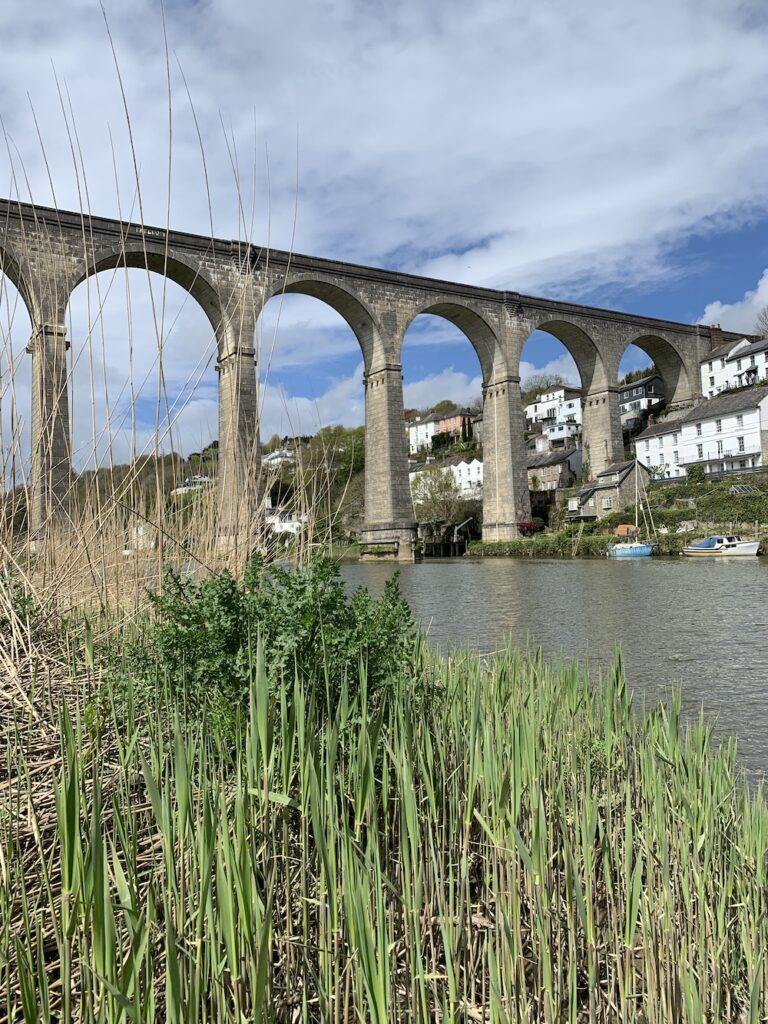
“I think we need to move again,” I say to my husband, lying next to me on the grass. The dog circles us, barking at us to get up, “because you get stuck when you stay still and our ideas of ourselves get stuck.”
“I think we should stay living where we are, but just go out more”, he says.
Driving around the lanes, I think of all the visits from family and friends, seeing my son, all gangle swinging and climbing on trees. I remember Friday nights driving home from The Plough full of beer and sadness, the awkward nights at people’s houses trying to make friends. I think of people looking down from the Conservative club balcony, smoking and sneering beneath the Union flag.
Back in the village I realise that none of our neighbours, the people we knew, who made up the day-to-day of our life were still here, conscious of how being in a place can feel like forever, and then it’s all gone, shifted.
After the reverse journey, ticking off the milestones signalling where home is now, I come through the gate into the garden, comforted by its familiar click, its ramshackle arrangement tied together with hessian and woven by ivy.
The light is glinting on the pond, the first delicate umbels of cow parsley waving in the cold wind and dimming sun. A blackbird is singing from one of the three lime trees, towering 60 feet into the sky. In sepia photos of children in pinafores holding hoops and staring at the camera, you can see a distinctive crop of trees in the same place. When the wind blows I wonder whether their roots are the only thing keeping the bank of shillet, sand and stone that the house is balanced on, in place. In late spring they flower, drawing in bees with their sweet honey scent until their branches tremble with pleasure.
I learn that Lime trees are Linden trees, that in fairy tales and celtic mythology they are trees of magic, healing and protection, sacred spots to hide, trees of love and mothers.
Here we are, then, and there he is, sheltered by the canopy of mothers.
*
Ysella Sims is a writer, poet and performer. Based in the rural South West of England, her work explores identity, belonging and our relationship to place. Find her website here / follow her on Substack.