Dead nor alive, safe nor dangerous, beautiful nor dreadful, bogs are thresholds that refuse categorisation, writes Merritt R. Turetsky, in an extract from her book ‘Boglands’.
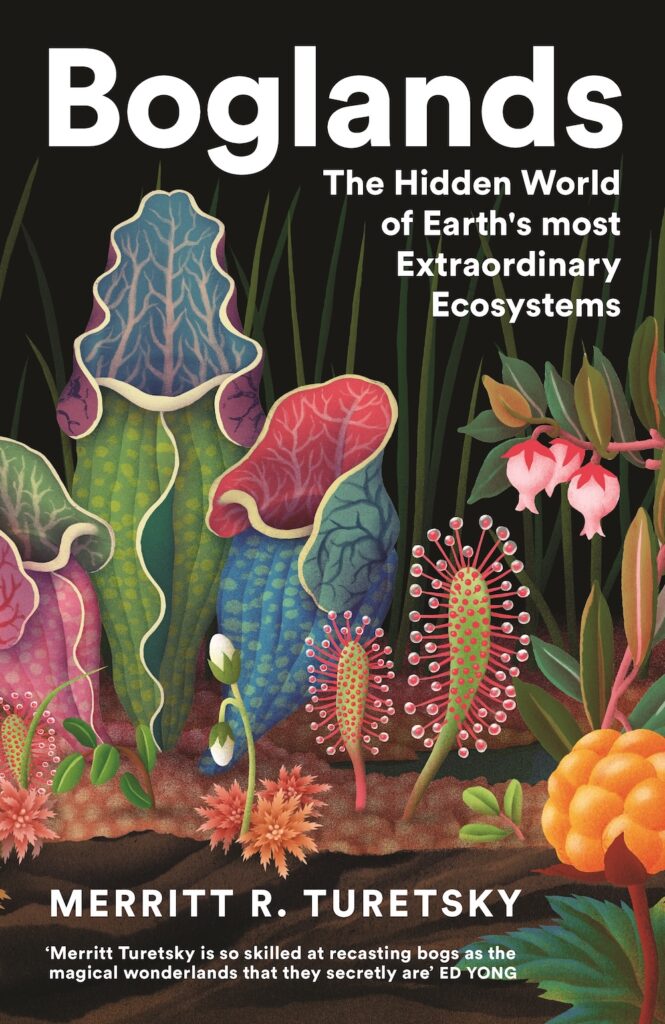
Bogs are messy and wild, places the human mind has difficulty understanding. Can we comprehend a place suspended between life and death? Do we want to? Most folklore around the world portrays boglands as places of venerable fear, filled with danger, disorientation, and disillusion, “without clear borders and without solid sub-stance below.” As a child, the great Irish poet Seamus Heaney was told never to go near the bog, because it was bottomless and hid bogeymen and other perils.
How can boglands be so beautiful, yet maligned and scorned in recent history? How can they have persisted through massive environmental change, yet today be vulnerable and fragile? Boglands refuse to be boxed into simplistic binaries; they are difficult to categorize or label. Their in-between nature makes them curious and interesting, to be sure. But has it also influenced us and our thinking, turning bogs into the most misunderstood and feared ecosystem on our planet?
The word “liminal” (from the Latin limen, meaning threshold) describes in-between states of being. Many studies have documented how liminal spaces affect human psychology. The human mind often finds these places—connecting areas or stages, such as those that lie between somewhere we have left and somewhere we want to go—eerie and unsettling. We might frequently think of examples from our built environment, like desolate stairwells and corridors, but the concept is easily applied to boglands. Often found between firm ground and lakes or rivers, boglands are too wet for vehicles or easy walking but often too solid for boats. They certainly are not a convenient physical threshold for human travel. The liminality of boglands is unmistakable: They are neither dead nor alive, safe nor dangerous, beautiful nor dreadful. They are the thresholds that lie in between all these states, refusing to be one or the other. Could this be why bogs have been portrayed as weird, spooky systems—why most of us genuinely think of them with disgust and contempt? In the end, perhaps they are simply too complicated, defying concepts we need to rationalize for humanity, for us to admire.
And yet, liminal spaces have their role to play in human society and culture. Mediating the world of the living and the after-life of the dead, liminal spaces long have been revered as sacred. Often, religious ceremonies are conducted in spaces defined by liminality—for example, where worshippers can connect with beloved ancestors while also praying for their future. It thus seems fitting that throughout history, even as they have been feared and misunderstood, bogs were honored as portals connecting various realms. For thousands of years, they have served as quiet receptacles, accepting treasures offered to the gods or aiding post-burial journeys to the afterlife. Boglands not only receive these riches, but also preserve them, protecting organic materials from decay for centuries or even millennia. It requires violent destruction of their very foundation—peat drainage or mining—to force boglands to give up their secrets.
It is only in the past few hundred years, in fact, that bogs have been interpreted consistently as dreadful places. As we have seen, bogs once were woven into the fabric of human life and survival, from early communities to the traditional peat uses still common today. The concept of wetlands as wastelands—boglands as eerie, dangerous, and marginalized—arose in a near-blink of an eye with the spread of modern agriculture. At that time, taming, draining, and ultimately destroying bogs became synonymous with societal progress. Like so many traditional practices, respect for boglands seems to have been forgotten, undermined, or actively destroyed by colonialism. Colonists and conquerors saw strange-looking plants and stagnant water, and assumed their difficulties and dangers outweighed benefits that they neither understood nor appreciated. Meanwhile, Indigenous knowledge not only valued these in-between places, but often thrived because of them. This was yet another reason for colonists to firmly reject boglands and the surrounding traditional knowledge stemming from generations of respect and wise use.
This reality is unfortunate, but it gives me hope to know that the tides of human sentiment reversed against boglands only recently, with respect for them dwindling in a brief window of time. For most of our history, humans and boglands have shared a special relationship. These deep ties mean we can reclaim these places for what they really are: magnificent thresholds between land and water—and past, present, and future—that deserve our admiration and gratitude in so many ways.
*
Extracted from ‘Boglands: The Hidden World of Earth’s Most Extraordinary Ecosystems’ by Merritt R. Turetsky, published by Profile Books and available here (£20).