Rainbows and tangled growth thread their way through uncertain weather on Annie Worsley and Kirsteen Bell’s respective crofts.
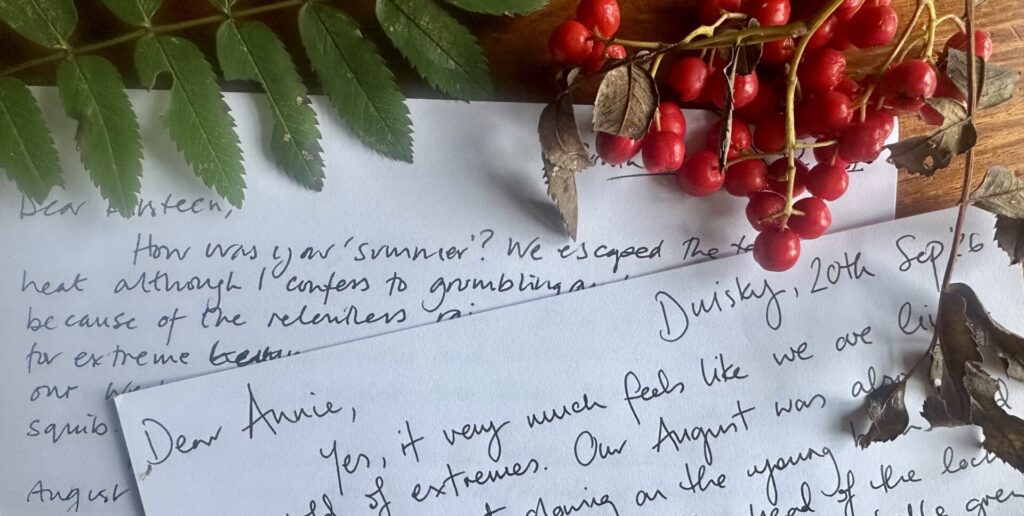
South Erradale, September 12th
Dear Kirsteen,
How was your ‘summer’? We escaped the terrible heat although I confess to grumbling and moaning because of the relentless rain. 2026 will be remembered for extreme temperatures and drought in the UK but our Wester Ross summer has been such a soggy damp squib.
R. and I did get a taste of the heat. In early August we drove south to a family gathering in Wales. To celebrate our 70th birthdays, our four kids, their partners and children holidayed with us in a big house close to the sea; ten adults and nine little ones together in mayhem.
The journey down was interesting. We passed lorries loaded with bales of hay heading south, and once we were in England, saw mile after mile of pale parched fields, dust devils, dull dark hedges, and woodlands flailed by heat. No summer greenery. Everywhere looked faded and tired. It was shocking. And after the deep, dense jungle greens of home, upsetting too. The pressure on hay supplies for cattle and horses, on food crops and ultimately on supermarket shelves, seemed insurmountable.
Our kids and their families in Paris, London and NW England struggled in the prolonged heat and stifling conditions; they longed for our Highland rains. We listened to their complaints about how hard it was to keep cool, especially at night, and sympathised of course. Being together at the holiday house, listening to the joyful laughter of children playing was the best medicine for everyone.
We watched the eclipse armed with special glasses, boxes with pinholes, a colander. Amidst all the news of forest fires around the world, the irony of a hot burning sun tamed by sister moon, the blistering fury of fire cooled by the slow calm movements of an orb 400 times smaller, was not lost on us. When the birds fell silent and the air cooled, the children hollered and danced with excitement. Later, we watched the Perseid meteors and battalions of satellites, grieving for a future in which stars might be lost behind a man-made grid of technology.
Red River Croft’s hay meadows were in my mind as we holidayed. Crofters cutting silage had waited until the end of July – a month later than usual – delayed by a very cold spring then summer downpours. Meadows were late to get going; growth was slow. I fretted about whether we’d even get a crop of hay.
We came home to familiar green fields, gentle breezes, misty rains. Some of the family came with us and revelled in wearing wellies and raincoats while building sandcastles and collecting shells. Finally, the weather changed with more dry August days than wet ones. And at last, the meadows began to flourish – growing tall and dense, filled with grasses and wildflowers. But with hay-making in mind, I obsessed over forecasts, repeatedly checking the weather app on my phone.
Occasionally, we lost the sea breeze and endured clouds of midges. But there were some glorious sunsets and fine days with azure skies and straggles of high translucent cloud. One day, we picnicked at Firemore beach. I remembered the militaristic lines of satellites wondering if they’d be visible in the clear air and deep blue sky.
Over the summer our garden became a riotous tangle of all sorts of things. The jungle yielded a bumper crop of strawberries and blackcurrants and a feeble attempt by runner beans to find the sun. But we grew giant courgettes! We’ve laughed about that and filled the freezer, wondering how they managed to grow so big with so little heat.
The expansive, tangled growth is everywhere – great clusters of brambles heavy with fruit, dog rose in bloom but spotted with mildew, rowans buckling under the weight of crimson berries. Our young trees have coped with the rains but we will need to think carefully about drainage in the future.
And what about your family and the croft? Has your polytunnel been productive? Are you still thinking of getting pigs?
After fretting too much, our hay harvest happened! The cutting, tedding and baling was done in a rush in early September, in a tiny weather window between awful forecasts for yet more rain. We rely on local young crofters, the three sons of Donald “Duck” Mackenzie affectionately known as the “Ducklings”, to harvest our hay. They take the hay for their cattle, Red River Croft and our wildlife neighbours benefit from management with nature at its heart. This symbiosis seems to work although our arrangements might need to change in the future if UK weather patterns become less predictable and more extreme.
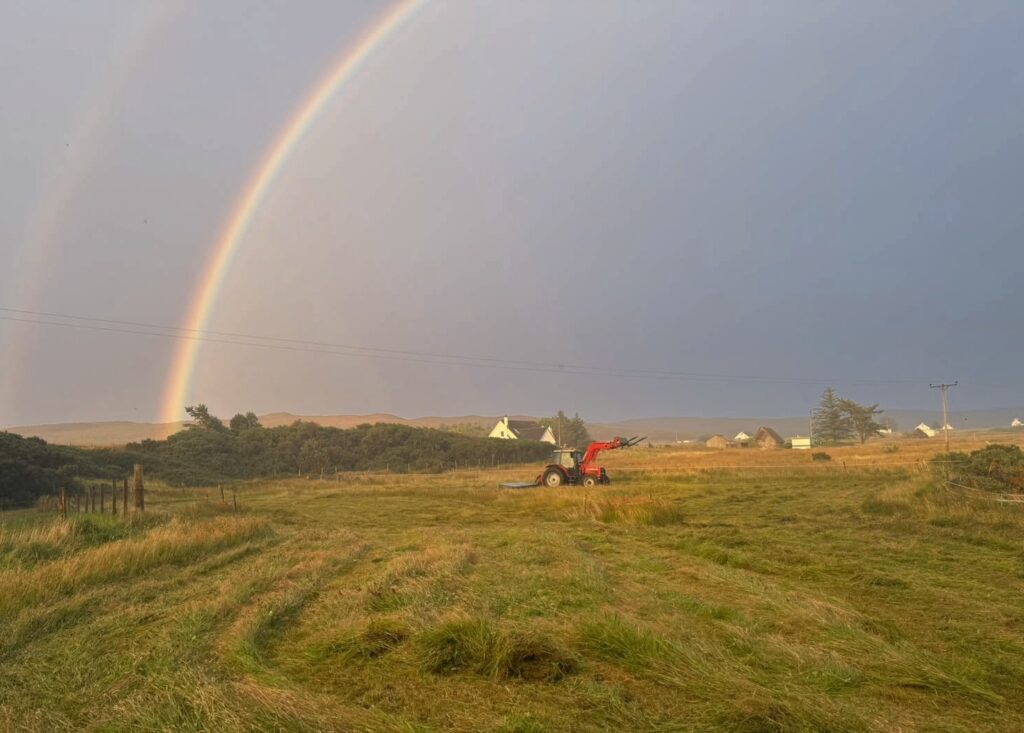
The boys came with two tractors and began the cutting framed by rainbows. They worked by the orange glow of a hazy sunset and on into the darkness. The gamble paid off. A few days later, just as the last load of bales left the croft, the rains returned. As the “Ducklings” stored the precious harvest in their barn, I remembered those wagons of hay heading south.
How precarious everything feels when our climate is upended and re-ordered. Giant courgettes in the cold wet northwest, failure of crops in the far south. What a topsy-turvy world. Our forebears must have suffered similar variations and rapid change, right? I wonder if we have their strength and resilience. Cold, wet summers certainly contributed to the potato famine, the Clearances and the instigation of crofting, but local croft and estate records in Gairloch Museum may reveal more about specific harvests.
I’m still hoping for a sunny dry spell. Even the midges have given up. The meadows are pale gold but edged with colour – purple scabious, knapweeds and vetch, red clover, white sneezewort and yarrow, yellow hawkbit and tormentil. In the tangles are orb spider nests – wee globes made from grasses, rushes and vetch, tied together with webs. Ah! the resilience, determination and ingenuity of nature. That’s where the answers lie. In margins and edgelands, and the wild, wild spaces all around us.
Send news soon,
A xx
*
Duisky, September 20th
Dear Annie,
Yes, it very much feels like we are living in a world of extremes. Our August was also full of contrasts, sunlight glowing on the young birch round the house while the whole of the head of the loch, its hills, the wide glen, were lost to impenetrable grey rain. So many rainbows though, wavering between.
Unsettling seasonal changes too. I looked ahead in my calendar to find a free weekend in which I might run the gauntlet of bramble thorns, before realising that bramble season was already upon us. Rosehip vines over the garden fence were red and luscious long before summer hinted towards autumn. The apple trees we planted are still too young for fruit, but in a hidden corner of the croft two Bramley apple trees were full, their branches dipped down with the weight so that I barely needed the ladder. I had to enlist one of the kids to help me gather the apples before September gales emptied the boughs.
It would have been no hardship if I’d missed the early fruiting. I have in previous years, even when everything grew on its expected schedule. I have shrugged the loss off as leaving more for the deer and birds. There are two young female roe deer currently browsing the croft; they would undoubtedly make use of the windfalls. That said, histories of past hardships here combined with visible suffering in other parts of the world make it harder to leave anything. And the threat of hardships returning seems like a closer reality than it has before in my lifetime.
The extremes of moisture in the Highlands is indeed one of the constants we share with our predecessors. You’re right; it was a mild spring followed by incessant summer rains that destroyed the potato crops in the Western Highlands in 1846. Descriptions of mass decay and the consequences for crofters are as alarming to read as the news of the equally devastating desiccation we are seeing now.
The inability of waterlogged soil to nurture growth has long been a source of work. Ditches and underground drains score every slope and level. It’s one thing to learn how to manage an abundance of water, quite another to learn how to work with the opposite. I don’t imagine we can easily find ways to adapt to these new climate changes, but, as you say, there is resilience in and around us in the living landscape. The process of turning hay to silage in some ways gives me hope; the cut grass wrapped against the air and allowed to ferment. At some point, someone found a way to make anaerobic environments work with them instead of against.
The varying extremes have continued into September, although these ones feel more like the Septembers of my memory. Morning mists obscure loch and hill with a gentleness at odds with the heavy rains that saturated them to begin with. And when the mists clear, sharp sunlight lances through leaves into wilting undergrowth.
The air now is sweet with decay, edged with a promise of cold. I keep getting adverts asking if I want perfume that makes me smell like the Highlands, which makes me laugh, living as we do beside a landfill. Although, it no longer accepts food waste and the heavy sickly methane clouds have gone. Instead, I breathe deeply into the dark fecund air of summer’s rot. Foxgloves are columns of mottled brown tongues, and sedge grass hangs empty of seed, architecture for orb spiders and sheetwebs.
I am worried for the fieldfare and redwings that usually visit in October. The rowans fruited so early that the berries are already losing their vibrancy. The moss below their trunks is scattered with dried berries like beads.
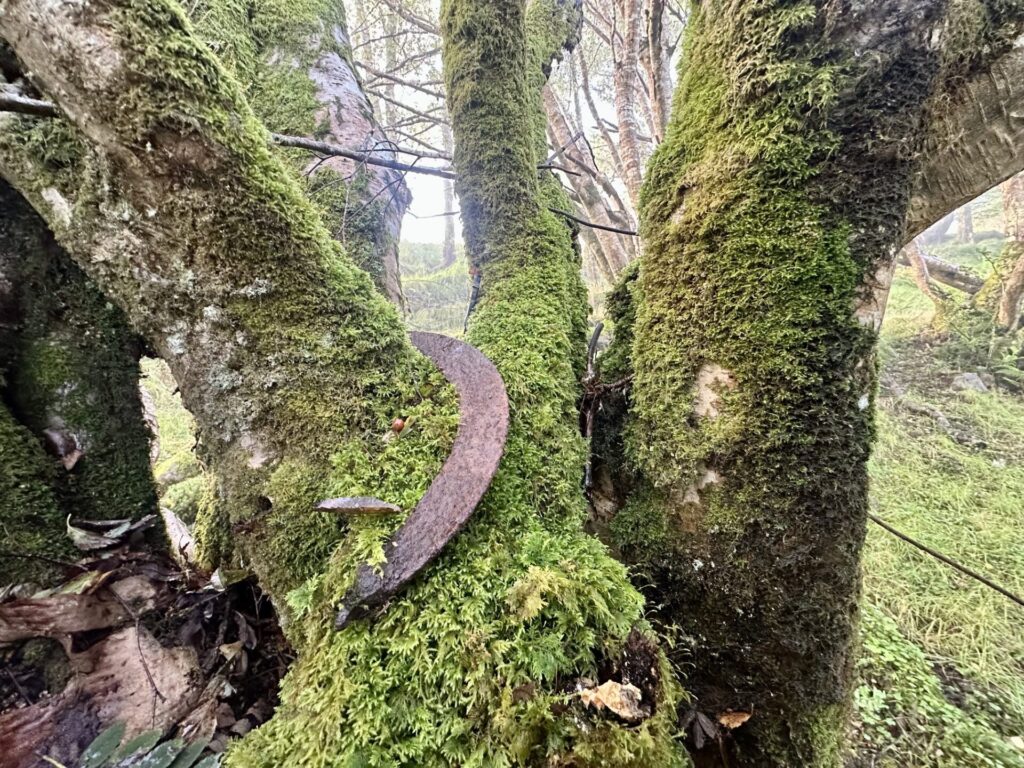
I found the remains of a sickle amongst the fallen fruit today. It had been embedded into the middle of a cluster of coppiced rowan for as long as I’ve been here, a curved metal heart. The blackened edges had finally rotted through. I wonder if the crofter who lodged that sickle knew that it was the last time they were going to use it.
On the ground between the trees and wall is a slightly raised circular platform of stones, now covered in a thick layer of wood sorrel, deer fern, moss, and thin dried grass. It was once the foundation for a hay stook.
For haymaking here I have to look back. I found again black and white photos someone sent, taken in the 50s perhaps. One image looks from the west onto our croft, we think. The stone wall along the level beside these now overgrown stones appears to match with a stone wall and a stook that points up like a witch’s hat. The fields are pale and shorn in the image, with only a few dark patches of trees. My old oaks are young on the steep slope behind the stook, and a cluster of dark scrub around rough ground where our house now huddles heavily against the hill.
A fence line in the foreground of the image has a black jacket propped on one of the posts. Those fenceposts have long rotted away. In the far distance, Ben Nevis and Aonoch Mhor are held in their own vast timelines. The stones of the old houses and walls, and the traced lines of slope beneath our feet, are the only other fixed points linking that landscape and ours.
I suppose the photos I take now might receive the same attention one day. Our kitchen table conversations revolve around where new fences should go, which ditches need filled in, which need cleared. I am itching to get pigs again but the fences need sorted first. Nothing happens quickly, Annie! Over the almost twenty years I’ve lived here, the croft has taught me what I need most is patience and the ability to envision this land on a far wider scale than our individual lives.
I almost wrote ‘that’s needed now more than ever’, however I suspect many of our predecessors felt the same way about their own times. Their future arrived and we are still here.
With love,
Kx
*
Kirsteen Bell is a Scottish writer of narrative non-fiction and sometimes poetry. All her words are gathered from the croft in Lochaber where she lives, and the surrounding Scottish Highlands. Her writing and reviews can be found in such places as Paperboats, Caught by the River, The Guardian Country Diary, The Lochaber Times, and Northern Scotland Journal. Kirsteen can also be found at Moniack Mhor, Scotland’s Creative Writing Centre, where she is Projects Manager and Highland Book Prize Co-ordinator.
Annie Worsley is a writer, crofter, grandmother and geographer with an enduring love of the Scottish Highlands. In 2013 she and her husband moved to the crofting township of South Erradale near Gairloch. While her husband was a community pharmacist, Annie worked on Red River Croft. She began a blog about life on the croft and then wrote essays on nature and environment for various publications including Elementum Journal, Women on Nature, the Seasons’ Anthologies edited by Melissa Harrison, Caught by the River and Inkcap Journal. Her first book about life on Red River Croft and the natural history of Wester Ross, ‘Windswept: Life, Nature and Deep Time in the Scottish Highlands’, was published by William Collins in 2023, and is out now in paperback.