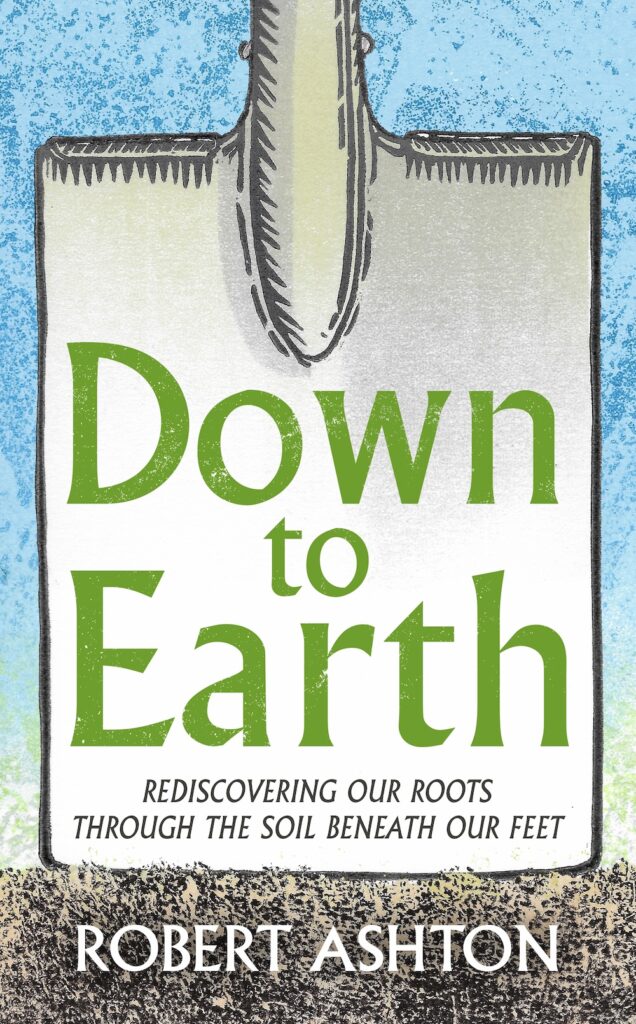
In ‘Down to Earth’, recently published by Wilton Square Books, Robert Ashton traces our evolving relationship with the soil. In the following extract, he considers self-sufficiency guides and the East Anglian rural wring canon.
‘There is nothing to writing. All you do is sit down at a typewriter and bleed.’ Ernest Hemingway
A spell in hospital took me away from my research into soil for a while. It gave me an opportunity to reflect on the places I had been and the people I had met. It also gave me the chance to read more old books, written by people who had shared my interest in the land. What began to emerge was the realisation that just as I had felt compelled to make sandcastles, mud pies and jump in puddles as a child, so too had I felt drawn as I grew up to somehow make my living from the land.
I’d gone to agricultural college because I’d been happiest when milking cows, feeding pigs and driving tractors. The next ten years were spent in the sales and marketing team of a fertiliser manufacturer, which kept me close to the land. I fell for and married a farmer’s daughter, which then meant that whatever work I was doing, I was always in touch with the farming world.
Later I realised that my desire to write was greater than my sense that I need to work the land in a practical way, and so what followed was a marketing career, writing words that influence others. Writing books about the land is where I now find myself, and that perhaps has always been where I was destined to be; it has just taken me a long while to get there.
People talk about hearing the call of the wild and the almost primal urge to leave civilisation in search of a more natural, elemental and grounded life. Too many of us now find ourselves remote from the natural world, perhaps living in a city flat, working in an office, eating processed food and wearing clothes made from synthetic fibres. It should not be surprising that many break free from such an artificial lifestyle in search of something more authentic.
While it is true to say that the last hundred years has seen the pace of technological and social change accelerate, taking us further and further from nature, people have always felt compelled to walk away from comfort and convenience to reconnect with the land. It is as if deep down, we have an instinctive need to live in harmony with our natural world. I’ve always been particularly interested in East Anglian rural writers and have been surprised by how many there have been over the past few hundred years.
Thomas Tusser is the earliest example I have found, of someone choosing to leave behind an easy life, to live closer to the land and then write about his experience. Born near Witham in Essex, it is thought in 1524, he had a privileged upbringing, becoming a chorister at St Paul’s in London before going to Eton College. This was a time when as few as one in ten could read and write, and only the wealthy sent their children to school.
His career got off to a promising start, when he joined the team of William Paget, one of Henry VIII’s most influential political advisors. For many, this would be a dream job, at the very centre of power with no doubt an envious network of contacts. Providing he toed the line and did not fall from favour, he would have been assured of a long, interesting and lucrative career.
But I don’t think bureaucracy sat comfortably with him as he was also a budding poet, although none of his early poetry was ever published. His head will have told him to sit tight, keep his nose clean and look forward to a wealthy retirement, but his heart was drawing him to nature and the land. In around 1556, despite Paget’s protestations he gave it all up to and farm at Cattawade in Suffolk. Biographies of Tusser say that he married and started farming at the same time, which makes me suspect that like me, he married a farmer’s daughter. His book 100 Good Points of Husbandry was written from experience and proved to be a best seller when first published in 1557. So much so, that a sequel titled 500 Good Points of Husbandry quickly followed. Even then, publishers were not slow to push a writer for more if a first book sold well.
While his books were a great success, his farming was less so and he moved first to Ipswich, then Norfolk where he had another try at farming, then to London where he died in 1580. It is said that he died in poverty, but his legacy is his writing, and arguably he was the first to write authentically about life on the land in East Anglia. He launched a tradition that others, me included, have strived to continue.
A century after Tusser, John Mortimer, an affluent London trader who by the age of 43 had become wealthy as city merchant, also turned his back on London life and bought a country estate in Essex. Clearly he too wanted to experience the satisfaction of growing and harvesting crops, rather than just buying things from one man, then selling them at a profit to another. There is I’m sure some satisfaction to be had from making money, but for Mortimer, like Tusser, he wanted to connect with the land.
He too wrote a book; The Whole Art of Husbandry was first published in 1716 when he was 60 and had been farming for more than fifteen years. Unlike Tusser, he did not write his in verse, but it is packed with practical tips, suggesting that he was not afraid to get his hands dirty, rather than be a gentleman farmer who returns indoors once the morning’s orders have been given to the farm workers.
Perhaps better known for his adventure novels, Henry Rider Haggard, as I’ve already mentioned, also wrote an excellent and very descriptive book about farming, A Farmer’s Year in 1898. Born in Norfolk, he’d lived and worked in South Africa, before returning and marrying Louisa Margitson, who had inherited her family farm at Ditchingham.
Interestingly, while he wrote the novels he is perhaps best remembered for, King Solomon’s Mines, She and Allan Quartermain in the 1880s, after he had written A Farmer’s Year a good proportion of his future writing was about rural affairs. Once he had found contentment living on a south Norfolk farm, he no longer needed to look further afield for excitement. For the rest of his life, he just wrote about rural affairs, although his last years were lived in London. Like Tusser, I think he earned more from writing than he did from farming.
In the 20th century, Adrian Bell shocked his parents by leaving London in 1930 at the age of nineteen to learn how to farm. Unlike others I have mentioned, he continued hands-on farming for more than sixty years, writing books about his experiences along the way. He had an inquisitive nature and hungry mind, and thanks to an introduction made by his father, who was editor of The Observer, also compiled The Times crossword each week for nearly fifty years. This shows in his writing, which is particularly lyrical and rich.
You won’t have failed to notice that all of the examples I’ve given of people who chose farming over an easier life elsewhere were men. This is a stark reminder that until relatively recently, women had little opportunity to follow a career, let alone give up that career to farm. One notable exception is Lady Eve Balfour, who I mentioned in the last chapter. Not only did she became a farmer, but she also challenged the way farming was done, setting up the Soil Association because even in 1946, when fertiliser and herbicides were considered new and exciting, she could see that farming organically was more sustainable and so better for us all.
But as I look back on these writers’ lives, most were born into wealthy families, most had the benefit of a good education, and most managed to farm, either because they had grown wealthy in an earlier career, or because they had married well. Their routes into farming were not ones many of us could follow, which makes their stories interesting, but frustrating because we cannot easily follow their example. And then I discovered and was moved by the 1973 book Self Sufficiency, written by the late John Seymour and illustrated by his wife Sally.
I was not alone; Seymour’s biographer Paul Peacock wrote: ‘Ever since I read The Fat of the Land I had considered myself his friend. More desperate a friend he never had. Reading The Fat of the Land brought me a companion who was living out a life of which I had only dreamed. If John could do it, why not me?’
The Peacocks visited the Seymours’ farm in Pembrokeshire shortly after John’s death, to seek the support of his daughters to write a biography of their father. They helped where they could and A Good Life was published in 2005. It is an insightful book, which tells both the story of a remarkable life, and the deep respect that Peacock had for both the man and his work. Paul Peacock had become an enthusiastic follower of Seymour’s path to self-sufficiency. As well as books about gardening, he also wrote books about keeping bees and chickens. Several of his books focused on growing food in a built-up area, and one, Nature’s Wild Harvest, on foraging. His wife Diana also wrote a number of books about preserving and cooking the products the couple grew.
I love Seymour’s simple and honest style of writing and can quite see how it motivated Paul Peacock to change the direction of his own life. In fact after writing about Seymour, Peacock went on to write thirty more books, charting his own journey in search of self-sufficiency. One was titled The Sausage Book and tells you everything you need to know about making sausages, apart that is, from how rear and kill your pig. For that you need Seymour’s Self Sufficiency. For many years Peacock also wrote a regular column for The Mirror, signing off each week as Mr Digwell.
Talking with Peacock’s daughter Rebecca and his widow Diana I learned that he’d picked up a copy of Seymour’s book The Fat of the Land in a second-hand bookshop and found it captivating. Diana told me how it had changed her husband’s life, who as a botanist, had always been interested in growing food, but Seymour’s book had helped him realise that he could start with what he had, rather than wait until he could afford to buy more land. Seymour’s book showed how what he thought was impossible, was achievable straight away.
*
Robert Ashton’s ‘Down to Earth’ is out now and available here, published by Wilton Square Books.
Robert will be appearing at the Leiston Book Festival on 19 September.